Where does x = 2 come from in an equation with a square root and two different bases? The answer is not simply “try 2 and see.” First we rewrite the equation to see which number is worth trying. Then we give a separate proof to find out whether it is the only solution.

Contents
- The observation that reveals a solution
- The general rule: existence and uniqueness
- Integers, roots and a zero difference
- Factoring identities, a common base and different exponents
- When the number of solutions changes
- When no simple exponent stands out
- Twelve exercises to practise the method
- Three questions for the next problem
The observation that reveals a solution
We work with real exponents and positive bases. When two exponents are proportional, try rewriting the powers so that they share an exponent. That makes the bases easier to compare.
1. A square root hides the common exponent
1 + √(3x) = 2x
The square root halves the first exponent. To get x/2 in the second power as well, write 2 as the square root of 4. The required difference is exactly 4 − 3, so the common exponent can be 1. Check: 1 + √9 = 4.
√(3x) = 3x/2
2x = 4x/2
4x/2 − 3x/2 = 1 = 4 − 3
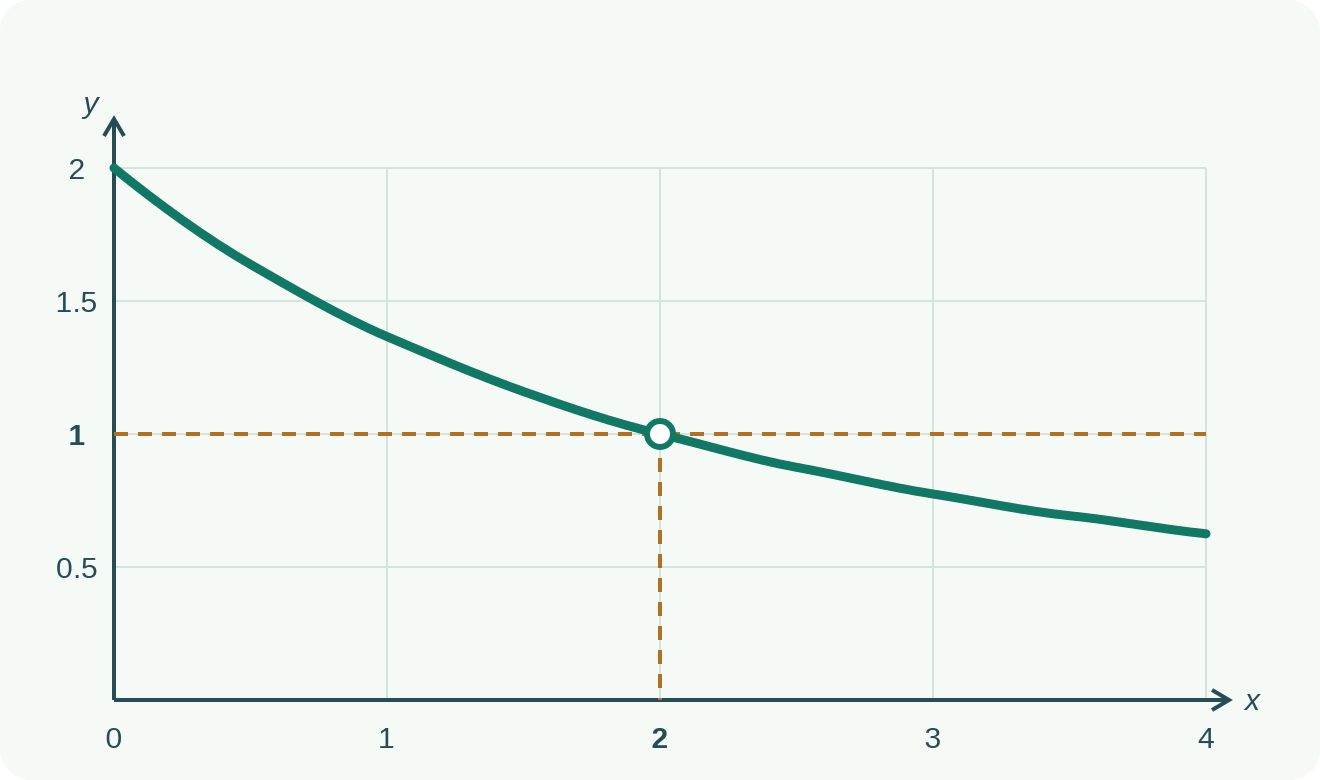
To rule out other solutions, divide the original equation by 2ˣ to get (1/2)ˣ + (√3/2)ˣ = 1. Both bases lie between 0 and 1, so the sum strictly decreases. The general rule below reaches the same conclusion with B = 4, A = 3 and t = x/2.
x = 2
The general rule: existence and uniqueness
Write Bᵗ − Aᵗ = K, with 0 < A < B. If you recognise K as Bⁿ − Aⁿ, then t = n is certainly a solution. Matching the terms does not prove that it is the only one: the differences 7 − 5 and 4 − 2 are also equal.
For uniqueness, also suppose B > 1 and K > 0. Move Aᵗ to the right and divide by Bᵗ, which is always positive:
Bt = At + K ⇒ (A/B)t + K · (1/B)t = 1
Since 0 < A/B < 1 and 0 < 1/B < 1, both powers strictly decrease as t increases. The coefficient K is positive, so their sum is strictly decreasing too: it cannot equal 1 at two different points.
The sum is continuous, equals 1 + K > 1 at t = 0, and tends to 0 as t → +∞. By the intermediate value theorem, it crosses 1 exactly once. The real solution therefore exists, is unique and is positive.
Notice that we have not claimed Bᵗ − Aᵗ is increasing on the entire real line. It is the sum obtained after division whose monotonicity matters.
Integers, roots and a zero difference
Instead of guessing, look at the number on the right. Is it the difference between the bases? Are the bases perfect squares or cubes? If K = 0, compare the ratio of the bases. The examples in this group with positive K satisfy the hypotheses of the proof.
2. The difference between the bases
7x − 2x = 5
Before trying squares or cubes, check the simplest difference: 7 − 2 is already 5. The first powers give the required value.
71 − 21 = 5
This is the only solution: here 0 < A < B, B > 1 and K > 0.
x = 1
3. The difference of two squares
5x − 3x = 16
The bases differ by 2, not 16. But their sum is 8, so the product 2 · 8 = 16 points to the difference of their squares.
52 − 32 = 25 − 9 = 16
This is the only solution: here 0 < A < B, B > 1 and K > 0.
x = 2
4. From squares to cubes
3x − 2x = 19
The squares give only 9 − 4 = 5. Try cubes and compare 27 with 8: their difference is exactly 19.
33 − 23 = 27 − 8 = 19
This is the only solution: here 0 < A < B, B > 1 and K > 0.
x = 3
5. Recognising fourth powers
3x − 2x = 65
The differences for the first, second and third powers are 1, 5 and 19. Fourth powers give 65. The trials follow a clear order.
34 − 24 = 81 − 16 = 65
This is the only solution: here 0 < A < B, B > 1 and K > 0.
x = 4
6. A base smaller than 1
2x − (1/2)x = 15/4
Squaring 1/2 gives 1/4, not 1/2. Subtracting 1/4 from 4 gives the required fraction. The larger base is 2 > 1; the other base is allowed to be smaller than 1.
22 − (1/2)2 = 4 − 1/4 = 15/4
This is the only solution: here 0 < A < B, B > 1 and K > 0.
x = 2
7. Two perfect squares: try their roots
25x − 9x = 2
Both 25 and 9 are perfect squares. Their roots are 5 and 3, so the difference 2 appears at exponent 1/2.
251/2 − 91/2 = 5 − 3 = 2
This is the only solution: here 0 < A < B, B > 1 and K > 0.
x = 1/2
8. Two perfect cubes
64x − 27x = 1
The numbers 64 and 27 are the cubes of 4 and 3. Their cube roots differ by 1, making 1/3 the natural exponent to try.
641/3 − 271/3 = 4 − 3 = 1
This is the only solution: here 0 < A < B, B > 1 and K > 0.
x = 1/3
9. Take the square roots, then cube them
16x − 4x = 56
The square roots of 16 and 4 are 4 and 2. Their difference is not 56, but the difference of their cubes is. Taking a square root and then cubing amounts to using exponent 3/2.
163/2 − 43/2 = 43 − 23 = 64 − 8 = 56
This is the only solution: here 0 < A < B, B > 1 and K > 0.
x = 3/2
10. The right-hand side is zero
7x − 2x = 0
Divide by 2ˣ, which never vanishes. A power with base 7/2 equals 1 only when its exponent is 0. There is no need for the proof that assumes positive K.
(7/2)x = 1
x = 0
Factoring identities, a common base and different exponents
The difference between the bases suggests which products to check. If one base is a power of the other, a substitution can turn the equation into a polynomial. Remember that the new unknown is a positive power, so not every polynomial root is admissible.
11. The product (B − A)(B + A)
11x − 7x = 72
72 is divisible by 11 − 7 = 4. The quotient is 18, which is exactly 11 + 7. That is the clue to use the squares.
72 = 4 · 18 = (11 − 7)(11 + 7) = 112 − 72
This is the only solution: here 0 < A < B, B > 1 and K > 0.
x = 2
12. The factor that points to cubes
6x − 4x = 152
Divide 152 by 6 − 4 to get 76. Since 36 + 24 + 16 = 76, you recognise the remaining factor in the difference of cubes.
152 = 2 · 76 = (6 − 4)(62 + 6 · 4 + 42) = 63 − 43
This is the only solution: here 0 < A < B, B > 1 and K > 0.
x = 3
13. One base is the square of the other
81x − 9x = 72
Since 81 = 9², look for y such that y(y − 1) = 72 instead of guessing x. The product 9 · 8 suggests y = 9; the other root, −8, is impossible because y = 9ˣ > 0. Then 9ˣ = 9 gives x = 1.
y = 9x > 0
y2 − y − 72 = (y − 9)(y + 8) = 0
x = 1
14. Three times the same exponent
23x − 3x = 55
Write 3x as 3 · x and note that 2³ = 8. The two powers now share an exponent. The difference of the squares is 55, and the uniqueness proof applies with B = 8 and K = 55.
8x − 3x = 55 = 64 − 9 = 82 − 32
This is the only solution: here 0 < A < B, B > 1 and K > 0.
x = 2
15. Two rewrites, two solutions
2x+1 − 3x = 1
The first identity suggests x = 0 and the second x = 1. To see whether there are others, divide by 2ˣ and rearrange. One power in the resulting sum grows while the other falls, so the previous proof does not apply.
1 = 21 − 30 = 22 − 31
(3/2)x + (1/2)x = 2
The sum is strictly convex: the second derivative of each aˣ with a > 0 and a ≠ 1 is (ln a)²aˣ > 0. If the sum were 2 at three points, the middle point would have to lie strictly below the horizontal segment joining the other two. That is impossible. The values 0 and 1 are all the solutions.
x ∈ {0, 1}
When the number of solutions changes
A solution you have verified remains valid even when the hypotheses of the proof fail. What changes is what you can conclude about other solutions. The next examples use a base equal to 1, two bases between 0 and 1, and a negative difference.
16. The larger base equals 1
1x − (1/2)x = 3/4
Replace 1ˣ by 1 and isolate the remaining power. Since the base is 1/2, the function strictly decreases and exponent 2 is unique. More generally, if B = 1 and K > 0, there is a solution only when K < 1.
(1/2)x = 1/4 = (1/2)2
x = 2
17. Both bases lie between zero and one
(1/2)x − (1/4)x = 3/16
The base 1/4 is the square of 1/2. Substitute y = (1/2)ˣ to get y − y² = 3/16. Both roots, 1/4 and 3/4, are positive. Since (1/2)ˣ takes each positive value exactly once, each root gives exactly one exponent.
y = (1/2)x > 0
(y − 1/4)(y − 3/4) = 0
x ∈ {2, log1/2(3/4)}
18. A negative difference
4x − 2x = −3/16
Recognise −3/16 as 1/16 − 1/4 to find x = −2. But with y = 2ˣ the equation becomes y² − y + 3/16 = 0. The value y = 3/4 is admissible too, giving a second solution. When K is negative and B > 1, the second term in the normalised sum increases rather than decreases.
y = 2x > 0
(y − 1/4)(y − 3/4) = 0
x ∈ {−2, log2(3/4)}
19. No solution: the limiting value is never reached
1x − (1/2)x = 1
Isolating (1/2)ˣ gives 0. A power with a positive base is never zero, though it can get arbitrarily close. Here 1 is the limit of the left-hand side as x → +∞, not a value it attains.
(1/2)x = 0
S = ∅
When no simple exponent stands out
An exact answer may require a logarithm. If you cannot find a useful rewrite, you can still bracket the solution and approximate it by bisection: halve the interval and keep the half on which the sign change remains.
20. The solution lies between two integers
5x − 3x = 10
First and second powers bracket 10. Bisection checks 1.5 and then 1.75, where the difference is still below 10. At the next midpoint, 1.875, it is above 10. Keep [1.75, 1.875] and narrow it further. The proof with B = 5, A = 3 and K = 10 guarantees that we are approximating the only solution.
51 − 31 = 2 < 10 < 16 = 52 − 32
x ≈ 1.756154
21. An exact answer written with a logarithm
4x − 2x = 1
The polynomial has two roots, but (1 − √5)/2 is negative. To express the positive root as a power of 2, take its base-2 logarithm. This gives an exact answer even though the exponent is not an integer or an easy fraction.
y = 2x > 0
y2 − y − 1 = 0
y = (1 + √5)/2
x = log2((1 + √5)/2)
Twelve exercises to practise the method
First look for the observation that suggests what to try. Then justify how many real solutions there are. In the final exercise, it is enough to bracket the solution between consecutive integers.
8x − 3x = 5
Show the worked solution · 1
8 − 3 = 5: first powers are enough.
This is the only solution: here 0 < A < B, B > 1 and K > 0.
x = 1
7x − 4x = 33
Show the worked solution · 2
33 = (7 − 4)(7 + 4) = 49 − 16: a difference of squares.
This is the only solution: here 0 < A < B, B > 1 and K > 0.
x = 2
4x − 3x = 37
Show the worked solution · 3
The squares give 7; the cubes give 64 − 27 = 37.
This is the only solution: here 0 < A < B, B > 1 and K > 0.
x = 3
49x − 25x = 2
Show the worked solution · 4
The square roots are 7 and 5, which differ by 2.
This is the only solution: here 0 < A < B, B > 1 and K > 0.
x = 1/2
125x − 8x = 3
Show the worked solution · 5
The cube roots are 5 and 2, which differ by 3.
This is the only solution: here 0 < A < B, B > 1 and K > 0.
x = 1/3
16x − 4x = 12
Show the worked solution · 6
16 − 4 is already 12: use the first powers.
This is the only solution: here 0 < A < B, B > 1 and K > 0.
x = 1
24x − 32x = 7
Show the worked solution · 7
Rewrite the bases as 16 and 9 with common exponent x. Since 16 − 9 = 7, the required exponent is 1.
This is the only solution: here 0 < A < B, B > 1 and K > 0.
x = 1
3x/2 − 2x = −1
Show the worked solution · 8
Reverse the signs and write 2ˣ = 4ˣ⁄². With t = x/2, you get 4ᵗ − 3ᵗ = 1, so t = 1. The rule proves uniqueness in t and hence in x.
x = 2
4x − 2x = −7/64
Show the worked solution · 9
Set y = 2ˣ. Factor y² − y + 7/64 as (y − 1/8)(y − 7/8). Both roots are positive, so each gives an exponent.
x ∈ {−3, log2(7/8)}
(1/3)x − (1/9)x = 2/9
Show the worked solution · 10
Set y = (1/3)ˣ. Then y − y² = 2/9 is equivalent to (y − 1/3)(y − 2/3) = 0. Both roots are positive and each gives an exponent.
x ∈ {1, log1/3(2/3)}
5x − 2x = 0
Show the worked solution · 11
Divide by 2ˣ: (5/2)ˣ equals 1 only at x = 0.
x = 0
3x − 2x = 10
Show the worked solution · 12
At x = 2 the difference is 5; at x = 3 it is 19. By continuity it equals 10 between 2 and 3. The rule rules out other solutions.
2 < x < 3
Three questions for the next problem
- Can I match the exponents or write the bases as powers of the same number?
- Which identity suggests a value to try, and how can I verify it in the original equation?
- What argument shows that I have found every solution?
If you can answer all three, you have done more than solve one equation: you have learned how to choose a strategy and check it.