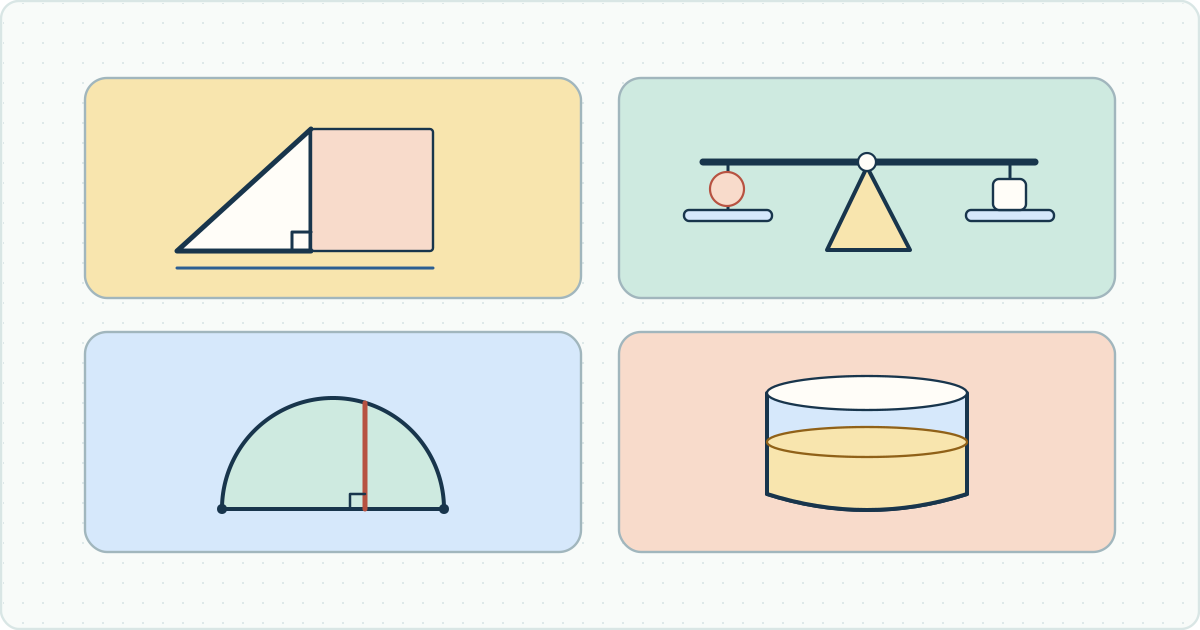
A diagram can suggest the first step, but not all the data matter equally. In one picture, you need to isolate an object. In another, the useful length is not marked. And sometimes the question asks for more than the given facts can tell you.

How to use this collection
Read the problem, then point out what you know and what you need in the diagram. Before calculating, try to say which relationship you would use. The drawings are schematic: do not measure them on screen. Open only the solution you want to check.
The first six problems
Which rope has the greatest tension?
A rigid beam is held fixed by a support. Three masses of 45 kg, 35 kg and 40 kg hang from separate vertical ropes. A 120 kg mass rests on top of the beam. Which of the three ropes has the greatest tension?
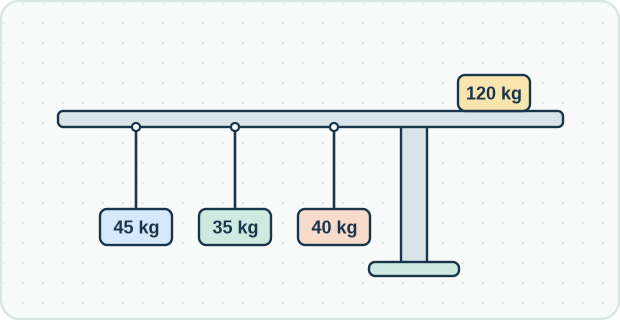
Each rope supports just one of the hanging masses. Show the solution · 1
- Isolate one hanging mass. Gravity pulls it down and the rope pulls it up. Since the mass is at rest, these two forces are equal in magnitude.
- The tension is T = m × g. Since g is the same for all three, just compare 45, 35 and 40. The largest tension is about 45 × 9.81 = 441.45 N.
- The 120 kg weight acts on the beam. It does not hang from any of these ropes, so it does not affect the comparison.
The rope holding 45 kg has the greatest tension, about 441 N.
Around the triangle
A square of area 49 m² is placed next to a right triangle. Their common vertical side is one leg of the triangle. Together their horizontal bases measure 17 m. What is the perimeter of the triangle?
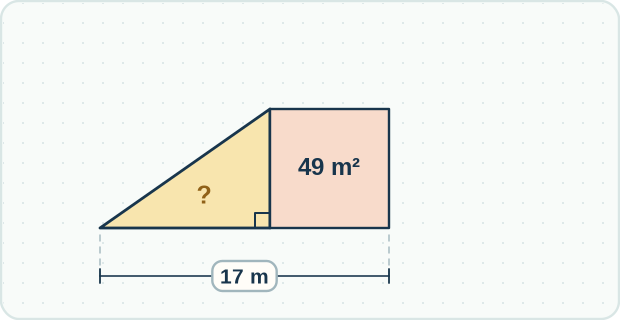
The 17 m measurement is for the two bases together. Show the solution · 2
- The square has side length √49 = 7 m. The vertical leg of the triangle therefore measures 7 m.
- The horizontal leg is what remains: 17 − 7 = 10 m.
- By Pythagoras, the hypotenuse is √(7² + 10²) = √149 m. The shared side is still part of the perimeter of the triangle, so add all three sides.
P = (17 + √149) m ≈ 29.21 m.
The boxing pad on the balance
The balance is level. On the left are two identical boxing pads and a weight of 0.80 kg. On the right are one pad and a weight of 1.024 kg. Find the mass of one pad in grams.

The diagram shows the given weights in grams. Show the solution · 3
- Since 1 kg = 1,000 g, the two known masses are 800 g and 1,024 g.
- Remove one pad from each pan. Removing the same mass from both sides keeps the balance level.
- One pad and 800 g remain on the left, with 1,024 g on the right. The pad is the difference. If x is its mass in grams, this is the equation 2x + 800 = x + 1,024.
One boxing pad has a mass of 1,024 − 800 = 224 g.
Three eggs, two questions
Three eggs are released from rest at the same time. A is 1 m above concrete, B is 3 m above bubble wrap and C is 2 m above a trampoline. Ignoring air resistance, which touches its surface first? Must it also be the first to break?
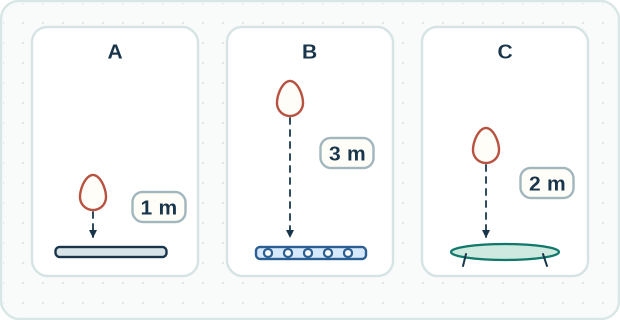
Each height measures the distance to the first surface the egg meets. Show the solution · 4
- In the free-fall model they start from rest with the same acceleration. After a given time they have fallen the same distance, so the shortest fall ends first. The order of impacts is A, C, B.
- Breaking is a different question. Concrete tends to stop an egg more abruptly than a surface that gives way, but that does not guarantee a crack.
- If A breaks on its first impact, it breaks before the others. Without further information about the shells and surfaces, we cannot know for sure.
A lands first; we cannot say for certain which egg breaks first.
The clearance under an arch
BC is the diameter of a semicircle. Point E on the diameter is 12 m from C and 6 m from B. A line through E perpendicular to the diameter meets the arc at D. What is x = ED?
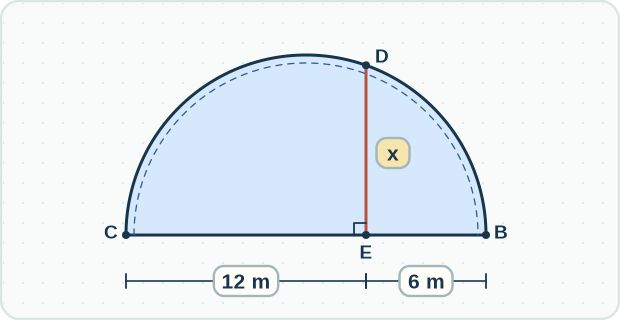
The required height is above E, not at the centre of the arch. Show the solution · 5
- The diameter is 12 + 6 = 18 m, so the centre O is 9 m from C and OE = 12 − 9 = 3 m.
- Join O to D. OD is a radius of 9 m, and OED is right-angled at E. By Pythagoras, ED² = 9² − 3² = 72 m².
- There is a shortcut too: triangle CDB is right-angled at D because it is inscribed in a semicircle. The right-triangle altitude theorem gives ED² = CE × EB = 12 × 6 = 72 m².
ED = 6√2 m ≈ 8.49 m.
How much fuel is in the tank?
An upright cylindrical tank has a diameter of 8 m and a total height of 7.5 m. The fuel is 3 m deep. What volume of fuel does it contain, in cubic metres and in litres?
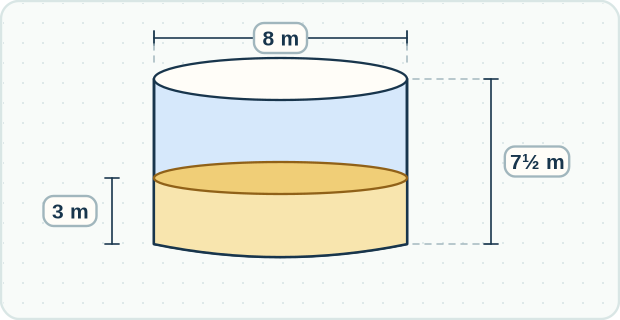
The coloured part is the region occupied by the fuel. Show the solution · 6
- The radius is half the diameter: 8 ÷ 2 = 4 m. The circular base has area π × 4² = 16π m².
- The filled part is itself a cylinder with the same base but a height of 3 m. Its volume is 16π × 3 = 48π m³.
- Multiply the exact volume by 1,000 to convert to litres. The 7.5 m height would be needed to find the full capacity.
48π m³ ≈ 150.80 m³, or about 150,796 L.
Nine further challenges
Two weighings and two unknowns
Two identical cubes and a sphere have a total mass of 14 kg. One cube and the same sphere have a total mass of 9 kg. How much does one cube weigh? What about the sphere?
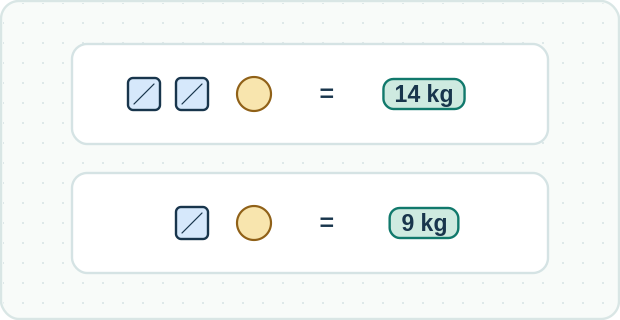
Only one object changes between the two weighings. Show the solution · 7
- Compare the two rows: one cube and the sphere appear in both.
- The difference 14 − 9 = 5 kg is therefore the mass of the extra cube.
- In the second weighing the cube and sphere together are 9 kg. Subtract the cube: 9 − 5 = 4 kg. Check: 5 + 5 + 4 = 14.
Cube: 5 kg. Sphere: 4 kg.
Balancing a seesaw
On a horizontal seesaw, Arianna has a mass of 30 kg and sits 2 m from the pivot. Bruno has a mass of 20 kg and sits on the other side. At what distance x should he sit to balance her? Assume the weight of the board contributes no turning effect about the pivot.
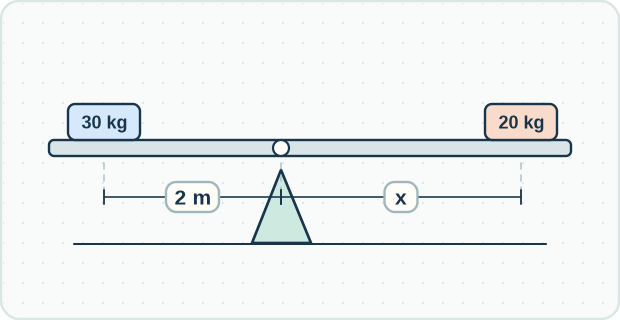
Both distances are measured from the pivot. Show the solution · 8
- The masses alone do not settle it: the distance from the pivot matters. On this horizontal lever, the turning moment is weight × distance.
- At equilibrium the moments have equal magnitudes and opposite directions. Write 30 × g × 2 = 20 × g × x.
- Cancel g, which is the same for both. This gives 60 = 20x, so x = 3 m. The lighter person has to sit farther away.
Bruno should sit 3 m from the pivot.
The ladder against the wall
A ladder 5 m long leans against a vertical wall. Its foot is 3 m from the wall and the ground is level. What height x does the ladder reach?
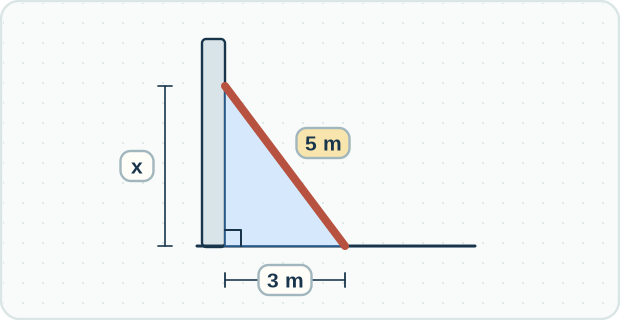
The wall and the ground meet at a right angle. Show the solution · 9
- The wall, ground and ladder form a right triangle. The ladder is opposite the right angle, so it is the hypotenuse.
- Pythagoras gives x² + 3² = 5². Hence x² = 25 − 9 = 16 m².
- The height is positive, so x = √16 m. Check: 3² + 4² = 5².
The ladder reaches 4 m up the wall.
The lamppost’s shadow
A vertical stick 1.5 m tall casts a 2 m shadow. At the same time, on the same level ground, a lamppost casts an 8 m shadow. How tall is the lamppost?
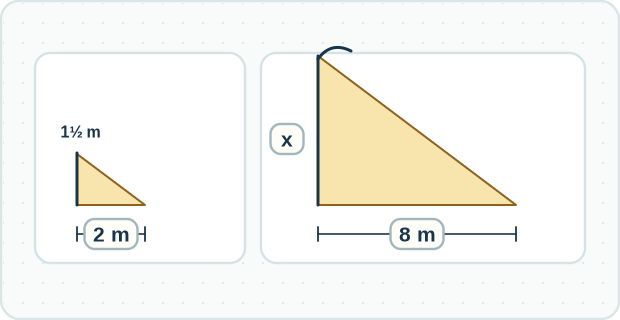
Both shadows are measured under the same conditions. Show the solution · 10
- Sunlight meets the ground at the same angle in both cases. Each vertical object forms a right triangle with the ground and the ray of sunlight: the triangles are similar.
- The lamppost’s shadow is 8 ÷ 2 = 4 times as long. Its height must therefore also be 4 times as large.
- Multiply 1.5 m by 4. There is no need to know the angle of the sun: the stick provides the comparison.
The lamppost is 6 m tall.
The strip around the courtyard
A rectangular courtyard measures 12 m by 8 m. On the inside a 1 m wide strip runs along all four sides. What is the area of this strip, including the corners?
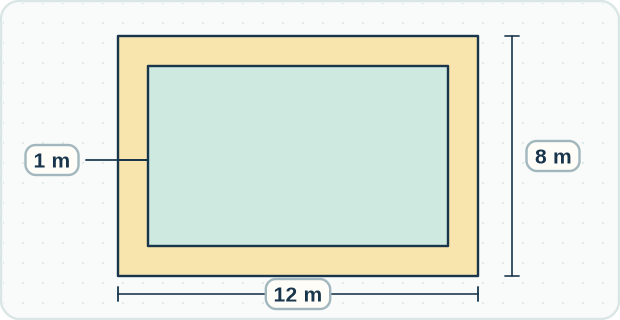
The strip reduces both ends of each dimension. Show the solution · 11
- The whole courtyard has area 12 × 8 = 96 m².
- Subtract 1 m from each end of both dimensions to get an inner rectangle of 10 m by 6 m. Its area is 60 m².
- Now subtract the areas. This already includes each corner of the strip exactly once.
Area of the strip: 96 − 60 = 36 m².
Five extra centimetres of water
A rectangular aquarium has an inside base of 80 cm by 35 cm. When more water is poured in, the level rises by 5 cm. How many litres were added? Assume no objects occupy the newly filled band.
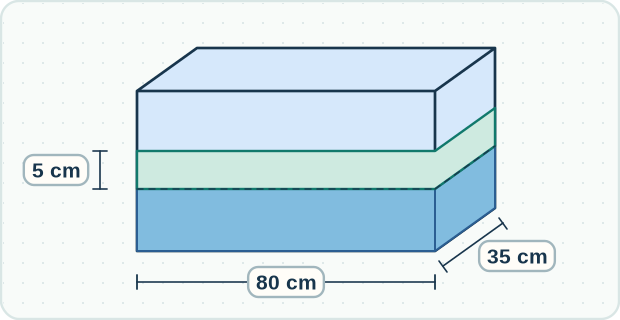
The lighter band is the water added, not all the water in the tank. Show the solution · 12
- We do not need the original water level: the added volume is the band between the two levels.
- Multiply the base area by the rise: 80 × 35 × 5 = 14,000 cm³.
- One litre is 1,000 cm³, so divide by 1,000.
14 L of water were added.
Turning a tank on its side
A sealed cylindrical container has a diameter of 2 m and is 4 m long. When upright it is filled with water to half its height. It is laid on its side, with its axis horizontal, without spilling. Once the water has settled, what is its depth x measured from the lowest point?
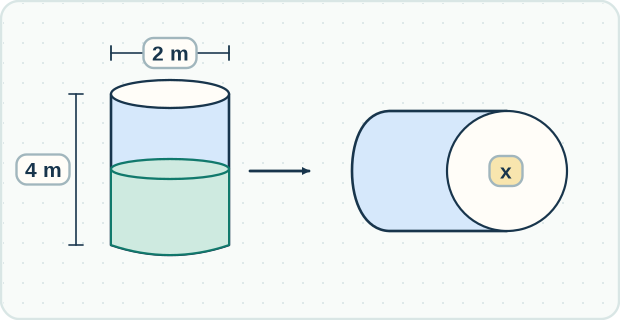
Turning it changes the shape of the filled region, not the amount of water. Show the solution · 13
- Upright, half the height means half the volume, since each horizontal cross-section has the same area. Turning the cylinder does not change the volume of water.
- With the axis horizontal, a cross-section perpendicular to the axis is a circle. If the waterline goes through the centre, half of each circle is filled for the entire length. That is exactly half the volume.
- From the bottom of the circle to its centre is one radius, half the diameter.
The new depth is 1 m.
One ball falls and the other goes sideways
Two balls start 5 m above the same floor at the same time. A is released from rest. B is launched horizontally. Ignoring air resistance, which hits first? Use g ≈ 10 m/s² to estimate the time.
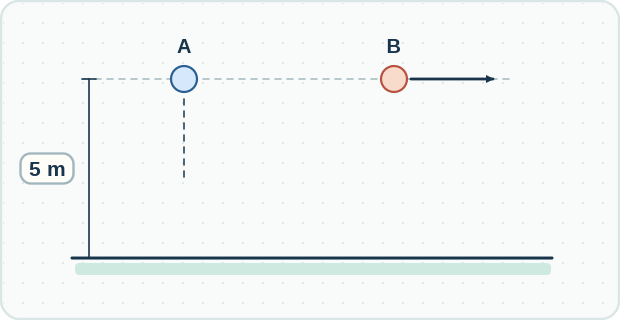
B’s initial velocity points sideways, not downwards. Show the solution · 14
- Look only at vertical motion. Neither ball has an initial vertical velocity, and both accelerate downwards in the same way.
- B also travels sideways, but this does not change its fall in the model. Both balls have to drop 5 m.
- From h = gt²/2 we get t = √(2h/g). With 5 m and g ≈ 10 m/s², the time is about 1 s.
They land at the same time, after about 1 s, at different points on the floor.
Is the shorter route also the faster one?
Two cyclists start at P at the same instant and head to Q. Route A is 720 m long and is ridden at 3 m/s. Route B is 960 m long and is ridden at 6 m/s. Assume both speeds are constant. Who gets there first, and by how much?
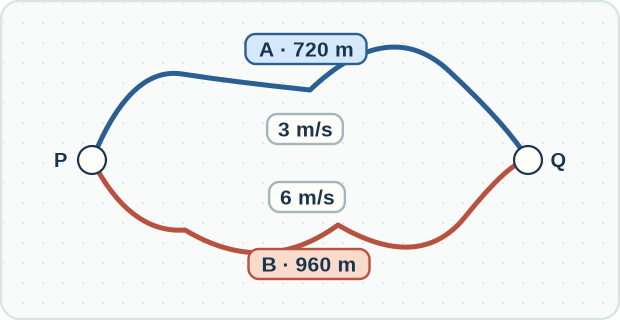
The routes share their endpoints, but have different distances and speeds. Show the solution · 15
- Find the time by dividing distance by speed, not by comparing distances alone.
- For A: 720 ÷ 3 = 240 s, or 4 minutes. For B: 960 ÷ 6 = 160 s, or 2 minutes 40 seconds.
- The difference is 240 − 160 = 80 s. The greater speed on B more than makes up for the extra distance.
The cyclist on B arrives 1 minute 20 seconds earlier.
What gets the calculation started?
When a diagram leaves you stuck, try changing it in your head: remove the same object from two pans, add a radius, or separate horizontal motion from vertical motion. That is not an extra calculation. It is how you find the calculation you need.