Open the lab · Back to the index
To decide when a logarithm exists, return to lesson one: is there exactly one real exponent x such that bˣ = y?
log_b(y) = x  ⇔  bˣ = y
b > 0,  b ≠ 1,  y > 0
Why must the base be positive?
For base 0, 0¹ and 0² both give 0, while 0⁻¹ is undefined. Negative bases admit some powers, for example (−2)³ = −8, but (−2)^(1/2) is not real. Thus we do not get an exponential function defined for every real exponent to invert.
Why can the base not be 1?
The equation 1ˣ = 1 holds for every x; 1ˣ = 2 holds for none. There is never a unique exponent to return, so log₁ is not defined.
Why must the argument be positive?
For b > 0, bˣ is positive for every real x. It cannot be zero or negative. In particular, 2⁻³ = 1/8: a negative exponent gives a reciprocal, not a negative value.
Bases between 0 and 1 are allowed
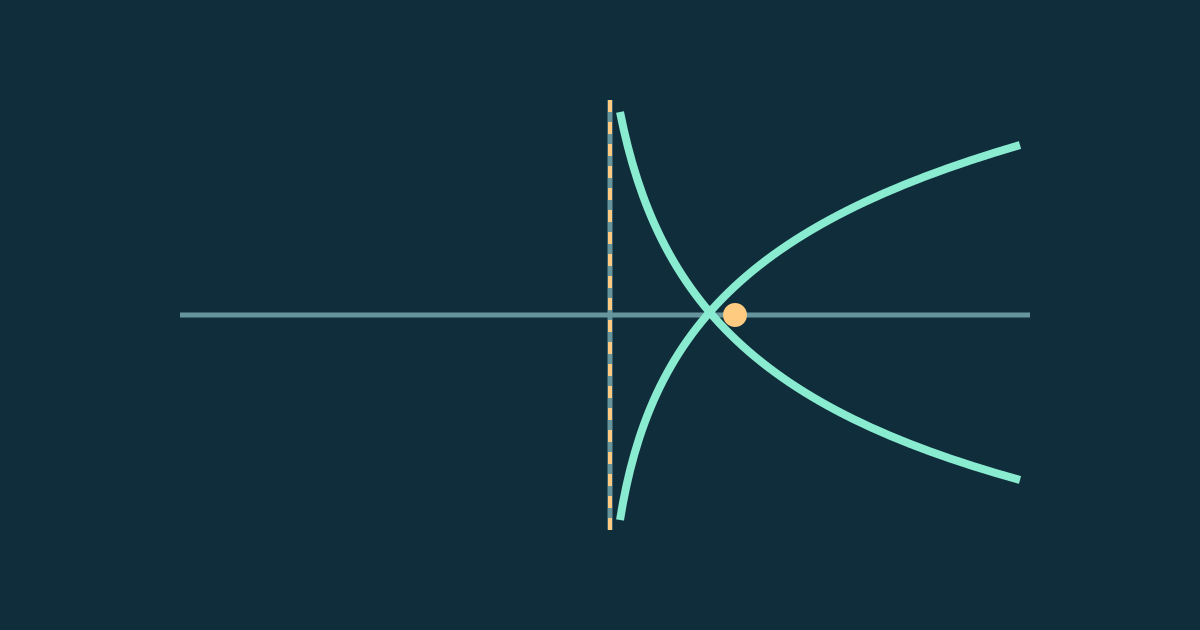
Powers increase for b > 1 and decrease for 0 < b < 1. In either case they take every positive value exactly once. For example, (1/2)⁻³ = 8, so log_(1/2) 8 = −3.
Try it: which exist over the reals? log₂ 0, log₁ 3, log₃(1/9), log_(1/2) 4.
Show solution
The last two exist and both equal −2. The first has argument zero; the second has base 1.