When -50% means an increase
The hidden limitation of the traditional percentage change formula
Guiding example: -100 -> -50
The numerical value increases by 50. Yet the most common formula returns -50%.
1. The formula we all know
Percentage change is normally calculated by comparing the difference between the final value and the initial value with the initial value itself:
Δ% = (F - I) / I × 100%
With positive initial values, the formula works in a completely intuitive way: an increase produces a positive percentage, a decrease a negative percentage.
| Initial | Final | Difference | Ratio to |I| | Relative value | Percentage | Interpretation |
|---|---|---|---|---|---|---|
| 100 | 120 | 20 | 20 / 100 | 0,20 | 20% | increase |
| 100 | 80 | -20 | -20 / 100 | -0,20 | -20% | decrease |
From number to percentage: 20 does not become 20%
It is important not to confuse absolute change with percentage change. In the transition from 100 to 120, the difference is 20: this is a number, not a percentage. To obtain the relative change, we must compare 20 with the initial value 100: 20/100 = 0,20. Only then do we write the result as a percentage. Since 1% = 1/100 and therefore 100% = 1, multiplying 0,20 by 100% does not change the value of the number, but changes its written form: 0,20 × 100% = 20%. The conceptual sequence is therefore: 20 -> 20/100 -> 0,20 -> 20%.
20 ≠ 20% but 20 / 100 = 0,20 = 20%
This step also clarifies the meaning of the formula: first we construct a ratio relative to the initial value, then express that ratio in hundredths.
For this reason, the formula can be written in the compact form:
Δ% = (F - I) / |I| × 100%
where I is the initial value and F the final value. The factor 100% is not a trick: since 100% = 1, it does not change the value of the ratio, but expresses it as a percentage.
2. The case that challenges the interpretation
Now take two negative numbers:
-100 -> -50
There is no doubt about their order: -50 is greater than -100. The value has therefore increased. The difference confirms this too:
-50 - (-100) = +50
But applying the traditional formula gives:
(-50 - (-100)) / (-100) × 100 = -50%
The calculation is arithmetically correct with respect to the chosen formula. The problem arises when the sign of the result is automatically interpreted as a “decrease”.
Online example 1 - Rivaluta.it

Link: Rivaluta.it
Online example 2 - WolframAlpha
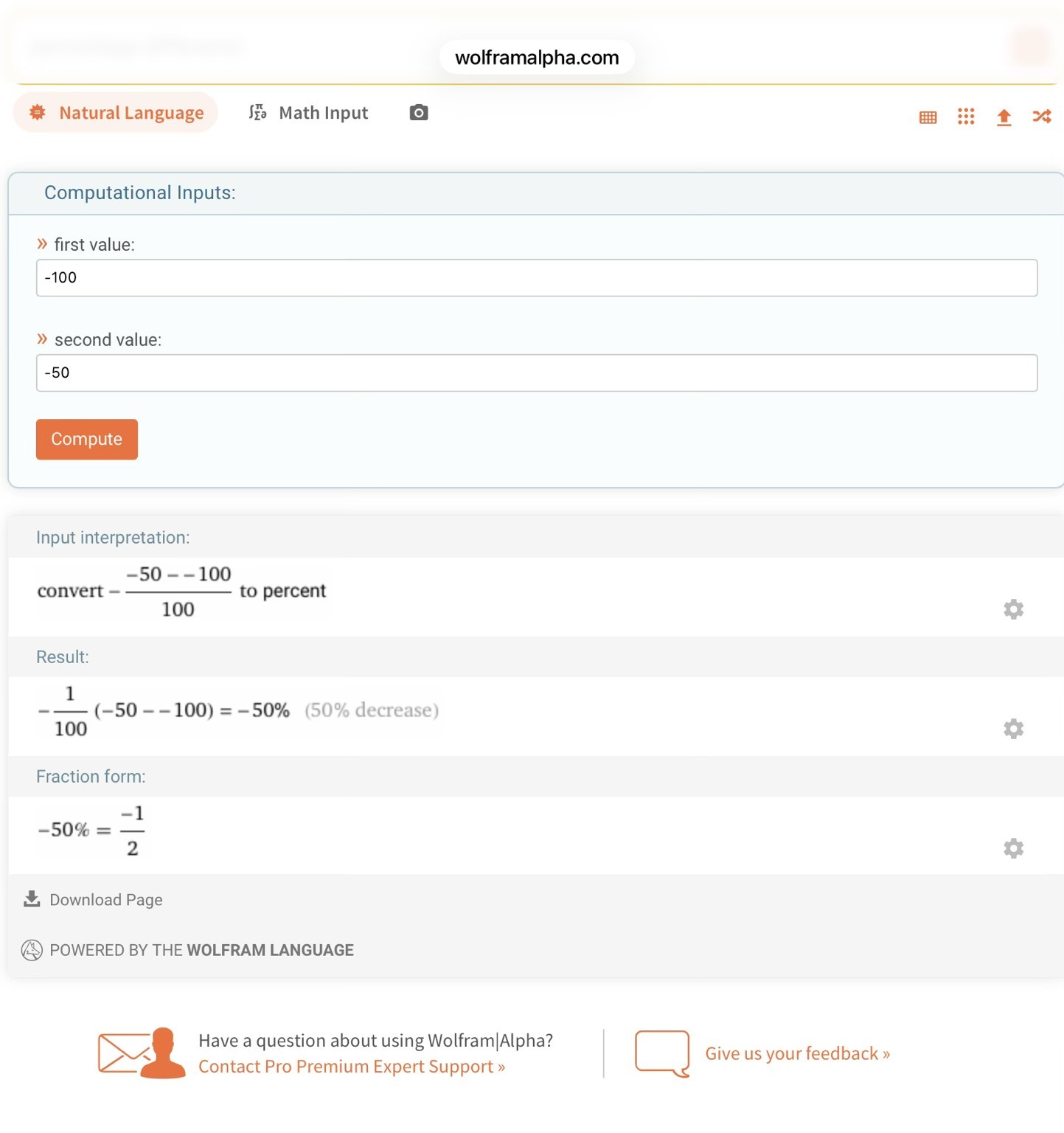
Link: WolframAlpha
3. Where the paradox arises
In the traditional fraction, the numerator and denominator play two different roles. The numerator Vf - Vi correctly describes the direction of change. If the final value is greater, the numerator is positive; if it is smaller, it is negative.
The problem arises from the denominator. If Vi is negative, dividing by Vi reverses the sign. Thus a positive change can become a negative percentage.
4. A minimal change: absolute value in the denominator
If we want the sign of the percentage always to indicate the direction of numerical change, we need only use the absolute value of the initial value:
Δ% = (F - I) / |I| × 100%
In our example:
(-50 - (-100)) / |-100| × 100% = +50%
The result is now consistent with the ordering of the numbers: -50 is greater than -100, so the change is positive.
5. The resulting property
For every nonzero initial value, |I| is always positive. Consequently, the denominator cannot change the sign of the numerator. We therefore obtain a very simple and strong property:
F > I <=> Δ% > 0
F < I <=> Δ% < 0
In other words: the numerator determines the direction; the denominator establishes only the reference scale.
| From | To | Calculation of the ratio | Conversion to % | Interpretation |
|---|---|---|---|---|
| 100 | 120 | (120-100)/|100| = 20/100 = 1/5 | (1/5) × 100% = 20% | increase |
| 100 | 80 | (80-100)/|100| = -20/100 = -1/5 | (-1/5) × 100% = -20% | decrease |
| -100 | -50 | (-50-(-100))/|-100| = 50/100 = 1/2 | (1/2) × 100% = 50% | increase |
| -50 | -100 | (-100-(-50))/|-50| = -50/50 = -1 | (-1) × 100% = -100% | decrease |
6. This is not an artificial case
Negative values occur regularly in economics and finance: profits and losses, margins, accounting results, cash flows, returns and deviations. A company can move, for example, from -10 million to -6 million. Its result has improved by 4 million: the numerical value has increased.
(-6 - (-10)) / |-10| × 100% = +40%
The same care applies in many other contexts where the quantity under consideration can take negative values.
7. Value and absolute value are not the same thing
From -100 to -50, the numerical value increases, while the distance from zero decreases. These are two different descriptions, and both can be correct, provided we specify which quantity we are measuring. In the case of a company loss, for example, we can say both that the result has increased and that the size of the loss has fallen by 50%.
The difficulty arises when a formula referring to the value is automatically interpreted as though it described its absolute value.
8. Some online calculations also use absolute value
Not all online material mechanically uses the initial value with its sign. Some sources and calculators explicitly write percentage change as (F - I) / |I| × 100%, precisely to keep the sign of the percentage consistent with the direction of change.
For example, Math Is Fun presents the formula “Percent Change = (New Value - Old Value) / |Old Value| × 100%”. CalculatorX also states that it uses |V1| in the denominator so that an increase remains positive and a decrease negative, even when the initial value is below zero.
References: Math Is Fun, CalculatorX
9. The zero case
An unavoidable limitation remains: if the initial value is zero, a percentage change relative to the initial value is undefined, because it would involve division by zero. In that case, it makes sense to state the absolute change or choose a different reference.
Conclusion
The point is not to claim that an arithmetic calculation is “wrong” when it applies the traditional formula. The point is to recognize that a formula can have a domain of use in which its interpretation is natural, and other cases in which it reveals a limitation.
When the initial value can be negative, using |I| in the denominator makes the sign of the percentage consistent with the direction of change. It is a minimal change, but it conceptually clarifies the role of the two elements: the difference determines the direction, and the absolute value of the initial value determines the scale.
THE FINAL QUESTION
If the problem is known and real examples clearly show the limitation of the traditional formula, why is nothing done? Why do we continue to teach a formula without making its limitations explicit, instead of also teaching when it works, when it becomes ambiguous, and which alternative definition makes the sign of change consistent?