Open the lab · Back to the index
The inverse chooses one angle
Sine, cosine and tangent do not have inverses over their full domains: several angles can produce the same value. To define each inverse, choose an interval where every allowed value occurs exactly once.
arcsin(c) ∈ [−90°, 90°]
arccos(c) ∈ [0°, 180°]
arctan(c) ∈ (−90°, 90°)
Sine and cosine: recover the other angles
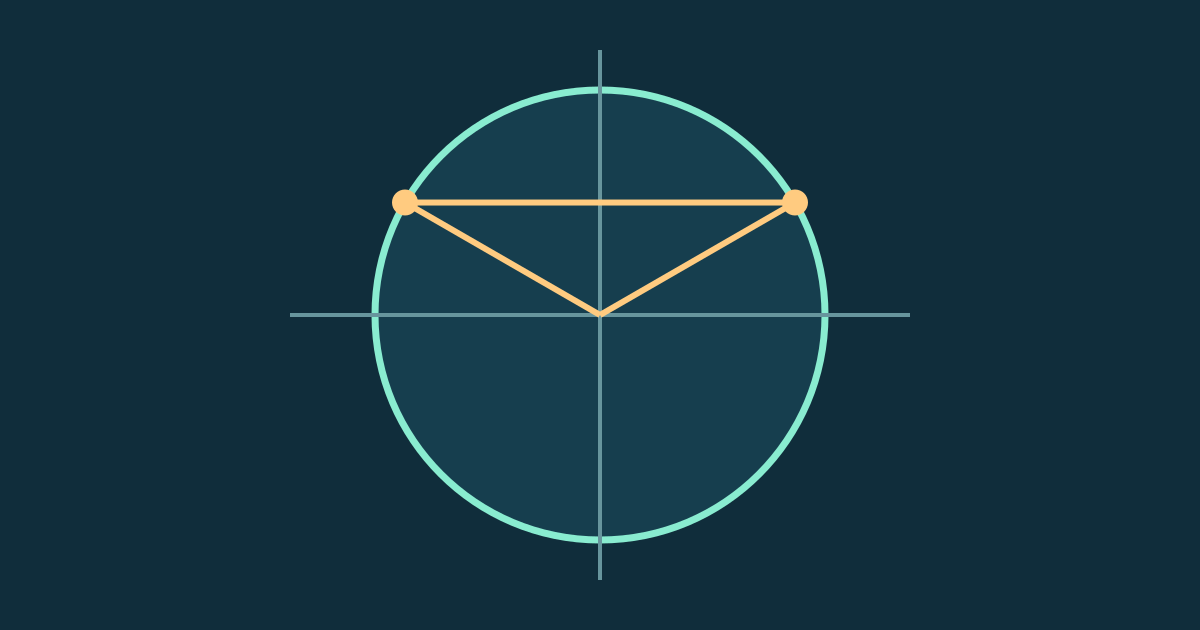
If α = arcsin(c), points at height c are symmetric across the vertical axis: their angles are α and 180° − α. If β = arccos(c), points with x-coordinate c are symmetric across the horizontal axis: their angles are β and −β. Repeat after every full turn. For c = ±1 the two points coincide; for |c| > 1 there are no real solutions.
sin θ = c  →  θ = α + 360°k  |  θ = 180° − α + 360°k
cos θ = c  →  θ = β + 360°k  |  θ = −β + 360°k
k ∈ ℤ
Tangent: half a turn is enough
If γ = arctan(c), the line through the origin with slope c meets the circle at opposite points. Their angles differ by 180°, so add multiples of 180°, not just 360°. Any real c is allowed; tangent is undefined when cosine is zero.
tan θ = c → θ = γ + 180°k, k ∈ ℤ
Worked example: sin θ = 1/2
Arcsine returns 30°. The other angle in the turn is 180° − 30° = 150°. In 0° ≤ θ < 360°, the solutions are 30° and 150°. In general add 360°k to each, with integer k. In radians they are π/6 + 2πk and 5π/6 + 2πk.
Try it: solve cos θ = −1/2 in one turn and then in general.
Show solution
Arccosine returns 120°. Its reflection is −120°, equivalent to 240° in one turn. The general solutions are 120° + 360°k and 240° + 360°k.