Open the lab · Back to the index
Choose the angle first
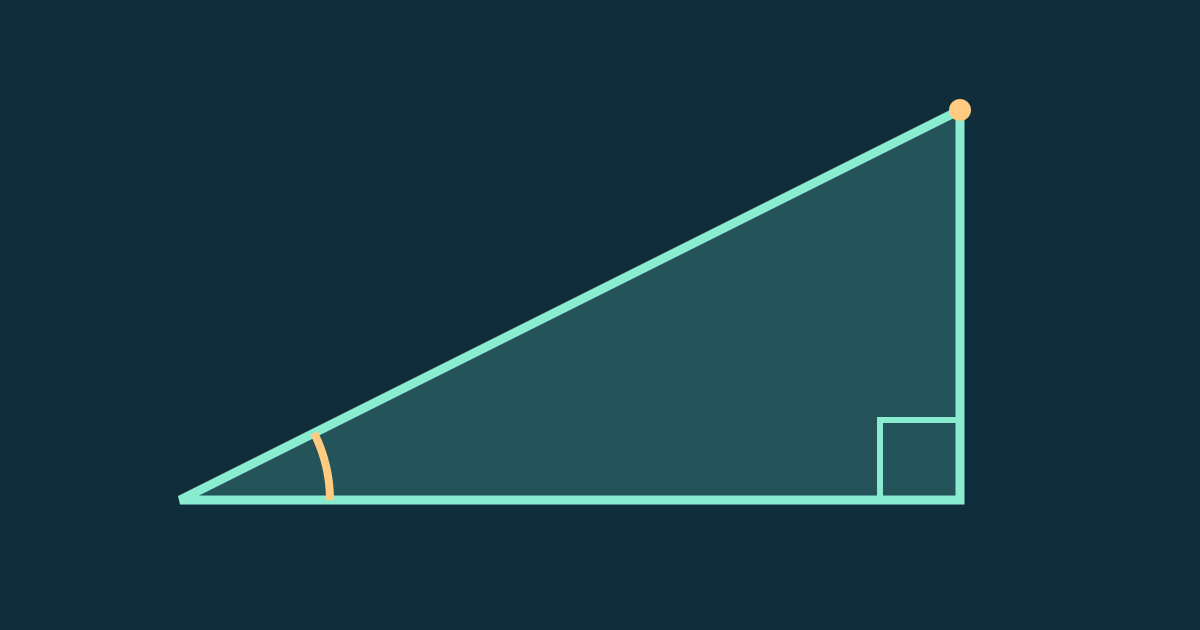
The hypotenuse is opposite the right angle. Relative to acute angle α, the opposite leg faces α and the adjacent leg touches it. Choosing the other acute angle swaps the roles of the legs.
The three ratios come from similarity: as a triangle grows, its sides scale together. The ratios depend on the angle, not the size.
sin α = opposite / hypotenuse
cos α = adjacent / hypotenuse
tan α = opposite / adjacent
A 3–4–5 triangle
With opposite leg 3 and adjacent leg 4, the hypotenuse is 5: sin α = 3/5, cos α = 4/5 and tan α = 3/4. Dividing sine by cosine cancels the common hypotenuse and gives the tangent.
Measuring a tree
You stand 12 m from a tree on level ground. The angle of elevation to its top is 35°, and your eyes are 1.60 m above ground. How tall is the tree?
The adjacent leg is 12 m; the opposite leg is the rise from your eyes to the top. That rise is 12 × tan(35°) ≈ 8.40 m. Add 1.60 m: the tree is about 10.00 m tall.
Try it: at 10 m, with an angle of 45° and an eye height of 1.50 m, how tall is the tree?
Show solution
Since tan(45°) = 1, the rise is 10 m. The total height is 11.50 m.