
Reasoning, organising, deciding and learning to question
Computational thinking does not belong only in computer programs. Breaking problems down, identifying dependencies, describing procedures, comparing alternatives and checking results can also help with everyday choices. It does not mean literally thinking like a computer: it means making our reasoning more explicit and open to inspection.
In the first two articles we turned intuition into precise procedures and learned to build sequences, decisions and loops. Now the question shifts: not just ‘How do I execute these instructions?’, but ‘Am I addressing the right problem, with the right objective and reliable assumptions?’.
We start with ordinary actions, move on to organising work and education, and reach decisions under uncertainty. Not all these situations are algorithmic problems in a strict sense: they also involve critical thinking, systems thinking, probability and organisation. Intuition remains valuable, but becomes a hypothesis to test.
The first two stages of the journey: From intuition to precise algorithms · Sequences, decisions and loops.
Organising time better
Before trying to work faster, examine the order of activities. Some depend on others; some can proceed together, provided they do not simultaneously require the same resource or our continuous attention.
1. Calling the lift before leaving
Sequence A: I take the bags outside, lock the door, reach the lift, call it and wait. Sequence B: if the button can be reached safely, I call the lift first and finish getting ready while it arrives.
If getting ready and reaching the lift takes 30 seconds and its arrival takes 20, the first sequence takes about 50 seconds; the second may take about 30. We have not made the lift faster: we have overlapped waiting with an activity.
| Situation | First intuition | Explicit reasoning | Assumptions and limits |
|---|---|---|---|
| Leaving home and waiting for the lift. | I finish everything involved in leaving, then call it. | I start the autonomous process first and compare the two timelines. | The button must be accessible, and the lift must not leave before I arrive. Times may vary. |
Pause and think. If the lift arrives after 20 seconds but cannot wait until second 30, is the saving still guaranteed?
Show the explained answer
No. Overlapping helps only if the outcome of the wait remains available when needed. We must understand how the lift works and check the constraint: a correct sum is not enough when the model is wrong.
2. The toll booth: releasing a shared resource
After paying I can put my wallet away immediately, or clear the toll booth and put it away later, when stopped in a safe place where stopping is allowed. The second option reduces how long I occupy a resource that others also need.
The same idea appears in computing when we limit how long a shared resource remains occupied. The objective is not to perform every movement faster: it is to avoid holding others up unnecessarily.
| Situation | First intuition | Explicit reasoning | Assumptions and limits |
|---|---|---|---|
| Completing payment without prolonging the queue. | I put everything away before moving on. | I distinguish operations required at the booth from those that can wait. | Safety comes before efficiency: no handling a wallet while driving and no prohibited stops beyond the barrier. |
Pause and think. Does the personal time spent putting the wallet away disappear?
Show the explained answer
No: the action still takes time. What changes is when I perform it, and therefore how long I prevent others from using the booth. Optimising a shared resource does not mean eliminating the work.
3. Putting groceries away and boiling water
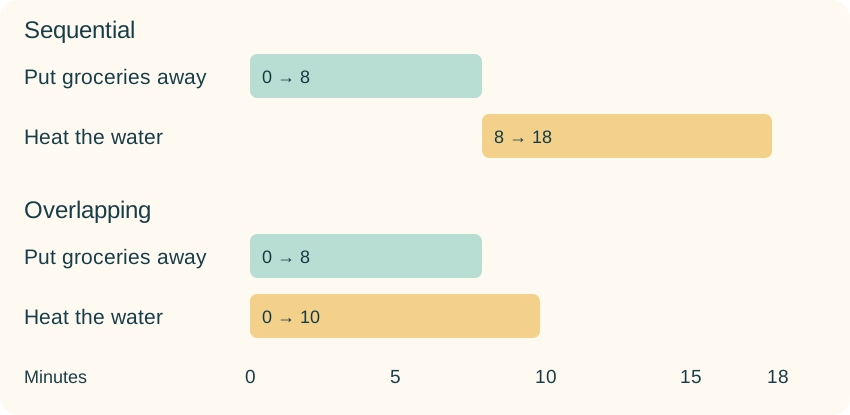
If I first spend 8 minutes putting groceries away and then 10 heating water, I need 18 minutes. If I start heating the water and put the groceries away while it heats, under ideal conditions both activities finish in about 10 minutes, while maintaining the necessary supervision.
For two independent activities, sequential time is T1 + T2; the minimum with complete overlap is max(T1, T2). The greatest theoretical saving is min(T1, T2). Starting, monitoring, resources and dependencies can reduce that advantage.
| Situation | First intuition | Explicit reasoning | Assumptions and limits |
|---|---|---|---|
| Completing two household activities. | I finish one and then start the other. | I check whether I can start an autonomous process and overlap the durations. | Two activities that both need continuous attention do not become independent just because I wish they were. |
T1 + T2 = 8 + 10 = 18
max(T1, T2) = max(8, 10) = 10
min(T1, T2) = min(8, 10) = 8
Pause and think. If the second activity needs an object available only when the first ends, can I use max(T1, T2)?
Show the explained answer
No: there is a dependency. The second activity must wait for the first, so in the simple model the time returns to T1 + T2. You can activate exactly this constraint in the laboratory and see how the result changes.
4. Advertising breaks: observing and planning
During a programme I can observe how long breaks last and how frequently they occur, then prepare small activities with estimated durations. A break averaging four minutes may accommodate a short activity that is easy to interrupt.
Recognising patterns helps planning, but an average is not a promise. It is sensible to allow a margin and expect a break sometimes to end earlier. Resting is also a legitimate objective: not every interval must become productive.
| Situation | First intuition | Explicit reasoning | Assumptions and limits |
|---|---|---|---|
| Using an available interval consciously. | The previous break lasted four minutes, so the next will too. | I observe several breaks, estimate a duration and choose interruptible activities with a margin. | Durations and frequencies can change. Leaving an activity unfinished may cost more than the time saved. |
Pause and think. Will a four-minute activity definitely fit into a break averaging four minutes?
Show the explained answer
No. The average summarises several observations; it does not determine the next break’s duration. I can choose something shorter or interruptible, and distinguish a prediction from a guarantee.
Breaking down and coordinating a problem
Dividing a complex task into parts helps only if we know how to put them back together. Responsibilities, interfaces, constraints and checks matter as much as each person’s individual work.
5. Renovating a home: by trade or by room?
A flat needs a builder, electrician, plumber, decorator and furnishing specialist. We can organise work by trade, with each specialist working in all the necessary rooms, or by room, giving each room a lead who performs or coordinates the required work.
The first model favours specialisation, shared equipment and consistency; the second favours autonomy, clear responsibility and progressively completed rooms. Neither removes dependencies: services may connect several rooms. A hybrid solution is possible.
In software, teams can be divided by interface, data and logic, or each team can own a complete component. The choice also depends on how much the parts need to communicate: defining their interfaces prevents surprises when assembling the system.
| Situation | First intuition | Explicit reasoning | Assumptions and limits |
|---|---|---|---|
| Organising work involving several skills and rooms. | I divide the work and each group proceeds alone. | I compare different decompositions and represent responsibilities, interfaces and prerequisites. | Parts are not always independent; coordination is necessary and no organisation is best in every context. |
Pause and think. Does assigning a lead to every room remove the need for a plumber?
Show the explained answer
No. It changes the organisation of responsibilities, not the skill required. The lead may need to coordinate a specialist working in several rooms. Good decomposition also makes these connections visible.
6. Education for building surveyors: start with what students must be able to do
A course can start from intended outcomes: surveying a building, reading plans, calculating areas and volumes, preparing quantities and checking stages and costs. Mathematics, construction, surveying, valuation, law and computing contribute to concrete skills without losing their own identities.
Consider a project divided into stages, each with a share of the total and a completion level. When both are written as percentage numbers, the contribution in percentage points is weight × progress / 100. Weights must total 100 and follow a consistent criterion, such as economic value.
Masonry that is half complete and weighs 10% contributes 50/100 × 10% = 5% of the whole project. Adding the table’s contributions gives 22.5%. We are not simply counting how many stages have started or finished.
This is primarily an example of competence-based education and interdisciplinary design. It also becomes computational thinking when objectives, sub-objectives, data, dependencies, calculation rules and checks are made explicit.
| Situation | First intuition | Explicit reasoning | Assumptions and limits |
|---|---|---|---|
| Assessing overall project progress. | I average the completion percentages of the five stages. | I multiply each stage’s progress by its weight and add the contributions. | A simple average is appropriate only for equal weights. Economic weight, duration and number of tasks are different measures. |
| Stage | Progress | Share of total | Contribution to total |
|---|---|---|---|
| Demolition | 100% | 10% | 10% |
| Masonry | 50% | 10% | 5% |
| Services | 25% | 30% | 7,5% |
| Finishes | 0% | 30% | 0% |
| Testing | 0% | 20% | 0% |
| Total | — | 100% | 22,5% |
Pause and think. Why is the simple average of 35% not the correct result for this table?
Show the explained answer
The average (100 + 50 + 25 + 0 + 0) / 5 = 35% assigns every stage an equal 20% weight. Here the weights are 10%, 10%, 30%, 30% and 20%, and must be respected. The correct sum is 10% + 5% + 7.5% + 0% + 0% = 22.5%.
Choosing well and learning to question
A procedure can be executed without mistakes and still lead to an unwise decision. It may optimise the wrong measure, ignore essential information or overlook other people’s reactions.
7. Politics: does changing incentives change the outcome?
We can hypothesise that those in government seek the support needed for re-election and, in some circumstances, favour measures attractive to particular groups. If a change of government were certain, that incentive would change: would better decisions necessarily follow?
The deduction is not automatic. Other interests would remain, and accountability to voters might also decrease. Explicit reasoning lists actors, incentives, alternatives, possible effects, evidence and counterexamples. Political choice remains a personal judgement, not an algorithm’s mandatory output.
| Situation | First intuition | Explicit reasoning | Assumptions and limits |
|---|---|---|---|
| Assessing a proposal that changes incentives. | I remove an incentive and the unwanted behaviour disappears. | I distinguish the hypothesis from the conclusion and look for other incentives and opposing effects. | A model cannot capture all human motives and values; a possibility is not a certain prediction. |
Pause and think. Is a coherent argument enough to prove that a reform will have the desired effect?
Show the explained answer
No. I can reason correctly from incomplete or false assumptions. We must check premises, compare scenarios and seek observations that could disprove the conclusion, without turning the example into voting advice.
8. The supermarket: optimising the right variable
The shortest queue is not necessarily the fastest. Three full trolleys may take longer than six customers with a few items each. The number of people is easy to observe, but the real objective is reducing expected waiting time.
A simple model adds a handling time per customer and a time per item. It cannot predict everything: cashier speed, payments, surprises and customers already partly served can change the estimate. The laboratory lets you vary precisely the customers, items and times.
| Situation | First intuition | Explicit reasoning | Assumptions and limits |
|---|---|---|---|
| Choosing a checkout queue. | I join the queue with fewer people. | I estimate the work remaining and compare predicted queue times. | An estimate is not a guarantee; distinguish people ahead, remaining items and my own service. |
Pause and think. Is counting people enough to choose a queue?
Show the explained answer
No: that count is an indicator, not the time we want. I must identify relevant variables and accept uncertainty. A simple, declared model is easier to inspect than certainty based only on appearances.
9. Traffic: individual advantage and collective outcomes
Adding a road always seems useful. In particular networks, however, a new connection can lead drivers to change routes and increase journey times: this is Braess’s paradox. It does not mean that every new road worsens traffic.
The network is not a fixed backdrop: times depend on how many people choose each section. A change also alters individuals’ decisions, and those decisions change the system. Assessing an intervention means considering reactions, not merely drawing another connection.
| Situation | First intuition | Explicit reasoning | Assumptions and limits |
|---|---|---|---|
| Assessing a new link in a road network. | More alternatives always mean less waiting for everyone. | I model routes, congestion and users’ choices before and after the change. | The effect depends on the network and behaviour; the counterintuitive case does not justify an opposite universal rule. |
Pause and think. Does the paradox prove that new roads should not be built?
Show the explained answer
No. It shows that ‘adding a road always improves the outcome’ is not valid without conditions. The correct conclusion is to assess the system and its incentives, not replace one absolute claim with another.
10. Special offers: a discount is not necessarily a saving
‘Spend another 20 euros and get 10 euros off.’ If those 20 euros buy things I would not otherwise purchase, spending increases by 10 euros compared with stopping. The discount is real, but does not necessarily mean saving towards my objective.
Before calculating value I must choose the comparison: planned spending on necessities, or an enlarged basket. If the additional goods were already needed, the judgement may change. Optimising the discount without checking total spending can reward the wrong variable.
| Situation | First intuition | Explicit reasoning | Assumptions and limits |
|---|---|---|---|
| Assessing a promotion with a spending threshold. | A ten-euro discount always means ten euros saved. | I compare net spending with and without the promotion for genuinely necessary purchases. | The result depends on the comparison and the usefulness of added goods, not only the discount percentage. |
Pause and think. If I need no other products, does spending 20 euros to get 10 euros off reduce my spending?
Show the explained answer
No: 20 − 10 = 10 euros of additional spending. I may still choose to buy, but I should not describe an increase relative to adding nothing as a reduction in spending.
11. A test: pay attention to prior probabilities
We use an invented mathematical example, not a tool for interpreting personal medical tests. In a population of 10,000 people, 1%, or 100 people, have the condition. A sensitivity of 90% produces 90 true positives; a specificity of 95% produces false positives in 5% of the 9,900 people without the condition, or 495.
Expected positives total 90 + 495 = 585. Among these, the proportion with the condition is 90/585 × 100% ≈ 15.4%. The 90% sensitivity answers a different question: how often the test is positive among those with the condition. Reversing the question without considering the prior probability is the error.
Sensitivity, specificity and positive predictive value are different measures. Real values depend on the test and clinical context; this calculation explains a probabilistic relationship, not a diagnosis.
| Situation | First intuition | Explicit reasoning | Assumptions and limits |
|---|---|---|---|
| Interpreting a positive result in an explicit model. | The test identifies 90% of cases, so a positive result means a 90% probability. | I distinguish the initial groups and count true and false positives before calculating the ratio. | The initial frequency matters; invented data cannot be transferred to an individual or a real test. |
| Group | Positive | Negative | Total |
|---|---|---|---|
| With the condition | 90 | 10 | 100 |
| Without the condition | 495 | 9405 | 9900 |
| Total | 585 | 9415 | 10000 |
Pause and think. Where do the 495 false positives come from?
Show the explained answer
First I separate 100 people with the condition and 9,900 without it. A specificity of 95% means that, in the model, 5% of the second group test positive: 9,900 × 5/100 = 495. I do not apply that 5% only to the 100 people with the condition.
A shared method: observe, model, check
- Define the objective: time, quality, cost, safety or learning? Which comparison makes the result meaningful?
- Break the problem down: which activities, people and resources are involved? Which parts depend on others?
- State assumptions: which data do I know, and which am I only estimating or assuming?
- Look for alternatives: can I reorder, overlap, distribute or coordinate differently?
- Check and revise: which exceptions, counterexamples or unintended consequences would change the conclusion?
Open the laboratory: Organise, compare, check
Three ways of thinking that support each other
| Perspective | A question to take away |
|---|---|
| Computational thinking | How do I represent the problem and describe an explicit, testable and reusable procedure? |
| Critical thinking | How reliable are the data and assumptions? What evidence might disprove the conclusion? |
| Systems thinking | How do the parts interact, and what consequences follow from others’ choices? |
These perspectives are not separate compartments, and they are not all the same as programming. Together they help us move from intuition to a clearer representation of objectives, rules and consequences. Computational thinking is useful not only for solving problems, but also for reconsidering how we approach them.
We can ask AI to compare strategies, state assumptions and find counterexamples. A convincing explanation is not enough, however: we must check calculations, premises and the meaning of the result. In problems involving people and values, the model supports judgement rather than replacing it.
Doing the steps correctly is not enough: we must ask whether they are the right steps, for the right objective, on reliable assumptions.
Further reading
These links explore the concepts discussed; the situations and numerical data in this article are educational examples.
- Jeannette M. Wing, Computational Thinking (2006): formulating and representing problems
- Cornell University, Traffic Network Games: Braess’s paradox
- FDA: sensitivity, specificity and predictive measures of tests
From intuition to precise algorithms · Sequences, decisions and loops