Salvatore Mosaico · 2026
Contents
- 1. Two stories, the same problem
- 2. Classifying by topic or by idea?
- 3. A — Start at the end
- 4. B — Look for what does not change
- 5. C — Make the information comparable
- 6. D — Isolate the difference
- 7. E — Make a simple assumption and correct it
- 8. F — Remove the common part
- 9. G — Go through one unit
- 10. H — Calculate what we are not looking for
- 11. I — Understand how many times we are counting
- 12. L — Change the way you see it
- 13. The classes are not closed boxes
- 14. Three unlabelled problems
- 15. The role of AI: helping us recognize, not merely answer
- 16. Conclusion — Learn to recognize, not merely to carry out
Different problems can conceal the same structure. Learning to recognize it means moving from looking for a formula to building an argument.
1. Two stories, the same problem
The teacher writes on the board:
A pen contains 20 animals, chickens and rabbits. There are 56 legs altogether. How many rabbits are there?
Then, without solving it, the teacher asks a second question:
A cinema sells 20 tickets: some cost 10 euros and others 20 euros. The total takings are 280 euros. How many 20-euro tickets were sold?
Teacher: Are these two problems similar?
Student: Not very. The first is about animals; the second is about tickets.
Teacher: Let us forget the animals and the cinema for a moment. In both cases we know the total number of objects. Each object makes either a small contribution or a large one. We also know the sum of the contributions. What are we looking for?
Student: How many objects make the larger contribution.
We have found something more important than similar wording: the same mathematical structure.
In the pen, imagine all 20 animals are chickens: 20 × 2 = 40 legs. We are 16 legs short. Replacing a chicken with a rabbit adds two legs, so (56 − 40) / 2 = 8 rabbits.
At the cinema, imagine all tickets cost 10 euros: 20 × 10 = 200 euros. We are 80 euros short. Each 20-euro ticket replacing a 10-euro ticket adds 10 euros: (280 − 200) / 10 = 8 tickets.
The method does not depend on both answers being 8. It depends on each replacement adjusting the total by a constant amount.
This dialogue is a teaching simulation, not a transcript of an actual lesson.
2. Classifying by topic or by idea?
We are used to sorting problems into arithmetic, algebra, geometry and probability. This is useful: it tells us which mathematical objects we are studying. But it does not always suggest how to approach them.
There is another question:
What idea might make this problem simpler?
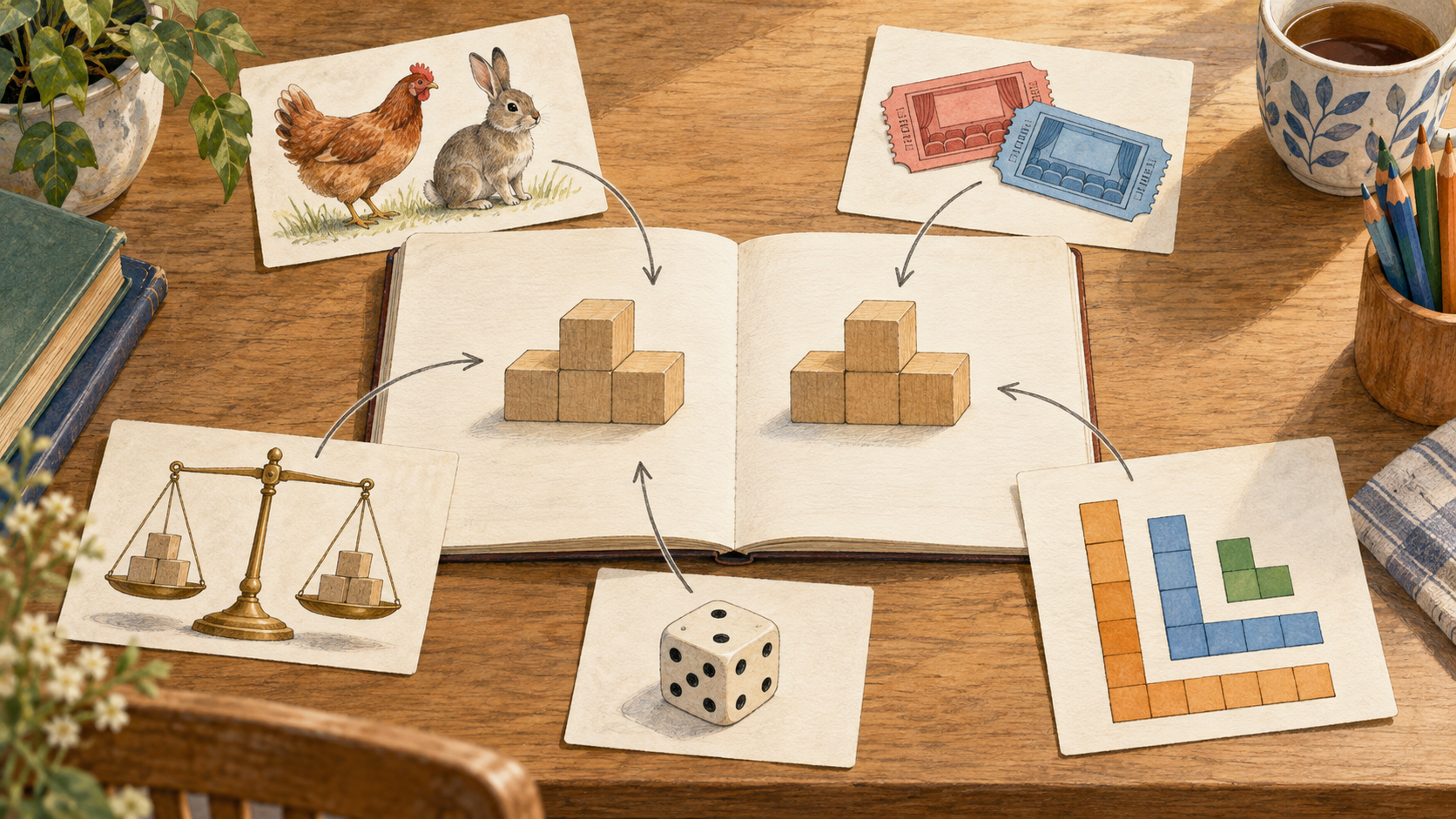
An age problem and a problem about two tanks may share a difference that stays constant. A probability question and an area question may both be solved by first finding the complementary part. A purchase and a balance scale may require eliminating a common quantity.
We can therefore organize problems by problem-solving strategies. What follows is a teaching proposal, not an official or exhaustive classification. The letters are signposts, not separate compartments. One problem can use several strategies.
| Class | Central idea | Question to ask |
|---|---|---|
| A | Work backwards | Can I start at the end? |
| B | Find an invariant | What does not change? |
| C | Bring to a common basis | Can I make the information comparable? |
| D | Study the difference | How much more or less is there? |
| E | Make a convenient assumption and correct it | How much does each correction change? |
| F | Eliminate the common part | What can I remove from both situations? |
| G | Reduce to one unit | How much corresponds to one? |
| H | Calculate the complement | Is what I am not looking for easier to find? |
| I | Use double counting | How many times am I counting each element? |
| L | Change representation | Would a drawing or diagram reveal the structure? |
Let us explore them through ten short investigations.
3. A — Start at the end
I think of a number, multiply it by 3, add 5 and get 26. What was my number?
We could write an equation, but we can also retrace the story backwards. The last operation was adding 5. Undo it: 26 − 5 = 21. Before that came multiplication by 3. Undo it by dividing: 21 / 3 = 7.
The original number was 7. Check by going forwards: 7 × 3 + 5 = 26.
The rule is not just to use inverse operations: we must use them in reverse order. This is particularly useful for successive transformations, spending, transfers between containers and reconstructing initial quantities.
There is an important limitation: not every operation preserves enough information to work backwards uniquely. If a number squared is 9, the number could be 3 or −3. We must also know the conditions of the problem.
4. B — Look for what does not change
A father is 40 and his son is 10. In how many years will the father be twice as old as his son?
Their ages change. Their age ratio changes. But the difference stays the same: 40 − 10 = 30. Each year both grow one year older, so the father will remain 30 years older than his son.
When the father is twice the son's age, picture the son as one part and the father as two parts. Their difference will be one part, exactly the son's age. That part must equal 30 years.
The son must therefore go from 10 to 30: 30 − 10 = 20. In 20 years their ages will be 60 and 30.
Instead of tracking two changing quantities separately, we have found a stable relationship. An invariant may be a difference, a sum, an area, a remainder or parity. Recognizing it is not enough: we must explain why the allowed transformations preserve it.
5. C — Make the information comparable
Mary, Nellie and Susie share 770 chestnuts. For every 4 chestnuts Mary receives, Nellie receives 3. For every 6 chestnuts Mary receives, Susie receives 7. How are the chestnuts shared?
Mary appears in both relationships, but with different quantities: 4 and 6. We can bring them to a common basis through one continuous sharing process.
Mary and Nellie begin with 4 for Mary, 3 for Nellie. To take Mary from 4 to 6, add 2, which is half of 4. Nellie must also receive half her original share: 3 / 2 = 1.5.
We now have 6 for Mary, 4.5 for Nellie. We can bring Susie in because we already know her share when Mary has 6: 6 for Mary, 4.5 for Nellie, 7 for Susie.
These are proportional shares, not chestnuts physically handed out yet. Double everything to remove the half-unit: 12, 9, 14.
The number 12 emerges at the end, as a consequence of the reasoning. We did not have to find it beforehand using the least common multiple.
A complete group contains 12 + 9 + 14 = 35 chestnuts. With 770 chestnuts we can form 770 / 35 = 22 groups. Therefore:
Mary = 12 × 22 = 264
Nellie = 9 × 22 = 198
Susie = 14 × 22 = 308
Bringing information to a common basis makes it possible to use it together.
6. D — Isolate the difference
Anna is 8 years older than Luca. Their ages add up to 32. How old are they?
Imagine subtracting only Anna's extra 8 years. The total becomes 32 − 8 = 24. We now have two ages equal to Luca's: 24 / 2 = 12.
Luca is 12 and Anna is 12 + 8 = 20.
This reasoning gives a general formula. If two quantities have sum S and difference d, the smaller is (S − d) / 2 and the larger is (S + d) / 2.
The formula is not something to memorize without a reason: it summarizes an understandable operation.
7. E — Make a simple assumption and correct it
Return to the chickens and rabbits. Saying “suppose they are all chickens” is not a random guess. We know the assumption is not the final situation, but we choose it because it gives a simple starting point.
The discrepancy is 56 − 20 × 2 = 16. Each replacement adds 4 − 2 = 2 legs. The number of replacements is therefore 16 / 2 = 8.
We can generalize. There are N objects. Each contributes either a or b, with b > a. The total contribution is T. If all contributed a, we would have Na. Each change from a to b adds b − a. The number x of objects of the second kind is:
x = (T − Na) / (b − a), b > a
This is an assumption-and-correction argument, related to false position. The crucial condition is that each correction has the same effect. We cannot automatically apply this mechanism to a nonlinear situation.
If the objects are indivisible, the answer must also be an integer between 0 and N. Checking this is part of solving the problem.
8. F — Remove the common part
A sandwich and a drink cost 7 euros. The same sandwich and three drinks cost 11 euros. How much does one drink cost?
The sandwich appears in both purchases at the same price. The difference between the purchases is two drinks. The price difference is 11 − 7 = 4 euros. Thus two drinks cost 4 euros and one costs 4 / 2 = 2 euros.
We do not need to find the sandwich price first. Write P for the sandwich price and B for the drink price:
P + B = 7
P + 3B = 11
(P + 3B) − (P + B) = 11 − 7
2B = 4
B = 2
We have not done something opposed to algebra: we have understood concretely the principle behind algebraic elimination.
If the common part is not already equal, we can first make it equal and then eliminate it. Strategies C and F become two stages of the same route.
9. G — Go through one unit
Five kilograms of apples cost 12 euros. How much do 8 kilograms cost, at the same price per kilogram?
First find the price of one kilogram: 12 / 5 = 2.40 euros. Then build up the required cost: 2.40 × 8 = 19.20 euros.
5 kg → 1 kg → 8 kg
The unitary method makes proportionality explicit. But the assumption “at the same price per kilogram” is essential. With a fixed charge, a quantity discount or tiered prices, the reasoning would need adapting.
Before calculating, check which relationship connects the quantities.
10. H — Calculate what we are not looking for
Roll a fair die four times, independently. What is the probability of getting at least one 6?
“At least one 6” includes several possibilities: one, two, three or four results of 6. Its complement is much simpler: never getting a 6.
On each roll the probability of not getting 6 is 5/6. Because the four rolls are independent, the probability of never getting 6 is (5/6)⁴.
The events “at least one 6” and “no 6” cannot happen together and cover every possibility. The required probability is therefore:
1 − (5/6)⁴ = 1 − 625/1296 = 671/1296 ≈ 51.8%
Using the complement here is not merely “doing a subtraction”. It means choosing the event that is easier to calculate. Negate the condition carefully: the opposite of “at least one” is “none”, not “not all”.
11. I — Understand how many times we are counting
There are 10 people at a party. Each shakes hands with every other person exactly once. How many handshakes take place?
Each person meets 9 others: 10 × 9 = 90. But each handshake has been counted twice, once from each person's perspective. So 90 / 2 = 45.
A more precise formulation distinguishes handshakes from participations in handshakes: the 10 people produce 90 participations in total; every handshake contains exactly 2 participations. If S is the number of handshakes, 2S = 90.
For n people this gives:
S = n(n − 1) / 2
The useful question is not “should I divide by two?” but how many times has my method counted each object? The multiplicity is not always two. Nor is it always the same for every object; in that case we need a different argument.
12. L — Change the way you see it
What is the sum of the first n odd positive integers?
Calculating a few examples suggests a rule:
1 = 1²
1 + 3 = 2²
1 + 3 + 5 = 3²
But a few examples do not prove that a rule always holds. Let us move from arithmetic to geometry.
To turn a square of side n − 1 into a square of side n, add an L-shaped border: one strip of n cells and one of n − 1. The number of added cells is n + (n − 1) = 2n − 1, exactly the nth odd number.
Starting with the first cell and adding these borders therefore builds a square of side n:
1 + 3 + 5 + ⋯ + (2n − 1) = n²
The drawing does not merely decorate an explanation already completed: it makes the reason the formula works visible. Changing representation may mean turning a text into a diagram, a percentage into a fraction, a list into a table, or a meeting between people into a connection between points.
13. The classes are not closed boxes
It would be a mistake to turn this proposal into another labelling exercise: “Is this problem in class C or F?” Often the best answer is both.
We can bring two situations to a common basis, eliminate the common part and finally reduce to one unit. In the age problem we can use an invariant and a part-based representation together. Strategies are tools that cooperate, not mutually exclusive categories.
Algebra also retains its role. It expresses relationships compactly, generalizes them and handles problems where concrete reasoning becomes difficult to manage.
The aim is not to avoid equations at all costs. It is to avoid writing an equation without understanding what it represents.
14. Three unlabelled problems
Before opening the solutions, try choosing a question from the initial table.
Problem 1 — Money left over
I spend half my money, then another 6 euros. I have 15 euros left. How much did I have initially?
Show the worked solution
Work backwards. Before spending the last 6 euros I had 15 + 6 = 21 euros. This was half my initial money, so I started with 42 euros. Check: 42 − 21 − 6 = 15.
Problem 2 — Two purchases
Two notebooks and three pens cost 14 euros. Four notebooks and three pens cost 22 euros. What is the price of one notebook and one pen?
Show the worked solution
Eliminate the common part. The same three pens appear in both purchases. Two extra notebooks cost 22 − 14 = 8 euros: one notebook costs 4 euros. In the first purchase, 14 − 8 = 6 euros remain for three pens: one pen costs 2 euros. Check: 2 × 4 + 3 × 2 = 14 and 4 × 4 + 3 × 2 = 22.
Problem 3 — An impossible jump
I start at 0 and may add or subtract 4 on each move. Can I reach 2026?
Show the worked solution
Find an invariant. Starting at 0 and adding or subtracting 4 only reaches multiples of 4. The remainder on division by 4 stays zero. Since 2026 = 4 × 506 + 2, 2026 cannot be reached.
There is no need to test thousands of move sequences. A property shared by every sequence settles the question.
15. The role of AI: helping us recognize, not merely answer
An AI assistant can provide a quick solution. But it can also become a tool for comparing arguments. Instead of just asking “solve this”, we can ask:
- What relationship makes this problem solvable?
- Suggest a problem with a different story but the same structure.
- Show the concrete reasoning first, then translate it into algebra.
- What assumption makes this step valid?
- Find a case in which the method cannot be applied.
Checking remains essential. A persuasive text can hide inconsistent data, an omitted assumption or an unproved generalization. Even assigning a class is not enough: we must explain where that strategy enters and why it is valid.
Collaboration becomes more interesting when AI helps produce examples and comparisons while the teacher guides the choice of questions, the progression and the checking.
16. Conclusion — Learn to recognize, not merely to carry out
After solving many problems, a student may have learned many procedures. Or they may have begun recognizing a few deep ideas that recur in different situations. It is this second possibility that we want to cultivate.
Faced with a new problem, the first question need not be “Which formula should I use?” It can be: “Can I start at the end? What stays constant? Can I make two quantities equal? What can I eliminate? Is the complement easier to calculate? Am I counting something more than once?”
These questions do not guarantee an immediate solution. They give the search a direction.
A solved problem gives us an answer. A recognized structure helps us tackle many more.