
A formula need not be merely a result to memorise. It can become the starting point for another: “I know this sum… so how can I transform it into the one I want?”

The journey starts with nine formulas and develops six more. In each case we distinguish what we know, the transformation to try and the proof. Formulas remain visible; open the steps when you want to compare them with your own attempt.
This article applies reduction to a known problem to finite sums. The general method: reduce a new problem to a known one.
Before starting: terms, indices and conditions
Unless stated otherwise, n is a positive integer. In the first formula, the natural numbers are 1, 2, …, n; the even numbers considered start at 2. Dots mean that we continue the same rule to the last term shown, not that we sum infinitely many terms.
For a fixed n, S₁, S₂, S₃, S₄ and S₅ denote sums of the first five powers from 1 to n. If the endpoint changes, we write it in parentheses: for example, S₃(2n) sums cubes up to 2n. Tₖ will denote the kth triangular number, namely 1 + 2 + … + k.
Adding a constant c exactly n times gives nc, not c. This is why a +1 in every identity being added becomes +n.
A numerical check can reveal an error but does not prove a formula for every n. Our proofs will not use a sum formula before deriving it.
S₁ = 1 + 2 + … + n
S₂ = 1² + 2² + … + n²
S₃ = 1³ + 2³ + … + n³
S₄ = 1⁴ + 2⁴ + … + n⁴
S₅ = 1⁵ + 2⁵ + … + n⁵
Choose a route
- Start here: pairing, multiplying and counting: 1, 2, 3, 9, 10
- Using algebra: from known sums to powers: 4, 5, 6, 7, 8, 11, 13
- More cancellations: products and fractions: 12, 14, 15
A new idea to recognise: telescoping cancellation
A telescoping sum consists of differences: a positive term in one bracket reappears negatively in the next. For example, +2³ cancels −2³ and +3³ cancels −3³.
(2³ − 1³) + (3³ − 2³) + (4³ − 3³)
= 4³ − 1³
In the general case, the final and initial terms remain. We are not deleting terms arbitrarily: we use associativity and the fact that a number plus its opposite equals zero. This idea helps in formulas 4, 6, 8, 12, 13 and 14.
The fifteen sums
- Sum of the first n natural numbers
- Sum of the first n even numbers
- Sum of the first n odd numbers
- Sum of squares
- Sum of squares of odd numbers
- Sum of cubes
- Sum of cubes of odd numbers
- Sum of fourth powers
- Sum of integers from p to q
- Sum of an arithmetic progression
- Sum of triangular numbers
- Sum of products of three consecutive integers
- Sum of fifth powers
- A telescoping sum of fractions
- Sum of a finite geometric progression
From basic sums to powers
1. Sum of the first n natural numbers
1 + 2 + … + n = n(n + 1)/2
I know… Addition and the ability to reorder terms without changing their sum.
Therefore… I write two copies of the sum, one backwards, to obtain identical column totals.
Open the step-by-step proof · 1
1. Call the unknown quantity S. Both rows contain exactly the same n terms, merely in a different order.
S = 1 + 2 + … + (n − 1) + n
S = n + (n − 1) + … + 2 + 1
2. Add the rows column by column. Each column totals n + 1 and there are n columns. This also holds for odd n: we used two copies, rather than trying to pair all terms within a single copy. Finally divide by 2.
2S = (n + 1) + … + (n + 1)
2S = n(n + 1)
S = n(n + 1)/2
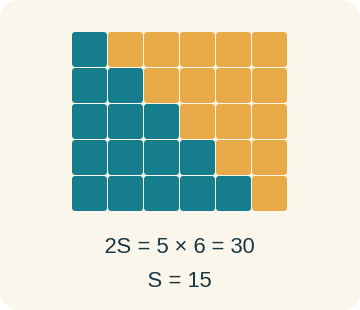
Numerical check
n = 5: 1 + 2 + 3 + 4 + 5 = 15
5(5 + 1)/2 = 15
2. Sum of the first n even numbers
2 + 4 + … + 2n = n(n + 1)
I know… The sum of natural numbers, formula 1.
Therefore… I recognise that each term is twice the corresponding term in the known sum.
Useful references: 1
Open the step-by-step proof · 2
1. Factor out 2. We are not doubling the number of terms: there are still n.
2 + 4 + … + 2n = 2(1 + 2 + … + n)
2. Substitute formula 1 and cancel the factor 2 against the denominator 2.
= 2 · n(n + 1)/2
= n(n + 1)
Numerical check
n = 4: 2 + 4 + 6 + 8 = 20
4(4 + 1) = 20
3. Sum of the first n odd numbers
1 + 3 + … + (2n − 1) = n²
I know… The sum of the first n even numbers, formula 2.
Therefore… I subtract 1 from each even number to obtain the preceding odd number.
Useful references: 2
Open the step-by-step proof · 3
1. There are n terms, so the total subtraction is n. Writing just −1 at the end would change only one term.
1 + 3 + … + (2n − 1)
= (2 − 1) + (4 − 1) + … + (2n − 1)
= (2 + 4 + … + 2n) − n
2. Substitute the even-number formula and expand. The drawing illustrates four layers; the algebra proves the result for every n.
= n(n + 1) − n
= n² + n − n
= n²
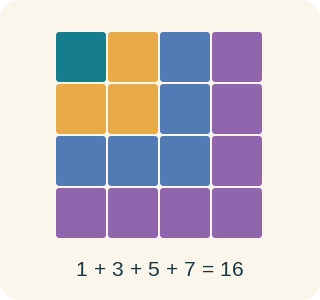
Numerical check
n = 4: 1 + 3 + 5 + 7 = 16 = 4²
4. Sum of squares
1² + 2² + … + n² = n(n + 1)(2n + 1)/6
I know… The sum of natural numbers and the expansion of a cube.
Therefore… I seek an identity containing k² and only other quantities whose terms I can already sum.
Useful references: 1
Open the step-by-step proof · 4
1. Expand the cube of k + 1 and subtract k³. The cubic term disappears: this is why a difference of cubes can help sum squares.
(k + 1)³ = k³ + 3k² + 3k + 1
(k + 1)³ − k³ = 3k² + 3k + 1
2. Write the identity for k = 1, 2, …, n and add both sides. The squares give S₂, linear terms give S₁, and n copies of 1 give n.
(2³ − 1³) + (3³ − 2³) + …
+ ((n + 1)³ − n³)
= 3S₂ + 3S₁ + n
3. All intermediate cubes cancel on the left. Only (n + 1)³ and −1³ remain: the boundary terms have no opposites within the sum.
(n + 1)³ − 1 = 3S₂ + 3S₁ + n
4. Move the other terms to the right and substitute S₁. We are not assuming S₂ is known: it is precisely the unknown to isolate.
3S₂ = (n + 1)³ − 1 − 3S₁ − n
3S₂ = (n + 1)³ − 1 − 3n(n + 1)/2 − n
5. Multiply by 2 to clear the denominator, expand and collect equal powers. The final factorisation uses 2n² + 3n + 1 = (n + 1)(2n + 1).
6S₂ = 2(n + 1)³ − 2 − 3n(n + 1) − 2n
= 2n³ + 6n² + 6n + 2 − 2
− 3n² − 3n − 2n
= 2n³ + 3n² + n
= n(2n² + 3n + 1)
= n(n + 1)(2n + 1)
6. Divide by 6. The sum of squares has been derived from a binomial cube and the sum of natural numbers.
S₂ = n(n + 1)(2n + 1)/6
Numerical check
n = 4: 1 + 4 + 9 + 16 = 30
4 · 5 · 9/6 = 30
5. Sum of squares of odd numbers
1² + 3² + … + (2n − 1)² = n(4n² − 1)/3
I know… The sums of squares and natural numbers, formulas 4 and 1.
Therefore… I write the kth odd number as 2k − 1 and expand its square.
Open the step-by-step proof · 5
1. The expansion contains a square, a linear term and a constant: three sums I can calculate.
(2k − 1)² = 4k² − 4k + 1
2. Sum from k = 1 to n. The factor 4 applies to every square and every linear term; the constant 1 occurs n times.
1² + 3² + … + (2n − 1)²
= 4S₂ − 4S₁ + n
3. Substitute the previously proved formulas and simplify the numerical coefficients.
= 4 · n(n + 1)(2n + 1)/6
− 4 · n(n + 1)/2 + n
= 2n(n + 1)(2n + 1)/3 − 2n(n + 1) + n
4. Factor out n and use the common denominator 3. The expanded bracket shows that linear terms cancel and 2 − 6 + 3 = −1.
= n[2(n + 1)(2n + 1) − 6(n + 1) + 3]/3
2(n + 1)(2n + 1) − 6(n + 1) + 3
= 4n² + 6n + 2 − 6n − 6 + 3
= 4n² − 1
5. Return the result to the original sum of odd squares.
1² + 3² + … + (2n − 1)² = n(4n² − 1)/3
Numerical check
n = 3: 1 + 9 + 25 = 35
3(4 · 3² − 1)/3 = 35
6. Sum of cubes
1³ + 2³ + … + n³ = n²(n + 1)²/4
I know… The formula Tₖ = k(k + 1)/2, the relation Tₖ − Tₖ₋₁ = k and the difference of squares a² − b² = (a − b)(a + b).
Therefore… To obtain k³ = k · k², I need a second factor k². I calculate Tₖ + Tₖ₋₁: if it equals k², the difference of the squares of these two triangular numbers will give exactly k³.
Useful references: 1
Open the step-by-step proof · 6
1. Also define T₀ = 0: it will provide the initial boundary term for cancellation.
Tₖ = k(k + 1)/2
Tₖ₋₁ = (k − 1)k/2
T₀ = 0
2. The difference between consecutive triangular numbers is k: subtracting 1 + 2 + … + (k − 1) from 1 + 2 + … + k leaves the last term. The formulas also verify this.
Tₖ − Tₖ₋₁
= [k(k + 1) − (k − 1)k]/2
= k[(k + 1) − (k − 1)]/2
= k · 2/2 = k
3. Now add the same two triangular numbers. Factor out k and simplify to obtain k². This gives the second factor I needed, without assuming the sum-of-cubes formula.
Tₖ + Tₖ₋₁
= [k(k + 1) + (k − 1)k]/2
= k[(k + 1) + (k − 1)]/2
= k · 2k/2 = k²
4. I know the difference of squares: the difference of the squares of these triangular numbers is the product of their difference and their sum. The two factors just calculated are k and k²: this explains why this choice produces k³.
Tₖ² − Tₖ₋₁²
= (Tₖ − Tₖ₋₁)(Tₖ + Tₖ₋₁)
= k · k² = k³
5. Replace every cube by this difference and add. Each intermediate squared triangular number appears once positively and once negatively.
1³ + 2³ + … + n³
= (T₁² − T₀²) + (T₂² − T₁²) + …
+ (Tₙ² − Tₙ₋₁²)
= Tₙ² − T₀² = Tₙ²
6. Only Tₙ² remains. Substitute Tₙ: the sum of cubes is the square of the sum of natural numbers.
= [n(n + 1)/2]²
= n²(n + 1)²/4
Numerical check
n = 4: 1 + 8 + 27 + 64 = 100
(1 + 2 + 3 + 4)² = 10² = 100
7. Sum of cubes of odd numbers
1³ + 3³ + … + (2n − 1)³ = n²(2n² − 1)
I know… The sum of all cubes up to a specified endpoint, formula 6.
Therefore… From the sum of cubes up to 2n, I subtract the even-number cubes.
Useful references: 6
Open the step-by-step proof · 7
1. From 1 to 2n there are n even and n odd numbers; the last odd number is 2n − 1. Watch the factor: cubing 2k gives 8k³, not 2k³.
(2k)³ = 8k³
1³ + 3³ + … + (2n − 1)³
= S₃(2n) − 8S₃(n)
2. Apply formula 6 once with endpoint 2n and once with endpoint n. Simplify the coefficients separately.
= (2n)²(2n + 1)²/4 − 8n²(n + 1)²/4
= n²(2n + 1)² − 2n²(n + 1)²
3. Factor out n² and expand the binomial squares. The 2 before the second square multiplies every term in it.
= n²[(2n + 1)² − 2(n + 1)²]
= n²[4n² + 4n + 1 − 2n² − 4n − 2]
4. The linear terms cancel; 2n² − 1 remains inside the bracket.
= n²(2n² − 1)
Numerical check
n = 3: 1 + 27 + 125 = 153
3²(2 · 3² − 1) = 153
8. Sum of fourth powers
1⁴ + 2⁴ + … + n⁴
= n(n + 1)(2n + 1)(3n² + 3n − 1)/30
I know… The sums of natural numbers, squares and cubes, formulas 1, 4 and 6.
Therefore… I repeat the strategy of formula 4, using fifth-power differences to produce k⁴.
Open the step-by-step proof · 8
1. In the expansion of (k + 1)⁵, subtracting k⁵ removes the k⁵ term. What remains is k⁴ and lower powers already known.
(k + 1)⁵ − k⁵ = 5k⁴ + 10k³ + 10k² + 5k + 1
2. Sum the identity from k = 1 to n. The left side telescopes; each type of power on the right gives its own sum.
(n + 1)⁵ − 1 = 5S₄ + 10S₃ + 10S₂ + 5S₁ + n
3. Isolate 5S₄ and substitute the three known sums. To avoid collecting fractional coefficients, multiply everything by 6, obtaining 30S₄ on the left.
5S₄ = (n + 1)⁵ − 1 − n
− (5/2)n²(n + 1)²
− (5/3)n(n + 1)(2n + 1)
− (5/2)n(n + 1)
30S₄ = 6[(n + 1)⁵ − 1 − n]
− 15n²(n + 1)²
− 10n(n + 1)(2n + 1) − 15n(n + 1)
4. Expand the four products separately. In the expression for 30S₄, the first is positive and the other three must be subtracted in full.
6[(n + 1)⁵ − 1 − n]
= 6n⁵ + 30n⁴ + 60n³ + 60n² + 24n
15n²(n + 1)² = 15n⁴ + 30n³ + 15n²
10n(n + 1)(2n + 1) = 20n³ + 30n² + 10n
15n(n + 1) = 15n² + 15n
5. Collect coefficients by degree. The coefficient of n² is shown too: it is zero. No constant term remains.
30S₄ = 6n⁵ + (30 − 15)n⁴
+ (60 − 30 − 20)n³
+ (60 − 15 − 30 − 15)n²
+ (24 − 10 − 15)n
= 6n⁵ + 15n⁴ + 10n³ − n
= n(6n⁴ + 15n³ + 10n² − 1)
6. Do not jump directly to the final factorisation. Regroup the same polynomial: added and subtracted terms balance. Factor out n + 1 first, then 2n + 1.
6n⁴ + 15n³ + 10n² − 1
= (6n⁴ + 6n³) + (9n³ + 9n²)
+ (n² + n) − (n + 1)
= (n + 1)(6n³ + 9n² + n − 1)
6n³ + 9n² + n − 1
= (6n³ + 3n²) + (6n² + 3n) − (2n + 1)
= (2n + 1)(3n² + 3n − 1)
7. Substitute the factors and divide by 30. The complete final factor is 3n² + 3n − 1.
S₄ = n(n + 1)(2n + 1)(3n² + 3n − 1)/30
Numerical check
n = 3: 1 + 16 + 81 = 98
3 · 4 · 7 · 35/30 = 98
9. Sum of integers from p to q
p + (p + 1) + … + q
= (q + p)(q − p + 1)/2
I know… The two-copy method with opposite order, used in formula 1.
Therefore… I change the endpoints and count the terms exactly.
Useful references: 1
Open the step-by-step proof · 9
1. Here p and q are integers, including zero or negative values, with p ≤ q. There are q − p + 1 terms because both endpoints are included. If p = q, there is just one term.
m = q − p + 1
p ≤ q, p, q ∈ ℤ
2. Write the same sum in both orders. Each row has m columns, not necessarily q columns.
S = p + (p + 1) + … + (q − 1) + q
S = q + (q − 1) + … + (p + 1) + p
3. Every column totals p + q. Add the copies and divide by 2. This is “mean of endpoints × number of terms”, without improperly applying a sum from 1 to n to negative endpoints.
2S = (p + q)m
S = (p + q)(q − p + 1)/2
Numerical check
p = −3, q = 2: −3 − 2 − 1 + 0 + 1 + 2 = −3
(−3 + 2)[2 − (−3) + 1]/2 = −3
Six further applications of the same idea
10. Sum of an arithmetic progression
a + (a + r) + … + [a + (n − 1)r]
= n[2a + (n − 1)r]/2
I know… The sum of natural numbers, formula 1.
Therefore… I separate the fixed part a from the increments that are multiples of r.
Useful references: 1
Open the step-by-step proof · 10
1. There are n terms: a is repeated n times and the increments are 0r, 1r, …, (n − 1)r. Here a and r are real; r may be zero or negative.
a + (a + r) + … + [a + (n − 1)r]
= na + r[0 + 1 + … + (n − 1)]
2. Obtain the index sum by subtracting n from the sum from 1 to n. This also works for n = 1, when only index 0 remains.
0 + 1 + … + (n − 1)
= (1 + 2 + … + n) − n
= n(n + 1)/2 − n
= n(n − 1)/2
3. Substitute, use denominator 2 and factor out n. The common difference r does not change the number of terms.
= na + rn(n − 1)/2
= [2na + rn(n − 1)]/2
= n[2a + (n − 1)r]/2
Numerical check
a = 5, r = 3, n = 4: 5 + 8 + 11 + 14 = 38
4[2 · 5 + (4 − 1) · 3]/2 = 38
11. Sum of triangular numbers
T₁ + T₂ + … + Tₙ = n(n + 1)(n + 2)/6
I know… Tₖ = k(k + 1)/2 and the sums S₂ and S₁.
Therefore… I expand Tₖ to obtain half the combined sums of squares and natural numbers.
Open the step-by-step proof · 11
1. Division by 2 applies to every term, so it can be factored outside the whole sum.
Tₖ = k(k + 1)/2 = (k² + k)/2
T₁ + T₂ + … + Tₙ = (S₂ + S₁)/2
2. Substitute S₂ and S₁. With common denominator 6, multiply the second numerator by 3; the outer 2 makes the denominator 12.
= [n(n + 1)(2n + 1)/6 + n(n + 1)/2]/2
= n(n + 1)[(2n + 1) + 3]/12
3. Simplify 2n + 4 = 2(n + 2) and cancel the factor 2.
= n(n + 1)(2n + 4)/12
= n(n + 1) · 2(n + 2)/12
= n(n + 1)(n + 2)/6
Numerical check
n = 4: 1 + 3 + 6 + 10 = 20
4 · 5 · 6/6 = 20
12. Sum of products of three consecutive integers
1·2·3 + 2·3·4 + … + n(n + 1)(n + 2)
= n(n + 1)(n + 2)(n + 3)/4
I know… The sums of cubes, squares and natural numbers, formulas 6, 4 and 1.
Therefore… I expand each product to recognise three known sums, then compare this route with telescoping cancellation.
Open the step-by-step proof · 12
1. Expand the product: only k³, k² and k appear. We can sum the three parts separately.
k(k + 1)(k + 2) = k(k² + 3k + 2)
= k³ + 3k² + 2k
1·2·3 + 2·3·4 + … + n(n + 1)(n + 2)
= S₃ + 3S₂ + 2S₁
2. Substitute S₃, 3S₂ and 2S₁ and simplify the coefficients: every sum used has already been proved.
= n²(n + 1)²/4
+ n(n + 1)(2n + 1)/2 + n(n + 1)
3. Factor out n(n + 1)/4. The bracket becomes n² + 5n + 6 = (n + 2)(n + 3), giving the formula.
= [n(n + 1)/4][n(n + 1) + 2(2n + 1) + 4]
= [n(n + 1)/4](n² + 5n + 6)
= n(n + 1)(n + 2)(n + 3)/4
4. A second route: define Fₖ and Fₖ₋₁ as products of four factors. Their three middle factors are common; the remaining difference in brackets equals 4.
Fₖ = k(k + 1)(k + 2)(k + 3)
Fₖ₋₁ = (k − 1)k(k + 1)(k + 2)
Fₖ − Fₖ₋₁ = k(k + 1)(k + 2)[(k + 3) − (k − 1)]
= 4k(k + 1)(k + 2)
5. Add the differences from k = 1 to n. All intermediate F terms cancel; F₀ is zero because it contains a factor 0.
4[1·2·3 + 2·3·4 + … + n(n + 1)(n + 2)]
= (F₁ − F₀) + (F₂ − F₁) + … + (Fₙ − Fₙ₋₁)
= Fₙ − F₀
F₀ = 0
6. Divide by 4 and substitute Fₙ. There was no need to expand and separately sum a cubic polynomial.
1·2·3 + 2·3·4 + … + n(n + 1)(n + 2)
= Fₙ/4
= n(n + 1)(n + 2)(n + 3)/4
Numerical check
n = 3: 6 + 24 + 60 = 90
3 · 4 · 5 · 6/4 = 90
13. Sum of fifth powers
1⁵ + 2⁵ + … + n⁵
= n²(n + 1)²(2n² + 2n − 1)/12
I know… Triangular numbers and S₃ = Tₙ², formula 6.
Therefore… Instead of subtracting triangular squares, I try subtracting triangular cubes.
Open the step-by-step proof · 13
1. Factor out k³/8 and expand both cubes. Their difference contains 6k² + 2; multiplication produces a combination of k⁵ and k³.
Tₖ³ − Tₖ₋₁³ = (k³/8)[(k + 1)³ − (k − 1)³]
(k + 1)³ − (k − 1)³
= (k³ + 3k² + 3k + 1) − (k³ − 3k² + 3k − 1)
= 6k² + 2
Tₖ³ − Tₖ₋₁³ = (3k⁵ + k³)/4
2. Sum from k = 1 to n and multiply by 4. The left side reduces to 4Tₙ³; the right contains the unknown S₅ and the known S₃.
4(Tₙ³ − T₀³) = 3S₅ + S₃
T₀ = 0
3S₅ = 4Tₙ³ − S₃
3. Substitute S₃ = Tₙ², isolate S₅ and factor out Tₙ².
S₃ = Tₙ²
S₅ = (4Tₙ³ − Tₙ²)/3
= Tₙ²(4Tₙ − 1)/3
4. Insert Tₙ = n(n + 1)/2 and expand 2n(n + 1) − 1. This proof does not use the fourth-power formula.
= [n²(n + 1)²/4] · [2n(n + 1) − 1]/3
= n²(n + 1)²(2n² + 2n − 1)/12
Numerical check
n = 3: 1 + 32 + 243 = 276
3² · 4² · (2 · 3² + 2 · 3 − 1)/12 = 276
14. A telescoping sum of fractions
1/(1·2) + 1/(2·3) + … + 1/[n(n + 1)]
= n/(n + 1)
I know… Subtracting fractions using a common denominator.
Therefore… I turn each fraction into a difference whose terms can cancel.
Open the step-by-step proof · 14
1. Calculate 1/k − 1/(k + 1): the common numerator is (k + 1) − k = 1. We can therefore read the identity in the opposite direction too.
1/k − 1/(k + 1)
= [(k + 1) − k]/[k(k + 1)]
= 1/[k(k + 1)]
2. Replace each fraction and add. Every intermediate fraction appears once with each sign; only 1 and −1/(n + 1) remain.
(1 − 1/2) + (1/2 − 1/3) + … + [1/n − 1/(n + 1)]
= 1 − 1/(n + 1)
3. Combine the final difference into one fraction. Denominators are nonzero because k runs from 1 to n.
= (n + 1 − 1)/(n + 1)
= n/(n + 1)
Numerical check
n = 4: 1/2 + 1/6 + 1/12 + 1/20
= (30 + 10 + 5 + 3)/60 = 48/60 = 4/5
15. Sum of a finite geometric progression
a + ar + … + arn−1 = a(1 − rn)/(1 − r)
r ≠ 1; r = 1: S = na
I know… I can multiply an equality and subtract corresponding sides.
Therefore… I multiply the unknown sum by r so that its terms align with the following terms.
Open the step-by-step proof · 15
1. Call the sum of n terms S; a and r are real. The second row contains the same intermediate multiples, but starts at ar and ends at arn.
S = a + ar + … + arn−1
rS = ar + ar² + … + arn
2. Subtract the second row from the first: every common term disappears. The first term a and last term arn do not cancel.
S − rS = a − arn
(1 − r)S = a(1 − rn)
3. Divide by 1 − r only when r ≠ 1. We never divide by a, so a = 0 is included.
S = a(1 − rn)/(1 − r), r ≠ 1
4. If r = 1, all n terms equal a and the sum is na. This is a finite sum: the condition |r| < 1 needed in some infinite-sum contexts is unnecessary.
r = 1: S = a + a + … + a = na
Numerical check
a = 3, r = 2, n = 5: 3 + 6 + 12 + 24 + 48 = 93
3(1 − 2⁵)/(1 − 2) = 93
Three exercises: identify the known sum first
Before using a formula, write “I know… therefore…”. Open the solution only after an attempt.
1. Calculate 3 + 6 + 9 + … + 60.
Show the reasoned solution
The last term is 3 · 20, so there are 20 terms. I know the natural-number sum: factor out 3 to obtain 3 · 20 · 21/2 = 630.
2. Calculate 2² + 4² + 6² + … + 20².
Show the reasoned solution
These are the squares of the first 10 even numbers. Since (2k)² = 4k², factor out 4 and use S₂ with n = 10: 4 · 10 · 11 · 21/6 = 1540. The factor is not 2.
3. Calculate 11² + 12² + … + 20².
Show the reasoned solution
I know the sum of squares starting from 1. Subtract the part I do not need: S₂(20) − S₂(10) = 2870 − 385 = 2485. This removes precisely the terms from 1² to 10².
One question, many formulas
Multiplying a sum, subtracting a constant from each term, separating even and odd numbers or creating differences that cancel are reusable transformations. We need not guess every formula: we need to ask which familiar structure we can reveal, which conditions apply and what remains to calculate.