
When a problem looks unfamiliar, a useful first question is: “Which problem that I already know how to solve could this become?” We are not looking for a formula to apply at random. We are looking for a justified transformation that makes existing knowledge useful.

A bridge from the unfamiliar to the familiar
Reduction does not necessarily make the numbers smaller. It may mean changing units, reorganizing a count, introducing an auxiliary variable, taking a complement or changing representation. A known problem is one for which you already have a reliable procedure.
A first example: 99 × 47 needs no new technique if I know how to multiply by 100. Write 99 × 47 = (100 − 1) × 47 = 4700 − 47 = 4653. The distributive property justifies the transformation, and the answer is already in the required form.
The method in five moves
- Focus on the question. What must I find? Which data, units and constraints must I respect?
- Recognize a known case. Which operation, formula, shape or algorithm can I already use? Look for structure, not just similar words.
- Build the connection. Justify the transformation. Write what changes, what is preserved and which conditions are needed.
- Solve the transformed problem. Use the familiar method. If reversing the transformation needs extra conditions, treat the results as candidates.
- Return and check. Convert units or variables back, recover what the question asked for and check the result in the original problem.
Transform carefully: equivalence, candidates and constraints
Two problems are equivalent in the chosen domain when their solutions correspond in both directions. Not every transformation guarantees this automatically. Squaring can add candidates, dividing by a quantity that might be zero can lose solutions, and moving to integers can overlook a requirement for nonnegative quantities.
Sometimes we deliberately discard irrelevant information: to match Leo with LEO, we ignore case but keep the original name for display. The key question is: “Have I preserved everything needed to answer the original question?”
Choose where to start
The first 19 examples follow the original collection; the next eight extend it. Different examples need different prior knowledge, so choose those suitable for you. Read the question and try to identify the known case before opening the reasoning.
- 1–4. Numbers and fractions
- 5–7. Percentages and measurement
- 8–10. Geometry
- 11–14. Algebra, counting and data
- 15–19. Probability, search and models
- 20–27. Eight more changes of perspective
1–4. Numbers and fractions
1. From a mixed recurring decimal to a purely recurring one
Find the fraction represented by 1.1(2), meaning 1.12222…
Show the reasoning · 1
| I can already solve | I can turn a purely recurring decimal, whose repeating block starts immediately after the decimal point, into a fraction. |
|---|---|
| Transform the problem | Call the original number x and set y = 10x. Now y = 11.(2) is purely recurring: the decimal point has moved past the one non-repeating decimal digit. |
| Solve the known case | Align the recurring tails: 10y = 112.(2) and y = 11.(2). Subtraction gives 9y = 112 − 11 = 101, so y = 101/9. |
| Return to the question and check | The question was about x, not y. Divide by 10 to get x = 101/90. With n non-repeating decimal digits, the first transformation multiplies by 10ⁿ and must be undone at the end. |
2. Multiplying by 125
Work out 72 × 125 mentally.
Show the reasoning · 2
| I can already solve | I can multiply by 1000 and divide by 8. |
|---|---|
| Transform the problem | Replace 125 by an equal quantity: 125 = 1000 ÷ 8. The product becomes (72 ÷ 8) × 1000. |
| Solve the known case | 72 ÷ 8 = 9. Then 9 × 1000 = 9000. |
| Return to the question and check | This already answers the original question. Dividing first is valid because we have rewritten the same expression, not changed the operation. |
3. Comparing two fractions
Which is greater, 4/9 or 5/11?
Show the reasoning · 3
| I can already solve | I can compare positive unit fractions: the greater the denominator, the smaller the fraction. |
|---|---|
| Transform the problem | Use 1/2 as a common reference. Find how much each fraction lacks: 1/2 − 4/9 = 1/18 and 1/2 − 5/11 = 1/22. |
| Solve the known case | Since 1/22 < 1/18, the second fraction is closer to 1/2. |
| Return to the question and check | Both fractions are below the reference, so the closer one is greater: 5/11 > 4/9. We must interpret the comparison of gaps in terms of the original fractions. |
4. An equation containing a fraction
Solve (3/5) × (x + 4) = 12.
Show the reasoning · 4
| I can already solve | I can recover a whole from a fractional part by dividing by that fraction. |
|---|---|
| Transform the problem | Treat x + 4 as a single object. If 12 is 3/5 of that object, the whole object is 12 ÷ (3/5). |
| Solve the known case | 12 × 5/3 = 20. The problem is now x + 4 = 20. |
| Return to the question and check | Subtract 4 to get x = 16. Check the original equation: (3/5) × (16 + 4) = 12. |
5–7. Percentages and measurement
5. The price before a discount
A jacket costs 64 euros after a 20% discount. What was its original price?
Show the reasoning · 5
| I can already solve | I can find a whole from a known fraction of it. |
|---|---|
| Transform the problem | After the discount, 100% − 20% = 80% of the original price remains. Thus 64 euros represents 80/100 of the whole. |
| Solve the known case | Divide by the remaining fraction: 64 ÷ (80/100) = 64 × 100/80 = 80. |
| Return to the question and check | The original price was 80 euros. A 20% discount is 16 euros, and 80 − 16 = 64. Adding 20% to 64 would not undo the discount because it uses a different reference value. |
6. The price before VAT
A price including VAT at 22% is 183 euros. What is the price before VAT?
Show the reasoning · 6
| I can already solve | I can undo multiplication by dividing. |
|---|---|
| Transform the problem | The final price is 122% of the initial price, which has been multiplied by 122/100. |
| Solve the known case | Divide by the same factor: 183 ÷ (122/100) = 150. |
| Return to the question and check | The price before VAT is 150 euros; 22% of 150 is 33 and 150 + 33 = 183. The percentage is given for this example and is not a percentage to subtract from the final price. |
7. Travel time and compatible units
How long does it take to travel 750 m at a constant 5 km/h?
Show the reasoning · 7
| I can already solve | I can use time = distance ÷ speed when the units are compatible. |
|---|---|
| Transform the problem | Convert 750 m into 0.75 km. Now I can divide kilometres by kilometres per hour. |
| Solve the known case | 0.75 ÷ 5 = 0.15 hours. |
| Return to the question and check | Convert hours to minutes: 0.15 × 60 = 9 minutes. The value 0.15 does not mean 15 minutes: it is a decimal fraction of an hour. |
8–10. Geometry
8. The area of a frame
A rectangular frame measures 18 × 12 cm outside. Its rectangular opening measures 14 × 8 cm. Find the area of the frame.
Show the reasoning · 8
| I can already solve | I can calculate the area of a rectangle. |
|---|---|
| Transform the problem | The frame is the outer rectangle minus the opening. There is no need to measure four strips separately and risk counting the corners incorrectly. |
| Solve the known case | 18 × 12 = 216 cm²; 14 × 8 = 112 cm². The difference is 216 − 112 = 104 cm². |
| Return to the question and check | 104 cm² is already the requested area. Check that 104 + 112 = 216. Subtraction works because the opening is entirely inside the outer rectangle. |
9. The height of a tree
A vertical 1.5 m stick casts a 2 m shadow. At the same time, a vertical tree casts a 12 m shadow on the same level ground. How tall is the tree?
Show the reasoning · 9
| I can already solve | I can use proportional corresponding sides in similar triangles. |
|---|---|
| Transform the problem | The stick and tree form right triangles with their shadows. The sun’s rays make the same angle with the ground. The shadow scale factor is 12 ÷ 2 = 6. |
| Solve the known case | The same factor applies to the heights: 1.5 × 6 = 9 m. |
| Return to the question and check | The tree is 9 m tall. The ratios 1.5/2 and 9/12 agree. “At the same time”, “vertical” and “level ground” are conditions that justify the transformation. |
10. The diagonal of a box
Find the internal diagonal of a rectangular box measuring 3 × 4 × 12 cm.
Show the reasoning · 10
| I can already solve | I can find the hypotenuse of a right triangle with Pythagoras’ theorem. |
|---|---|
| Transform the problem | Reduce the spatial problem to two plane problems. First find the diagonal of the 3 × 4 base. Then use that diagonal and the height as the legs of another right triangle. |
| Solve the known case | The first diagonal is √(3² + 4²) = 5 cm. The second is √(5² + 12²) = 13 cm. |
| Return to the question and check | The internal diagonal is 13 cm long. It exceeds every side, and its square satisfies 13² = 3² + 4² + 12². |
11–14. Algebra, counting and data
11. An exponential equation
Solve 8^x = 32 over the real numbers.
Show the reasoning · 11
| I can already solve | I can solve a linear equation. |
|---|---|
| Transform the problem | Write both sides as powers of the same base: 8 = 2³ and 32 = 2⁵. The equation becomes 2^(3x) = 2⁵. |
| Solve the known case | Equal powers of base 2 have equal exponents. Solve 3x = 5 to get x = 5/3. |
| Return to the question and check | Substitution gives 8^(5/3) = (2³)^(5/3) = 2⁵ = 32. A comparison of powers has become a linear equation. |
12. Chickens and rabbits
An enclosure contains 10 animals, all chickens or rabbits, with 28 legs in total. How many are rabbits?
Show the reasoning · 12
| I can already solve | I can count the legs in the simpler case where all the animals are chickens. |
|---|---|
| Transform the problem | Start with 10 chickens, which would have 20 legs. Replacing a chicken with a rabbit adds 2 legs without changing the number of animals. |
| Solve the known case | The extra legs are 28 − 20 = 8. We need 8 ÷ 2 = 4 replacements. |
| Return to the question and check | There are 4 rabbits and 6 chickens. Check: 4 + 6 = 10 animals and 4 × 4 + 6 × 2 = 28 legs. |
13. Handshakes
Twelve people shake hands once for each pair. How many handshakes take place?
Show the reasoning · 13
| I can already solve | I can count how many hands each person shakes. |
|---|---|
| Transform the problem | Each person meets the other 11. The product 12 × 11 counts participations in handshakes, not yet distinct handshakes. |
| Solve the known case | 12 × 11 = 132. Every handshake is counted by both participants, so divide by 2. |
| Return to the question and check | There are 132 ÷ 2 = 66 handshakes. Nobody shakes their own hand, and every pair must be counted once. |
14. The mean of two groups
Five students have a mean score of 6 and fifteen have a mean score of 8. Find the overall mean for all 20 students.
Show the reasoning · 14
| I can already solve | I can recover a total from a mean and calculate a mean from a total. |
|---|---|
| Transform the problem | Return to totals: the first group contributes 5 × 6 = 30, the second 15 × 8 = 120. |
| Solve the known case | The total is 150 across 20 students: (30 + 120) ÷ 20 = 7.5. |
| Return to the question and check | The mean is 7.5, not (6 + 8) ÷ 2 = 7. The groups have different sizes: the group of 15 needs three times the weight of the group of 5. |
15–19. Probability, search and models
15. Hands with at least one ace
How many unordered three-card hands from a 40-card Neapolitan deck contain at least one ace? There are 4 aces.
Show the reasoning · 15
| I can already solve | I can count how many three-element subsets an ensemble has. |
|---|---|
| Transform the problem | Instead of separating one, two and three aces, count the complement: no ace. There are 36 non-aces. |
| Solve the known case | All hands: (40 × 39 × 38) ÷ 6 = 9880. Hands with no ace: (36 × 35 × 34) ÷ 6 = 7140. Subtract: 9880 − 7140 = 2740. |
| Return to the question and check | There are 2740 hands with at least one ace. Divide each product by 6 because each unordered triple has 3 × 2 × 1 orderings. Hands with aces and without aces cover all hands without overlap. |
16. Exactly one ace
Draw 3 cards without replacement from a 40-card Neapolitan deck with 4 aces. What is the probability of exactly one ace?
Show the reasoning · 16
| I can already solve | I can calculate the probability of draws in a fixed order. |
|---|---|
| Transform the problem | Start with “ace, non-ace, non-ace”. Then consider the three possible positions of the only ace: ANN, NAN and NNA. |
| Solve the known case | For the first order the probability is (4/40) × (36/39) × (35/38). The other two orders give the same product with the factors rearranged. Add the three cases: 3 × (4/40) × (36/39) × (35/38) = 63/247. |
| Return to the question and check | The probability is 63/247, about 25.5%. These events are mutually exclusive: no draw with one ace belongs to two orders. The draws are not assumed independent; the denominators change because the cards are not replaced. |
17. Searching a name without case sensitivity
You want a search for Leo to find LEO and leo too.
Show the reasoning · 17
| I can already solve | I can compare two strings for exact equality. |
|---|---|
| Transform the problem | Convert both the query and each name being compared to lowercase. Keep the original text separately. |
| Solve the known case | Leo, LEO and leo all become leo. Compare the transformed values for equality. |
| Return to the question and check | Display the original name associated with the match. We normalized the comparison, not the display text. This example does not remove accents or distinguish people with the same name; those are different requirements. |
18. Painting a room together
A paints one room in a hours and B in b hours, with a and b positive. If their rates are constant and their contributions add, how long do they take together?
Show the reasoning · 18
| I can already solve | I can divide a total time by the number of jobs completed in it. |
|---|---|
| Transform the problem | Choose a convenient duration of a × b hours. A can finish b rooms because (a × b) ÷ a = b. B can finish a because (a × b) ÷ b = a. |
| Solve the known case | Together they finish a + b rooms in that duration. One room takes (a × b) ÷ (a + b) hours. |
| Return to the question and check | If a = 3 and b = 6, in 18 hours they finish 6 + 3 = 9 rooms; one takes 18 ÷ 9 = 2 hours. This is less than both 3 and 6. The model assumes divisible work, the same job and no mutual slowdown. |
19. A random integer between two bounds
The function casuale(n) draws an integer uniformly from 1 to n. How can we draw from a to b, with integer a ≤ b and both bounds included?
Show the reasoning · 19
| I can already solve | I can draw an integer from 1 to n. |
|---|---|
| Transform the problem | The target interval contains b − a + 1 integers. Draw r = casuale(b − a + 1), then shift every value by adding a − 1. |
| Solve the known case | The formula is casuale(b − a + 1) + (a − 1). For the interval from 3 to 10, use casuale(8) + 2. |
| Return to the question and check | 1 becomes 3 and 8 becomes 10, so both bounds are included. The correspondence is one-to-one and preserves uniformity. If a = b, there is only one choice. Here casuale is a pseudocode name, not a specific programming language function. |
20–27. Eight more changes of perspective
20 · 21 · 22 · 23 · 24 · 25 · 26 · 27
20. Turn a long sum into pairs
Calculate 1 + 2 + 3 + … + 100 without adding one term at a time.
Show the reasoning · 20
| I can already solve | I can multiply the number of equal groups by the value of each group. |
|---|---|
| Transform the problem | Pair the first term with the last, the second with the second-last: 1 + 100, 2 + 99 and so on. |
| Solve the known case | Each pair adds to 101 and there are 50 pairs. The sum is 50 × 101 = 5050. |
| Return to the question and check | No term was added or lost: every term belongs to one pair. Alternatively, write the sum twice in opposite directions to obtain 100 pairs of 101, then divide by 2. |
21. Average speed is not the mean of the speeds
Travel 120 km at 60 km/h, then another 120 km at 40 km/h. What is your average speed over the whole trip, without stops?
Show the reasoning · 21
| I can already solve | I can calculate speed as total distance divided by total time. |
|---|---|
| Transform the problem | Convert each speed to its corresponding travel time: 120 ÷ 60 = 2 hours and 120 ÷ 40 = 3 hours. |
| Solve the known case | The total distance is 240 km and the total time 5 hours. Average speed is 240 ÷ 5 = 48 km/h. |
| Return to the question and check | 48 km/h answers the question. The arithmetic mean, 50 km/h, does not apply here. The slower part lasts longer. The arithmetic mean would apply to travelling at the two speeds for equal durations. |
22. How much time across midnight?
A journey starts at 23:40 and ends at 01:15 the following day. How long does it last?
Show the reasoning · 22
| I can already solve | I can subtract two measurements made from the same origin. |
|---|---|
| Transform the problem | Measure everything in minutes from the start of the first day. Departure is 23 × 60 + 40 = 1420; arrival is 24 × 60 + 75 = 1515. |
| Solve the known case | Subtract: 1515 − 1420 = 95 minutes. |
| Return to the question and check | The journey lasts 1 hour 35 minutes. Check in two pieces: 20 minutes to midnight, then 75 minutes after it. Specifying “the following day” removes the ambiguity. |
23. A quartic hiding a quadratic
Solve x⁴ − 5x² + 4 = 0 over the real numbers.
Show the reasoning · 23
| I can already solve | I can factor or solve a quadratic equation. |
|---|---|
| Transform the problem | Set t = x². The equation becomes t² − 5t + 4 = 0, with the condition t ≥ 0. |
| Solve the known case | Factor (t − 1)(t − 4) = 0, giving t = 1 or t = 4. |
| Return to the question and check | Return to x: x² = 1 gives x = −1 or 1; x² = 4 gives x = −2 or 2. All four satisfy the original equation. A negative t would give no real x. |
24. Removing a square root with care
Solve √(x + 1) = x − 1 over the real numbers.
Show the reasoning · 24
| I can already solve | I can solve a polynomial equation. |
|---|---|
| Transform the problem | The domain requires x ≥ −1. The square root is nonnegative, so equality also requires x − 1 ≥ 0, hence x ≥ 1. Now square both sides to find candidates. |
| Solve the known case | x + 1 = (x − 1)² = x² − 2x + 1. Thus x² − 3x = 0, or x(x − 3) = 0. The candidates are 0 and 3. |
| Return to the question and check | 0 fails x ≥ 1 and gives 1 = −1 in the original equation, so reject it. 3 gives √4 = 2 and works. Squaring can lose sign information, so check candidates in the original problem. |
25. The route across two walls
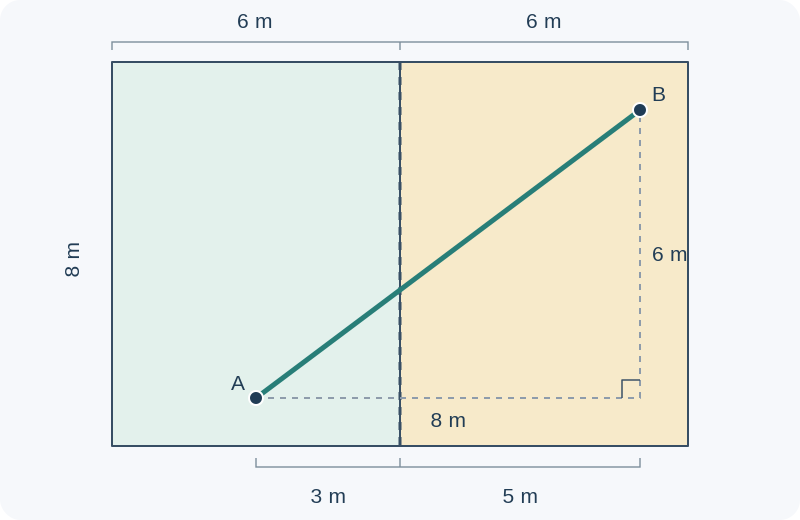
Two perpendicular rectangular walls are each 8 m high and 6 m wide. A is on the first, 3 m from the shared edge and 1 m above the floor. B is on the second, 5 m from the edge and 7 m above the floor. Find the shortest route from A to B confined to the two walls.
Show the reasoning · 25
| I can already solve | I can find the shortest distance between two points in a plane using Pythagoras’ theorem. |
|---|---|
| Transform the problem | Unfold the walls along their shared edge like a book, without distorting them. In the plane, the horizontal separation is 3 + 5 = 8 m and the vertical separation is 7 − 1 = 6 m. |
| Solve the known case | The straight segment measures √(8² + 6²) = 10 m. |
| Return to the question and check | Fold the walls back: the segment becomes the required route. It crosses the shared edge at height 1 + 6 × (3/8) = 3.25 m, between 0 and 8, and stays inside the walls. It is not the unrestricted diagonal through space: the surface constraint matters. |
26. Packs of 6 and 10
A shop sells items only in packs of 6 or 10. Can you buy exactly 28 items? How many packs of each size do you need? Can you also buy exactly 23 or 8 items?
Show the reasoning · 26
| I can already solve | I can find integer solutions of a linear equation, then check their constraints. |
|---|---|
| Transform the problem | Let x and y be the numbers of packs. Write 6x + 10y = N with nonnegative integer x and y. The greatest common divisor of 6 and 10 is 2, so integer solutions require even N. |
| Solve the known case | For N = 28 divide by 2: 3x + 5y = 14. Set y = 1 to get x = 3. For N = 23 there is no integer solution because every possible total is even. |
| Return to the question and check | 28 comes from three packs of 6 and one of 10. But evenness is not enough for 8. A pack of 10 already exceeds 8, so y = 0; 6x = 8 has no integer solution. The divisor test decides whether unrestricted integer solutions exist, not whether valid pack quantities exist. |
27. From a maze to a graph
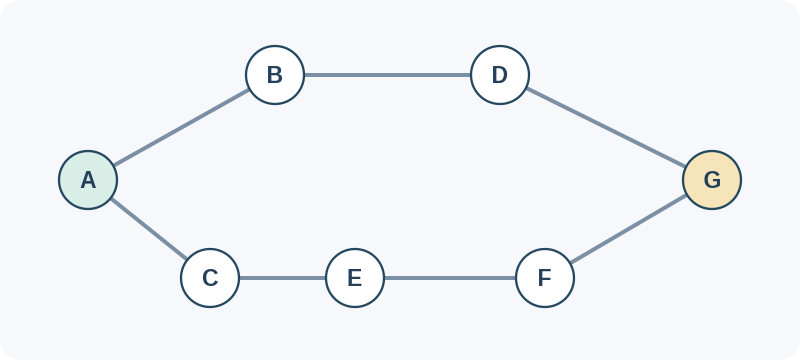
Seven rooms are labelled A, B, C, D, E, F and G. Two-way passages connect A–B, A–C, B–D, D–G, C–E, E–F and F–G. Each passage counts as one move. Find the fewest moves from A to G.
Show the reasoning · 27
| I can already solve | I can explore a graph in levels from a starting node. |
|---|---|
| Transform the problem | Ignore the shapes and lengths of corridors. For this question, only the rooms and their connections matter. Each room becomes a node and each passage an edge. |
| Solve the known case | From A, level 1 contains B and C. Level 2 contains D and E. Level 3 contains G and F. G first appears at the third level. |
| Return to the question and check | A → B → D → G takes 3 moves and is shortest. A → C → E → F → G takes 4. To minimize different corridor lengths or travel times instead, this reduction to equal-cost moves would not suffice. |
Three exercises: find the transformation first
Before calculating, state which problem you can already solve and how to reach it.
1. Another original price
An item costs 90 euros after a 25% discount. What did it cost before the discount?
Show the reasoning · 1
75% of the original price is 90, so divide by 75/100. This gives 90 ÷ 0.75 = 120 euros. Check: 25% of 120 is 30, and 120 − 30 = 90.
2. An interval crossing midnight
Leave at 23:50 and arrive at 00:20 the following day. How much time passes?
Show the reasoning · 2
Use a common origin: departure is 23 × 60 + 50 = 1430 minutes and arrival 24 × 60 + 20 = 1460. The difference is 30 minutes.
3. Another auxiliary variable
Solve x⁴ − 13x² + 36 = 0 over the reals.
Show the reasoning · 3
Set t = x² ≥ 0. Solve t² − 13t + 36 = (t − 4)(t − 9) = 0, so t = 4 or 9. Returning to x gives −2, 2, −3, 3, all of which satisfy the original equation.
The question to take with you
Faced with an unfamiliar problem, try saying: “I cannot do this yet, but I can do that. What must change to connect the two?” The important skill is not remembering many isolated tricks. It is recognizing the same structure in different forms without losing the problem’s constraints.
Keep exploring
- Arithmetic methods for word problems without equations
- Computational thinking: from intuition to algorithms
I know… therefore: fifteen sums with guided proofs. An application of the method: deriving new sum formulas from previously proved results.