Many word problems do not require starting with a letter or an equation. We can draw, work backwards, correct an initial assumption or look for what stays unchanged. The aim is not to guess an operation, but to understand why it works.
This course brings together 10 arithmetic reasoning methods with two examples each, adds completing a whole, systematic listing and clever grouping, and provides 16 new practice problems: 36 problems altogether. Even the guided examples have their solutions hidden initially.
It is designed mainly for primary school. Fractions, ratios, worker-days and profit or loss are challenges for the later years, perhaps with adult support. There is no need to tackle everything in one sitting.
Before calculating: how to choose a method
Read the question, describe the situation in your own words and separate what is known from what you need to find. Draw the objects or a bar model; always include units. Then ask how the quantities are related.
The 13 headings are not separate compartments: bar models and proportional parts are related; constant differences and conserved totals are examples of invariants; false position and exchanges often describe the same reasoning. One problem can have more than one correct approach.
| Method | When it can help |
|---|---|
| Working backwards | You know the final result of a sequence of actions. |
| False position | You know both the total number of objects and a total value or number of legs. |
| Bar models | One quantity is twice, three times or several parts of another. |
| Constant difference | Two quantities increase or decrease by the same amount. |
| Sum and difference | You know the total of two quantities and how much one exceeds the other. |
| The unitary method | You know the value of several equal units and need a different number of units. |
| Proportional parts | You must share a total in given ratios. |
| Exchanges | You can replace one object with another without changing the number of objects. |
| Invariants | Items move between groups, but none enter or leave the whole system. |
| Successive differences | The same group appears in two scenarios with different individual contributions. |
| Completing the whole | You know a total and one or more parts, and need what is missing. |
| Systematic listing | You need every possible combination, not just one. |
| Clever grouping | You need to add many numbers and can recognise pairs with the same total. |
The 36 problems: observe, try, then reveal the solution
Every “Show solution and check” panel starts closed. Try in your notebook first; then tap or click its heading to open it, and press again to close it. On a keyboard use Tab, then Enter or Space. The last problem for each method is one to try independently.
1. Working backwards
Start at the end and undo the operations in reverse order: the last action is the first to undo. Undo addition by subtraction and multiplication by division.
Watch the order: changing operation signs is not enough. If you double and then add, first subtract and then halve.
The mystery number
Example. A number is doubled, then increased by 14, giving 50. What was the original number?
Show solution and check
- Undo the last addition:
50 − 14 = 36. - Undo the doubling:
36 : 2 = 18. The original number was 18.
Check. Repeat the actions forwards:
18 × 2 + 14 = 50.- Undo the last addition:
Lucia’s sweets
Example. Lucia gives away half her sweets and then another 5. She has 9 left. How many did she start with?
Show solution and check
- Before the last gift she had
9 + 5 = 14sweets. - The remaining 14 were half the original amount:
14 × 2 = 28. She started with 28 sweets.
Check. Half are given away, then another 5:
28 : 2 − 5 = 9.- Before the last gift she had
The number machine
Your turn. A machine triples a number and adds 9. Its display shows 45. Which number went in?
Show solution and check
- Remove the last addition:
45 − 9 = 36. - Before tripling:
36 : 3 = 12. The input was 12.
Check.
12 × 3 + 9 = 45: the display returns to 45.- Remove the last addition:
2. False position
Imagine a simple situation, even though it is not the real one. Calculate the shortfall and how much the total changes when just one item is replaced: the gap tells you how many corrections are needed.
These are not random guesses: every replacement must produce the same change. If the gap is not divisible by that change, those whole-number data have no solution.
Hens and rabbits
Example. There are 12 animals, all hens or rabbits, with 34 legs altogether. How many rabbits and how many hens are there?
Show solution and check
- Imagine they are all hens:
12 × 2 = 24. We are short of34 − 24 = 10legs. - Each rabbit replacing a hen adds
4 − 2 = 2legs. We need10 : 2 = 5rabbits. - There are
12 − 5 = 7hens.
Check. There are 12 heads and
5 × 4 + 7 × 2 = 34legs.- Imagine they are all hens:
Two ticket prices
Example. Twenty tickets costing either €4 or €7 are sold for a total of €104. How many tickets of each price were sold?
Show solution and check
- If all cost €4:
20 × 4 = 80. The shortfall is104 − 80 = 24euros. - Each replacement adds
7 − 4 = 3euros:24 : 3 = 8tickets cost €7. - That leaves
20 − 8 = 12tickets costing €4.
Check.
8 × 7 + 12 × 4 = 104; the ticket count stays at 20.- If all cost €4:
Pencils in the shop
Your turn. Fifteen pencils are sold, some costing €2 and others €5. The takings are €48. How many of each type were sold?
Show solution and check
- With only €2 pencils:
15 × 2 = 30. The gap is48 − 30 = 18. - Each replacement adds
5 − 2 = 3euros, so18 : 3 = 6pencils cost €5. - The number of €2 pencils is
15 − 6 = 9.
Check.
6 × 5 + 9 × 2 = 48; there are 15 pencils altogether.- With only €2 pencils:
3. Bar models
Draw one bar for the smaller quantity and several equal bars for the other. Keep any additional piece separate. Find the value of one part and rebuild the quantities.
Equal parts must represent the same quantity. An extra piece, such as 10 cm, does not automatically become a part equal to the others.
Two brothers
Example. Two brothers have €80 together. The elder has three times as much as the younger. How much does each have?
Show solution and check
- Draw one part for the younger and three for the elder:
1 + 3 = 4parts. - One part is worth
80 : 4 = 20euros. The younger has €20; the elder has20 × 3 = 60euros.
Check. The total is
20 + 60 = 80and the ratio is60 : 20 = 3.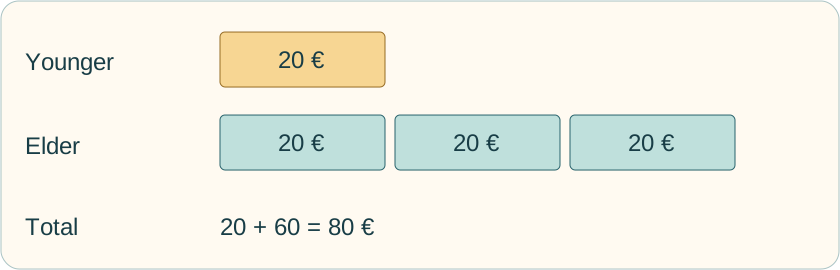
Four equal parts: one for the younger and three for the elder. The completed drawing stays inside the solution. - Draw one part for the younger and three for the elder:
Two ribbons
Example. Two ribbons have a combined length of 70 cm. The second is twice as long as the first, plus 10 cm. How long is each?
Show solution and check
- Separate the extra piece:
70 − 10 = 60cm. - There are
1 + 2 = 3equal parts left. Each part measures60 : 3 = 20cm. - The first ribbon is 20 cm; the second is
20 × 2 + 10 = 50cm.
Check.
20 + 50 = 70; the second is 10 cm longer than twice the first.- Separate the extra piece:
The two boxes
Your turn. Two boxes contain 54 counters altogether. The second contains twice as many as the first, plus 6. How many counters are in each?
Show solution and check
- Mentally remove the extra 6:
54 − 6 = 48. - There are
1 + 2 = 3parts, each worth48 : 3 = 16counters. - First box: 16; second box:
16 × 2 + 6 = 38counters.
Check.
16 + 38 = 54; the twice-as-many-plus-6 condition is met.- Mentally remove the extra 6:
4. Constant difference
Adding the same number to two quantities leaves their difference unchanged. Ages both increase by one each year: the gap stays fixed even though their ratio changes.
A difference is not constant in every situation: transferring money from one person to another decreases one amount and increases the other. Here both must change in the same way.
Father and son
Example. A father is 42 and his son is 12. In how many years will the father be twice his son’s age?
Show solution and check
- The difference is
42 − 12 = 30years and stays unchanged. - When the father has two parts and the son one, the difference will be exactly one part: the son will be 30.
- The wait is
30 − 12 = 18years.
Check.
42 + 18 = 60and12 + 18 = 30; therefore60 : 30 = 2.- The difference is
Two sisters
Example. Anna has €25 more than Bea. They both receive €10. What will the difference between their savings be?
Show solution and check
- Both add the same amount: neither gains ground on the other.
- The difference remains €25. We can represent the change in the gap as
25 + 10 − 10 = 25.
Check. For a check, choose €40 and €15. After the gift they become €50 and €25: the difference is still €25.
When will it be three times?
Your turn. A father is 36 and his daughter is 8. In how many years will the father be three times her age?
Show solution and check
- The gap is
36 − 8 = 28years. - Three parts minus one makes
3 − 1 = 2parts, so each is worth28 : 2 = 14years. The daughter must reach 14. - The wait is
14 − 8 = 6years.
Check. The father will be
36 + 6 = 42years old;42 : 14 = 3.- The gap is
5. Sum and difference
Mentally remove the extra piece from the total. What remains consists of two equal quantities: divide by two to find the smaller, then put the extra piece back to find the larger.
Subtract the extra piece only once from the total. For whole objects, the remainder must split into two equal whole-number groups.
The stickers
Example. Two friends have 86 stickers altogether. One has 24 more than the other. How many does each have?
Show solution and check
- Remove the excess:
86 − 24 = 62stickers. - Two equal groups:
62 : 2 = 31. This is the smaller amount. - The larger amount is
31 + 24 = 55stickers.
Check. Sum:
31 + 55 = 86. Difference:55 − 31 = 24.- Remove the excess:
The two paths
Example. Two paths have a combined length of 18 km; the first is 4 km longer. How long is each path?
Show solution and check
- Remove the extra 4 km:
18 − 4 = 14km. - The shorter path is
14 : 2 = 7km long. - The first, longer path is
7 + 4 = 11km long.
Check.
7 + 11 = 18and11 − 7 = 4.- Remove the extra 4 km:
Books on shelves
Your turn. Two shelves hold 48 books altogether. The upper shelf has 10 more books than the lower. How many books are on each shelf?
Show solution and check
- Remove the extra 10:
48 − 10 = 38. - The lower shelf has
38 : 2 = 19books. - The upper shelf has
19 + 10 = 29books.
Check.
19 + 29 = 48; also29 − 19 = 10.- Remove the extra 10:
6. The unitary method
Go from many to one, then from one to the required quantity. Price per notebook, litres per bottle or work per person makes clear what remains constant.
Ask what stays constant. More notebooks cost more; more workers may need less time. For work we assume equal rates, no interference and perfectly divisible tasks.
The notebooks
Example. Seven identical notebooks cost €21. How much do 11 notebooks of the same kind cost, with no discount?
Show solution and check
- Price of one:
21 : 7 = 3euros. - Price of 11:
3 × 11 = 33euros.
Check. The unit price remains
33 : 11 = 3euros.- Price of one:
The workers: a challenge
Example. Five workers complete a job in 12 days. How long do 3 workers take, at the same rate, without interference and with perfectly divisible work?
Show solution and check
- The total work requires
5 × 12 = 60worker-days: one worker-day is the work of one person for one day. - One worker would take 60 days; three workers share that work:
60 : 3 = 20days.
Check.
3 × 20 = 60worker-days: the same job. Fewer workers need more days, not fewer.- The total work requires
Ribbon by the metre
Your turn. If 6 metres of ribbon cost €18, how much do 9 metres of the same ribbon cost at the same price per metre?
Show solution and check
- One metre costs
18 : 6 = 3euros. - Nine metres cost
3 × 9 = 27euros.
Check. The price per metre is
27 : 9 = 3euros.- One metre costs
7. Proportional parts
Translate each ratio into parts of the same size. Count all the parts, find the value of one, then give each recipient the right number of parts.
“Three times the second” does not mean “three times the first”. If the second has two parts, three times the second is six parts.
Three brothers
Example. Three brothers share €270. The second receives twice as much as the first and the third three times as much as the second. How much does each receive?
Show solution and check
- Give the first 1 part, the second 2 and the third
2 × 3 = 6parts. - There are
1 + 2 + 6 = 9parts in total; each is worth270 : 9 = 30euros. - The shares are €30,
30 × 2 = 60euros and30 × 6 = 180euros.
Check.
30 + 60 + 180 = 270; the third really has three times the second’s share:180 : 60 = 3.- Give the first 1 part, the second 2 and the third
Books for two schools
Example. Two schools receive 120 books to share in the ratio 2 to 3. How many books does the first school receive, and how many the second?
Show solution and check
- There are
2 + 3 = 5parts. - One part is
120 : 5 = 24books. - First school:
24 × 2 = 48books; second school:24 × 3 = 72books.
Check.
48 + 72 = 120; the shares are two and three groups of 24 books.- There are
Two bags of sweets
Your turn. Share 96 sweets between two bags in the ratio 3 to 5. How many go in the first and how many in the second?
Show solution and check
- There are
3 + 5 = 8parts; one part is96 : 8 = 12sweets. - First bag:
12 × 3 = 36; second bag:12 × 5 = 60.
Check.
36 + 60 = 96; there are three and five groups of 12.- There are
8. Exchanges
Keep the object count fixed and imagine one-for-one exchanges. Replacing a €1 coin with a €2 coin increases the value by €1, not €2.
This belongs to the same family as false position: the emphasis here is on each individual exchange. Remember also to count the objects you have not replaced.
The coins
Example. A money box holds 18 coins, each worth €1 or €2, with a total value of €29. How many coins of each kind are there?
Show solution and check
- Start with only €1 coins:
18 × 1 = 18. We need29 − 18 = 11more euros. - Each exchange increases the value by
2 − 1 = 1euros:11 : 1 = 11exchanges, hence 11 €2 coins. - The number of €1 coins is
18 − 11 = 7.
Check.
11 × 2 + 7 × 1 = 29; there are still 18 coins.- Start with only €1 coins:
The tables
Example. A hall has 12 tables, some seating 4 and others seating 6, with 58 seats altogether. How many of each kind of table are there?
Show solution and check
- Imagine only four-seat tables:
12 × 4 = 48seats. We are short of58 − 48 = 10seats. - Each exchange adds
6 − 4 = 2seats. We need10 : 2 = 5six-seat tables. - There are
12 − 5 = 7four-seat tables.
Check.
5 × 6 + 7 × 4 = 58; there are 12 tables.- Imagine only four-seat tables:
Single and double packs of pens
Your turn. Ten packs are sold: single packs cost €3 and double packs €5. The takings are €42. How many packs of each kind were sold?
Show solution and check
- With only single packs:
10 × 3 = 30euros. The gap is42 − 30 = 12euros. - Each exchange increases takings by
5 − 3 = 2euros:12 : 2 = 6double packs. - That leaves
10 − 6 = 4single packs.
Check.
6 × 5 + 4 × 3 = 42; we count packs, not individual pens.- With only single packs:
9. Invariants
Look for a quantity that remains unchanged. Moving balls from one box to another changes the distribution but not the total; reconstruct the original situation by undoing the transfer.
Define the boundary: if someone gives objects to an outsider, the total in the original two groups may decrease. Always explain why something “does not change”.
Balls in boxes
Example. Two boxes hold 100 balls altogether. After 15 are moved from the first to the second, each box holds 50. How many were in each box originally?
Show solution and check
- The total remains 100. Undo the transfer by putting 15 back in the first:
50 + 15 = 65. - Remove those same 15 from the second:
50 − 15 = 35. The original amounts were 65 and 35.
Check.
65 + 35 = 100; repeating the transfer gives65 − 15 = 50and35 + 15 = 50.- The total remains 100. Undo the transfer by putting 15 back in the first:
The hidden sum
Example. Marco and Sara have 74 stickers between them. Marco gives Sara 9. How many stickers do they have together afterwards?
Show solution and check
- The 9 stickers do not disappear: they leave Marco’s group but enter Sara’s.
- The effect on the total is
74 − 9 + 9 = 74. They still have 74 stickers; we need not know how many each originally had.
Check. No sticker enters or leaves the group consisting of Marco and Sara.
Two containers
Your turn. Two containers hold 60 litres of water altogether. After 8 litres are poured from the first into the second, both contain the same amount. How much was in each originally?
Show solution and check
- At the end each contains
60 : 2 = 30litres. - Work backwards: the first held
30 + 8 = 38litres and the second30 − 8 = 22litres.
Check.
38 + 22 = 60; after pouring,38 − 8 = 30and22 + 8 = 30. No water was lost.- At the end each contains
10. Successive differences
Compare two situations involving the same group: how much does the total change? How much does the contribution of one person or object change? Divide the total change by the individual change.
Going from a shortfall to a surplus crosses zero, so add the two distances. These are challenge problems; drawing a line with zero in the middle can help.
The shopkeeper: a challenge
Example. A shopkeeper sells all the items at the same price. Selling each at €7 would mean a €30 loss against the total cost; at €9 there would be a €50 profit. How many items are there?
Show solution and check
- Moving from loss to profit increases takings by
30 + 50 = 80euros. - Each item produces
9 − 7 = 2more euros. The number of items is80 : 2 = 40. - If we also reconstruct the total cost, it is €310.
Check. From the €7 scenario:
40 × 7 + 30 = 310. From the €9 scenario:40 × 9 − 50 = 310. The cost is the same.- Moving from loss to profit increases takings by
The outing
Example. If each participant pays €12 towards an outing, €24 is missing; if each pays €15, €18 is left over. The cost stays the same. How many participants are there?
Show solution and check
- Moving from a shortfall to a surplus amounts to
24 + 18 = 42euros. - Each participant pays
15 − 12 = 3more euros. There are42 : 3 = 14participants.
Check. The cost is
14 × 12 + 24 = 192euros or14 × 15 − 18 = 192euros: the two agree.- Moving from a shortfall to a surplus amounts to
The class gift
Your turn. If each child pays €4, the collection is €7 short of the price of a gift; with €5 each, €6 is left over. How many children take part?
Show solution and check
- The difference between the collections is
7 + 6 = 13euros. - Each child adds
5 − 4 = 1euros, so13 : 1 = 13children take part.
Check. The gift costs
13 × 4 + 7 = 59euros, and also13 × 5 − 6 = 59euros.- The difference between the collections is
11. Completing the whole
Picture the total as a full box or a complete bar. First collect the known parts, then subtract them from the total. If you know a fraction, first find how many objects it represents.
Check that the parts do not overlap: you must not subtract the same objects twice. Fractional parts of the whole must be equal.
Coloured squares
Example. A sheet has 28 equal squares. You colour three quarters of them. How many remain white?
Show solution and check
- Split the whole into four parts:
28 : 4 = 7squares per part. - The three coloured parts contain
7 × 3 = 21squares. - The complement is
28 − 21 = 7white squares. Alternatively, notice that one quarter is missing.
Check.
21 + 7 = 28: coloured and white squares reconstruct the whole sheet.- Split the whole into four parts:
Completing the album
Your turn. An album has 100 spaces. On Monday you stick in 37 pictures and on Tuesday another 28, all different and in previously empty spaces. How many spaces remain empty?
Show solution and check
- Occupied spaces:
37 + 28 = 65. - Spaces still to complete:
100 − 65 = 35.
Check.
65 + 35 = 100; there are no duplicates or spaces counted twice.- Occupied spaces:
12. Systematic listing
Choose an order and follow it: fix a first choice and vary the second, then move to the next first choice. A list or table prevents missed cases and double counting.
Decide first whether order matters and whether zero is allowed. Strawberry-vanilla is the same two-flavour choice as vanilla-strawberry when scoop order does not matter.
Two ice-cream flavours
Example. Vanilla, chocolate and strawberry are available. You want two different flavours and their order does not matter. How many pairs can you choose?
Show solution and check
- Fix vanilla: vanilla-chocolate and vanilla-strawberry.
- Without vanilla, chocolate-strawberry remains. There are 3 pairs; do not add strawberry-vanilla because it is already included.
Check. Counting order would give
3 × 2 = 6choices; each pair would occur twice. Hence6 : 2 = 3.Spending exactly €12
Your turn. A pen costs €2 and a notebook €3. In how many ways can you spend exactly €12? You may buy zero pens or zero notebooks; only the numbers of objects count, not purchase order.
Show solution and check
- Try 0, 1, 2, 3, 4 notebooks: more than 4 would exceed €12.
- With 0 notebooks buy
12 : 2 = 6pens; with 2 notebooks buy(12 − 2 × 3) : 2 = 3pens; with12 : 3 = 4notebooks buy zero pens. - With 1 or 3 notebooks, €9 or €3 remains, which cannot buy a whole number of €2 pens. There are 3 ways.
Check. The pairs (pens, notebooks) are (6, 0), (3, 2), (0, 4). Each costs €12; the table exhausts the cases.
Every possibility, in order of notebook count Notebooks Euros left for pens Pens that can be bought 0 12 € 6 1 9 € Not whole: reject 2 6 € 3 3 3 € Not whole: reject 4 0 € 0
13. Clever grouping
Regroup the addends without changing them: look for pairs making 10, 20, 100 or another convenient sum. Count the groups and multiply when they are equal.
Use each number exactly once. This freedom applies to addition; you cannot freely reorder subtractions or divisions.
Adding from 1 to 20
Example. Add all the whole numbers from 1 to 20 inclusive. How can you do it without a long chain of additions?
Show solution and check
- Pair first and last:
1 + 20 = 21. Then second and next-to-last:2 + 19 = 21. Each pair has the same total. - There are
20 : 2 = 10pairs. The sum is10 × 21 = 210.
Check. The pairs are (1, 20), (2, 19), through to (10, 11): 10 pairs with no number repeated.
- Pair first and last:
The four baskets
Your turn. Four baskets contain 19, 21, 18 and 22 apples. How many apples are there altogether? Look for two convenient pairs.
Show solution and check
- Group
19 + 21 = 40and18 + 22 = 40. - The total is
40 + 40 = 80apples.
Check. We used each quantity 19, 21, 18, 22 exactly once. No apples were added or removed.
- Group
What to take away
Do not immediately hunt for “the right formula”. First look for a structure: something to undo, an equal part, a gap, a conserved total or a list to organise. A drawing and a sentence may explain more than a page of calculations.
Before opening a solution, write down at least one reasoned attempt. After reading it, close it and try to explain the reasoning without looking. Always check the required total, difference, ratio and units: a plausible number alone is not enough.
Explore bar models and equal parts further: 25 more illustrated problems