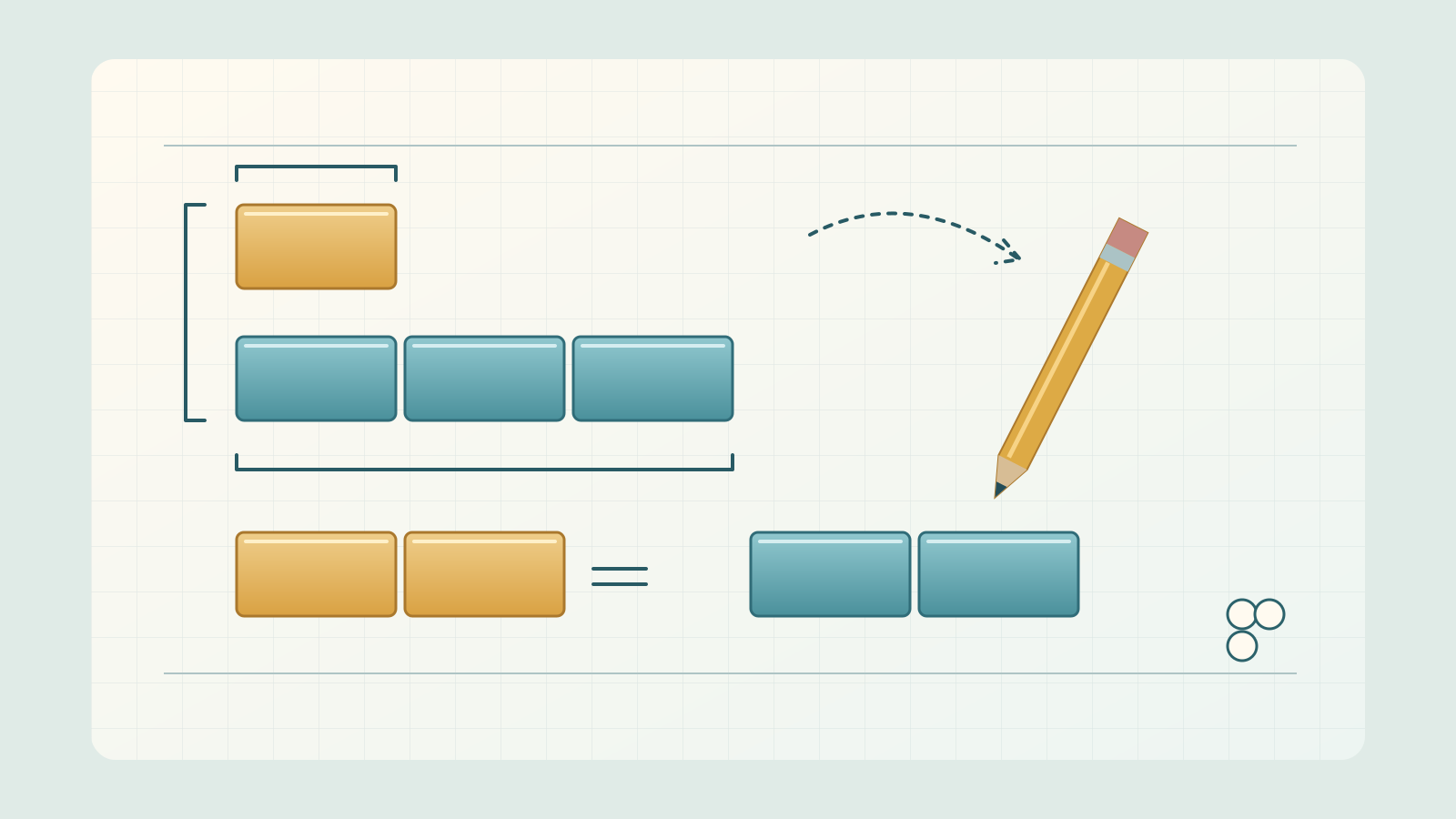
A problem becomes easier when you can see it. The equal-parts method, also called the bar-model method, represents quantities as groups of equal rectangles. First find the value of one rectangle, then rebuild the required quantities: often no equations or trial and error are needed.
Source document: The equal-parts method, from primary to lower secondary school (PDF in Italian). This course preserves the explanation and all 12 problems from the supplied document, adds 13 new problems and develops every solution. Problems are reordered by difficulty; fractional ages and amounts that cannot be paid exactly in cents receive an explicit explanation.
1. The idea: draw a part, not every object
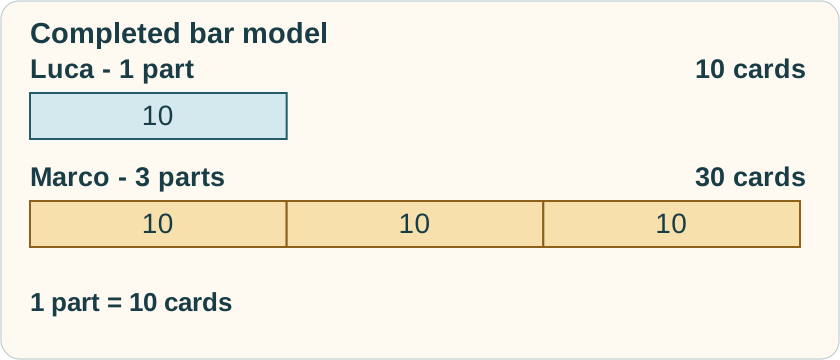
Marco and Luca have 40 cards altogether. Marco has three times as many as Luca. How many does each have? If Luca occupies 1 part, Marco occupies 3 parts equal to Luca’s part. This does not mean Luca has 1 card and Marco 3: we do not yet know the value of a part.
The total number of parts is 1 + 3 = 4. One part therefore contains 40 : 4 = 10 cards. Luca has 1 × 10 = 10 cards and Marco 3 × 10 = 30. Check: 10 + 30 = 40 and 30 = 3 × 10.
The key question is always: which given quantity corresponds to how many parts? Divide only after answering this.
2. The three basic cases
You know the sum: add the parts
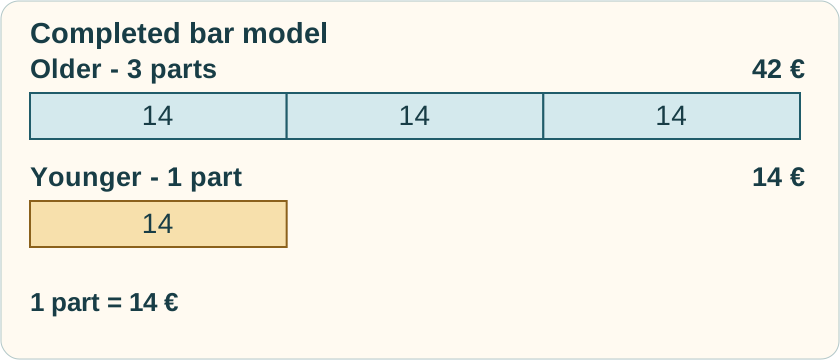
Two brothers have €56 altogether. The older has three times as much money as the younger. Their parts are 3 and 1: 56 : (3 + 1) = 14 euros per part. The older has 3 × 14 = 42 euros and the younger 14. The total, not the difference, represents four parts.
You know the difference: subtract the parts
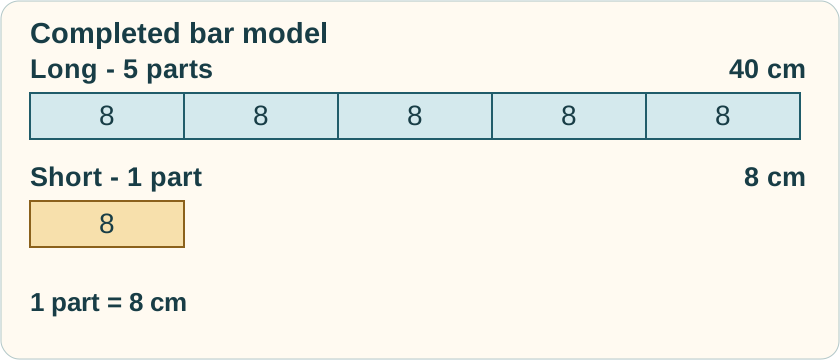
One segment is five times as long as another. Their difference is 32 cm. The parts are 5 and 1; the extra parts are 5 − 1 = 4. Thus 32 : (5 − 1) = 8 cm per part. The segments measure 5 × 8 = 40 cm and 8 cm. Check: 40 − 8 = 32.
You know one quantity: use its own parts
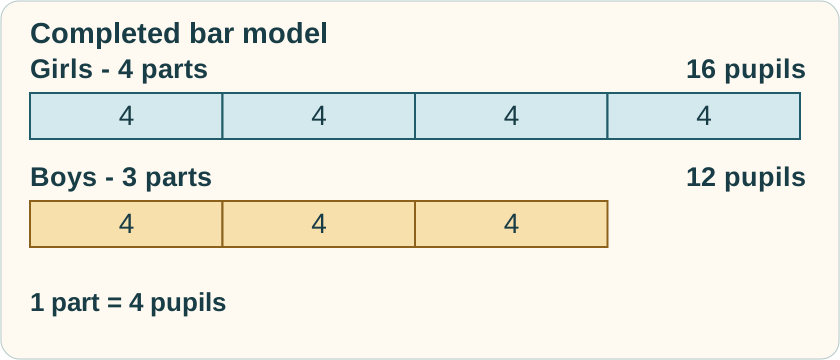
In a class, the number of girls is 4/3 of the number of boys, and there are 12 boys. Girls occupy 4 parts and boys 3. One part is 12 : 3 = 4 pupils; there are 4 × 4 = 16 girls. Do not divide by 7: 12 is not the total class size.
3. At secondary school: a fraction is a ratio of parts
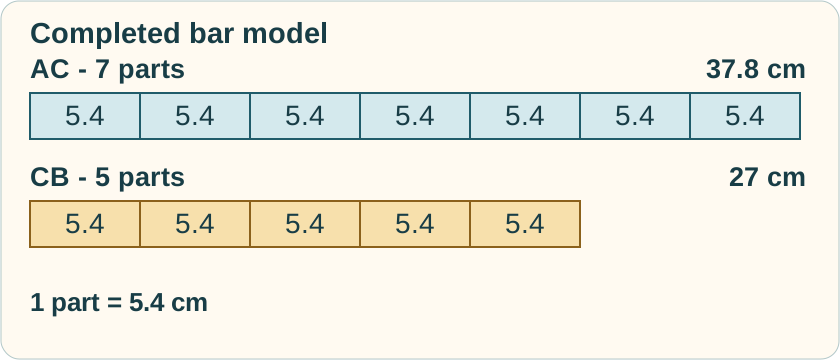
Writing AC = (7/5) CB does not mean AC measures 7 cm and CB 5 cm. It means AC contains 7 parts and CB 5 parts of the same size. If AC exceeds CB by 10.8 cm, those two extra parts are exactly 10.8 cm.
(7 − 5) parts = 10.8 cm; therefore 1 part = 10.8 : 2 = 5.4 cm. Rebuild the lengths: AC = 7 × 5.4 = 37.8 cm, CB = 5 × 5.4 = 27 cm. Check: 37.8 − 27 = 10.8 and 37.8 : 27 = 7 : 5.
For quantities A and B in the ratio a : b, this table gives the value of one part:
| Known quantity | Value of one part |
|---|---|
| Sum S | S : (a + b) |
| Difference D, with a > b | D : (a − b) |
| First quantity A | A : a |
| Second quantity B | B : b |
Once you know one part, multiply by a and b. With three quantities, for example 1, 2 and 6 parts, count 1 + 2 + 6 parts in the sum. First make sure all parts really represent the same amount.
4. A five-step procedure
- Read: what is given and what must you find? Underline the units.
- Draw: translate double, triple or a fraction into equal parts.
- Match: is the given number a sum, a difference or one quantity?
- Calculate: find one part, then every required quantity.
- Check: verify both the numerical condition and the stated ratio. Give an answer with the correct units.
Watch the wording: “three times as much” means multiplication by three, whereas “3 more” means a difference of 3 units. For a rectangle, perimeter = 2 × (length + width): before adding the length and width parts, divide the perimeter by 2. With coins of different denominations, counting coins is not the same as adding euros.
The ratio may not hold at the start. When both people age or receive the same gift, their difference stays unchanged. When objects move from one group to another, their total stays unchanged. First identify what does not change, then apply the method to the requested situation.
25 problems with diagrams and expandable solutions
Read the question, examine the diagram and try it in your notebook. Within a model, rectangles representing the same part have the same value. Colours distinguish quantities, not the value of a part. A question mark does not mean zero. Click Show the solution and completed diagram after trying; click again to close it. These are models, not drawings to measure with a ruler.
Level 1 - Primary: equal parts and simple information
The sweets
Anna and Pietro have 48 sweets altogether. Anna has twice as many as Pietro. How many does each have?
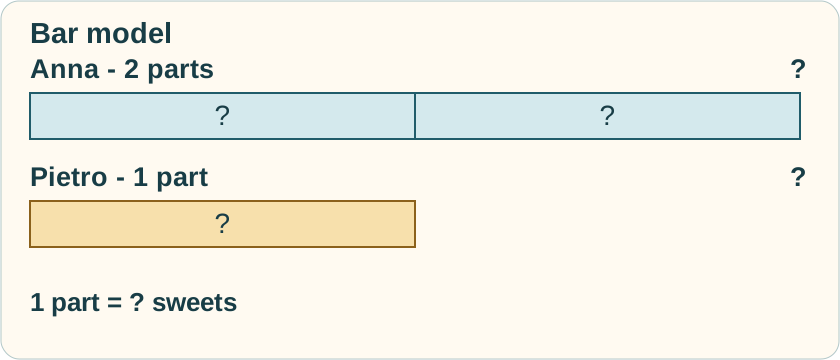
Two parts plus one: the total represents three parts. Show the solution and completed diagram
The parts are 2 for Anna and 1 for Pietro:
2 + 1 = 3. One part is48 : 3 = 16sweets.Anna:
2 × 16 = 32sweets. Pietro:1 × 16 = 16. Answer: Anna 32, Pietro 16.Check:
32 + 16 = 48and32 = 2 × 16.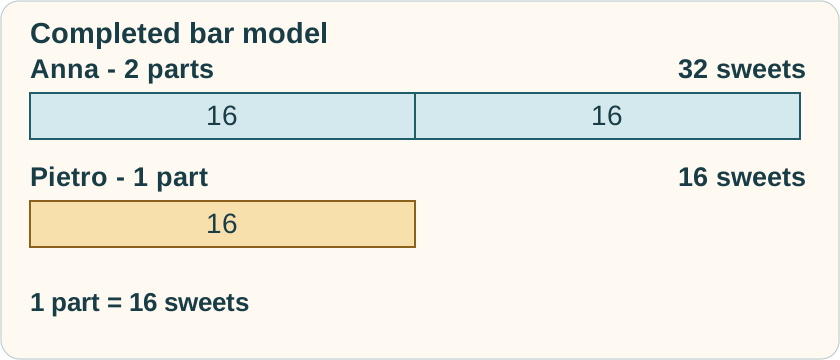
The completed model shows the value of each part and the required quantities. Bags of biscuits
Two bags contain 35 biscuits altogether. The large bag contains four times as many as the small bag. How many are in each?
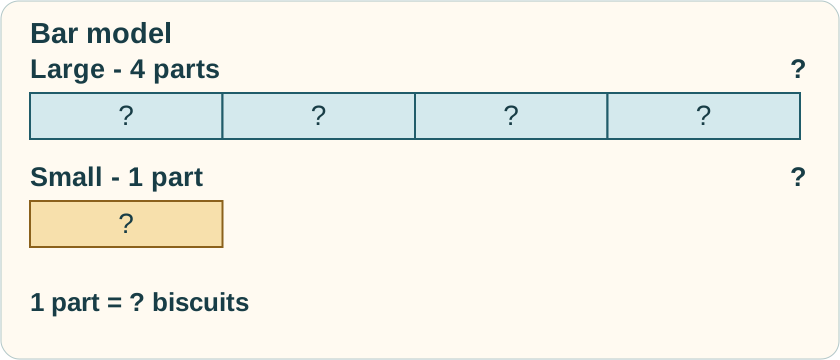
The small bag is the comparison unit. Show the solution and completed diagram
There are
4 + 1 = 5parts. One part is35 : 5 = 7biscuits.The large bag contains
4 × 7 = 28; the small one 7. Answer: 28 and 7 biscuits.Check:
28 + 7 = 35and28 : 7 = 4.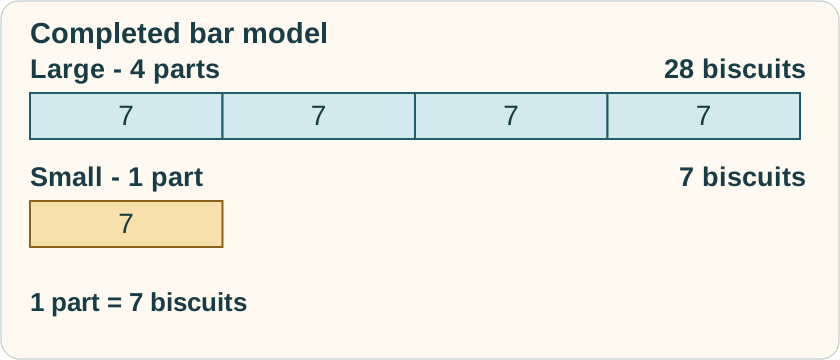
The completed model shows the value of each part and the required quantities. Savings
A boy has €24 more than his sister and three times her savings. How much does each have?
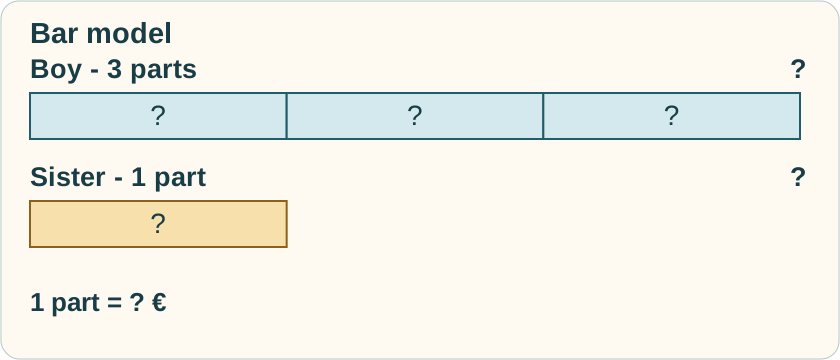
The given amount is the difference, not the total. Show the solution and completed diagram
There are
3 − 1 = 2extra parts. One part is therefore24 : 2 = 12euros.The boy has
3 × 12 = 36euros and his sister 12. Answer: €36 and €12.Check:
36 − 12 = 24and36 = 3 × 12.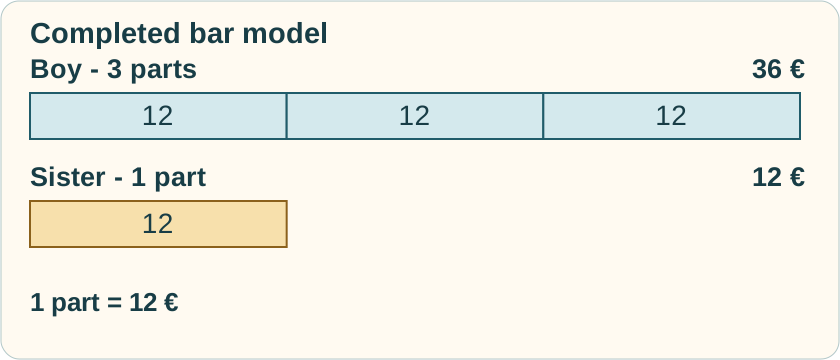
The completed model shows the value of each part and the required quantities. Giulia and Leo’s books
Giulia has 12 books, three times as many as Leo. How many books does Leo have?
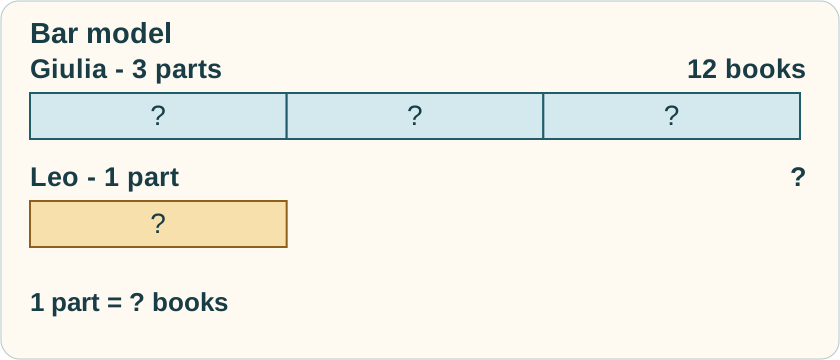
The known quantity belongs to Giulia and represents three parts. Show the solution and completed diagram
The 12 books represent Giulia’s 3 parts, not both children’s total. One part is
12 : 3 = 4books.Leo has one part: 4 books. Check:
3 × 4 = 12.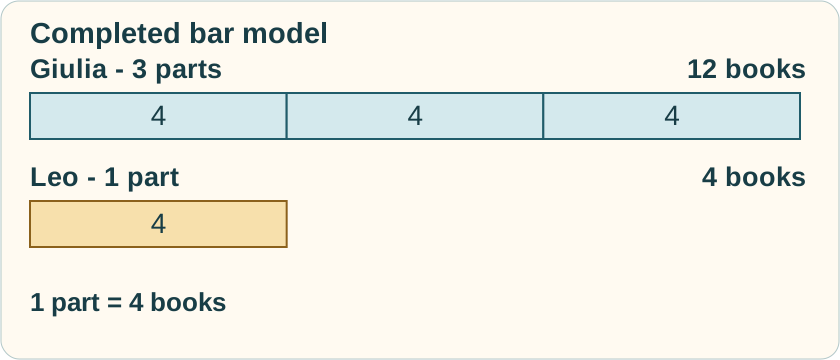
The completed model shows the value of each part and the required quantities. The trees
A garden has 72 trees, all pines or olive trees. There are five times as many pines as olive trees. How many of each?
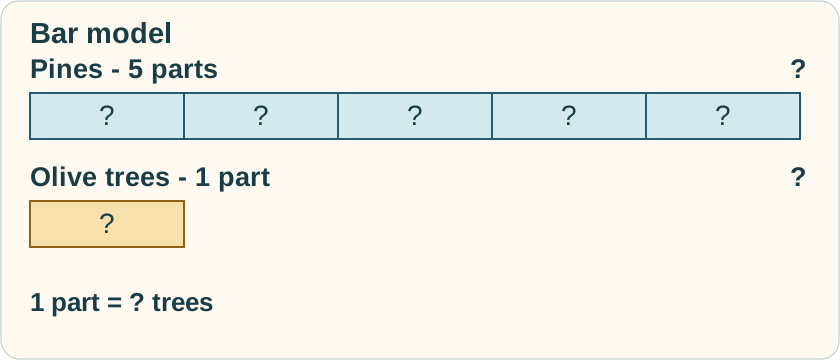
Six equal parts make up the garden. Show the solution and completed diagram
The total number of parts is
5 + 1 = 6. One part is72 : 6 = 12trees.Pines:
5 × 12 = 60. Olive trees: 12. Answer: 60 pines and 12 olive trees.Check:
60 + 12 = 72and60 = 5 × 12.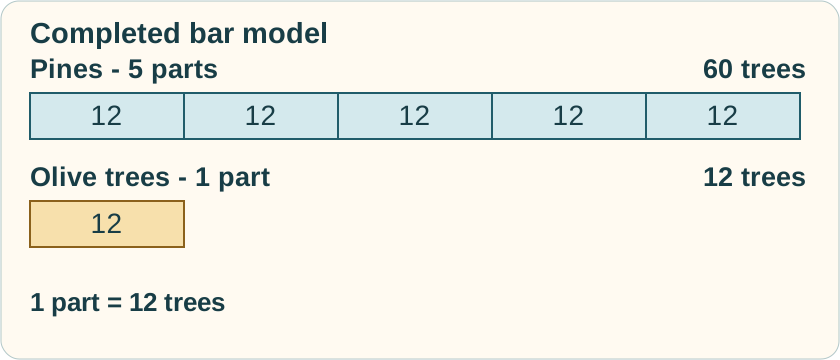
The completed model shows the value of each part and the required quantities. Two ribbons
One ribbon is four times as long as another. The long ribbon exceeds the short one by 18 cm. How long is each?
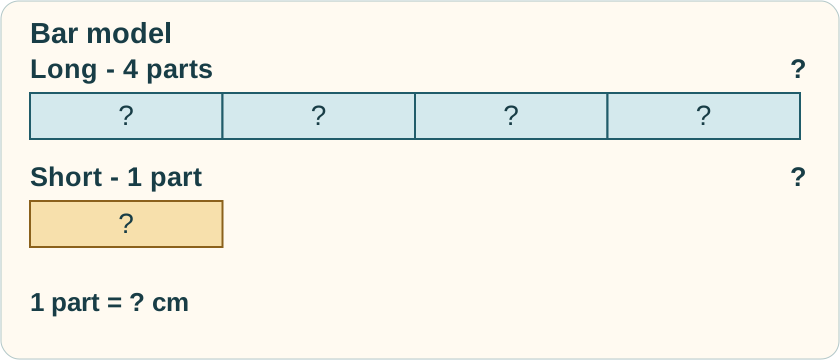
The difference corresponds to three parts. Show the solution and completed diagram
The difference in parts is
4 − 1 = 3. One part measures18 : 3 = 6cm.The long ribbon measures
4 × 6 = 24cm and the short one 6 cm. Answer: 24 cm and 6 cm.Check:
24 − 6 = 18and24 = 4 × 6.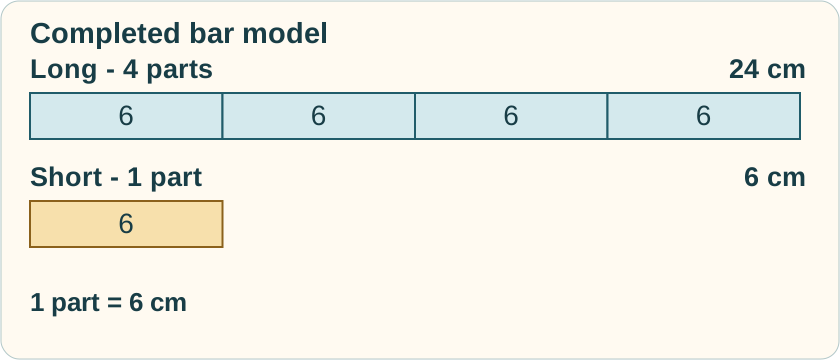
The completed model shows the value of each part and the required quantities. Three boxes of pencils
Three boxes contain 60 pencils altogether. The second contains twice as many as the first, and the third three times as many as the first. How many are in each box?
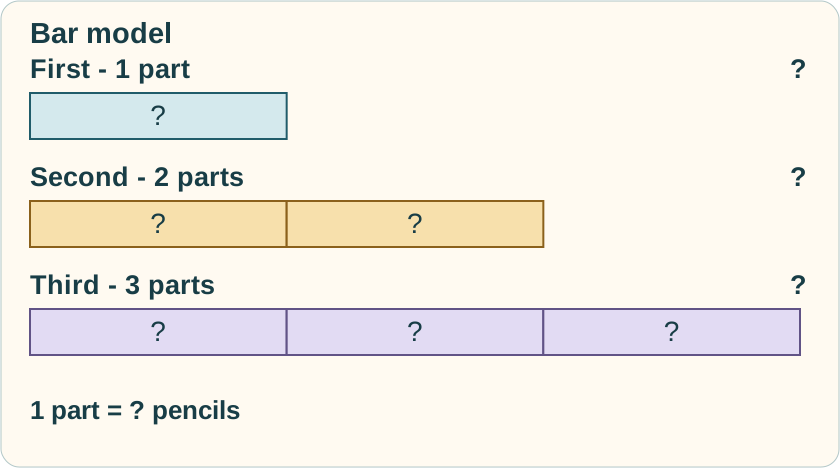
Both comparisons refer to the first box. Show the solution and completed diagram
The parts are 1, 2 and 3:
1 + 2 + 3 = 6. One part is60 : 6 = 10pencils.The boxes contain 10, 20 and 30 pencils. Check:
10 + 20 + 30 = 60; the second has double and the third triple the first.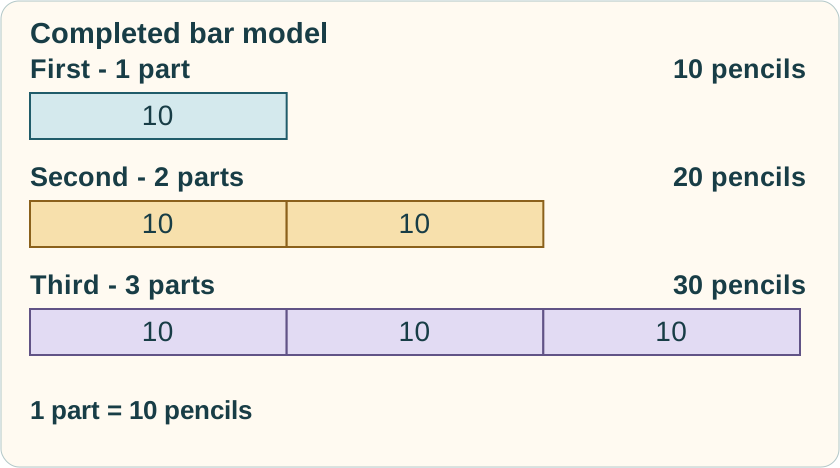
The completed model shows the value of each part and the required quantities. Red marbles
A bag contains 40 marbles, all red or blue. 3/5 of them are red. How many are there of each colour?
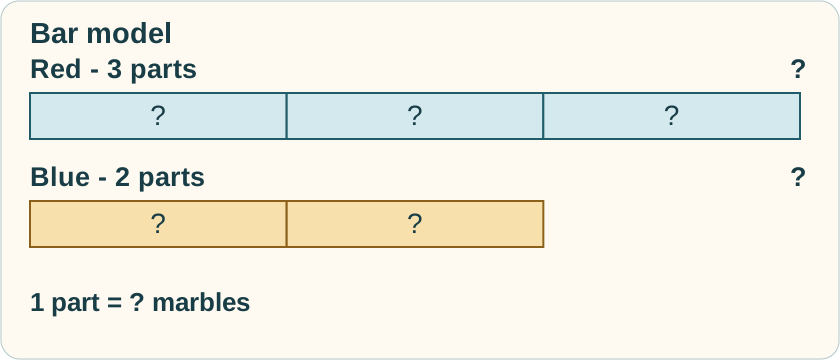
If the whole has five parts, the non-red parts are 5 − 3. Show the solution and completed diagram
The denominator 5 tells us how many parts make up the whole. One part is
40 : 5 = 8marbles.Red:
3 × 8 = 24. Blue:(5 − 3) × 8 = 16. Answer: 24 red and 16 blue.Check:
24 + 16 = 40and24/40 = 3/5.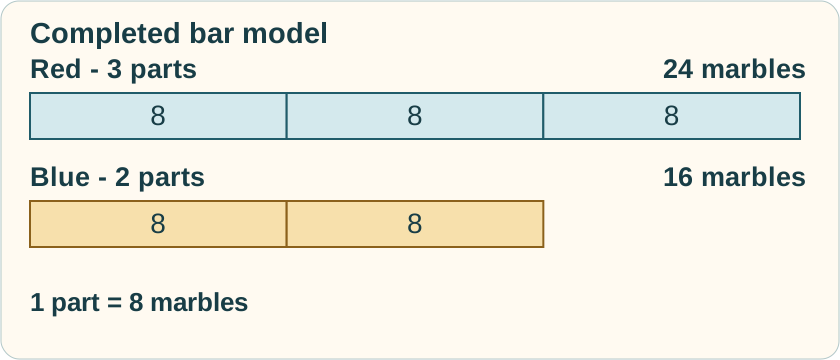
The completed model shows the value of each part and the required quantities. Cards: sum and difference
Sara and Paolo have 54 cards altogether. Sara has 14 more than Paolo. How many does each have?
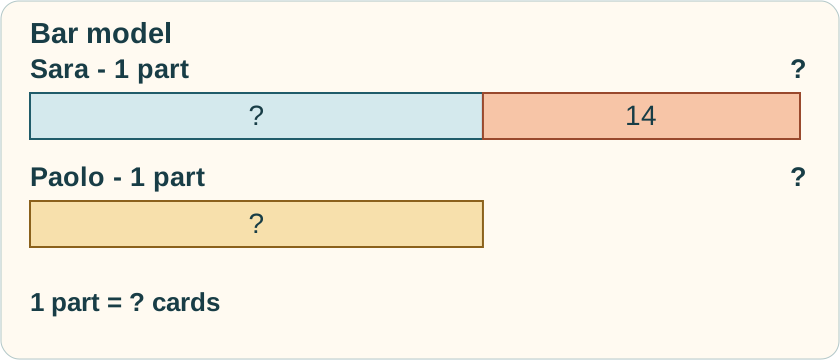
The extra rectangle of 14 is a known amount, not another equal part. Show the solution and completed diagram
Set aside Sara’s 14 extra cards. The remaining
54 − 14 = 40cards are divided into two equal quantities.One part is
40 : 2 = 20. Paolo has 20; Sara has20 + 14 = 34. Answer: Sara 34, Paolo 20.Check:
34 + 20 = 54and34 − 20 = 14.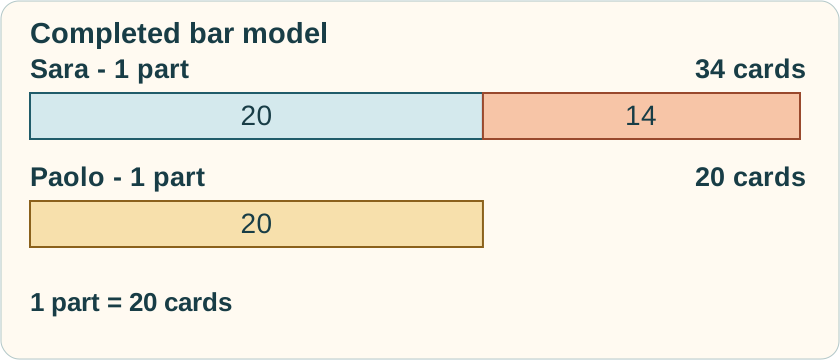
The completed model shows the value of each part and the required quantities. Three trays
Distribute 45 small cakes between three trays in the ratio 2 : 3 : 4. How many cakes go on each tray?
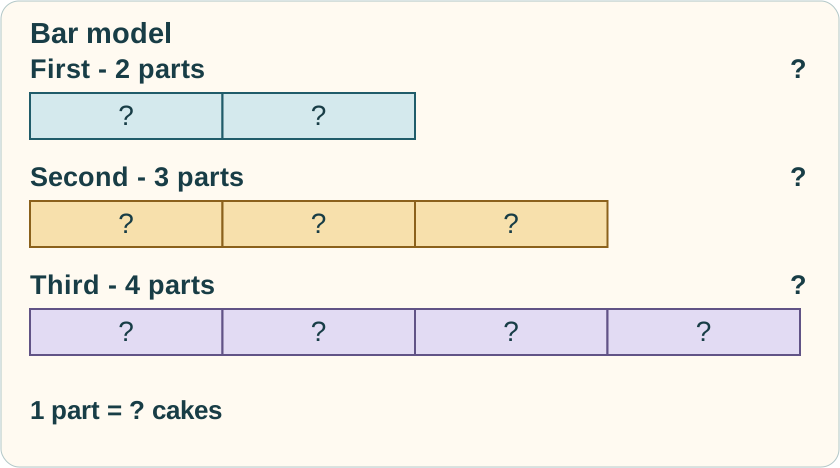
The ratio divides the total into nine equal parts. Show the solution and completed diagram
The total number of parts is
2 + 3 + 4 = 9. One part is45 : 9 = 5cakes.The trays receive
2 × 5 = 10,3 × 5 = 15and4 × 5 = 20cakes. Answer: 10, 15 and 20.Check:
10 + 15 + 20 = 45and10 : 15 : 20 = 2 : 3 : 4.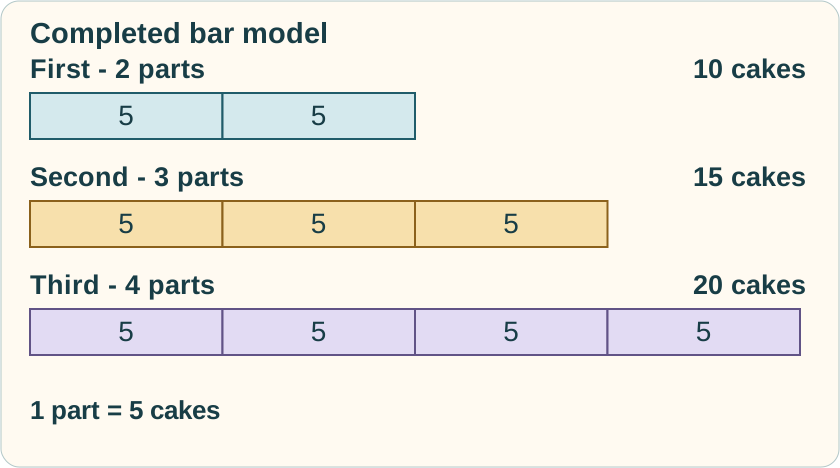
The completed model shows the value of each part and the required quantities.
Level 2 - Lower secondary: fractions, ratios and geometry
Two segments and their sum
Two segments have a combined length of 84 cm. The first is 4/3 of the second. Find their lengths.
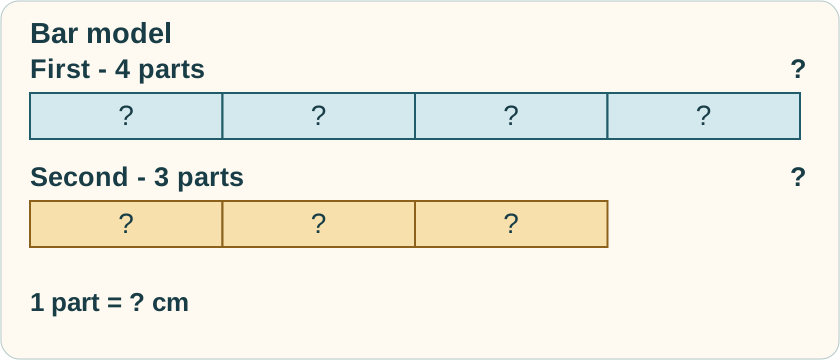
4/3 of the second means four parts against three, not four centimetres against three. Show the solution and completed diagram
The parts are 4 and 3. One part measures
84 : (4 + 3) = 12cm.First segment:
4 × 12 = 48cm. Second:3 × 12 = 36cm. Answer: 48 cm and 36 cm.Check:
48 + 36 = 84and48/36 = 4/3.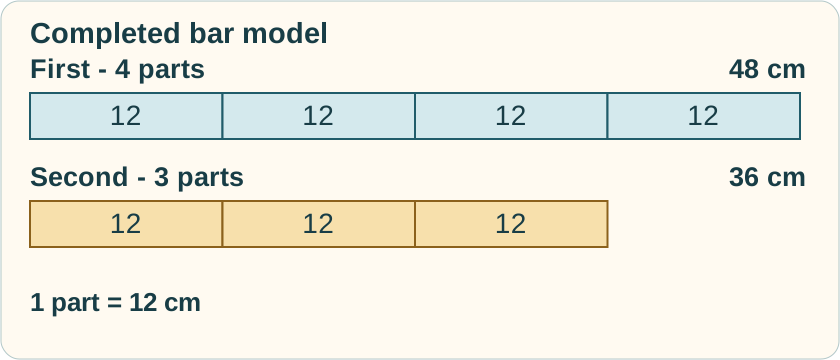
The completed model shows the value of each part and the required quantities. Two numbers and their difference
Two numbers differ by 45. The larger is 8/5 of the smaller. Find the numbers.
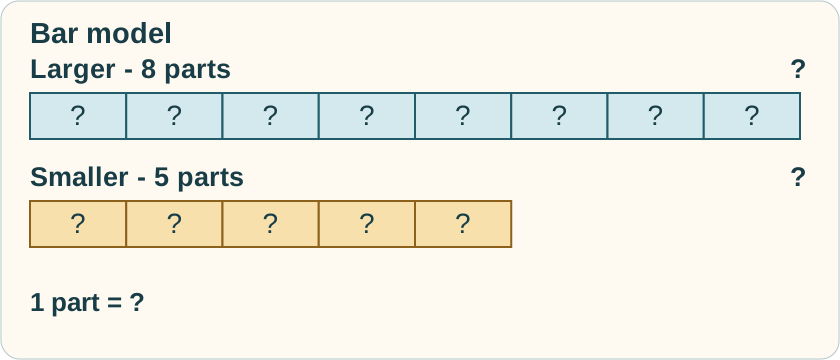
The given number represents only the extra parts, not all thirteen parts. Show the solution and completed diagram
The difference represents
8 − 5 = 3parts. One part is45 : 3 = 15.Larger:
8 × 15 = 120. Smaller:5 × 15 = 75. Answer: 120 and 75.Check:
120 − 75 = 45and120/75 = 8/5.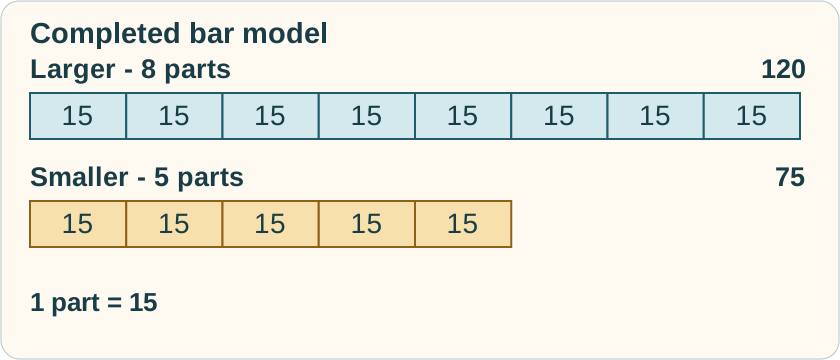
The completed model shows the value of each part and the required quantities. The class
In a class, the number of girls is 5/4 of the number of boys. There are 27 pupils altogether. How many boys and girls are there?
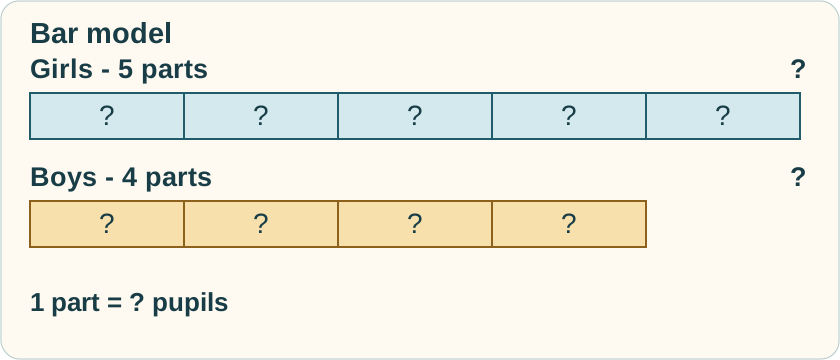
Nine parts represent the whole class. Show the solution and completed diagram
One part is
27 : (5 + 4) = 3pupils. Girls:5 × 3 = 15; boys:4 × 3 = 12.Answer: 12 boys and 15 girls. Check:
12 + 15 = 27and15/12 = 5/4.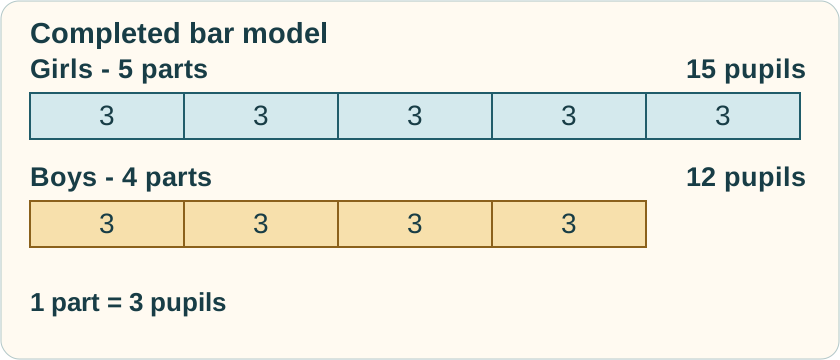
The completed model shows the value of each part and the required quantities. One segment is known
Segment A is 5/3 of segment B. B measures 18 cm. How long is A?
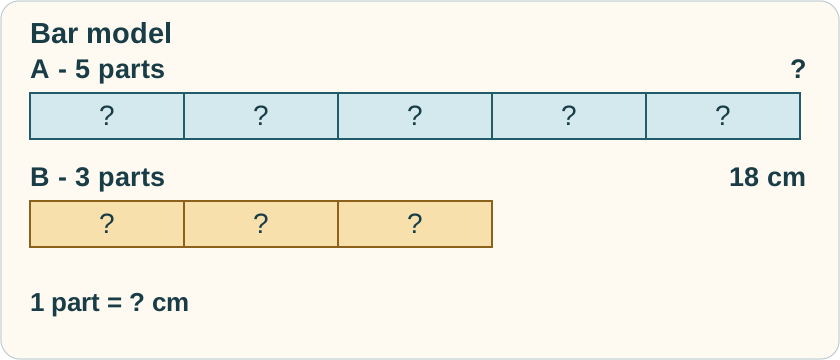
Divide 18 by the number of B’s parts. Show the solution and completed diagram
B’s 18 cm represent 3 parts:
18 : 3 = 6cm per part.A measures
5 × 6 = 30cm. Answer: 30 cm. Check:30/18 = 5/3.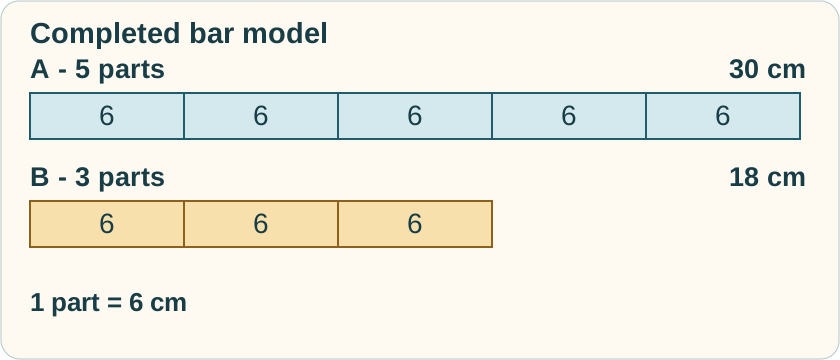
The completed model shows the value of each part and the required quantities. The rectangle with perimeter 84
A rectangle has perimeter 84 cm. Its length is 4/3 of its width. Find length, width and area.
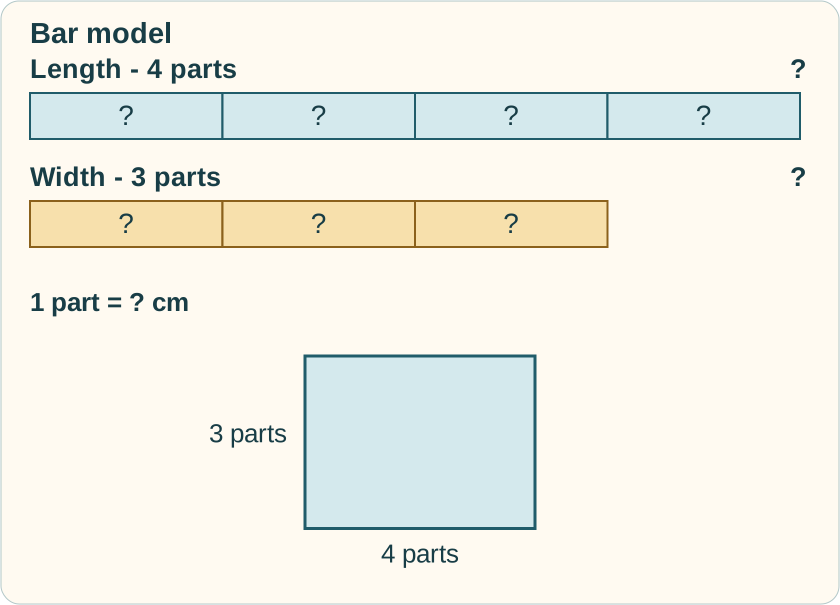
To work with length + width, use half the perimeter. Show the solution and completed diagram
First halve the perimeter:
84 : 2 = 42cm is length plus width. There are4 + 3 = 7parts.One part is
42 : 7 = 6cm. Length:4 × 6 = 24cm; width:3 × 6 = 18cm.Area:
24 × 18 = 432 cm². Answer: length 24 cm, width 18 cm, area 432 cm². Check:2 × (24 + 18) = 84.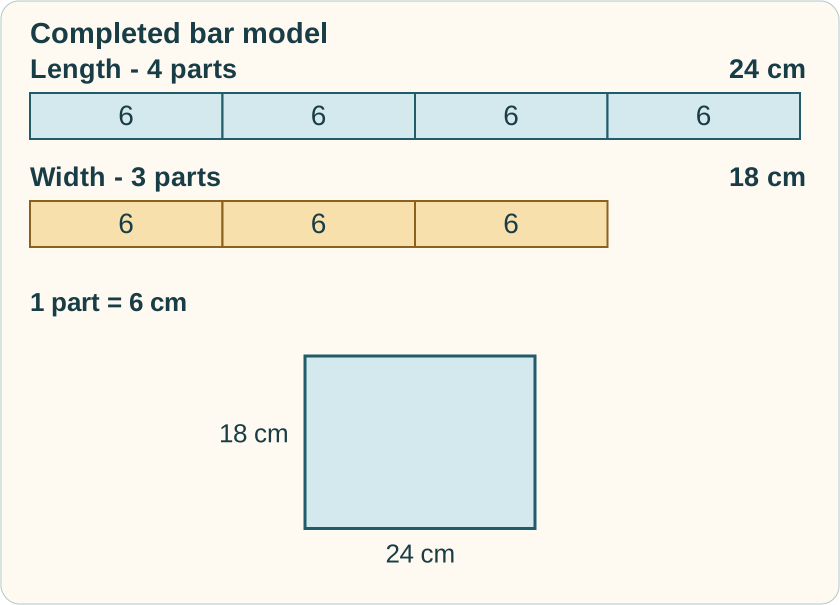
The completed model shows the value of each part and the required quantities. The plot of land
The length of a rectangular plot exceeds its width by 18 m. Its length is 8/5 of its width. Find perimeter and area.
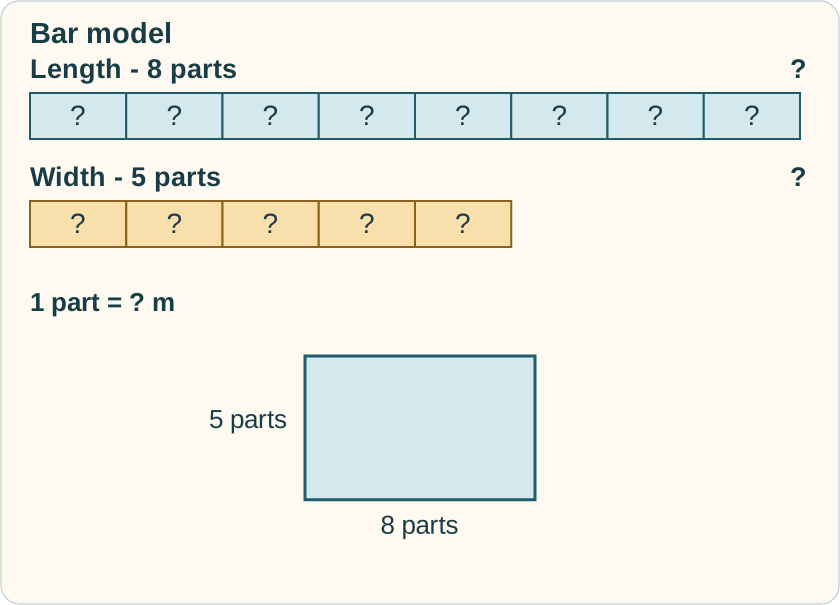
Here the known quantity is the difference of the dimensions, not the perimeter. Show the solution and completed diagram
The extra parts are
8 − 5 = 3. One part is18 : 3 = 6m. Length:8 × 6 = 48m; width:5 × 6 = 30m.Perimeter:
2 × (48 + 30) = 156 m. Area:48 × 30 = 1440 m². Answer: perimeter 156 m, area 1440 m².Check:
48 − 30 = 18and48/30 = 8/5.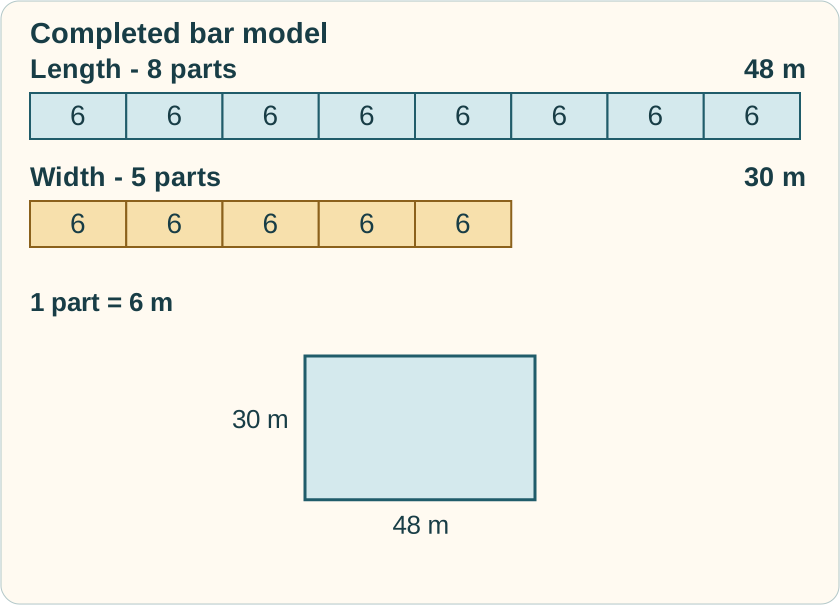
The completed model shows the value of each part and the required quantities. A classroom percentage
In a class of 30 pupils, 20% travel to school by scooter. The others do not. How many pupils are in each group?
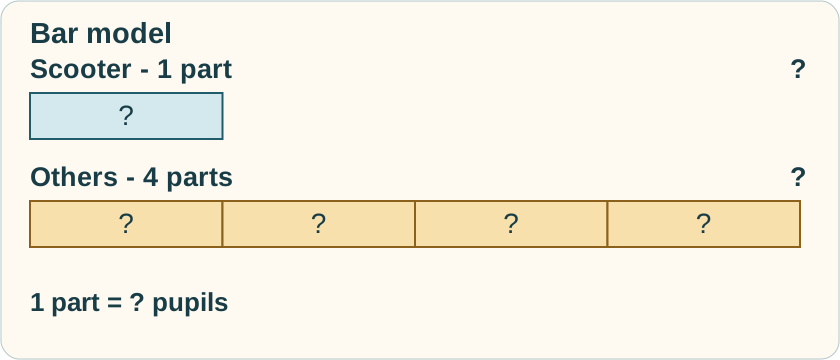
A percentage can be rewritten as a fraction of the whole. Show the solution and completed diagram
Convert the percentage to a fraction:
20% = 20/100 = 1/5. The whole has 5 parts; one part is30 : 5 = 6pupils.There are 6 scooter users; the others number
4 × 6 = 24. Answer: 6 and 24 pupils.Check, converting the fraction to a percentage:
(6/30) × 100% = 20%; also6 + 24 = 30.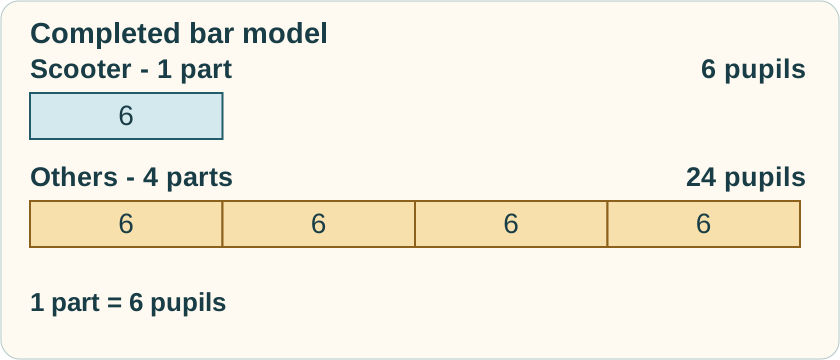
The completed model shows the value of each part and the required quantities. Pages still to read
Elena has read 3/7 of a book. She has 48 pages left. How many pages does the book have, and how many has she read?
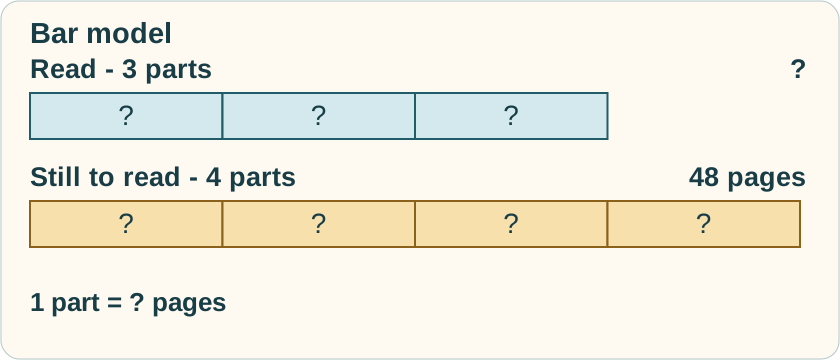
The given 48 refers to the unread fraction, not the whole book. Show the solution and completed diagram
The unread parts are
7 − 3 = 4. One part is48 : 4 = 12pages.The book has
7 × 12 = 84pages; Elena has read3 × 12 = 36. Answer: 84 pages altogether, 36 already read.Check:
84 − 36 = 48and36/84 = 3/7.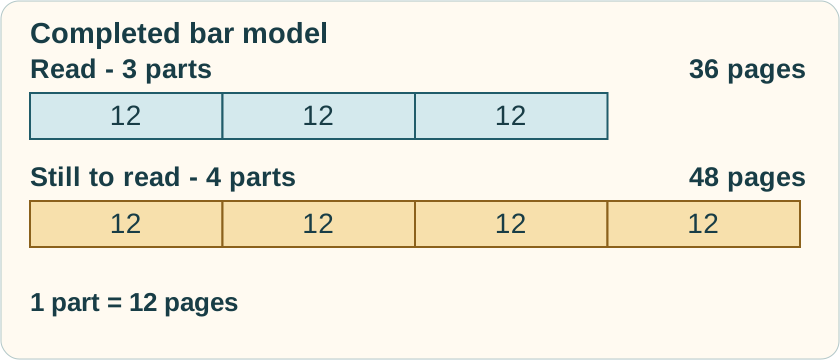
The completed model shows the value of each part and the required quantities. Three ribbons, two ratios
Three ribbons A, B and C have lengths in these ratios: A : B = 2 : 3 and B : C = 2 : 5. Their combined length is 100 cm. Find each length.
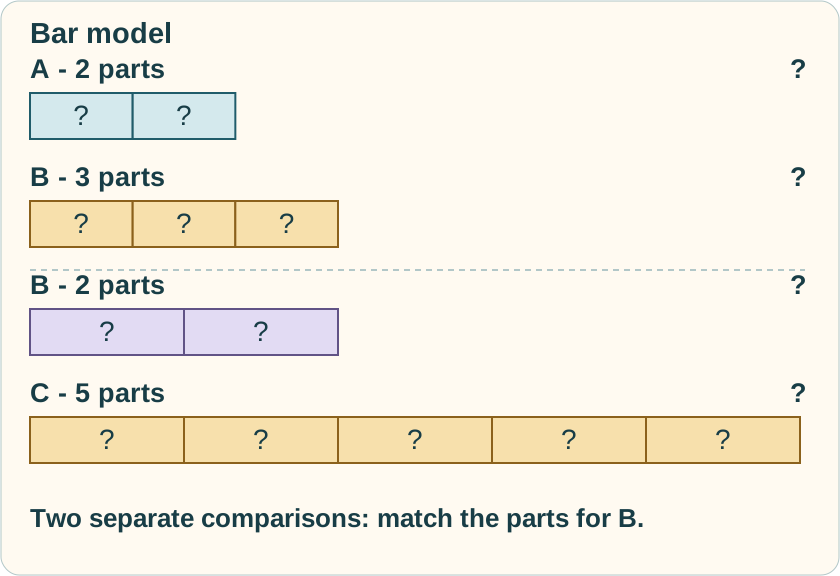
B has different part counts in the comparisons: first make the ratios compatible. Show the solution and completed diagram
Do not add 2 + 3 + 5: B has different numbers of parts in the two ratios. Give B 6 parts:
A : B = 4 : 6andB : C = 6 : 15.The common ratio is
A : B : C = 4 : 6 : 15. Total parts:4 + 6 + 15 = 25; one part is100 : 25 = 4cm.Answer: A = 16 cm, B = 24 cm, C = 60 cm. Check:
16 + 24 + 60 = 100,16/24 = 2/3and24/60 = 2/5.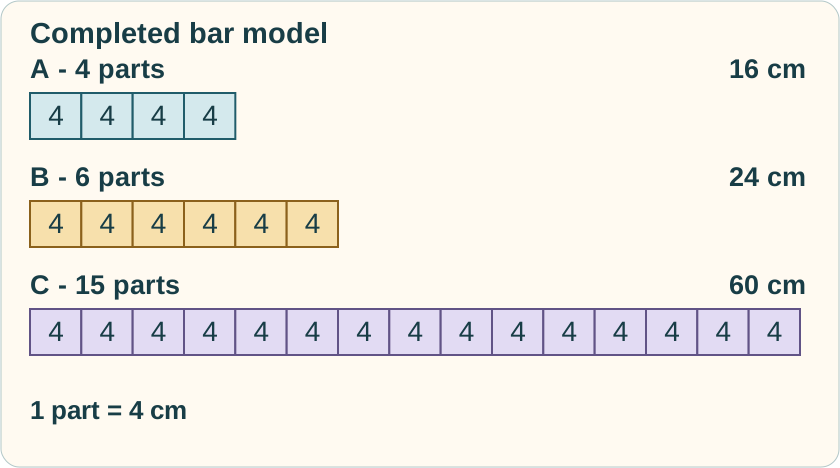
The completed model shows the value of each part and the required quantities. The PDF’s rectangle: exact results
A rectangle has perimeter 90 cm. Its length is 7/4 of its width. Find length, width and area, retaining exact fractions.
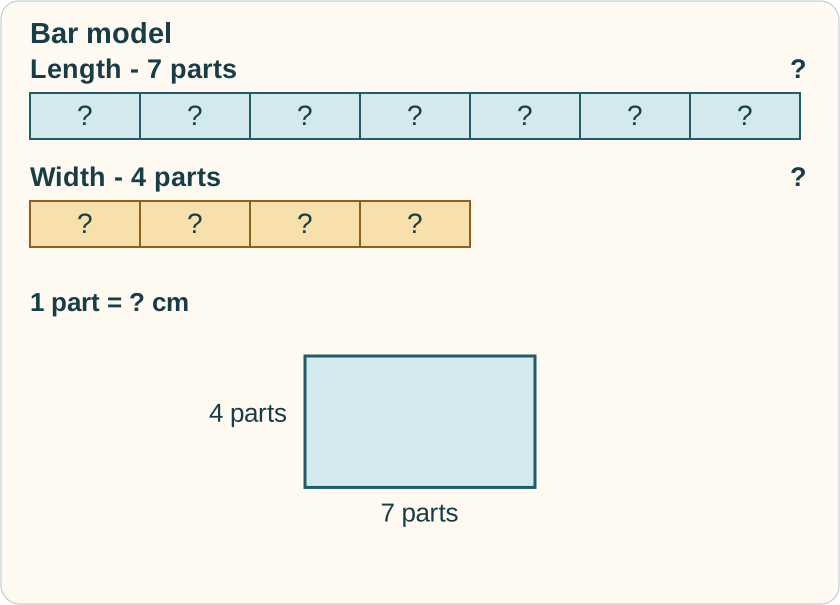
A part may have a fractional size: the method remains the same. Show the solution and completed diagram
Half the perimeter is
90 : 2 = 45cm. There are7 + 4 = 11parts: one part measures45/11cm.Length:
7 × (45/11) = 315/11 cm, approximately 28.64 cm. Width:4 × (45/11) = 180/11 cm, approximately 16.36 cm.Exact area:
(315/11) × (180/11) = 56700/121 cm², approximately 468.60 cm². Do not multiply already-rounded dimensions if you want to retain the exact answer.Check:
2 × (315/11 + 180/11) = 90and(315/11) : (180/11) = 7/4.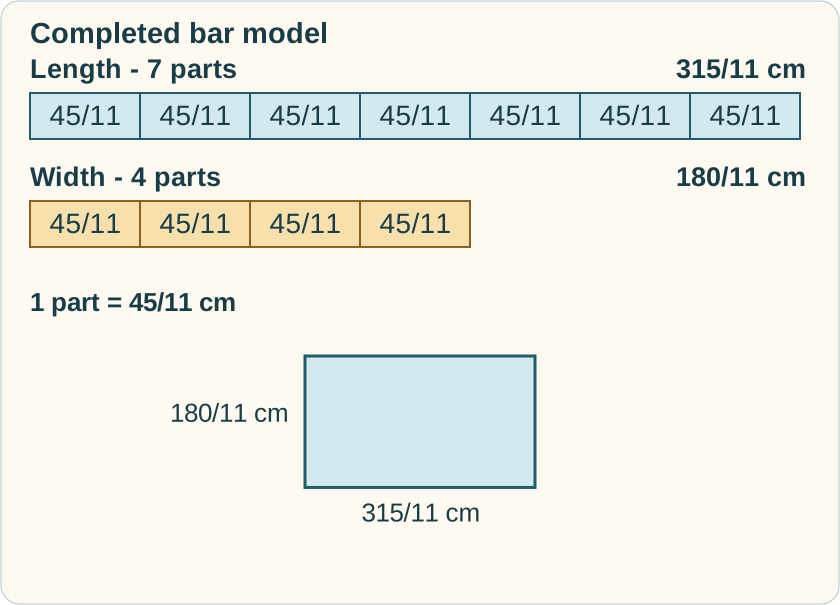
The completed model shows the value of each part and the required quantities.
Level 3 - One step further: values, ages and transformations
Three brothers and a theoretical division
Three brothers share €240. The second receives twice the first’s share, and the third three times the second’s. How much does each receive?
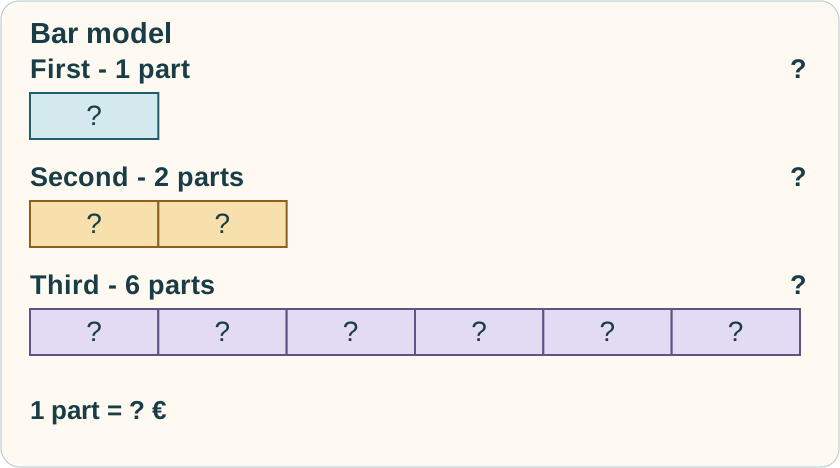
The third share occupies 3 × 2 = 6 parts. Show the solution and completed diagram
The first has 1 part, the second 2, the third
3 × 2 = 6. Total parts:1 + 2 + 6 = 9.One part is
240 : 9 = 80/3euros. The exact shares are 80/3 euros, 160/3 euros and 160 euros. Check:80/3 + 160/3 + 160 = 240; the second is double the first and the third triple the second.A note about money: 80/3 euros and 160/3 euros have recurring decimals. They are exact mathematical shares but cannot be paid exactly in cents; rounding cannot preserve all ratios. For a practical division without rounding, a version with €270 gives a €30 part and shares of €30, €60 and €180.
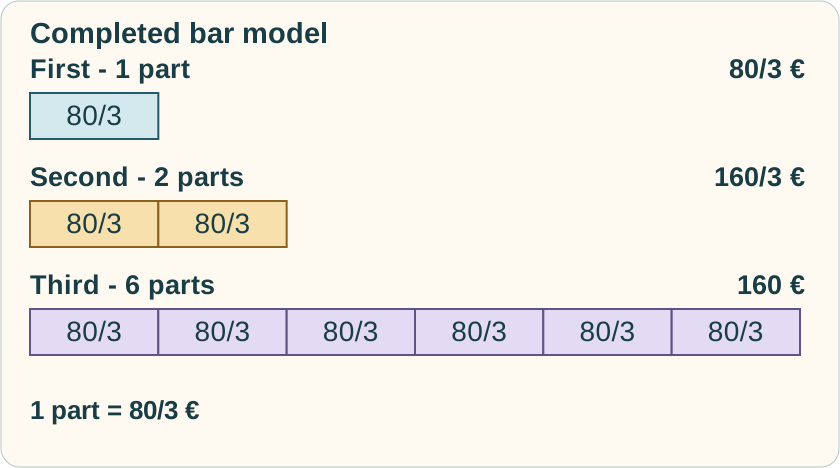
The completed model shows the value of each part and the required quantities. Coins: count and value
A money box contains €1 and €2 coins. There are three times as many €1 coins as €2 coins, and their total value is €70. How many of each coin are there?
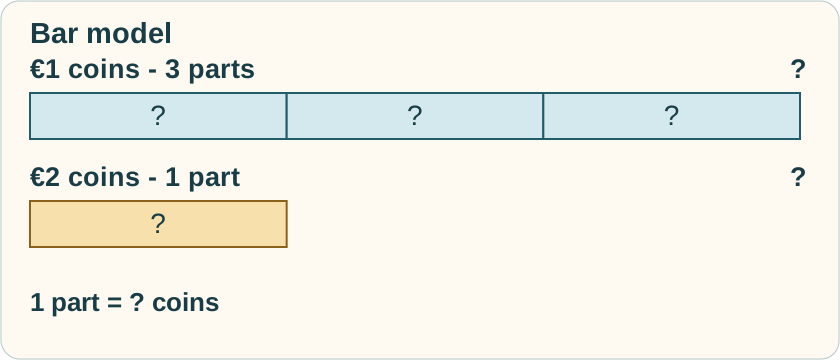
Here parts represent coin counts; their monetary values need weighting. Show the solution and completed diagram
Draw 3 parts of €1 coins and 1 part of €2 coins. A group of three €1 coins and one €2 coin is worth
3 × 1 + 1 × 2 = 5euros.The number of groups is
70 : 5 = 14. There are3 × 14 = 42€1 coins and1 × 14 = 14€2 coins. Answer: 42 and 14 coins.Check:
42 × 1 + 14 × 2 = 70euros and42 = 3 × 14. Dividing 70 by 4 would confuse euros with numbers of coins.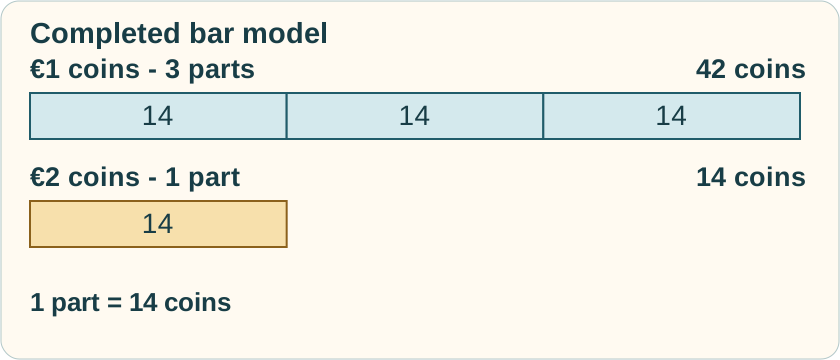
The completed model shows the value of each part and the required quantities. Equal money gifts
Two friends initially have €30 and €50. Both receive the same amount of money. Afterwards, the second has 3/2 of the first’s money. How much did each receive?
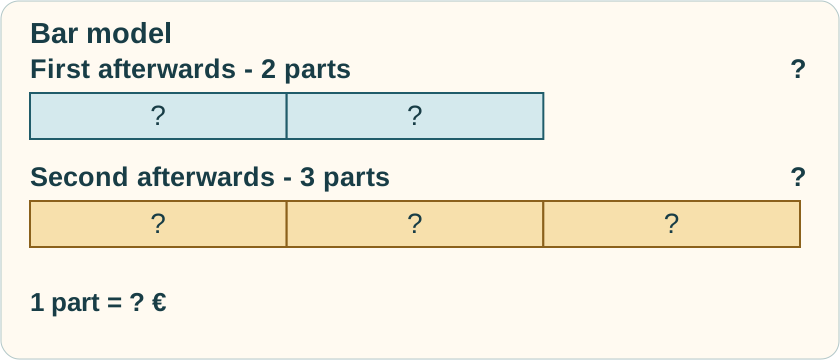
The model represents the situation after the gift. The initial difference does not change. Show the solution and completed diagram
Adding the same amount to both preserves the difference:
50 − 30 = 20euros. In the final ratio the parts are 2 and 3; the difference of3 − 2 = 1part is therefore €20.After the gift the first has
2 × 20 = 40euros and the second3 × 20 = 60. The gift is40 − 30 = 10euros, or60 − 50 = 10euros.Answer: €10 each. Check:
60/40 = 3/2and both increases are equal.
The completed model shows the value of each part and the required quantities. Ages: first find what stays unchanged
A father is 44 years old and his son is 11. In how many years will the father be three times as old as the son?
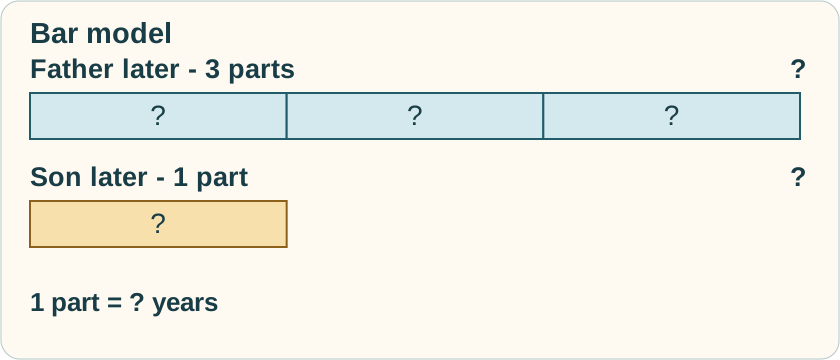
The parts represent future ages, not the starting ages. Show the solution and completed diagram
The age difference does not change:
44 − 11 = 33years. At the required time the father occupies 3 parts and the son 1; the two extra parts represent 33 years.One part is
33 : (3 − 1) = 16.5years. The son will be 16.5 and the father3 × 16.5 = 49.5.The waiting time is
16.5 − 11 = 5.5years. Answer: in 5 years and 6 months. Also49.5 − 44 = 5.5. Not 5 years: 49 would not be triple 16. We use exact ages in the model, not just whole numbers of birthdays.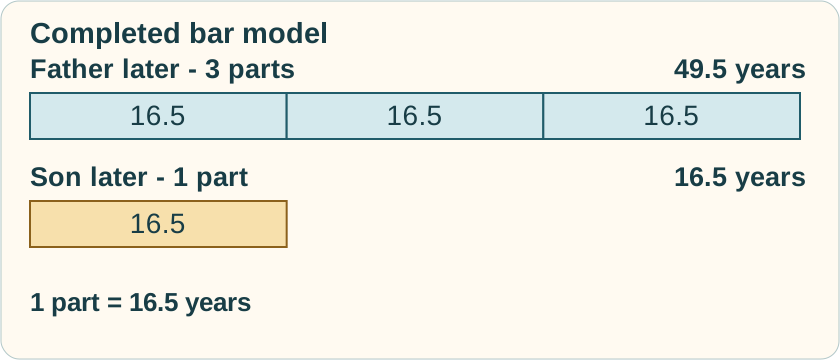
The completed model shows the value of each part and the required quantities. A transfer between groups
Group A has 48 cards and group B has 24. How many cards must A give B so that the groups have equal quantities?
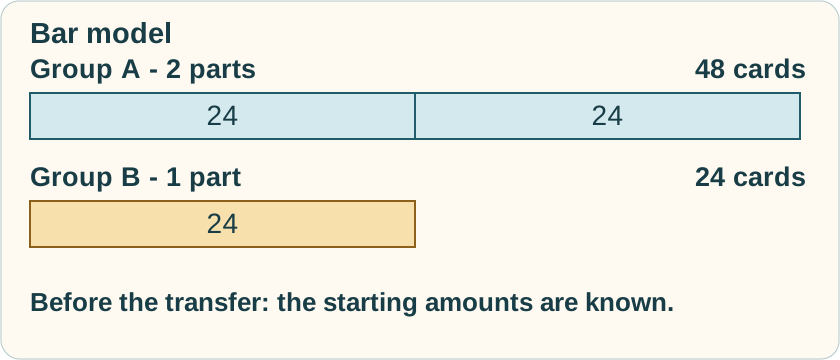
Start with the known quantities. Cards change groups but do not disappear. Show the solution and completed diagram
The total remains
48 + 24 = 72cards. To be equal, each group must have72 : 2 = 36cards.A must give away
48 − 36 = 12cards. B receives36 − 24 = 12. Answer: A must give B 12 cards.Check:
48 − 12 = 24 + 12 = 36. Do not transfer the whole difference of 24: each transferred card reduces the difference by 2, because A loses one and B gains one.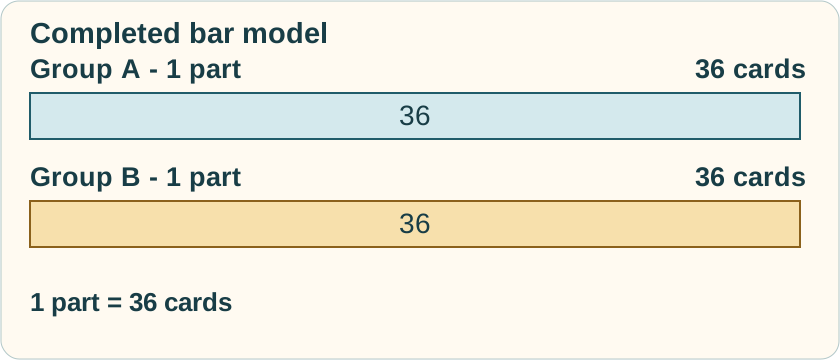
The completed model shows the value of each part and the required quantities.
6. What we have learnt
The equal-parts method is not a shortcut to avoid equations: it helps us understand relationships between quantities. At primary school we start with rectangles and objects; at secondary school we connect the same diagrams to fractions, ratios and proportions. Later, equations give a name to the unknown part.
For the opening example, equal parts give 40 : (1 + 3) = 10; a proportion can be written Luca : 40 = 1 : 4; an equation is x + 3x = 40. The language changes, not the reasoning. In transformation problems first look for what remains unchanged: a difference, a total or the value of a group.