A change of viewpoint can replace pages of calculations. Try each problem before opening its hint or solution. At the end we name the ideas so you can recognise them elsewhere.
1. The square you need not calculate
Find 2027² − 2026·2028 without expanding the products.
Reveal hint
Look at the middle number and its neighbours.
Reveal solution
Write the neighbours as n−1 and n+1. The cross terms +n and −n cancel, leaving n²−1. Subtracting from n² gives 1.
2. A stop at the wall
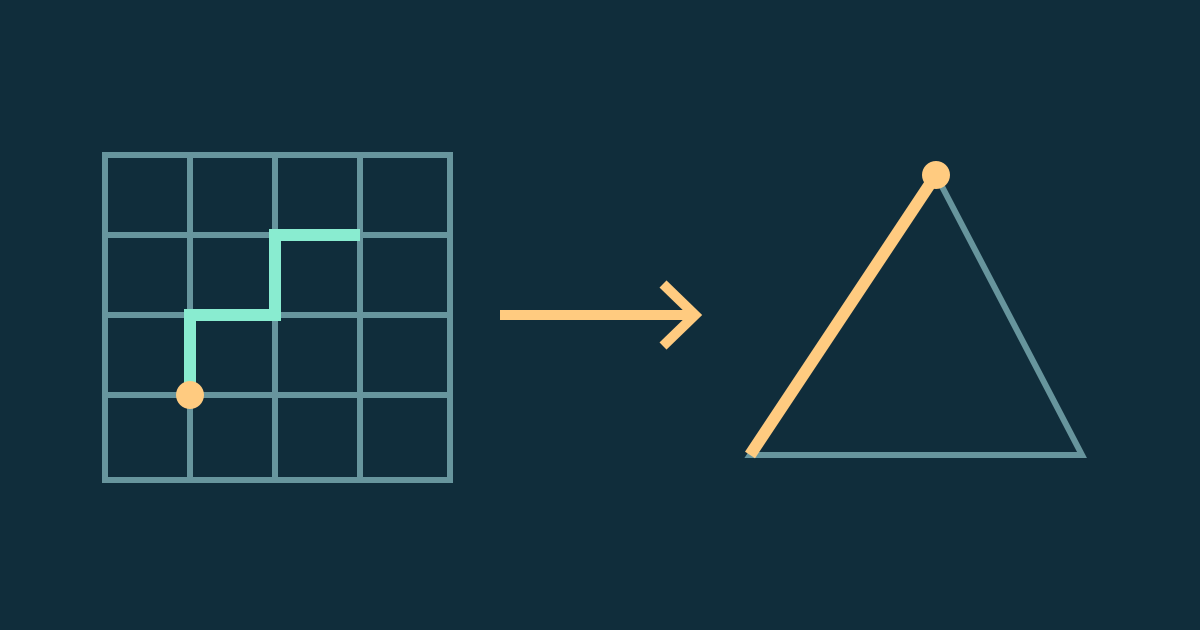
Two points on the same side of a wall are 3 m and 1 m from it. Their feet on the wall are 8 m apart. Where should you touch the wall for the shortest route?
Reveal hint
Reflect the destination across the wall.
Reveal solution
From any point on the wall, the destination and its reflection are equally far away. The broken route is at least as long as the direct segment, which crosses the wall here. It drops 3 of its total 4 m before crossing, so travels 3/4 of 8 m: 6 m.
3. One head only
One hundred coins show tails. Each move flips exactly two. Can exactly one show heads?
Reveal hint
Watch the total number of heads.
Reveal solution
Initially there are zero heads. Two tails become heads (+2), two heads become tails (−2), and one of each loses and gains a head (0). The count stays even after every move, so it cannot be 1.
4. The starting number
Triple a number, add 6 and divide by 2. The result is 18. What was the number?
Reveal hint
Undo the last operation first.
Reveal solution
Undo halving: 18 becomes 36. Undo adding 6: we get 30. Undo tripling: we get 10. Check: (3·10+6)/2 = 18.
5. Handshakes
Twelve people shake hands once per pair. How many handshakes occur?
Reveal hint
Count from each person’s perspective.
Reveal solution
Each of the 12 people counts 11 others. The handshake between A and B occurs in both their counts, so 132 is twice the total. There are 66.
6. One hundred addends
Add the integers from 1 to 100 without adding them one at a time.
Reveal hint
Pair first with last.
Reveal solution
Pair first with last until 50+51. This uses each number exactly once. All 50 pairs total 101 each, giving 5050.
7. One hundred doors
One hundred doors start closed. On round k toggle the multiples of k, from k = 1 to 100. Which doors finish open?
Reveal hint
Which rounds affect a fixed door?
Reveal solution
Door 12 toggles at rounds 1, 2, 3, 4, 6, 12; its divisor pairs give six changes. For door 9 the rounds are 1, 3, 9: the square root 3 counts only once. Only the ten squares have odd counts, so only those doors end open.
8. Missing corners
Remove opposite corners of an 8×8 chessboard. Can the rest be tiled with 1×2 dominoes without overlap?
Reveal hint
Look at the colours covered by each domino.
Reveal solution
A domino covers adjacent squares, one of each colour. The opposite corners are the same colour. After removal, 30 of one colour and 32 of the other remain, which no set of dominoes can cover.
9. The nearly empty pond
Water lilies double their coverage daily. The pond is full on day 30. When was it a quarter covered?
Reveal hint
Go back one day at a time.
Reveal solution
Going back one day divides the area by 2, rather than subtracting a fixed amount. Full on day 30 means 1/2 on day 29 and 1/4 on day 28.
10. At least one six
Roll two fair dice. What is the probability of at least one six?
Reveal hint
Count outcomes with no six.
Reveal solution
No six means both dice show 1 through 5: 5·5 = 25 of the 36 equally likely outcomes. The other 11 contain at least one six, giving 11/36.
11. Ninety-nine fractions
Add 1/[k(k+1)] for k from 1 to 99.
Reveal hint
Rewrite a term as a difference.
Reveal solution
Putting 1/k−1/(k+1) over k(k+1) gives numerator (k+1)−k = 1. In (1−1/2)+(1/2−1/3)+…+(1/99−1/100), every intermediate term cancels. The result is 99/100.
12. The hands at half past three
What is the smaller angle between the hands at 3:30?
Reveal hint
Turn minutes into degrees and let the hour hand move too.
Reveal solution
Each hour mark is 30° apart. At 3:00 the short hand is at 90°; in half an hour it advances 15° to 105°. The minute hand is at 180°, so the smaller angle is 75°.
13. Mixed-up digits
Why is the difference between 73142 and any rearrangement of its digits divisible by 9?
Reveal hint
Replace powers of 10 by their remainders modulo 9.
Reveal solution
Powers of 10 all leave remainder 1 modulo 9, so for that remainder each digit acts as if it were in the units place. Rearrangement preserves the digit sum; subtracting the two numbers gives remainder zero.
14. Money left
Spend a third of your money, then 8 euros. You have 12 euros left. What did you start with?
Reveal hint
Add back the last amount spent.
Reveal solution
Before the last purchase you had 12+8 = 20 euros. That is two thirds of the original amount. Half of 20 is one third, so three thirds are 30 euros.
15. A shared month
Among thirteen people, must two share a birth month?
Reveal hint
Think of a place to put each name.
Reveal solution
If all months were different, each of the 13 people would need a separate month. Only twelve months exist, so at least one must be used twice.
16. The meeting point
Five friends live at road marks 0, 2, 4, 8 and 15 km. Where should they meet to minimise total walking?
Reveal hint
Pair the two outer points, then the two remaining outer points.
Reveal solution
The outer pair must walk at least 15 km together and the inner pair at least 6 km. At km 4 both bounds are attained and the fifth friend walks zero. Elsewhere that friend walks a positive distance and neither pair can do better: only km 4 gives 21 km.
17. The misleading average
Travel along a road at 30 km/h and return along it at 60 km/h. What is your average speed?
Reveal hint
Choose a convenient distance.
Reveal solution
At 60 km each way, the trip takes 2 hours out and 1 hour back. Average speed is total distance divided by total time: 120/3 = 40 km/h. The slower leg matters more because it takes twice as long.
18. Water in wine
Two glasses hold equal volumes of water and wine. Transfer a spoonful of water to the wine, stir, and return one spoonful of the mixture. Which glass contains more of the other liquid?
Reveal hint
Both glasses return to their original volume.
Reveal solution
The water glass returns to its original volume. Any water missing from it is now in the wine glass, and exactly that volume must have been replaced by wine. Thus the foreign volumes match without calculating the mixture.
19. Twenty-one counters
Two players take 1, 2 or 3 counters per turn from 21. Whoever takes the last wins. How can the first player win?
Reveal hint
What would you leave before the last pair of turns?
Reveal solution
Leave the opponent 4 and you can take the last counters: if they take r, take 4−r. Work back through 8, 12, 16 and 20; every pair of turns removes 4. Begin by taking 1 from 21, then follow the rule.
20. How many sevens?
Write every two-digit code from 00 to 99. How often does the digit 7 appear?
Reveal hint
Count each position separately.
Reveal solution
Fix 7 on the left and vary the right digit from 0 to 9: ten occurrences. Fix 7 on the right for ten more. Count 77 twice because it has two occurrences, not because it is two codes.
Final chapter: five families of ideas
The groups are not rigid: a problem may have several keys. We group it by the idea that makes the decisive step clearest. In a new problem, try one of these questions before calculating.
1. Group and simplify
Can I pair or rewrite terms so they cancel?
- 1. The square you need not calculate
- 6. One hundred addends
- 11. Ninety-nine fractions
- 16. The meeting point
2. Change the representation
Can I replace the scene with a diagram, a count or a convenient unit?
3. Find what does not change
What property survives every move?
4. Work backwards
What step must come before the result I know?
5. Count a different way
Can I count pairs, positions, boxes or the complementary event?