
A problem can look difficult because we are looking at the least useful thing. Before searching for a formula, ask: what am I counting? What changes with each move? Which information do I actually need?

A good observation does not replace a proof: it often makes a short proof possible. These ten situations distinguish the spontaneous approach from the decisive idea, explaining the conditions under which the argument works.
Not a trick to guess, but a question to learn
- Count differently: match what you want to count with something easier to count.
- Track a regular change: if each move changes a quantity in the same way, the order may become irrelevant.
- Change representation: turn a sum into a picture, motion into relative motion, or a problem into a smaller one.
- Check the conditions: an elegant idea does not justify ignoring the rules or generalising without explanation.
Reducing a problem to a familiar one and finding the decisive observation are related, but distinct strategies. In the first, I recognise a structure I can already solve; in the second, I change what I look at and discover a simpler route.
The method of reduction to a known problem
Ten opportunities to change perspective
- The tournament: count who leaves
- Chocolate: one break, one extra piece
- Clock hands: watch their relative gain
- Down 10%, up 10%: the base changes
- Better twice, worse overall
- Odd numbers: build the square
- From 1 to 100: make equal columns
- The cable: the enormous measurement is unnecessary
- Fair division: settle one person at a time
- Hanoi: solve the smaller tower first
1. The tournament: count who leaves
Ninety players enter a single-elimination tournament. One champion remains. How many matches are played?
The spontaneous approach. Reconstruct every round, handling byes whenever the numbers are odd.
A hint without the solution · 1
What does every match produce besides a winner?
Show the observation and solution · 1
The decisive observation. Every match eliminates exactly one player.
- To leave one champion, the other 89 participants must leave. Each is eliminated just once, so there are 89 matches.
- With n participants, matches and eliminated players correspond one to one. There is no need to know how the rounds are arranged.
M = n − 1
n = 90: M = 89
When it applies. A completed tournament, one winner and one elimination per match; no withdrawals without a match and no additional placing matches. A bye is not a match.
Explore further on this site: Combinatorics: from first counts to complex problems · Combinatorics laboratory
2. Chocolate: one break, one extra piece
A chocolate bar contains 6 × 4 = 24 portions. Each move breaks one existing piece into two along a division. How many moves separate all the portions?
The spontaneous approach. Search for a clever order of breaks that saves moves.
A hint without the solution · 2
Count the pieces immediately before and after a single break.
Show the observation and solution · 2
The decisive observation. Every break increases the number of pieces by exactly one.
- There is one piece initially. After k breaks there are 1 + k pieces. Reaching 24 requires 1 + k = 24, so there are 23 breaks.
- Under these conditions, every complete procedure has the same length: both the minimum and the maximum are 23.
P = 1 + k
k = P − 1 = 23
When it applies. Break one piece at a time, always into two; do not stack pieces to break several in one action. Different rules give a different problem.
Explore further on this site: Word problems without equations: 13 arithmetic methods and 36 worked problems
3. Clock hands: watch their relative gain
At noon, the clock hands overlap. How long until their next overlap?
The spontaneous approach. Try various times, or assume that exactly one hour is enough.
A hint without the solution · 3
In an hour, how far does the minute hand gain on the hour hand?
Show the observation and solution · 3
The decisive observation. Track one hand’s gain on the other, not the two motions separately.
- In one hour, the minute hand completes one turn and the hour hand 1/12 of a turn. Their relative gain is therefore 11/12 of a turn per hour.
- For the next overlap, the gain must reach one turn. Dividing one turn by 11/12 of a turn per hour gives 12/11 hours: 65 minutes and approximately 27.27 seconds.
1 − 1/12 = 11/12
t = [1 ÷ (11/12)] h = (12/11) h
When it applies. An ideal analogue clock with uniform continuous motion, not one whose hands jump at fixed intervals.
Explore further on this site: Reducing to a known problem: transform it to solve it
4. Down 10%, up 10%: the base changes
Someone earns 15 euros per hour and works 20 hours, receiving 300 euros. Their hourly pay falls by 10% while their hours rise by 10%. Is the total unchanged?
The spontaneous approach. Add −10% and +10% as though they referred to the same quantity.
A hint without the solution · 4
Total pay is a product: hourly pay × hours.
Show the observation and solution · 4
The decisive observation. The two changes multiply total pay by 0.9 and 1.1.
- Hourly pay becomes 13.50 euros and hours become 22. Total pay is 13.50 × 22 = 297 euros: a loss of 3 euros, or 1%.
- For equal and opposite percentage changes p, the factors are 1 − p/100 and 1 + p/100. Their product is 1 − p²/10000, so the final percentage change is −(p²/100)%.
- Watch the notation: a rate rising from 20% to 25% gains 5 percentage points. Its relative increase is (25 − 20)/20 = 0.25 = 25%, not 5%.
300 × 0,9 × 1,1 = 297
Δ% = −(p²/100)%
[(25 − 20)/20] × 100% = 25%
When it applies. Relative changes to the respective initial values, with no thresholds, rounding or other constraints. For an ordinary decrease, assume 0 ≤ p < 100. The number 25 and the quantity 25% are not equal.
Explore further on this site: Successive percentage changes · Percentages: from meaning to the return to the original value · Percentages laboratory: choose the right base
5. Better twice, worse overall
In two groups of quiz questions, A answers 9 out of 10 correctly in the easy group and 18 out of 90 in the difficult group. B answers 72 out of 90 in the easy group and 1 out of 10 in the difficult group. Who has the better percentage?
The spontaneous approach. Assume that because A beats B in each group, A must also beat B overall.
A hint without the solution · 5
Calculate the percentages within groups and across the totals separately.
Show the observation and solution · 5
The decisive observation. The group percentages contribute to the overall rate with different weights.
- In the easy group, A scores 90% against B’s 80%; in the difficult group, 20% against 10%. A does better in both.
- Overall, A has 27 correct answers out of 100, whereas B has 73 out of 100. The total favours B, who mainly answered easy questions; A mainly answered difficult ones.
- There is no contradiction: these are not averages with the same weights. This reversal is an example of Simpson’s paradox.
| Group | A | B |
|---|---|---|
| Easy | 9/10 90% | 72/90 80% |
| Difficult | 18/90 20% | 1/10 10% |
| Total | 27/100 27% | 73/100 73% |
A: (9 + 18)/(10 + 90) = 27%
B: (72 + 1)/(90 + 10) = 73%
When it applies. Invented data illustrating the mechanism. The aggregate alone cannot establish who is more knowledgeable or what causes the difference: the composition of the groups matters.
Explore further on this site: Percentages of what? Groups, different bases and rate ratios · Reducing to a known problem: transform it to solve it
6. Odd numbers: build the square
Why does 1 + 3 + 5 + 7 + 9 equal 25? And why does the sum of the first n positive odd numbers equal n²?
The spontaneous approach. Check many examples and treat them as a general proof.
A hint without the solution · 6
What must be added to a square of side n − 1 to make a square of side n?
Show the observation and solution · 6
The decisive observation. An L-shaped border adds exactly 2n − 1 cells.
- Add a row of n cells and a column of n − 1 cells: do not count their shared corner twice. The new border contains 2n − 1 cells.
- Starting with one cell, the successive layers contain 3, 5, 7, 9… cells. After n layers we have an n × n square. The construction explains the formula for every positive integer n.
n² − (n − 1)² = 2n − 1
1 + 3 + … + (2n − 1) = n²
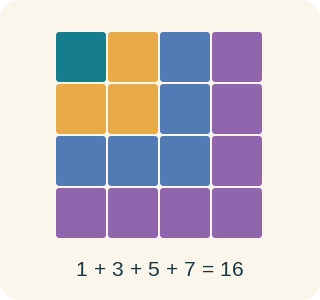
When it applies. Sum the first n positive odd numbers, beginning with 1. Consecutive odd numbers starting elsewhere need not add up to a square.
Explore further on this site: I know… therefore: deriving 15 sums · Notable sums: from Gauss to even and odd numbers
7. From 1 to 100: make equal columns
How can you calculate 1 + 2 + … + 100 without performing 99 additions in succession?
The spontaneous approach. Add in order, risking errors in intermediate totals.
A hint without the solution · 7
Write a second copy of the sum in reverse order.
Show the observation and solution · 7
The decisive observation. The first and last quantities always complement each other to the same total.
- Write S = 1 + 2 + … + 100, with S = 100 + 99 + … + 1 underneath. Every column totals 101, and there are 100 columns.
- We have counted two copies: 2S = 100 × 101. Divide by two to obtain 5050. Replacing 100 with n gives n(n + 1)/2, and the construction works for odd n too.
2S = n(n + 1)
S = n(n + 1)/2
n = 100: S = 5050
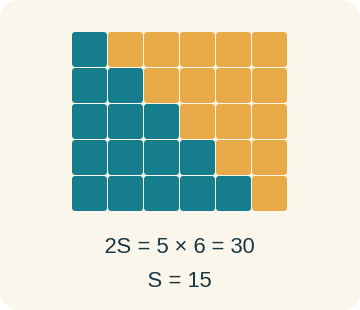
When it applies. n is a positive integer; every term from 1 to n occurs once in each copy. The factor 2 comes from the two copies, not from assuming an even number of terms.
Explore further on this site: I know… therefore: deriving 15 sums · Notable sums: from Gauss to even and odd numbers
8. The cable: the enormous measurement is unnecessary
A cable fits tightly around a perfectly circular equator. How much longer must it be to stand one metre above the surface everywhere? Do we need Earth’s radius?
The spontaneous approach. Look up Earth’s size and calculate two enormous circumferences.
A hint without the solution · 8
Subtract the circumference of radius r from that of radius r + h.
Show the observation and solution · 8
The decisive observation. The term containing the radius cancels in the difference.
- The initial circumference is 2πr and the final one 2π(r + h). Subtraction gives 2π(r + h) − 2πr = 2πh.
- For h = 1 metre, we need 2π metres, approximately 6.28 metres. In the circular model, the result is the same for a small ball and a planet.
- The existing article on this site asks the inverse question: add one metre of cable and find the height. Then h = 1/(2π) metres, approximately 15.9 centimetres. One metre added to the length is not one metre added to the radius.
ΔL = 2πh
h = ΔL/(2π)
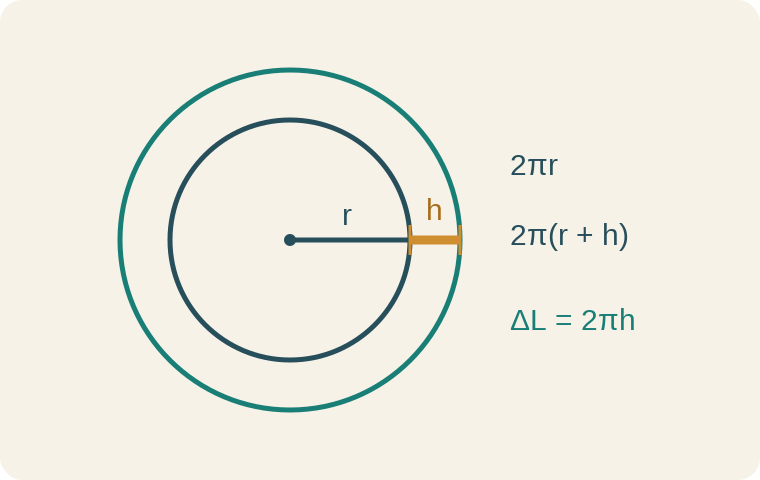
When it applies. Two concentric circles with a uniform gap h. Lifting the cable at just one point is a different problem.
Explore further on this site: One extra metre: the rope around the Earth
9. Fair division: settle one person at a time
Four people want to divide some juice without measuring tools, using a procedure that gives everyone at least the share they consider fair. How can they proceed?
The spontaneous approach. Argue about four glasses and all their possible differences simultaneously.
A hint without the solution · 9
Try allocating just one glass, then repeat with the remaining people.
Show the observation and solution · 9
The decisive observation. Anyone trimming a portion they judge excessive agrees to take it instead of its previous claimant.
- With m people remaining, the first prepares what they consider 1/m of the remaining juice. The glass passes once to every other person.
- Anyone finding it too full returns the excess to the container and becomes its prospective recipient. The last person to trim it receives it; if nobody trims it, the first person receives it.
- Everyone remaining judges that portion no greater than 1/m of the residue. At least (m − 1)/m therefore remains, by each of their assessments. Repeat with m − 1 people.
- With four people, the next stage guarantees at least (3/4) × (1/3) = 1/4 of the original total to a remaining person. The reasoning continues to the last person.
R ≥ (m − 1)/m
[(m − 1)/m] × [1/(m − 1)] = 1/m
When it applies. Consistent additive valuations, no waste, divisible portions and honest participation. The guarantee is proportional according to each person’s valuation; for three or more people it does not automatically imply envy-freeness.
Explore further on this site: Word problems without equations: 13 arithmetic methods and 36 worked problems · Reducing to a known problem: transform it to solve it
10. Hanoi: solve the smaller tower first
Five discs sit on one peg. Transfer them to another using a third peg, moving one disc at a time and never placing a larger disc on a smaller one. What is the minimum number of moves?
The spontaneous approach. Memorise a long sequence without understanding its structure.
A hint without the solution · 10
What must happen before you can move the largest disc?
Show the observation and solution · 10
The decisive observation. To move the largest disc, first clear it by transferring the smaller tower.
- Transfer the four upper discs to the spare peg; move the largest disc once; transfer the four discs onto it.
- Let Mₙ denote the minimum. Then Mₙ = 2Mₙ₋₁ + 1 with M₀ = 0, giving 1, 3, 7, 15, 31.
- The formula Mₙ = 2ⁿ − 1 satisfies both the initial case and the recurrence: 2(2ⁿ⁻¹ − 1) + 1 = 2ⁿ − 1. It is not merely a guess from the first few values.
- It is also minimal: before the largest disc first moves, it must be cleared; after its last arrival on the destination peg, the smaller tower must be rebuilt. At least two transfers of n − 1 discs and one move of the largest are necessary. The construction achieves that bound.
M₀ = 0; Mₙ = 2Mₙ₋₁ + 1
Mₙ = 2ⁿ − 1
M₅ = 31
When it applies. Three pegs and the classical rules. Extra pegs or different permitted moves require a new analysis.
Explore further on this site: Tower of Hanoi: rules, strategy and recursion · Tower of Hanoi: ten levels
Five challenges: find the idea first
For each problem, write a sentence explaining the idea before calculating. Answers remain hidden until you open them.
1. A tournament has 37 participants under the same rules as the first problem. How many matches?
Show the explained solution
36: 36 participants must be eliminated. There is no need to reconstruct the rounds.
2. A chocolate bar has 3 × 8 portions, with one existing piece broken at a time. How many breaks?
Show the explained solution
24 − 1 = 23. The shape changes, but each move adds one piece.
3. A quantity is 2400. It rises by 20%, then falls by 20%. What remains?
Show the explained solution
2400 × 1.2 × 0.8 = 2304. The change is −(20²/100)% = −4%, a loss of 96.
4. A circular cable is lengthened by 3 metres while keeping a uniform gap. How much does its radius increase?
Show the explained solution
h = 3/(2π) metres, approximately 0.4775 metres. The 3 metres refer to the circumference, not the radius.
5. Hanoi increases from 5 discs to 6. Is one more move enough beyond the original 31?
Show the explained solution
No: transfer the five-disc tower twice. M₆ = 2 × 31 + 1 = 63.
An idea becomes a method when you can explain it
After finding a shortcut, ask why it works, which rules it uses and what change would make it invalid. The aim is not to guess the author’s trick, but to recognise structures that transfer to other problems.
Inspiration and responsibility for this text
This learning sequence takes inspiration from the ten questions in the first chapter of Peter M. Higgins, Divertirsi con la matematica. Curiosità e stranezze del mondo dei numeri, Edizioni Dedalo, pp. 8–32. The presentation, adapted examples, commentary and explanations have been reworked for this article; the chapter is not reproduced.