
When we hear computer science, we immediately think of our home computer or the machines in the school laboratory. That is a good starting point, but not the whole story. The first question is not “which button should I press?” but “what information do I have, what does it mean, and how can I use it?”.
1. Computer science: the science of information
Computer science studies how to represent, handle, process, store and communicate information, including through automated tools. As a first definition, we can think of it as the science of information processing.
A computer helps us carry out operations, store data and repeat procedures very quickly. But first someone must decide which data is needed, how to represent it and which rules to apply. Thinking through these choices is already computer science, even with pencil and paper.
For example, sorting a list of names, extracting a date from eight digits or calculating how many pupils wear glasses are information-processing activities. Opening a program is only one possible tool for doing them.
2. What is information? A message for someone
Imagine a sender, who sends a message, and a receiver, who receives it. To understand one another, they must share a code: a language, symbols or conventions. The context in which the message arrives matters too.
Sender → message → receiver. A classmate speaks, a sentence carries the content, and you listen and interpret it.
An intuitive way to understand a message’s informational value is to ask: what does it tell me that I did not know before? If a friend whose name you already know tells you their name again, it adds nothing new for you. If instead they tell you that they enrolled in the Faculty of Engineering yesterday and you did not know, your knowledge changes.
Novelty therefore also depends on what the receiver already knows. This is an initial intuition, not a formal measure of information. Moreover, a new piece of news is not automatically true or useful: novelty, meaning, reliability and usefulness are different things.
In everyday life we store and communicate information because it may help us now or in the future: a timetable, an address, a measurement or a result. Sometimes information is not obvious at first glance: we must extract it from data and relationships.
3. Data and information: the same digits, different meanings
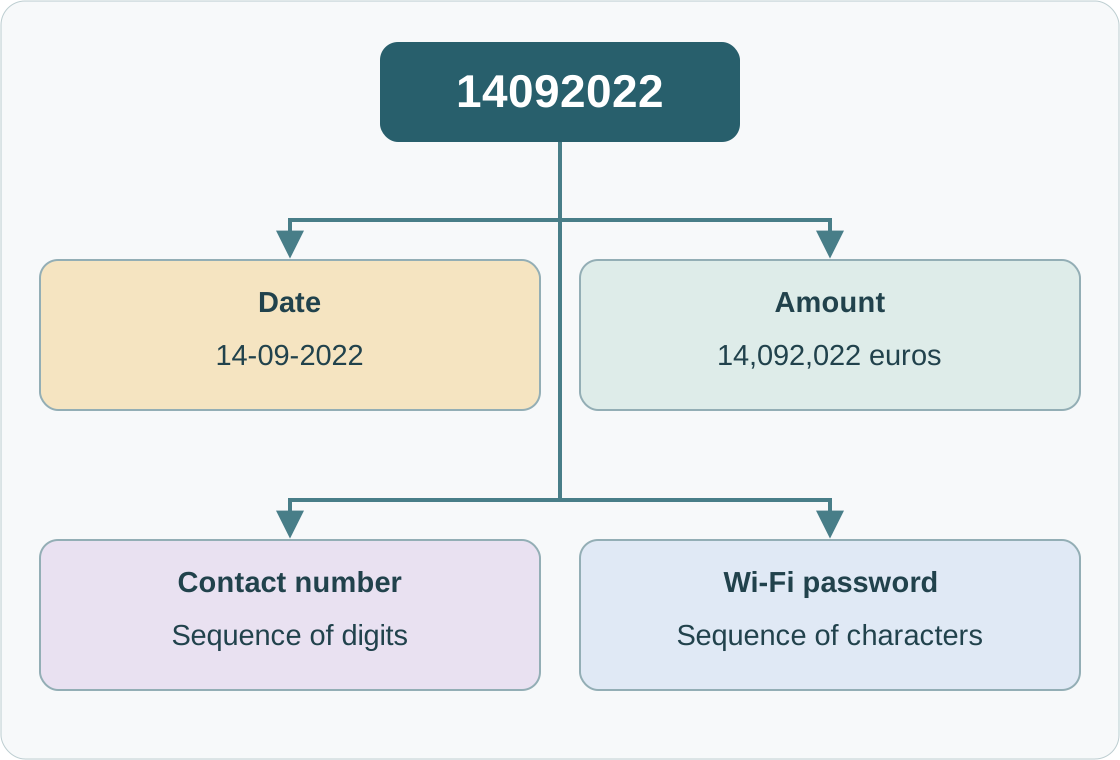
Write 14092022. This is data: a sequence of symbols. On its own, it does not tell us for certain what it represents. Interpreting it requires context and a reading rule.
| Context | Interpretation of the data |
|---|---|
| A calendar, using day-month-year format | 14-09-2022: 14 September 2022. |
| An amount expressed in whole euros | 14,092,022 euros. |
| A field intended for a telephone contact number | A sequence of digits interpreted according to the field’s rules. The context alone does not guarantee a valid telephone number. |
| A Wi-Fi password field | A character sequence acting as a password: this is only an interpretation example, not a password to use. |
Data + context + interpretation rule → understandable information. Interpreting a representation means applying decoding. We are not changing the digits: we are giving them meaning.
The unit of measurement is also part of the context. The data value 28 could mean pupils, degrees or euros: writing the number alone is often not enough. When storing data, we should therefore also retain the information needed to read it correctly.
4. Learning computer science is not just learning to use programs
Developing computing skills means learning to make informed choices about information:
- Select: distinguish relevant data from data that does not answer the question.
- Organise: assign names, categories and a clear order.
- Extract: derive a result or relationship that was not immediately visible.
- Present: choose words, tables or images that make the result understandable.
- Encode: decide how to represent content through shared symbols and rules so that it can later be decoded.
Computing and communication are closely connected. ICT stands for Information and Communication Technology: tools and systems for processing, storing and transmitting data.
You do not need to turn on a computer for the following examples. You do need three questions: what do I know, which rule am I using, and what can I actually conclude?
5. Four questions for the first lesson
Try answering before opening the explanation. In some cases, a piece of data is missing; in others, the same examples allow more than one rule. The aim is not to guess but to justify your answer.
Aldo has as many brothers as sisters
Aldo says: “I have as many brothers as sisters.” What can we infer about his family? Do we already know how many children there are?
Show answer and explanation
When counting his brothers, Aldo does not count himself. Let
bbe the number of boys in the family, including Aldo, andgthe number of girls. His brothers numberb - 1, and his sisters numberg.The statement means
b - 1 = g, sob = g + 1: there is one more boy than girl in the family.For example, with 3 boys and 2 girls, Aldo has 2 brothers and 2 sisters. But this is not the only possibility: the statement gives a relationship, not the exact number of children. We extract the information by considering who is speaking.
One seventh of the class wears glasses
We know that
1/7of the pupils in a class wear glasses. What information do we have? Can we say how many pupils that is?Show answer and explanation
We know that 1 in every 7 pupils wears glasses: this is a proportion, not yet an absolute count. If
Nis the total number of pupils, the number wearing glasses isN/7.If the class has 28 pupils, the answer is
28/7 = 4. But 28 is additional data for this example: it cannot be deduced from the fraction alone.If
1/7is exact, the total must be a multiple of 7 because we are counting whole people. If it were an approximation, this should be stated. Before calculating, check whether you have all the data you need.If it is not DUE, what rule are we using?
Complete the last row. The most immediate answer is DUE, Italian for two. Can you find another rule that fits all four preceding rows?
The two word puzzles deliberately retain Italian words: DODICI = twelve, DIECI = ten, OTTO = eight, SEI = six, QUATTRO = four, CINQUE = five, DUE = two, SETTE = seven, NOVE = nine, TRE = three, UNO = one. These words are the data being processed: translating them would change the letter counts and alphabetical order.
Starting word Result DODICI SEI DIECI CINQUE OTTO QUATTRO SEI TRE QUATTRO ???? Show answer and explanation
The first reading is arithmetic: 12 divided by 2 is 6, 10 divided by 2 is 5, 8 divided by 2 is 4, and 6 divided by 2 is 3. Under that rule, 4 divided by 2 gives DUE, meaning two.
But we can treat the words as data and count their letters:
DODICIhas 6 letters,DIECIhas 5,OTTOhas 4, andSEIhas 3.QUATTROhas 7 letters, so the second rule gives SETTE, meaning seven.DUE and SETTE follow two different rules, both compatible with the first four rows. To choose the intended result, we must specify the criterion: an operation on numbers or processing the words. It is a small lesson in representation and ambiguity.
A sorted sequence… but not sorted by value
The sequence
5,2,9,8,4,6,7,3,1is sorted. It is not in ascending or descending numerical order. Which criterion was used?Show answer and explanation
Write the numbers as words, in Italian, keeping the given order:
cinque → due → nove → otto → quattro → sei → sette → tre → uno.The words are in alphabetical order. For example,
seiandsetteshare their first two letters; at the third position,icomes beforet.Thus sorting does not always mean arranging from smallest to largest: we must state which property is compared and which conventions apply. Changing the language may change the ordering of the number names.
6. What we take away from this lesson
Data is a representation. To obtain information, we must interpret it in context. The same message may add different knowledge for different people, and the same sequence may be processed using different rules.
Computer science is therefore not limited to using a device: it teaches us to ask precise questions, identify data, make rules explicit and communicate results clearly. Reasoning comes before the command.
Want to continue? Explore three sorting algorithms and their visual laboratory: after choosing a criterion, see how a procedure arranges the data.