Two concentric circles enclose a ring-shaped region called an annulus. A chord of the larger circle is 20 cm long and tangent to the smaller circle. What is the area of the annulus?
Two measurements seem to be missing: the outer and inner radii. Yet we do not need them separately. The chord determines precisely the combination that appears in the area formula.
1. Reading the diagram
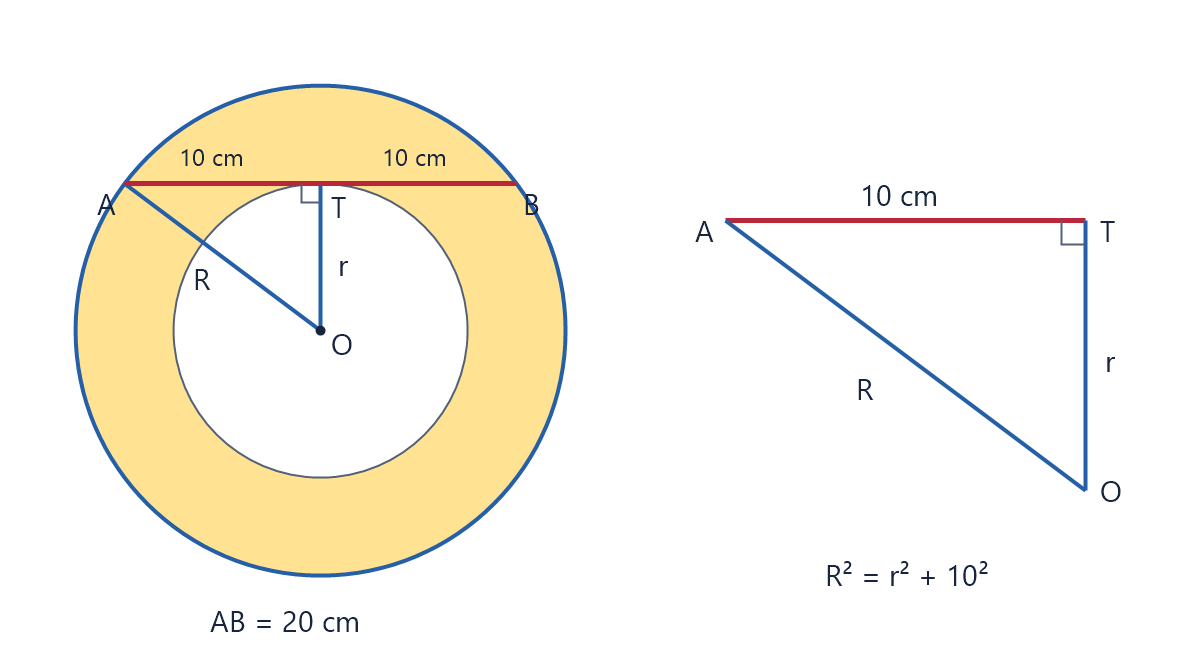
- O is the common centre.
- A and B are the endpoints of the chord on the outer circle.
- T is the point of tangency on the inner circle.
OA = OB = Ris the outer radius;OT = ris the inner radius.
2. Why is half the chord 10 cm?
A radius drawn to a point of tangency is perpendicular to the tangent, so OT ⟂ AB. Also, the perpendicular from the centre of a circle to a chord bisects that chord. This applies because O is also the centre of the outer circle.
To see why, compare right triangles ATO and BTO. They have equal hypotenuses, OA = OB, and share the leg OT. They are congruent, hence AT = TB.
AT = TB = AB/2 = 20/2 = 10 cmThe 10 cm segment is not a radius: it is half the chord. In triangle ATO, OA is the hypotenuse, of length R; the legs are OT, of length r, and AT, of length 10 cm.
3. Pythagoras gives exactly what we need
Apply the Pythagorean theorem to triangle ATO:
R² = r² + (10 cm)²
R² − r² = 100 cm²
Write the area as S to distinguish it from point A. Subtract the inner disk area from the outer disk area:
S = πR² − πr²
  = π(R² − r²)
  = 100π cm² ≈ 314.16 cm²
Answer: 100π cm². The expression containing π is exact; 314.16 cm² is rounded to two decimal places. The result does not depend on the particular radii selected for the illustration.
4. A formula for any tangent chord
If the tangent chord has length L and half-length h = L/2, the same argument gives:
R² − r² = h² = L²/4
S = πh² = πL²/4
The annulus therefore has the same area as a disk whose diameter is L. This is an equality of areas, not a claim that the shapes coincide. Doubling the chord quadruples the area.
The inverse formula recovers the chord from the area:
L = 2√(S/π)5. Different radii, the same area
For L = 20 cm, every positive pair satisfying R² − r² = 100 cm² gives the same area. Here are two examples:
| r (cm) | R (cm) | R² − r² (cm²) | Area (cm²) |
|---|---|---|---|
| 7.5 | 12.5 | 156.25 − 56.25 = 100 | 100π |
| 24 | 26 | 676 − 576 = 100 | 100π |
The second annulus is thinner, but extends around a larger circle. This compensation is also visible in the factorization:
S = π(R − r)(R + r)If the width w = R − r is also known, we can recover both radii. With a 20 cm chord and a width of 2 cm, R + r = 100/2 = 50 cm, so R = 26 cm and r = 24 cm.
6. The assumptions behind the shortcut
The circles must be concentric, with R > r > 0, and the chord must be tangent to the inner circle. The length of an arbitrary chord is not enough.
If the line containing the chord is at distance p from the centre, Pythagoras gives R² = p² + L²/4. The area becomes S = π(L²/4 + p² − r²). The additional terms cancel only when p = r, the tangency condition.
Avoid two common mistakes: R² − r² is not (R − r)², and 20 cm is the whole chord, not the leg to use in Pythagoras.
7. Try it yourself
A 12 cm chord
Find the annulus area.
Show solution
Half the chord is 6 cm:
S = π · 6² = 36π cm² ≈ 113.10 cm².A 30 cm chord
Find the area and compare it with the 20 cm case.
Show solution
S = π · 15² = 225π cm² ≈ 706.86 cm². The ratio is(30/20)² = 2.25: the area is 2.25 times the original area.The inverse problem
The area is 81π cm². How long is the tangent chord?
Show solution
L = 2√(81π/π) = 18 cm. The area does not determine the two radii separately.Checking a drawing
The radii are 13 cm and 5 cm. Find the chord tangent to the inner circle.
Show solution
h = √(13² − 5²) = √144 = 12 cm, henceL = 24 cm. Check:S = π(169 − 25) = 144π cm² = π · 24²/4.
The decisive step is to ask which quantity is actually needed: the area requires only the difference of the squared radii. The right triangle gives it immediately.
By Salvatore Mosaico.