Salvatore Mosaico · 2026
Contents
- 1. The problem
- 2. “12 for me, 9 for you and 14 for you”
- 3. A question that changes the problem
- 4. “Who said they must be whole numbers?”
- 5. Possible does not mean “more probable”
- 6. Why are the chestnuts determined but not the ages?
- 7. What have we learned about AI?
- 8. A final challenge for the class
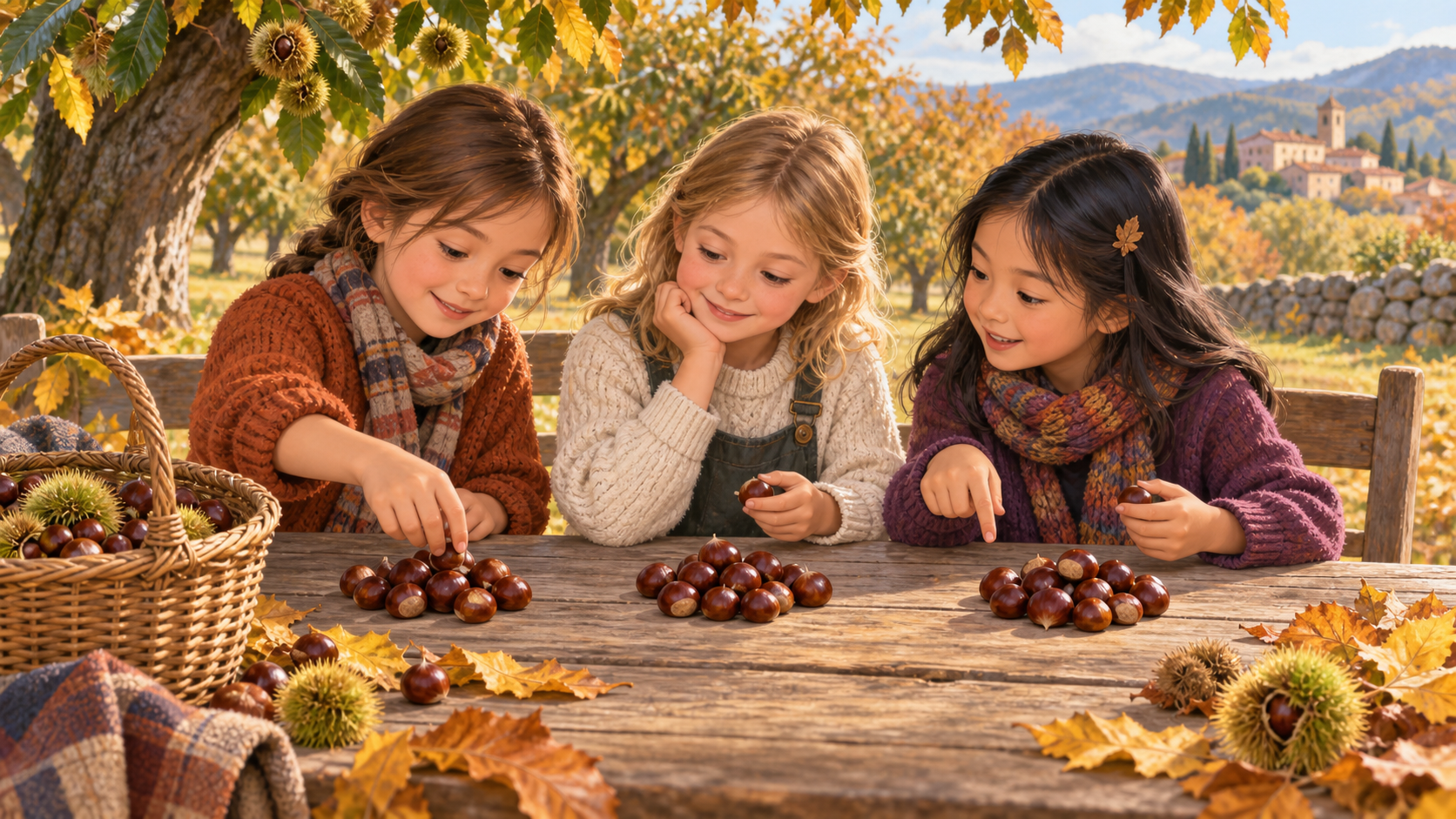
A teaching simulation inspired by the conversation “Calcolo delle castagne”. The dialogue has been adapted for the lesson; it is not a verbatim transcript. The cover is a narrative illustration, not a representation of exact quantities or ages.
1. The problem
Teacher: Three girls, Mary, Nellie and Susie, collect 770 chestnuts. They divide them in proportion to their ages. For every four chestnuts Mary receives, Nellie receives three; for every six Mary receives, Susie receives seven. How many does each girl receive?
Anna: There are three people, but we only know two ratios.
Teacher: Is that enough? Let us ask AI.
AI: The ratios are M : N = 4 : 3 and M : S = 6 : 7. Expressing Mary’s share as 12 parts gives M : N : S = 12 : 9 : 14. There are 35 parts; each is worth 770 ÷ 35 = 22 chestnuts. Mary receives 264, Nellie 198 and Susie 308.
Luca: It has already solved everything.
Teacher: It has supplied a solution. Now let us make its reasoning visible.
2. “12 for me, 9 for you and 14 for you”
Teacher: Put the information in a table:
| Situation | Mary | Nellie | Susie |
|---|---|---|---|
| First ratio | 4 | 3 | — |
| Second ratio | 6 | — | 7 |
Marta: Mary appears twice, with two different numbers.
Teacher: Exactly. We cannot simply take 4, 3 and 7: they are not yet on the same scale. How can we align Mary’s values?
Luca: The least common multiple of 4 and 6 is 12.
Teacher: Multiply the first row by 3 and the second by 2.
| Situation | Mary | Nellie | Susie |
|---|---|---|---|
| First ratio × 3 | 12 | 9 | — |
| Second ratio × 2 | 12 | — | 14 |
Anna: Now we can combine them: M : N : S = 12 : 9 : 14.
Teacher: Imagine repeated rounds of sharing: “12 for Mary, 9 for Nellie and 14 for Susie.” How many chestnuts do we need for one round?
Marta: Thirty-five: 12 + 9 + 14 = 35.
Teacher: How many rounds can we make? 770 ÷ 35 = 22.
| Girl | Parts | Chestnuts |
|---|---|---|
| Mary | 12 | 12 × 22 = 264 |
| Nellie | 9 | 9 × 22 = 198 |
| Susie | 14 | 14 × 22 = 308 |
Davide: Check the total: 264 + 198 + 308 = 770.
Teacher: Check the ratios too: 264 : 198 = 4 : 3 and 264 : 308 = 6 : 7. The solution satisfies every condition.
3. A question that changes the problem
Teacher: We have found the chestnut shares. What about the girls’ ages?
AI: Their ages are proportional to 12, 9 and 14. The most natural triple is therefore 12, 9 and 14 years.
Anna: That sounds reasonable.
Luca: But have we actually proved that Mary is twelve?
Teacher: Did 12 represent an age, or a number of parts?
Marta: A number of parts.
Teacher: Moving from “the ages have ratio 12 : 9 : 14” to “the ages are 12, 9 and 14 years”, what choice did we make?
Davide: We decided that each part means one year.
Teacher: Where does the problem say that?
The class rereads the problem.
Anna: It does not.
4. “Who said they must be whole numbers?”
Luca: Susie would be fourteen. The Italian word “bambine”, meaning young girls, makes me think of younger children.
AI: If the ages are whole numbers, the smallest positive triple is 12, 9 and 14. Perhaps a less child-specific description would be more appropriate.
Teacher: Before correcting the story, stop. Who said the ages must be whole numbers?
Marta: Nobody. A person can be four and a half.
Teacher: Exactly. The problem does not specify completed years expressed as integers. We can represent the ages in years as follows:
Mary = 12 × k
Nellie = 9 × k
Susie = 14 × k
k > 0
Anna: So 12, 9 and 14 years simply correspond to choosing k = 1.
Teacher: Precisely. That triple is not impossible as far as the ratios go. It is one possibility, not a necessary consequence of the data.
AI: Choosing k = ½ gives ages of 6, 4.5 and 7 years.
Marta: The ratios are unchanged: 6 : 4.5 = 4 : 3 and 6 : 7 = 6 : 7.
Teacher: We have found another compatible triple. That alone proves that the ages are not uniquely determined.
5. Possible does not mean “more probable”
Teacher: Try some other values of k.
| k | Mary | Nellie | Susie |
|---|---|---|---|
| ¼ | 3 years | 2 years 3 months | 3 years 6 months |
| ½ | 6 years | 4 years 6 months | 7 years |
| ⅔ | 8 years | 6 years | 9 years 4 months |
| ¾ | 9 years | 6 years 9 months | 10 years 6 months |
Davide: The first triple seems unrealistic for collecting and dividing 770 chestnuts.
Teacher: That is a judgement about context. The story does not tell us how long they took or whether anyone helped them.
Anna: Can we say that six, four and a half, and seven are the most probable ages?
Teacher: We can say they seem plausible. But we have no data for assigning probabilities to the different triples, or for declaring this one the most probable.
Luca: Eight, six, and nine years four months might fit the story too.
Teacher: Exactly. A word like “children” can guide interpretation, but does not supply an exact measurement.
- Proved: the ages have ratio 12 : 9 : 14.
- Possible: the ages are 6, 4.5 and 7 years.
- Not proved: these are the actual or most probable ages.
6. Why are the chestnuts determined but not the ages?
Marta: We use the same ratio. Why can we find the exact chestnut shares but not the ages?
Teacher: For the chestnuts, we also know the total. Let c be the number of chestnuts per part:
12 × c + 9 × c + 14 × c = 770
35 × c = 770
c = 770 ÷ 35 = 22
Teacher: For the ages, we have 12 × k + 9 × k + 14 × k = 35 × k, but we do not know their sum. Nothing determines k.
Davide: So I cannot use 22 for the ages too.
Teacher: Correct. That 22 comes from the chestnut total, not from information about ages. The ratio is shared; the scale is not.
Anna: What extra information would be enough?
Teacher: For example: “Mary is six years old.”
12 × k = 6
k = 6 ÷ 12 = ½
Teacher: Nellie would then be 4.5 and Susie 7. We know the scale, so we know every age.
7. What have we learned about AI?
Teacher: Did AI get the chestnut division wrong?
Class: No.
Teacher: Why keep discussing it, then?
Marta: Because asking about ages introduced a different problem.
Luca: And AI favoured a triple without evidence requiring it.
Anna: Instead of immediately questioning the whole-number assumption, it suggested changing the description of the children.
Davide: The decisive question was not “calculate again”, but “who said they must be whole numbers?”
Teacher: Exactly. The same question applies to answers from me, from you or from a book:
Which assumptions come from the problem, and which did we add ourselves?
We need neither reject every AI answer nor accept it because it sounds convincing. We can use AI to calculate, compare examples and build explanations while distinguishing data, deductions and assumptions.
8. A final challenge for the class
Teacher: Suppose we also know that the ages add up to 28 years. Find all three ages and explain which information removed the uncertainty.
Marta: May we use AI?
Teacher: Yes. But explain why the solution is unique this time.
Show solution and explanation
35 × k = 28
k = 28 ÷ 35 = 0.8
Mary = 12 × 0.8 = 9.6
Nellie = 9 × 0.8 = 7.2
Susie = 14 × 0.8 = 11.2
The sum of the ages determines k uniquely. Check: 9.6 + 7.2 + 11.2 = 28. Ages are expressed in decimal years: 9.6 years does not mean 9 years and 6 months.
The lesson is not that AI is always wrong. It is that a correct answer to one question does not guarantee that every subsequent interpretation is correct.