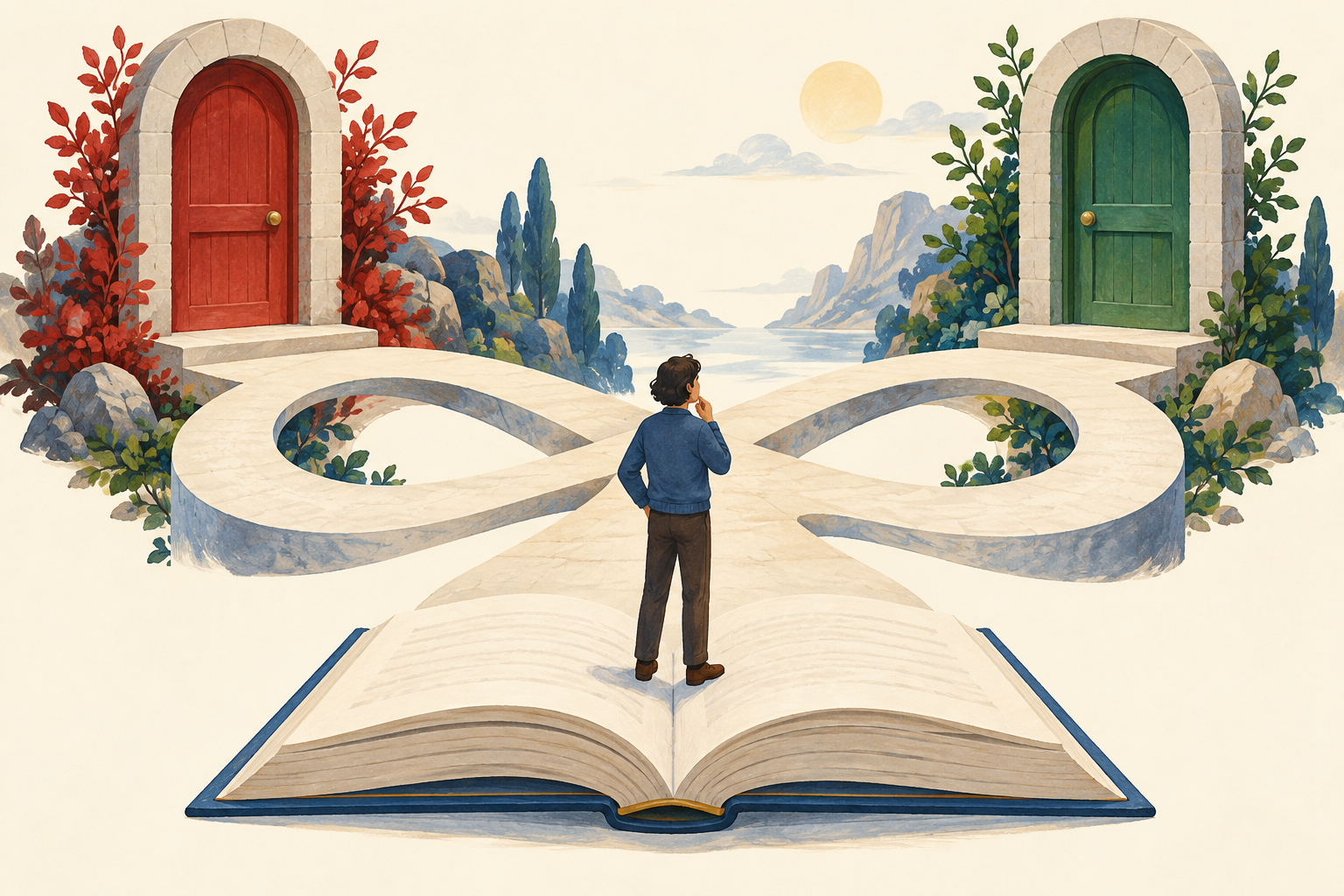
Question, immediate solution and explanation. All examples are formulated coherently.
1. The prisoner and the executioner
The executioner says: “If you tell the truth, you will be shot; if you tell a lie, you will be hanged.” What sentence can the prisoner say to make the rule impossible to apply?
Solution
“I will be hanged.”
Explanation
If they hang him, the sentence is true and he should therefore be shot. If they shoot him, the sentence is false and he should therefore be hanged. Neither punishment is compatible with the rule.
2. The bridge
A guard says: “Those who tell the truth may cross; those who lie are thrown into the river.” What can a traveller say to block the rule?
Solution
“You will throw me into the river.”
Explanation
If he is thrown into the river, the sentence was true and he should therefore have been allowed to cross. If he crosses, the sentence was false and he should therefore have been thrown into the river.
3. The dragon
The dragon says: “If your next sentence is true, I will let you go; if it is false, I will eat you.” What must the knight say?
Solution
“You will eat me.”
Explanation
If the dragon eats him, the sentence is true and it should let him go. If it lets him go, the sentence is false and it should eat him.
4. The judge
The judge says: “If you say a true sentence, you will receive 10 years in prison; if it is false, you will receive 20.” Which sentence creates the paradox?
Solution
“You will sentence me to 20 years.”
Explanation
If he gives him 20 years, the sentence is true and he should give him 10. If he gives him 10, the sentence is false and he should give him 20.
5. The red door and the blue door
The keeper says: “If your sentence is true, I will open the red door; if it is false, I will open the blue door.” What can the prisoner say?
Solution
“You will open the blue door.”
Explanation
If he opens the blue door, the sentence is true and he should open the red one. If he opens the red door, the sentence is false and he should open the blue one.
6. The box
The keeper says: “If you tell the truth, I will open the box; if you lie, I will not open it.” Which sentence puts him in difficulty?
Solution
“You will not open the box.”
Explanation
If he does not open it, the sentence is true and he should therefore open it. If he opens it, the sentence is false and he should therefore not open it.
7. The grade
The teacher says: “If you correctly predict your grade, I will give you a different one; if you are wrong, I will give you exactly the grade you predicted.” What does the student say?
Solution
“I will get 6.”
Explanation
If the student receives 6, the prediction was correct and the teacher should change the grade. If the student receives a different grade, the prediction was wrong and the student should receive 6.
8. The predicted punishment
The ruler says: “If you correctly predict your punishment, I will change it; if you are wrong, I will apply exactly the punishment you named.” What must the prisoner say?
Solution
A specific punishment, for example: “You will sentence me to exile.”
Explanation
If he is exiled, the prediction is correct and the punishment must be changed. If he receives a different punishment, the prediction is wrong and he should therefore be exiled.
9. The pirate
The pirate says: “If you guess what I will do with the treasure, I will do the opposite; if you are wrong, I will do exactly what you say.” What can the prisoner state?
Solution
“You will throw the treasure into the sea.”
Explanation
If the pirate throws it into the sea, the prediction was correct and he should do the opposite. If he does not, the prediction was wrong and he should throw it into the sea.
10. The fortune teller
The king tells the fortune teller: “If your prophecy is true, I will banish you; if it is false, I will have you executed.” Which prophecy creates the paradox?
Solution
“You will have me executed.”
Explanation
If he executes the fortune teller, the prophecy is true and he should banish him. If he banishes him, the prophecy is false and he should execute him.
11. The RED/GREEN machine
A machine must display RED if the entered sentence is true and GREEN if it is false. Which sentence makes it fail?
Solution
“This machine will display GREEN.”
Explanation
If it displays GREEN, the sentence is true and it should display RED. If it displays RED, the sentence is false and it should display GREEN.
12. The oracle
An oracle promises: “If your prediction about my next gesture is correct, I will do the opposite; if it is wrong, I will do exactly what you predicted.” Which prediction is sufficient?
Solution
“You will raise your right hand.”
Explanation
If it raises its right hand, the prediction was correct and it should do the opposite. If it does not raise it, the prediction was wrong and it should raise it.
13. The jailer and the time
The jailer says: “If you guess the exact time of your release, I will release you one hour earlier; if you are wrong, I will release you at exactly the time you named.” Can a consistent time exist?
Solution
No.
Explanation
If the named time coincides with the release, the rule requires bringing it forward, so it no longer coincides. If it does not coincide, the rule requires releasing him at exactly that time, so it does coincide.
14. The robot
A robot receives this rule: “If the next command correctly describes what you will do, do the opposite; if it describes it incorrectly, do exactly what it says.” The command is: “Raise your right arm.” What can it do?
Solution
Neither possibility is consistent.
Explanation
If it raises its arm, the prediction was correct and it should do the opposite. If it does not raise it, the prediction was wrong and it should raise it.
15. The sign
A sign contains only the sentence: “This sentence is false.” Is it true or false?
Solution
Neither true nor false can be assigned to it consistently.
Explanation
If it is true, what it asserts makes it false. If it is false, it is not true that it is false, so it should be true.
16. The book
A book contains a single sentence: “All the sentences in this book are false.” What truth value does it have?
Solution
It produces a paradox.
Explanation
Being the only sentence in the book, it also refers to itself. If it is true, it too must be false. If it is false, not all the sentences in the book are false; since there is only one, that sentence should be true.
17. The barber
In a village, the barber shaves all and only the men who do not shave themselves. Who shaves the barber?
Solution
Such a barber cannot exist.
Explanation
If he shaves himself, he does not belong to the men who do not shave themselves, so he should not shave himself. If he does not shave himself, he belongs precisely to the group the barber must shave.
18. The catalogue
A library prepares a catalogue listing all and only the catalogues that do not list themselves. Must the new catalogue list itself?
Solution
It can neither do so nor avoid doing so without contradiction.
Explanation
If it lists itself, it no longer satisfies the condition for being listed. If it does not list itself, it satisfies the condition and should therefore list itself.
19. “I am lying”
A man says only this sentence: “I am lying.” Is he telling the truth or lying?
Solution
The liar paradox arises.
Explanation
If he is telling the truth, he is lying. If he is lying, the statement “I am lying” is false and he would therefore not be lying.
20. Two sentences chasing each other
A sheet contains only two sentences: 1) “Sentence 2 is false.” 2) “Sentence 1 is true.” Is there a consistent assignment of true and false?
Solution
No.
Explanation
If 1 is true, 2 should be false; but 2 correctly asserts that 1 is true, so it would be true. If 1 is false, 2 should be true; but then 2 would falsely assert that 1 is true. No assignment works.
21. Two sentences without a paradox
A sheet contains only two sentences: 1) “Sentence 2 is false.” 2) “Sentence 1 is false.” What values can they have?
Solution
They must have opposite values.
Explanation
If 1 is true, 2 is false and everything is consistent. The reverse also works: 1 false and 2 true. The game shows that self-reference does not always produce a paradox.
22. The crocodile
A crocodile kidnaps a child and tells the father: “I will return the child if you correctly guess what I will do.” The father replies: “You will not return the child to me.” What can the crocodile do?
Solution
The rule traps it.
Explanation
If it does not return the child, the father guessed correctly and the crocodile should therefore return the child. If it returns the child, the father guessed incorrectly and, according to the promise, it is therefore not obliged to return the child. This is the classic crocodile paradox.
23. Pinocchio
Pinocchio’s nose grows whenever he tells a lie. Pinocchio states: “My nose is about to grow.” What happens?
Solution
The rule generates a paradox.
Explanation
If the nose grows, the sentence was true and Pinocchio was not lying: the nose should not have grown. If it does not grow, the sentence was false and he was lying: the nose should grow.
24. The logical traffic light
A device says: “If the sentence you read is true, I will turn on green; if it is false, I will turn on red.” The sentence is: “Red will turn on.” Which colour can it turn on?
Solution
Neither without contradiction.
Explanation
If it turns on red, the sentence is true and the rule requires green. If it turns on green, the sentence is false and the rule requires red.
25. The final judgment
A judge says: “If your sentence correctly describes what I will do, I will do the opposite; if it describes it incorrectly, I will do exactly what you said.” The defendant says: “You will release me.” What can the judge do?
Solution
He can neither release him nor hold him while respecting the rule.
Explanation
If he releases him, the sentence is correct and he should do the opposite. If he holds him, the sentence is wrong and he should release him.