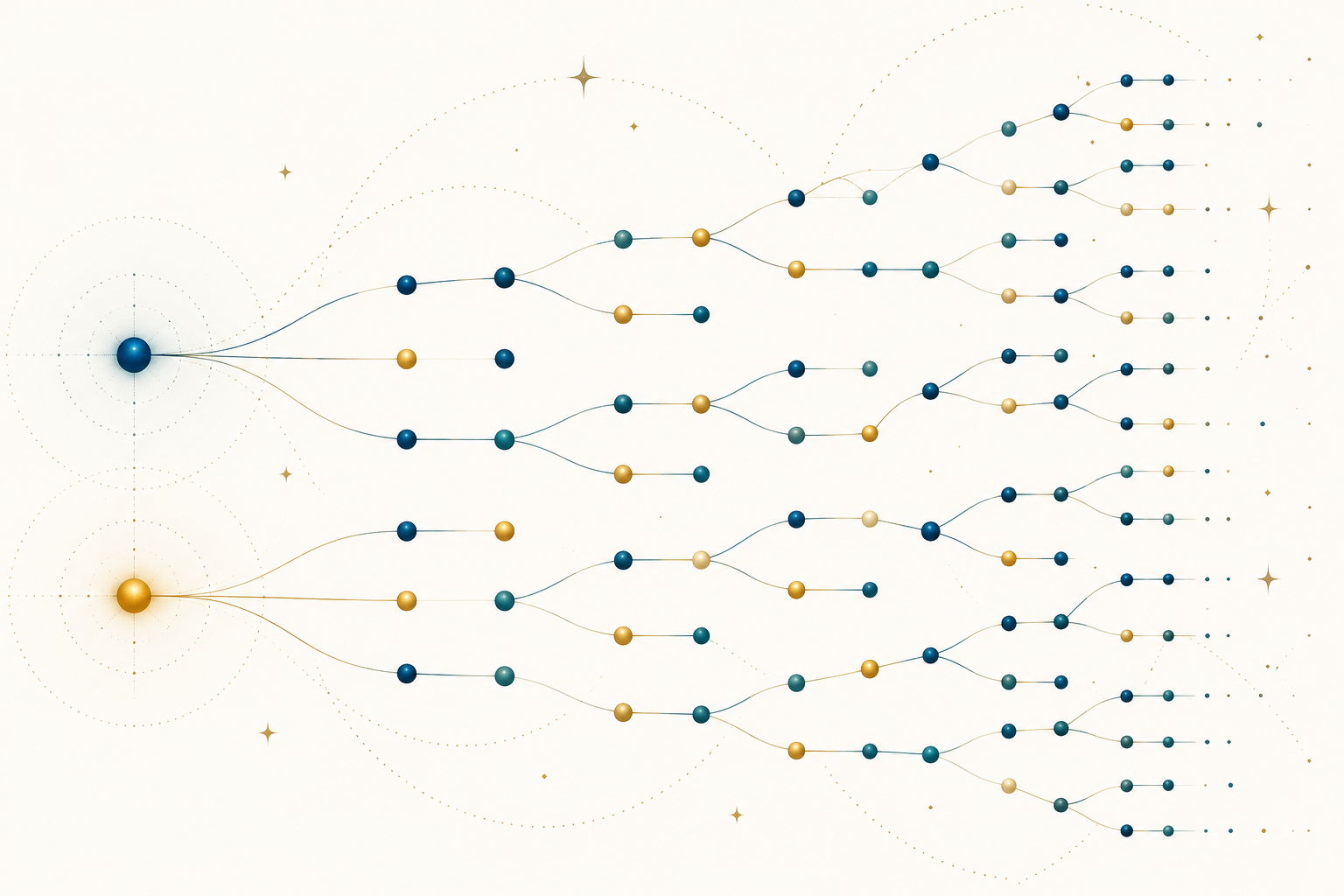
Fajtlowicz’s conjecture
In 1993 Siemion Fajtlowicz conjectured that every odd prime belongs to a three-prime arithmetic progression (Written on the Wall, no. 783).
Mode A — forward generation: two primes already reached, a < b, serve as the first two terms; we try only c = 2b − a. Starting from 3 and 5, this rule does not reach 13.
Mode B — full closure: the pair may occupy any two positions; we also test c = 2a − b and c = (a+b)/2, accepting only prime results. Here the question is stronger than the historical conjecture: can we reach every odd prime from {3,5}? A finite check cannot prove this.
We start with just two primes, 3 and 5. Can we build others by completing three-prime arithmetic progressions? The first move is simple: 3, 5, 7. But how far can the procedure take us? The interactive laboratory lets us explore the question one generation at a time.
Define the rule before calculating
Three numbers form an arithmetic progression when the difference between the second and first equals the difference between the third and second: a, a+d, a+2d. In our experiment all three must be prime. For example, 3, 5, 7 has common difference 2; 3, 7, 11 has difference 4; and 5, 11, 17 has difference 6.
Let S₀ = {3,5} be the initial set. These two primes are generation 0. Each new generation uses only primes already available; values discovered during one step become available in the next. This convention gives each prime an understandable genealogy.
Mode A: forward generation
Take two available primes a < b as the first two terms. The next candidate is c = 2b − a. Add c if it is prime. Pair (3,5) yields 7; pair (3,7) yields 11; later, (5,11) yields 17. Every new prime is larger than both parents: this mode follows the intuitive process of extending the progression forward.
The first prime not reached in this mode is 13. This is not a software failure: producing 13 in the forward direction would require two smaller primes as the first two terms of such a progression, and there are none. The laboratory nevertheless uses the cautious wording “not reached within the experiment’s limits”, especially while a larger computation is running or has stopped early.
Mode B: full closure
A pair of primes can occupy other positions as well. In addition to 2b − a, we test 2a − b as the first term and (a+b)/2 as the middle term, accepting only odd primes. Now 13 has a different fate: once 7 and 19 are available, we complete 7, 13, 19, because 13 is their average. In this mode 13 appears in generation 4. The modes must not be confused: they investigate different notions of reachability.
The limit N and margin M
The laboratory compares the reached primes with all odd primes up to N, found with the sieve of Eratosthenes. It shows how many are reached, percentage coverage, the largest reached prime, the generations and the first gap. Bounded closure accepts only values up to N. A margin search can generate primes up to M > N while still measuring coverage only up to N. In full-closure mode, a temporary step through primes larger than N might help reach a smaller prime.
Read the path, not only the answer
“Next generation” displays the pairs and formulas that produced new primes. Searching for a particular prime shows one witnessing progression and its chain of parents back to 3 and 5. Two charts show how many primes appear in each generation and how coverage evolves. Results can be exported as CSV or JSON. Computation stays in the browser and does not query the site database.
What does the experiment prove?
A check up to N proves only a finite statement about the examined numbers and the selected rule. It does not prove the property for all primes. Moreover, “a prime belongs to some three-prime progression” is weaker than “a prime can be reached from {3,5} by these iterations”. If the computation budget stops a generation, results are explicitly partial: a still-missing prime is not a counterexample.
Open the laboratory on primes in arithmetic progression
Can we start from another pair?
Yes: the laboratory accepts two user-chosen odd primes to start a new experiment. “Raise limit and continue” instead keeps every prime already reached, extends the limit and continues the same experiment while the page remains open. If a phase budget is exhausted, “Continue computation” resumes from the exact point where it stopped.