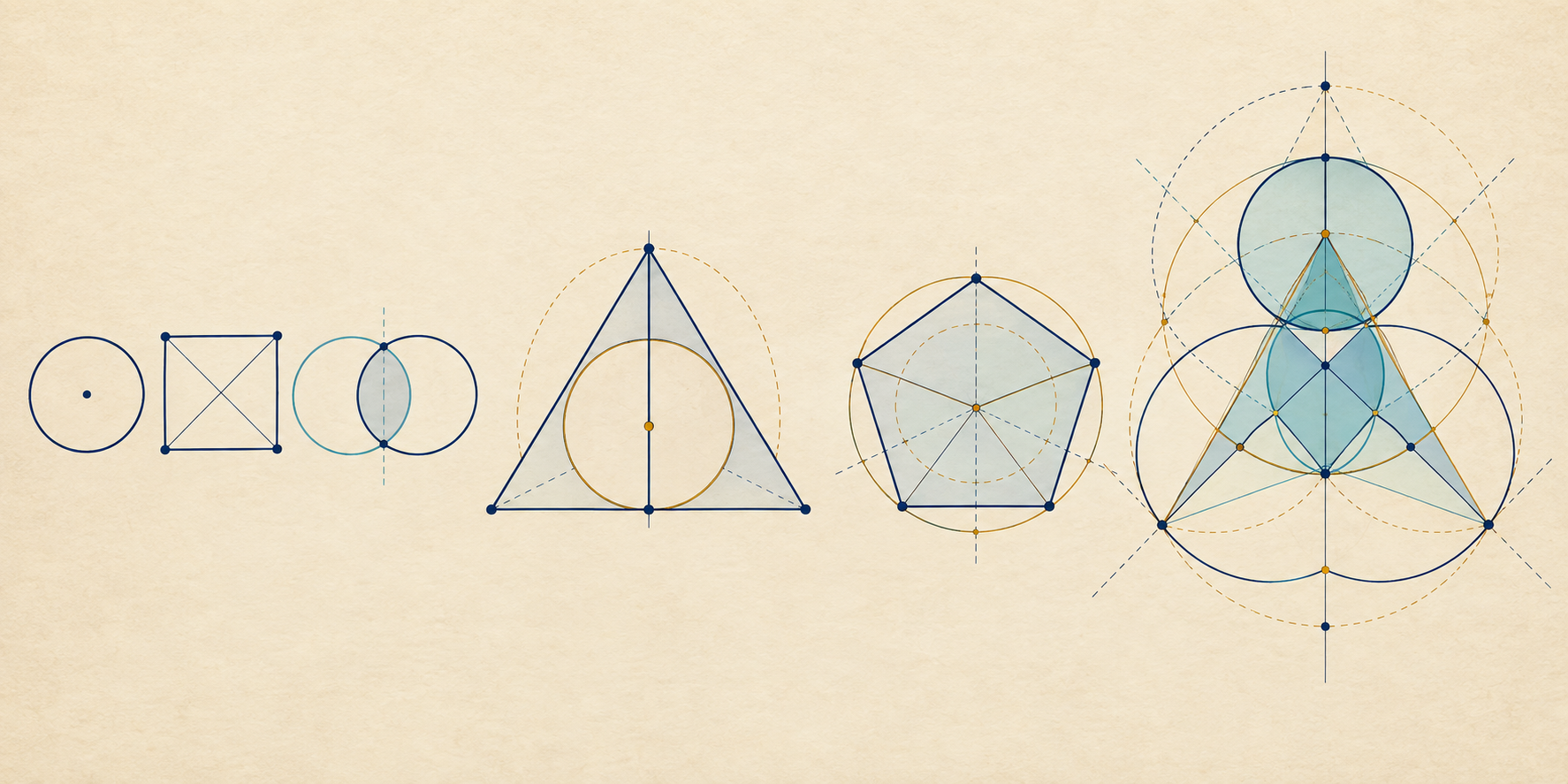
This collection covers triangles, quadrilaterals, circles, similarity and a final maximum-area problem. The early questions practise formulas; the later ones require a construction or a combination of ideas. The drawings are left to you: making one is often the first step toward a solution.
How to use it: try each problem on paper, show the units, and open the solution only after trying. When π appears, keep the exact result instead of replacing it with 3.14. All figures are Euclidean and all lengths are positive.
Basic level — problems 1–10
1. A rectangle from its perimeter
A rectangle has perimeter 46 cm and one side 8 cm. Find the other side and its area.
Show the solution
The sum of the two sides is 46/2=23 cm. The other side is 23−8=15 cm, and the area is 8·15=120 cm².
2. A square from its diagonal
The diagonal of a square is 10√2 cm. Find its side and area.
Show the solution
For a square d=l√2. Therefore l=10 cm and A=l²=100 cm².
3. Legs of 9 and 12
A right triangle has legs of 9 cm and 12 cm. Calculate its hypotenuse and area.
Show the solution
By Pythagoras c=√(9²+12²)=√225=15 cm. Its area is (9·12)/2=54 cm².
4. An isosceles triangle
An isosceles triangle has equal sides of 13 cm and a base of 10 cm. Find its altitude and area.
Show the solution
The altitude bisects the base into two 5 cm segments. By Pythagoras h=√(13²−5²)=12 cm. The area is 10·12/2=60 cm².
5. A quarter of a disk
A circular sector has radius 7 cm and central angle 90°. Find its area and arc length.
Show the solution
The sector is one quarter of the disk. Area=(π·7²)/4=49π/4 cm²; arc length=(2π·7)/4=7π/2 cm.
6. A regular hexagon
A regular hexagon has side length 6 cm. Find its perimeter and area.
Show the solution
The perimeter is 6·6=36 cm. Divide the hexagon into six equilateral triangles of side 6; each has area 9√3 cm². The total area is 54√3 cm².
7. Similar triangles
A triangle has sides 3, 4 and 5 cm. A similar triangle has perimeter 48 cm. Find its sides and area.
Show the solution
The first perimeter is 12 cm, so the scale factor is 48/12=4. The sides are 12, 16 and 20 cm. The triangle is right-angled, with area (12·16)/2=96 cm².
8. Trapezoid and midsegment
A trapezoid has bases of 10 and 18 cm and height 7 cm. Find its area and the length of its midsegment.
Show the solution
The midsegment is (10+18)/2=14 cm. Area=midsegment · height=14·7=98 cm².
9. A rhombus from its diagonals
The diagonals of a rhombus are 10 and 24 cm. Find its area and perimeter.
Show the solution
Area=(10·24)/2=120 cm². The half-diagonals are 5 and 12 cm and form a right triangle; the side is √(5²+12²)=13 cm. Perimeter=52 cm.
10. A circle inside a square
A circle is inscribed in a square of side 12 cm. What area of the square lies outside the circle?
Show the solution
The diameter is 12 cm, so the radius is 6 cm. The difference of the areas is 12²−π·6²=144−36π cm².
Intermediate level — problems 11–20
11. The 13–14–15 triangle
A triangle has sides 13, 14 and 15 cm. Find its area and the altitude to the 14 cm side.
Show the solution
The semiperimeter is s=(13+14+15)/2=21 cm. By Heron formula A=√[21(21−13)(21−14)(21−15)]=√7056=84 cm². Since A=14h/2, h=12 cm.
12. A chord
In a circle of radius 13 cm, a chord is 5 cm from the centre. How long is it?
Show the solution
The perpendicular from the centre bisects the chord. Half the chord is √(13²−5²)=12 cm, so the whole chord is 24 cm.
13. A circular annulus
Two concentric circles have radii 10 and 6 cm. Find the area between them.
Show the solution
Subtract the areas: π·10²−π·6²=(100−36)π=64π cm².
14. Two intersecting chords
Chords AB and CD meet at an interior point P. Given AP=3 cm, PB=8 cm and CP=4 cm, find PD.
Show the solution
The intersecting-chords theorem gives AP·PB=CP·PD. Therefore 3·8=4·PD and PD=6 cm.
15. A cyclic quadrilateral
Two opposite angles of a quadrilateral inscribed in a circle measure (2x+10)° and (3x−5)°. Find x and both angles.
Show the solution
Opposite angles are supplementary: (2x+10)+(3x−5)=180. Thus 5x+5=180 and x=35. The angles are 80° and 100°.
16. The centroid
Along a median of a triangle, the distance from a vertex to the centroid is 10 cm. Find the full median and the segment from the centroid to the midpoint of the opposite side.
Show the solution
The centroid divides the median in the ratio 2:1 from the vertex. The 10 cm represent two parts, so one part is 5 cm. The full median is 15 cm and the remaining segment is 5 cm.
17. An internal angle bisector
In triangle ABC, AB=6 cm, AC=9 cm and BC=10 cm. The bisector of angle A meets BC at D. Find BD and DC.
Show the solution
By the angle-bisector theorem BD:DC=AB:AC=6:9=2:3. Five parts make BC=10 cm, so one part is 2 cm: BD=4 cm and DC=6 cm.
18. A common external tangent
Two circles have radii 9 and 4 cm and their centres are 13 cm apart. Find the length of the common external tangent segment between the points of tangency.
Show the solution
The requested segment, the distance between centres and the difference of the radii form a right triangle. Its length is √[13²−(9−4)²]=√144=12 cm.
19. An equilateral triangle
An equilateral triangle has side 12 cm. Find its area, inradius and circumradius.
Show the solution
The altitude is 12√3/2=6√3 cm. Area=12·6√3/2=36√3 cm². The centre divides the altitude in the ratio 2:1, giving r=2√3 cm and R=4√3 cm.
20. A square inscribed in a circle
A circle has radius 5 cm. Find the area of the square whose four vertices lie on the circle.
Show the solution
The square diagonal is the diameter, 10 cm. Its side is 10/√2=5√2 cm and its area is (5√2)²=50 cm².
Advanced level — problems 21–25
21. Two radii of the 13–14–15 triangle
Return to the triangle with sides 13, 14 and 15 cm. Find its inradius and circumradius.
Show the solution
From problem 11, A=84 cm² and s=21 cm. Since A=rs, the inradius is r=84/21=4 cm. From A=abc/(4R), R=(13·14·15)/(4·84)=65/8 cm.
22. Perimeter and diagonal of a rectangle
A rectangle has perimeter 34 cm and diagonal 13 cm. Determine its sides and area.
Show the solution
If the sides are a,b, then a+b=17 and a²+b²=169. Since (a+b)²=a²+b²+2ab, we have 289=169+2ab and ab=60. The sides are the roots of t²−17t+60=0: 5 and 12 cm; the area is 60 cm².
23. The common chord of two circles
Two circles of equal radius 5 cm have centres 6 cm apart and intersect. Find the length of their common chord.
Show the solution
The common chord is perpendicular to the line of centres and, by symmetry, crosses it at its midpoint, 3 cm from either centre. Half the chord is √(5²−3²)=4 cm, so its length is 8 cm.
24. A square inside a right triangle
A right triangle has legs 6 and 8 cm. A square has one vertex at the right angle, two sides along the legs, and its opposite vertex on the hypotenuse. Find the side and area of the square.
Show the solution
Let s be the side of the square. The hypotenuse line meets the axes at 6 and 8 cm: a point (s,s) on it satisfies s/6+s/8=1. Hence 7s/24=1 and s=24/7 cm. The area is s²=576/49 cm².
25. The largest rectangle in a semicircle
A rectangle has its base on the diameter of a semicircle of radius 5 cm and its two upper vertices on the arc. What is its greatest possible area?
Show the solution
Let x be half the base and y the height. Pythagoras gives x²+y²=25 and the area is A=2xy. Because (x−y)²≥0, we have 2xy≤x²+y²=25. Equality holds at x=y=5/√2, so the maximum area is 25 cm².
A shared strategy
Before looking for a formula, ask which segment, angle or area can be derived from the given data. Sometimes drawing an altitude is enough; elsewhere similarity, a circle theorem or an inequality is needed. Geometry is also the art of choosing the right drawing.