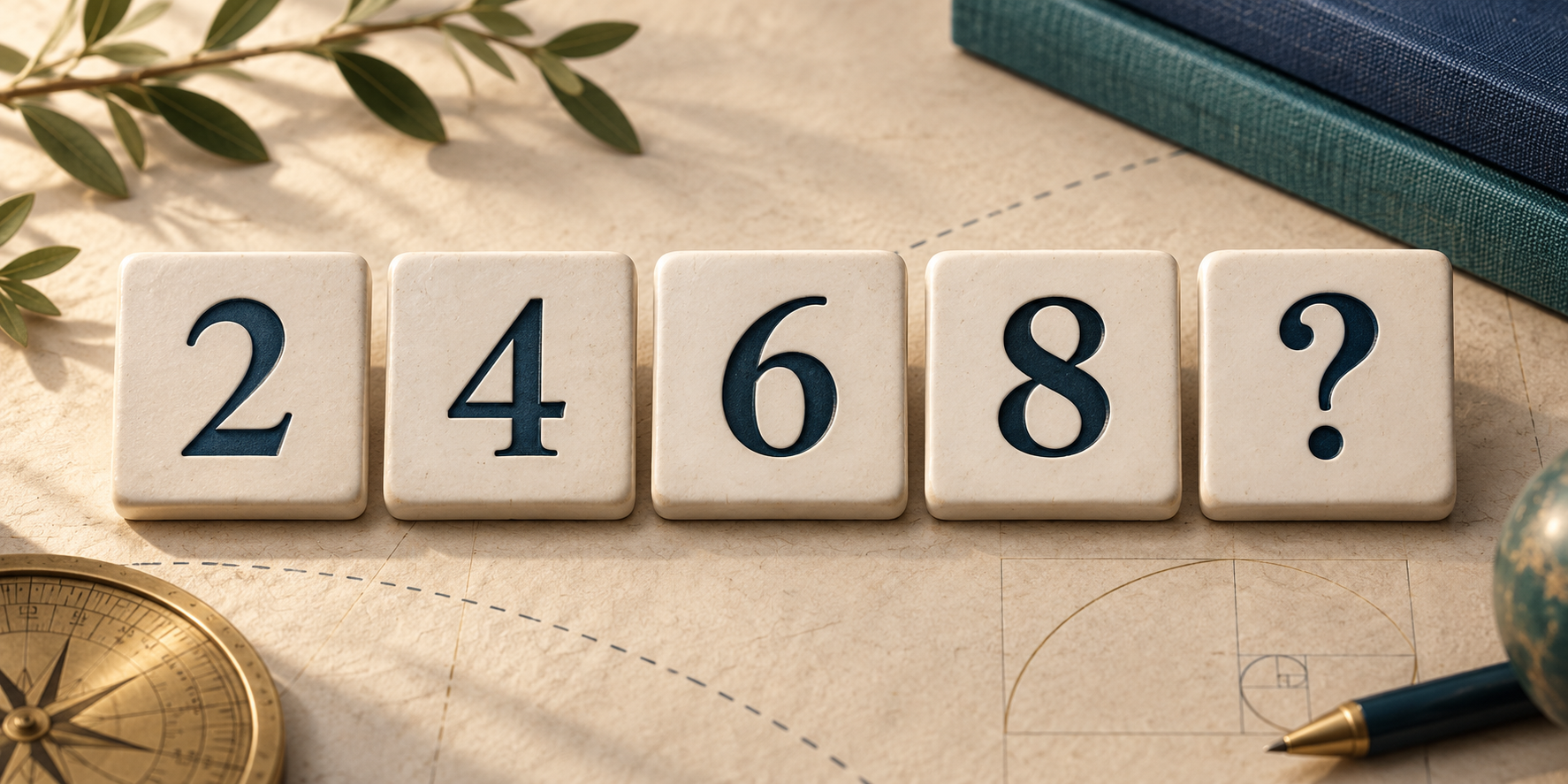
What number comes next? The question only looks simple. This collection offers one hundred puzzles grouped by strategy: progressions, differences, alternating patterns, digits, recurrences, famous families and traps. Each puzzle states an intended rule and verifies it; a finite prefix is never presented as forcing a unique continuation.
Open the interactive laboratory · Why four numbers do not determine the fifth
How to use this collection
Try guessing before opening the hints. Each puzzle offers two progressive clues, an answer and a check. In the laboratory you can choose among four options, enter a free answer, take a ten-puzzle challenge, analyze your own numbers, construct any continuation by Lagrange interpolation, or browse the filterable archive.
An answer is a choice of rule, not an inevitable deduction
Even when one solution fits every displayed number, another rule may produce a different next term. Interpolation can even construct an exact polynomial that matches the initial data and takes any chosen value at the next position. Here the question asks for the continuation under the stated rule: these puzzles train us to formulate and compare hypotheses, not to guess a hidden absolute truth.
A. Deceptively simple
They look immediate, yet require care in identifying the repeated operation.
1. Add three
Level 1 · 4, 7, 10, 13, 16, ?
Options: 22 · 16 · 32 · 19
First hint
Compare neighboring terms.
Second hint
Try a simple rule that works at every step. Δ=3
Solution and verification
Intended answer: 19. The intended rule is «Add three». Check that the same relation describes every term, not only the final step. Check : 16+3=19. This is a compatible continuation, not necessarily the only one.
Formula or property: a(n)=3n+1. 16+3=19
2. Multiply by three
Level 1 · 2, 6, 18, 54, 162, ?
Options: 594 · 378 · 486 · 270
First hint
Compare neighboring terms.
Second hint
Try a simple rule that works at every step. ratio=3
Solution and verification
Intended answer: 486. The intended rule is «Multiply by three». Check that the same relation describes every term, not only the final step. Check : 162·3=486. This is a compatible continuation, not necessarily the only one.
Formula or property: a(n)=2·3^(n−1). 162·3=486
3. Consecutive squares
Level 1 · 1, 4, 9, 16, 25, ?
Options: 27 · 36 · 34 · 45
First hint
Compare neighboring terms.
Second hint
Try a simple rule that works at every step. 1²,2²,3²
Solution and verification
Intended answer: 36. The intended rule is «Consecutive squares». Check that the same relation describes every term, not only the final step. Check : 6²=36. This is a compatible continuation, not necessarily the only one.
Formula or property: a(n)=n². 6²=36
4. Triangular numbers
Level 2 · 1, 3, 6, 10, 15, ?
Options: 21 · 20 · 26 · 16
First hint
Compare neighboring terms.
Second hint
Try a simple rule that works at every step. Δ=2,3,4,5
Solution and verification
Intended answer: 21. The intended rule is «Triangular numbers». Check that the same relation describes every term, not only the final step. Check : 15+6=21. This is a compatible continuation, not necessarily the only one.
Formula or property: a(n)=n(n+1)/2. 15+6=21
5. One above a square
Level 2 · 2, 5, 10, 17, 26, ?
Options: 35 · 46 · 28 · 37
First hint
Compare neighboring terms.
Second hint
Try a simple rule that works at every step. a(n)−1=n²
Solution and verification
Intended answer: 37. The intended rule is «One above a square». Check that the same relation describes every term, not only the final step. Check : 6²+1=37. This is a compatible continuation, not necessarily the only one.
Formula or property: a(n)=n²+1. 6²+1=37
6. One below a power of two
Level 2 · 1, 3, 7, 15, 31, ?
Options: 79 · 62 · 63 · 47
First hint
Compare neighboring terms.
Second hint
Try a simple rule that works at every step. a(n)+1=2^n
Solution and verification
Intended answer: 63. The intended rule is «One below a power of two». Check that the same relation describes every term, not only the final step. Check : 2^6−1=63. This is a compatible continuation, not necessarily the only one.
Formula or property: a(n)=2^n−1. 2^6−1=63
7. Neighboring product
Level 2 · 2, 6, 12, 20, 30, ?
Options: 32 · 42 · 40 · 52
First hint
Compare neighboring terms.
Second hint
Try a simple rule that works at every step. 1·2,2·3,3·4
Solution and verification
Intended answer: 42. The intended rule is «Neighboring product». Check that the same relation describes every term, not only the final step. Check : 6·7=42. This is a compatible continuation, not necessarily the only one.
Formula or property: a(n)=n(n+1). 6·7=42
8. Square plus double
Level 3 · 3, 8, 15, 24, 35, ?
Options: 48 · 46 · 59 · 37
First hint
Compare neighboring terms.
Second hint
Try a simple rule that works at every step. a(n)+1=(n+1)²
Solution and verification
Intended answer: 48. The intended rule is «Square plus double». Check that the same relation describes every term, not only the final step. Check : 6²+2·6=48. This is a compatible continuation, not necessarily the only one.
Formula or property: a(n)=n²+2n. 6²+2·6=48
9. Factorials
Level 2 · 1, 2, 6, 24, 120, ?
Options: 216 · 816 · 624 · 720
First hint
Compare neighboring terms.
Second hint
Try a simple rule that works at every step. ×2,×3,×4,×5
Solution and verification
Intended answer: 720. The intended rule is «Factorials». Check that the same relation describes every term, not only the final step. Check : 6!=720. This is a compatible continuation, not necessarily the only one.
Formula or property: a(n)=n!. 6!=720
10. Double then subtract one
Level 2 · 3, 5, 9, 17, 33, ?
Options: 81 · 66 · 65 · 49
First hint
Compare neighboring terms.
Second hint
Try a simple rule that works at every step. ×2−1
Solution and verification
Intended answer: 65. The intended rule is «Double then subtract one». Check that the same relation describes every term, not only the final step. Check : 2·33−1=65. This is a compatible continuation, not necessarily the only one.
Formula or property: a(n+1)=2a(n)−1. 2·33−1=65
11. Doubling jumps
Level 3 · 2, 3, 5, 9, 17, ?
Options: 34 · 33 · 25 · 41
First hint
Compare neighboring terms.
Second hint
Try a simple rule that works at every step. Δ=1,2,4,8
Solution and verification
Intended answer: 33. The intended rule is «Doubling jumps». Check that the same relation describes every term, not only the final step. Check : 17+16=33. This is a compatible continuation, not necessarily the only one.
Formula or property: Δa=1,2,4,8,16. 17+16=33
12. Consecutive cubes
Level 2 · 1, 8, 27, 64, 125, ?
Options: 216 · 186 · 277 · 155
First hint
Compare neighboring terms.
Second hint
Try a simple rule that works at every step. 1³,2³,3³
Solution and verification
Intended answer: 216. The intended rule is «Consecutive cubes». Check that the same relation describes every term, not only the final step. Check : 6³=216. This is a compatible continuation, not necessarily the only one.
Formula or property: a(n)=n³. 6³=216
13. Subtract increasingly more
Level 2 · 10, 9, 7, 4, 0, ?
Options: -4 · -1 · -9 · -5
First hint
Compare neighboring terms.
Second hint
Try a simple rule that works at every step. −1,−2,−3,−4
Solution and verification
Intended answer: -5. The intended rule is «Subtract increasingly more». Check that the same relation describes every term, not only the final step. Check : 0−5=−5. This is a compatible continuation, not necessarily the only one.
Formula or property: Δa=−1,−2,−3,−4,−5. 0−5=−5
14. Consecutive increases
Level 2 · 1, 2, 4, 7, 11, ?
Options: 20 · 12 · 16 · 15
First hint
Compare neighboring terms.
Second hint
Try a simple rule that works at every step. Δ=1,2,3,4
Solution and verification
Intended answer: 16. The intended rule is «Consecutive increases». Check that the same relation describes every term, not only the final step. Check : 11+5=16. This is a compatible continuation, not necessarily the only one.
Formula or property: Δa=1,2,3,4,5. 11+5=16
15. Early prime numbers
Level 2 · 2, 3, 5, 7, 11, ?
Options: 9 · 13 · 15 · 17
First hint
Compare neighboring terms.
Second hint
Try a simple rule that works at every step. 2,3,5,7,11
Solution and verification
Intended answer: 13. The intended rule is «Early prime numbers». Check that the same relation describes every term, not only the final step. Check : 13∈ℙ, 11<13. This is a compatible continuation, not necessarily the only one.
Formula or property: a(n)=prime(n). 13∈ℙ, 11<13
B. Hidden differences
When jumps change, their differences often reveal another hidden sequence.
16. Growing even differences
Level 2 · 3, 7, 13, 21, 31, ?
Options: 43 · 41 · 53 · 33
First hint
Write down consecutive differences.
Second hint
Also inspect the differences between those differences. Δ²=2
Solution and verification
Intended answer: 43. The intended rule is «Growing even differences». Compare consecutive jumps or values against their positions: their pattern suggests the rule. Check : 31+12=43. This is a compatible continuation, not necessarily the only one.
Formula or property: Δa=4,6,8,10,12. 31+12=43
17. Constant third differences
Level 3 · 1, 2, 5, 12, 25, ?
Options: 38 · 59 · 33 · 46
First hint
Write down consecutive differences.
Second hint
Also inspect the differences between those differences. Δ³=2
Solution and verification
Intended answer: 46. The intended rule is «Constant third differences». Compare consecutive jumps or values against their positions: their pattern suggests the rule. Check : 25+21=46. This is a compatible continuation, not necessarily the only one.
Formula or property: Δa=1,3,7,13,21. 25+21=46
18. Prime-number jumps
Level 3 · 1, 3, 6, 11, 18, ?
Options: 36 · 22 · 29 · 25
First hint
Write down consecutive differences.
Second hint
Also inspect the differences between those differences. Δ=2,3,5,7
Solution and verification
Intended answer: 29. The intended rule is «Prime-number jumps». Compare consecutive jumps or values against their positions: their pattern suggests the rule. Check : 18+11=29. This is a compatible continuation, not necessarily the only one.
Formula or property: Δa=2,3,5,7,11. 18+11=29
19. Square-number jumps
Level 3 · 0, 1, 5, 14, 30, ?
Options: 39 · 55 · 46 · 71
First hint
Write down consecutive differences.
Second hint
Also inspect the differences between those differences. Δ=1,4,9,16
Solution and verification
Intended answer: 55. The intended rule is «Square-number jumps». Compare consecutive jumps or values against their positions: their pattern suggests the rule. Check : 30+25=55. This is a compatible continuation, not necessarily the only one.
Formula or property: Δa=1²,2²,3²,4²,5². 30+25=55
20. Cube-number jumps
Level 3 · 0, 1, 9, 36, 100, ?
Options: 225 · 164 · 289 · 161
First hint
Write down consecutive differences.
Second hint
Also inspect the differences between those differences. Δ=1,8,27,64
Solution and verification
Intended answer: 225. The intended rule is «Cube-number jumps». Compare consecutive jumps or values against their positions: their pattern suggests the rule. Check : 100+125=225. This is a compatible continuation, not necessarily the only one.
Formula or property: Δa=1³,2³,3³,4³,5³. 100+125=225
21. Factorial jumps
Level 3 · 0, 1, 3, 9, 33, ?
Options: 57 · 177 · 129 · 153
First hint
Write down consecutive differences.
Second hint
Also inspect the differences between those differences. Δ=1,2,6,24
Solution and verification
Intended answer: 153. The intended rule is «Factorial jumps». Compare consecutive jumps or values against their positions: their pattern suggests the rule. Check : 33+120=153. This is a compatible continuation, not necessarily the only one.
Formula or property: Δa=1!,2!,3!,4!,5!. 33+120=153
22. Fibonacci jumps
Level 3 · 0, 1, 2, 4, 7, ?
Options: 15 · 9 · 12 · 10
First hint
Write down consecutive differences.
Second hint
Also inspect the differences between those differences. Δ=1,1,2,3
Solution and verification
Intended answer: 12. The intended rule is «Fibonacci jumps». Compare consecutive jumps or values against their positions: their pattern suggests the rule. Check : 7+5=12. This is a compatible continuation, not necessarily the only one.
Formula or property: Δa=1,1,2,3,5. 7+5=12
23. Power-of-two jumps
Level 2 · 0, 1, 3, 7, 15, ?
Options: 30 · 31 · 23 · 39
First hint
Write down consecutive differences.
Second hint
Also inspect the differences between those differences. Δ=1,2,4,8
Solution and verification
Intended answer: 31. The intended rule is «Power-of-two jumps». Compare consecutive jumps or values against their positions: their pattern suggests the rule. Check : 15+16=31. This is a compatible continuation, not necessarily the only one.
Formula or property: Δa=1,2,4,8,16. 15+16=31
24. Two families of jumps
Level 4 · 0, 1, 5, 7, 15, 18, ?
Options: 30 · 21 · 33 · 27
First hint
Write down consecutive differences.
Second hint
Also inspect the differences between those differences. Δ dispari=1,2,3
Solution and verification
Intended answer: 30. The intended rule is «Two families of jumps». Compare consecutive jumps or values against their positions: their pattern suggests the rule. Check : 18+12=30. This is a compatible continuation, not necessarily the only one.
Formula or property: Δa=1,4,2,8,3,12. 18+12=30
25. Alternating signed jumps
Level 3 · 0, 1, -1, 2, -2, 3, ?
Options: 8 · 2 · -8 · -3
First hint
Write down consecutive differences.
Second hint
Also inspect the differences between those differences. +1,−2,+3,−4
Solution and verification
Intended answer: -3. The intended rule is «Alternating signed jumps». Compare consecutive jumps or values against their positions: their pattern suggests the rule. Check : 3−6=−3. This is a compatible continuation, not necessarily the only one.
Formula or property: Δa=1,−2,3,−4,5,−6. 3−6=−3
26. Triangular jumps
Level 3 · 0, 1, 4, 10, 20, ?
Options: 45 · 25 · 35 · 30
First hint
Write down consecutive differences.
Second hint
Also inspect the differences between those differences. Δ=1,3,6,10
Solution and verification
Intended answer: 35. The intended rule is «Triangular jumps». Compare consecutive jumps or values against their positions: their pattern suggests the rule. Check : 20+15=35. This is a compatible continuation, not necessarily the only one.
Formula or property: Δa=1,3,6,10,15. 20+15=35
27. Even prime jumps
Level 3 · 0, 4, 10, 20, 34, ?
Options: 42 · 56 · 48 · 70
First hint
Write down consecutive differences.
Second hint
Also inspect the differences between those differences. Δ/2=2,3,5,7
Solution and verification
Intended answer: 56. The intended rule is «Even prime jumps». Compare consecutive jumps or values against their positions: their pattern suggests the rule. Check : 34+22=56. This is a compatible continuation, not necessarily the only one.
Formula or property: Δa=2·(2,3,5,7,11). 34+22=56
28. Rectangular jumps
Level 3 · 0, 2, 8, 20, 40, ?
Options: 70 · 60 · 90 · 50
First hint
Write down consecutive differences.
Second hint
Also inspect the differences between those differences. Δ=n(n+1)
Solution and verification
Intended answer: 70. The intended rule is «Rectangular jumps». Compare consecutive jumps or values against their positions: their pattern suggests the rule. Check : 40+30=70. This is a compatible continuation, not necessarily the only one.
Formula or property: Δa=2,6,12,20,30. 40+30=70
29. Cube plus position
Level 3 · 2, 10, 30, 68, 130, ?
Options: 192 · 284 · 160 · 222
First hint
Write down consecutive differences.
Second hint
Also inspect the differences between those differences. a(n)−n=n³
Solution and verification
Intended answer: 222. The intended rule is «Cube plus position». Compare consecutive jumps or values against their positions: their pattern suggests the rule. Check : 6³+6=222. This is a compatible continuation, not necessarily the only one.
Formula or property: a(n)=n³+n. 6³+6=222
30. Fourth powers
Level 4 · 1, 16, 81, 256, 625, ?
Options: 1665 · 927 · 1296 · 994
First hint
Write down consecutive differences.
Second hint
Also inspect the differences between those differences. 1⁴,2⁴,3⁴
Solution and verification
Intended answer: 1296. The intended rule is «Fourth powers». Compare consecutive jumps or values against their positions: their pattern suggests the rule. Check : 6⁴=1296. This is a compatible continuation, not necessarily the only one.
Formula or property: a(n)=n⁴. 6⁴=1296
C. Alternating and interleaved
One row may contain two or three intertwined stories: separating positions changes the view.
31. Squares and tens
Level 2 · 1, 10, 4, 20, 9, 30, ?
Options: -5 · 16 · 51 · 37
First hint
Do not always read all terms as one line.
Second hint
Separate odd and even positions, or look for a three-part cycle. 1,4,9 / 10,20,30
Solution and verification
Intended answer: 16. The intended rule is «Squares and tens». Separate the positions specified by the formula: each lane follows its own pattern. Check : 4²=16. This is a compatible continuation, not necessarily the only one.
Formula or property: a(2n−1)=n²; a(2n)=10n. 4²=16
32. Evens and squares
Level 3 · 2, 1, 4, 4, 6, 9, ?
Options: 8 · 12 · 11 · 5
First hint
Do not always read all terms as one line.
Second hint
Separate odd and even positions, or look for a three-part cycle. 2,4,6 / 1,4,9
Solution and verification
Intended answer: 8. The intended rule is «Evens and squares». Separate the positions specified by the formula: each lane follows its own pattern. Check : 2·4=8. This is a compatible continuation, not necessarily the only one.
Formula or property: a(2n−1)=2n; a(2n)=n². 2·4=8
33. Positions and powers
Level 3 · 1, 2, 2, 4, 3, 8, ?
Options: 13 · 9 · -1 · 4
First hint
Do not always read all terms as one line.
Second hint
Separate odd and even positions, or look for a three-part cycle. 1,2,3 / 2,4,8
Solution and verification
Intended answer: 4. The intended rule is «Positions and powers». Separate the positions specified by the formula: each lane follows its own pattern. Check : n=4. This is a compatible continuation, not necessarily the only one.
Formula or property: a(2n−1)=n; a(2n)=2^n. n=4
34. One rises while the other falls
Level 3 · 3, 100, 5, 90, 7, 80, ?
Options: 82 · -64 · 9 · 153
First hint
Do not always read all terms as one line.
Second hint
Separate odd and even positions, or look for a three-part cycle. 3,5,7 / 100,90,80
Solution and verification
Intended answer: 9. The intended rule is «One rises while the other falls». Separate the positions specified by the formula: each lane follows its own pattern. Check : 2·4+1=9. This is a compatible continuation, not necessarily the only one.
Formula or property: a(2n−1)=2n+1; a(2n)=110−10n. 2·4+1=9
35. Squares and counter
Level 3 · 1, 1, 4, 2, 9, 3, ?
Options: 10 · 16 · -3 · 22
First hint
Do not always read all terms as one line.
Second hint
Separate odd and even positions, or look for a three-part cycle. 1,4,9 / 1,2,3
Solution and verification
Intended answer: 16. The intended rule is «Squares and counter». Separate the positions specified by the formula: each lane follows its own pattern. Check : 4²=16. This is a compatible continuation, not necessarily the only one.
Formula or property: a(2n−1)=n²; a(2n)=n. 4²=16
36. Triple one lane
Level 3 · 2, 3, 6, 5, 18, 7, ?
Options: 54 · -4 · 65 · 43
First hint
Do not always read all terms as one line.
Second hint
Separate odd and even positions, or look for a three-part cycle. 2,6,18 / 3,5,7
Solution and verification
Intended answer: 54. The intended rule is «Triple one lane». Separate the positions specified by the formula: each lane follows its own pattern. Check : 18·3=54. This is a compatible continuation, not necessarily the only one.
Formula or property: a(2n−1)=2·3^(n−1); a(2n)=2n+1. 18·3=54
37. Fibonacci and tens
Level 4 · 0, 10, 1, 20, 1, 30, 2, 40, ?
Options: 78 · 41 · -35 · 3
First hint
Do not always read all terms as one line.
Second hint
Separate odd and even positions, or look for a three-part cycle. 0,1,1,2 / 10,20,30,40
Solution and verification
Intended answer: 3. The intended rule is «Fibonacci and tens». Separate the positions specified by the formula: each lane follows its own pattern. Check : 1+2=3. This is a compatible continuation, not necessarily the only one.
Formula or property: a(2n−1)=Fib(n−1); a(2n)=10n. 1+2=3
38. Odds and squares
Level 3 · 1, 1, 3, 4, 5, 9, ?
Options: 11 · 3 · 7 · 13
First hint
Do not always read all terms as one line.
Second hint
Separate odd and even positions, or look for a three-part cycle. 1,3,5 / 1,4,9
Solution and verification
Intended answer: 7. The intended rule is «Odds and squares». Separate the positions specified by the formula: each lane follows its own pattern. Check : 2·4−1=7. This is a compatible continuation, not necessarily the only one.
Formula or property: a(2n−1)=2n−1; a(2n)=n². 2·4−1=7
39. Multiples of five and squares
Level 3 · 5, 1, 10, 4, 15, 9, ?
Options: 14 · 20 · 3 · 26
First hint
Do not always read all terms as one line.
Second hint
Separate odd and even positions, or look for a three-part cycle. 5,10,15 / 1,4,9
Solution and verification
Intended answer: 20. The intended rule is «Multiples of five and squares». Separate the positions specified by the formula: each lane follows its own pattern. Check : 5·4=20. This is a compatible continuation, not necessarily the only one.
Formula or property: a(2n−1)=5n; a(2n)=n². 5·4=20
40. Doubling and sevens
Level 3 · 2, 7, 4, 14, 8, 21, ?
Options: 16 · 34 · 29 · 3
First hint
Do not always read all terms as one line.
Second hint
Separate odd and even positions, or look for a three-part cycle. 2,4,8 / 7,14,21
Solution and verification
Intended answer: 16. The intended rule is «Doubling and sevens». Separate the positions specified by the formula: each lane follows its own pattern. Check : 2⁴=16. This is a compatible continuation, not necessarily the only one.
Formula or property: a(2n−1)=2^n; a(2n)=7n. 2⁴=16
41. Three-scale cycles
Level 3 · 1, 10, 100, 2, 20, 200, ?
Options: 380 · 183 · -177 · 3
First hint
Do not always read all terms as one line.
Second hint
Separate odd and even positions, or look for a three-part cycle. 1,2 / 10,20 / 100,200
Solution and verification
Intended answer: 3. The intended rule is «Three-scale cycles». Separate the positions specified by the formula: each lane follows its own pattern. Check : n=3. This is a compatible continuation, not necessarily the only one.
Formula or property: a(3n−2)=n; a(3n−1)=10n; a(3n)=100n. n=3
42. Three multipliers
Level 4 · 1, 4, 9, 2, 8, 18, 3, 12, 27, ?
Options: 19 · -11 · 4 · 42
First hint
Do not always read all terms as one line.
Second hint
Separate odd and even positions, or look for a three-part cycle. 1,2,3 / 4,8,12 / 9,18,27
Solution and verification
Intended answer: 4. The intended rule is «Three multipliers». Separate the positions specified by the formula: each lane follows its own pattern. Check : n=4. This is a compatible continuation, not necessarily the only one.
Formula or property: a(3n−2)=n; a(3n−1)=4n; a(3n)=9n. n=4
43. Each number with its negative
Level 2 · 1, -1, 2, -2, 3, -3, ?
Options: -2 · 4 · -9 · 10
First hint
Do not always read all terms as one line.
Second hint
Separate odd and even positions, or look for a three-part cycle. 1,2,3 / −1,−2,−3
Solution and verification
Intended answer: 4. The intended rule is «Each number with its negative». Separate the positions specified by the formula: each lane follows its own pattern. Check : n=4. This is a compatible continuation, not necessarily the only one.
Formula or property: a(2n−1)=n; a(2n)=−n. n=4
44. Three proportional columns
Level 4 · 2, 3, 5, 4, 6, 10, 6, 9, 15, ?
Options: 8 · 21 · 14 · 2
First hint
Do not always read all terms as one line.
Second hint
Separate odd and even positions, or look for a three-part cycle. 2,4,6 / 3,6,9 / 5,10,15
Solution and verification
Intended answer: 8. The intended rule is «Three proportional columns». Separate the positions specified by the formula: each lane follows its own pattern. Check : 2·4=8. This is a compatible continuation, not necessarily the only one.
Formula or property: a(3n−2)=2n; a(3n−1)=3n; a(3n)=5n. 2·4=8
45. Powers of three and doubles
Level 3 · 1, 2, 3, 6, 9, 18, ?
Options: 36 · 18 · 28 · 27
First hint
Do not always read all terms as one line.
Second hint
Separate odd and even positions, or look for a three-part cycle. 1,3,9 / 2,6,18
Solution and verification
Intended answer: 27. The intended rule is «Powers of three and doubles». Separate the positions specified by the formula: each lane follows its own pattern. Check : 3³=27. This is a compatible continuation, not necessarily the only one.
Formula or property: a(2n−1)=3^(n−1); a(2n)=2·3^(n−1). 3³=27
D. Digits, powers and properties
Sometimes the way a number is written matters: digits, bases, powers and arithmetic properties.
46. Repeated ones
Level 2 · 1, 11, 111, 1111, 11111, ?
Options: 121111 · 101111 · 111111 · 21111
First hint
Look at the digits, not only the overall value.
Second hint
A representation, power or digit property may help. 1,11,111
Solution and verification
Intended answer: 111111. The intended rule is «Repeated ones». Here the notation or a property of the digits matters as much as the numerical value. Check : 11111·10+1=111111. This is a compatible continuation, not necessarily the only one.
Formula or property: a(n)=(10^n−1)/9. 11111·10+1=111111
47. Repeated nines
Level 2 · 9, 99, 999, 9999, ?
Options: 90999 · 99999 · 18999 · 108999
First hint
Look at the digits, not only the overall value.
Second hint
A representation, power or digit property may help. 9,99,999
Solution and verification
Intended answer: 99999. The intended rule is «Repeated nines». Here the notation or a property of the digits matters as much as the numerical value. Check : 9999·10+9=99999. This is a compatible continuation, not necessarily the only one.
Formula or property: a(n)=10^n−1. 9999·10+9=99999
48. Consecutive digit pairs
Level 2 · 12, 23, 34, 45, 56, ?
Options: 67 · 78 · 56 · 112
First hint
Look at the digits, not only the overall value.
Second hint
A representation, power or digit property may help. 12,23,34
Solution and verification
Intended answer: 67. The intended rule is «Consecutive digit pairs». Here the notation or a property of the digits matters as much as the numerical value. Check : 56+11=67. This is a compatible continuation, not necessarily the only one.
Formula or property: a(n)=11n+1. 56+11=67
49. Rising tens and units
Level 3 · 10, 21, 32, 43, 54, ?
Options: 76 · 54 · 108 · 65
First hint
Look at the digits, not only the overall value.
Second hint
A representation, power or digit property may help. 10→21→32
Solution and verification
Intended answer: 65. The intended rule is «Rising tens and units». Here the notation or a property of the digits matters as much as the numerical value. Check : 54+11=65. This is a compatible continuation, not necessarily the only one.
Formula or property: a(n)=11n−1. 54+11=65
50. Twin digits
Level 2 · 11, 22, 33, 44, 55, ?
Options: 55 · 110 · 66 · 77
First hint
Look at the digits, not only the overall value.
Second hint
A representation, power or digit property may help. 11,22,33
Solution and verification
Intended answer: 66. The intended rule is «Twin digits». Here the notation or a property of the digits matters as much as the numerical value. Check : 11·6=66. This is a compatible continuation, not necessarily the only one.
Formula or property: a(n)=11n. 11·6=66
51. Digital roots of two
Level 4 · 1, 2, 4, 8, 7, 5, ?
Options: 10 · 1 · 3 · -1
First hint
Look at the digits, not only the overall value.
Second hint
A representation, power or digit property may help. 1,2,4,8,16→7
Solution and verification
Intended answer: 1. The intended rule is «Digital roots of two». Here the notation or a property of the digits matters as much as the numerical value. Check : 2⁶=64→6+4=10→1. This is a compatible continuation, not necessarily the only one.
Formula or property: a(n)=digitalRoot(2^(n−1)). 2⁶=64→6+4=10→1
52. Units digits of powers of three
Level 4 · 1, 3, 9, 7, 1, 3, ?
Options: 9 · 5 · 11 · 7
First hint
Look at the digits, not only the overall value.
Second hint
A representation, power or digit property may help. 1,3,9,7
Solution and verification
Intended answer: 9. The intended rule is «Units digits of powers of three». Here the notation or a property of the digits matters as much as the numerical value. Check : 3⁶=729→9. This is a compatible continuation, not necessarily the only one.
Formula or property: a(n)=3^(n−1) mod 10. 3⁶=729→9
53. Units digits of squares
Level 4 · 1, 4, 9, 6, 5, 6, ?
Options: 7 · 10 · 8 · 9
First hint
Look at the digits, not only the overall value.
Second hint
A representation, power or digit property may help. 1²,2²,3² mod 10
Solution and verification
Intended answer: 9. The intended rule is «Units digits of squares». Here the notation or a property of the digits matters as much as the numerical value. Check : 7²=49→9. This is a compatible continuation, not necessarily the only one.
Formula or property: a(n)=n² mod 10. 7²=49→9
54. Counting in base two
Level 3 · 1, 10, 11, 100, 101, 110, ?
Options: 120 · 102 · 111 · 119
First hint
Look at the digits, not only the overall value.
Second hint
A representation, power or digit property may help. 1₂,10₂,11₂
Solution and verification
Intended answer: 111. The intended rule is «Counting in base two». Here the notation or a property of the digits matters as much as the numerical value. Check : 7₁₀=111₂. This is a compatible continuation, not necessarily the only one.
Formula or property: a(n)=bin₂(n). 7₁₀=111₂
55. One followed by zeros
Level 2 · 10, 100, 1000, 10000, ?
Options: 91000 · 100000 · 19000 · 109000
First hint
Look at the digits, not only the overall value.
Second hint
A representation, power or digit property may help. 10,10²,10³
Solution and verification
Intended answer: 100000. The intended rule is «One followed by zeros». Here the notation or a property of the digits matters as much as the numerical value. Check : 10⁵=100000. This is a compatible continuation, not necessarily the only one.
Formula or property: a(n)=10^n. 10⁵=100000
56. Count binary ones
Level 4 · 0, 1, 1, 2, 1, 2, 2, 3, ?
Options: 1 · 4 · 2 · 0
First hint
Look at the digits, not only the overall value.
Second hint
A representation, power or digit property may help. 0..7 in base 2
Solution and verification
Intended answer: 1. The intended rule is «Count binary ones». Here the notation or a property of the digits matters as much as the numerical value. Check : 8₁₀=1000₂→1. This is a compatible continuation, not necessarily the only one.
Formula or property: a(n)=popcount(n−1). 8₁₀=1000₂→1
57. Digit sums of squares
Level 4 · 1, 4, 9, 7, 7, 9, ?
Options: 11 · 15 · 18 · 13
First hint
Look at the digits, not only the overall value.
Second hint
A representation, power or digit property may help. 4²=16→7
Solution and verification
Intended answer: 13. The intended rule is «Digit sums of squares». Here the notation or a property of the digits matters as much as the numerical value. Check : 7²=49→4+9=13. This is a compatible continuation, not necessarily the only one.
Formula or property: a(n)=digitSum(n²). 7²=49→4+9=13
58. Three-digit palindromes
Level 3 · 101, 202, 303, 404, 505, ?
Options: 505 · 1010 · 606 · 707
First hint
Look at the digits, not only the overall value.
Second hint
A representation, power or digit property may help. 101,202,303
Solution and verification
Intended answer: 606. The intended rule is «Three-digit palindromes». Here the notation or a property of the digits matters as much as the numerical value. Check : 101·6=606. This is a compatible continuation, not necessarily the only one.
Formula or property: a(n)=101n. 101·6=606
59. Number and reversed digits
Level 3 · 12, 21, 13, 31, 14, 41, ?
Options: -12 · 15 · 68 · 42
First hint
Look at the digits, not only the overall value.
Second hint
A representation, power or digit property may help. 12,13,14 / 21,31,41
Solution and verification
Intended answer: 15. The intended rule is «Number and reversed digits». Here the notation or a property of the digits matters as much as the numerical value. Check : n=4→15. This is a compatible continuation, not necessarily the only one.
Formula or property: a(2n−1)=10+n+1; a(2n)=10(n+1)+1. n=4→15
60. Squares read backwards
Level 4 · 1, 4, 9, 61, 52, ?
Options: 63 · 43 · 72 · 54
First hint
Look at the digits, not only the overall value.
Second hint
A representation, power or digit property may help. 16→61;25→52
Solution and verification
Intended answer: 63. The intended rule is «Squares read backwards». Here the notation or a property of the digits matters as much as the numerical value. Check : 6²=36→63. This is a compatible continuation, not necessarily the only one.
Formula or property: a(n)=rev₁₀(n²). 6²=36→63
E. Surprising recurrences
A new term may depend on one or more earlier terms: look for a rule that passes every check.
61. Sum of the previous two
Level 2 · 1, 1, 2, 3, 5, ?
Options: 7 · 10 · 6 · 8
First hint
Compare each term with earlier ones.
Second hint
Try building each term from one or more known terms. 1+1=2;1+2=3
Solution and verification
Intended answer: 8. The intended rule is «Sum of the previous two». Apply the recurrence to the starting terms and check that it produces every later step. Check : 3+5=8. This is a compatible continuation, not necessarily the only one.
Formula or property: a(n)=a(n−1)+a(n−2). 3+5=8
62. Lucas starting values
Level 3 · 2, 1, 3, 4, 7, ?
Options: 14 · 8 · 11 · 10
First hint
Compare each term with earlier ones.
Second hint
Try building each term from one or more known terms. 2+1=3;1+3=4
Solution and verification
Intended answer: 11. The intended rule is «Lucas starting values». Apply the recurrence to the starting terms and check that it produces every later step. Check : 4+7=11. This is a compatible continuation, not necessarily the only one.
Formula or property: a(1)=2,a(2)=1; a(n)=a(n−1)+a(n−2). 4+7=11
63. Pell recurrence
Level 3 · 0, 1, 2, 5, 12, ?
Options: 22 · 29 · 19 · 36
First hint
Compare each term with earlier ones.
Second hint
Try building each term from one or more known terms. 2·5+2=12
Solution and verification
Intended answer: 29. The intended rule is «Pell recurrence». Apply the recurrence to the starting terms and check that it produces every later step. Check : 2·12+5=29. This is a compatible continuation, not necessarily the only one.
Formula or property: a(n)=2a(n−1)+a(n−2). 2·12+5=29
64. Add twice the penultimate
Level 3 · 0, 1, 1, 3, 5, ?
Options: 11 · 7 · 13 · 9
First hint
Compare each term with earlier ones.
Second hint
Try building each term from one or more known terms. 3=1+2·1
Solution and verification
Intended answer: 11. The intended rule is «Add twice the penultimate». Apply the recurrence to the starting terms and check that it produces every later step. Check : 5+2·3=11. This is a compatible continuation, not necessarily the only one.
Formula or property: a(n)=a(n−1)+2a(n−2). 5+2·3=11
65. Sum the previous three
Level 3 · 0, 0, 1, 1, 2, 4, ?
Options: 6 · 9 · 5 · 7
First hint
Compare each term with earlier ones.
Second hint
Try building each term from one or more known terms. 1=1+0+0
Solution and verification
Intended answer: 7. The intended rule is «Sum the previous three». Apply the recurrence to the starting terms and check that it produces every later step. Check : 4+2+1=7. This is a compatible continuation, not necessarily the only one.
Formula or property: a(n)=a(n−1)+a(n−2)+a(n−3). 4+2+1=7
66. Sum while skipping a term
Level 4 · 1, 1, 1, 2, 2, 3, 4, ?
Options: 4 · 8 · 5 · 6
First hint
Compare each term with earlier ones.
Second hint
Try building each term from one or more known terms. 4=2+2
Solution and verification
Intended answer: 5. The intended rule is «Sum while skipping a term». Apply the recurrence to the starting terms and check that it produces every later step. Check : 3+2=5. This is a compatible continuation, not necessarily the only one.
Formula or property: a(n)=a(n−2)+a(n−3). 3+2=5
67. Twice the last plus the penultimate
Level 3 · 1, 2, 5, 12, 29, ?
Options: 53 · 70 · 46 · 87
First hint
Compare each term with earlier ones.
Second hint
Try building each term from one or more known terms. 5=2·2+1
Solution and verification
Intended answer: 70. The intended rule is «Twice the last plus the penultimate». Apply the recurrence to the starting terms and check that it produces every later step. Check : 2·29+12=70. This is a compatible continuation, not necessarily the only one.
Formula or property: a(n)=2a(n−1)+a(n−2). 2·29+12=70
68. Twice the term plus its position
Level 3 · 1, 4, 11, 26, 57, ?
Options: 120 · 88 · 151 · 89
First hint
Compare each term with earlier ones.
Second hint
Try building each term from one or more known terms. 4=2·1+2
Solution and verification
Intended answer: 120. The intended rule is «Twice the term plus its position». Apply the recurrence to the starting terms and check that it produces every later step. Check : 2·57+6=120. This is a compatible continuation, not necessarily the only one.
Formula or property: a(n)=2a(n−1)+n. 2·57+6=120
69. Previous two plus one
Level 3 · 1, 1, 3, 5, 9, ?
Options: 13 · 19 · 11 · 15
First hint
Compare each term with earlier ones.
Second hint
Try building each term from one or more known terms. 3=1+1+1
Solution and verification
Intended answer: 15. The intended rule is «Previous two plus one». Apply the recurrence to the starting terms and check that it produces every later step. Check : 9+5+1=15. This is a compatible continuation, not necessarily the only one.
Formula or property: a(n)=a(n−1)+a(n−2)+1. 9+5+1=15
70. Second difference and position
Level 4 · 1, 2, 6, 14, 27, ?
Options: 59 · 33 · 46 · 40
First hint
Compare each term with earlier ones.
Second hint
Try building each term from one or more known terms. 6=2·2−1+3
Solution and verification
Intended answer: 46. The intended rule is «Second difference and position». Apply the recurrence to the starting terms and check that it produces every later step. Check : 2·27−14+6=46. This is a compatible continuation, not necessarily the only one.
Formula or property: a(n)=2a(n−1)−a(n−2)+n. 2·27−14+6=46
71. Double and alternate the sign
Level 3 · 1, 3, 5, 11, 21, ?
Options: 33 · 43 · 31 · 53
First hint
Compare each term with earlier ones.
Second hint
Try building each term from one or more known terms. 3=2·1+1;5=2·3−1
Solution and verification
Intended answer: 43. The intended rule is «Double and alternate the sign». Apply the recurrence to the starting terms and check that it produces every later step. Check : 2·21+1=43. This is a compatible continuation, not necessarily the only one.
Formula or property: a(n)=2a(n−1)+(−1)^n. 2·21+1=43
72. Multiply by position, subtract one
Level 4 · 2, 3, 8, 31, 154, ?
Options: 923 · 277 · 1046 · 800
First hint
Compare each term with earlier ones.
Second hint
Try building each term from one or more known terms. 3=2·2−1
Solution and verification
Intended answer: 923. The intended rule is «Multiply by position, subtract one». Apply the recurrence to the starting terms and check that it produces every later step. Check : 6·154−1=923. This is a compatible continuation, not necessarily the only one.
Formula or property: a(n)=n·a(n−1)−1. 6·154−1=923
73. Collatz even-odd steps
Level 4 · 7, 22, 11, 34, 17, ?
Options: 0 · 69 · 35 · 52
First hint
Compare each term with earlier ones.
Second hint
Try building each term from one or more known terms. 7→22→11
Solution and verification
Intended answer: 52. The intended rule is «Collatz even-odd steps». Apply the recurrence to the starting terms and check that it produces every later step. Check : 3·17+1=52. This is a compatible continuation, not necessarily the only one.
Formula or property: a→a/2 (2∣a), a→3a+1 (2∤a). 3·17+1=52
74. One plus the previous product
Level 4 · 2, 3, 7, 43, 1807, ?
Options: 3265207 · 3261679 · 3263443 · 3571
First hint
Compare each term with earlier ones.
Second hint
Try building each term from one or more known terms. 7=3·2+1
Solution and verification
Intended answer: 3263443. The intended rule is «One plus the previous product». Apply the recurrence to the starting terms and check that it produces every later step. Check : 1807·1806+1=3263443. This is a compatible continuation, not necessarily the only one.
Formula or property: a(n+1)=a(n)·(a(n)−1)+1. 1807·1806+1=3263443
75. Josephus step
Level 4 · 1, 1, 3, 1, 3, 5, ?
Options: 10 · 7 · 9 · 5
First hint
Compare each term with earlier ones.
Second hint
Try building each term from one or more known terms. J(4)=1;J(5)=3
Solution and verification
Intended answer: 7. The intended rule is «Josephus step». Apply the recurrence to the starting terms and check that it produces every later step. Check : J(7)=7. This is a compatible continuation, not necessarily the only one.
Formula or property: J(1)=1; J(n)=((J(n−1)+1) mod n)+1. J(7)=7
F. Famous and unusual
These families have names and definitions; recognizing them helps only if every term fits.
76. Catalan numbers
Level 3 · 1, 1, 2, 5, 14, 42, ?
Options: 132 · 70 · 160 · 104
First hint
This may be a named family of numbers.
Second hint
Seek a definition that produces every displayed term exactly. 1,1,2,5,14,42
Solution and verification
Intended answer: 132. The intended rule is «Catalan numbers». The family definition must account for all displayed terms, not only the requested one. Check : C(6)=132. This is a compatible continuation, not necessarily the only one.
Formula or property: C(n)=(2n)!/(n!(n+1)!). C(6)=132
77. Recamán sequence
Level 4 · 0, 1, 3, 6, 2, 7, ?
Options: 12 · 18 · 8 · 13
First hint
This may be a named family of numbers.
Second hint
Seek a definition that produces every displayed term exactly. 7−6=1
Solution and verification
Intended answer: 13. The intended rule is «Recamán sequence». The family definition must account for all displayed terms, not only the requested one. Check : 7−6=1∈{0,1,3,6,2,7};7+6=13. This is a compatible continuation, not necessarily the only one.
Formula or property: Recamán(n). 7−6=1∈{0,1,3,6,2,7};7+6=13
78. Thue–Morse binary parity
Level 4 · 0, 1, 1, 0, 1, 0, 0, 1, ?
Options: 0 · 3 · 1 · 2
First hint
This may be a named family of numbers.
Second hint
Seek a definition that produces every displayed term exactly. 0..7 in binario
Solution and verification
Intended answer: 1. The intended rule is «Thue–Morse binary parity». The family definition must account for all displayed terms, not only the requested one. Check : 8=1000₂→1. This is a compatible continuation, not necessarily the only one.
Formula or property: a(n)=popcount(n) mod 2. 8=1000₂→1
79. Perfect numbers
Level 4 · 6, 28, 496, 8128, ?
Options: 33542704 · 33550336 · 15760 · 33557968
First hint
This may be a named family of numbers.
Second hint
Seek a definition that produces every displayed term exactly. 6=1+2+3
Solution and verification
Intended answer: 33550336. The intended rule is «Perfect numbers». The family definition must account for all displayed terms, not only the requested one. Check : 33550336=2¹²(2¹³−1). This is a compatible continuation, not necessarily the only one.
Formula or property: σ(n)=2n. 33550336=2¹²(2¹³−1)
80. Centered triangular numbers
Level 3 · 1, 4, 10, 19, 31, 46, ?
Options: 64 · 61 · 79 · 49
First hint
This may be a named family of numbers.
Second hint
Seek a definition that produces every displayed term exactly. Δ=3,6,9,12,15
Solution and verification
Intended answer: 64. The intended rule is «Centered triangular numbers». The family definition must account for all displayed terms, not only the requested one. Check : 46+18=64. This is a compatible continuation, not necessarily the only one.
Formula or property: a(n)=1+3n(n+1)/2, n≥0. 46+18=64
81. Motzkin numbers
Level 4 · 1, 1, 2, 4, 9, 21, ?
Options: 33 · 63 · 39 · 51
First hint
This may be a named family of numbers.
Second hint
Seek a definition that produces every displayed term exactly. 1,1,2,4,9,21
Solution and verification
Intended answer: 51. The intended rule is «Motzkin numbers». The family definition must account for all displayed terms, not only the requested one. Check : M(6)=51. This is a compatible continuation, not necessarily the only one.
Formula or property: M(0..6)=1,1,2,4,9,21,51. M(6)=51
82. Bell numbers
Level 4 · 1, 1, 2, 5, 15, 52, ?
Options: 240 · 166 · 203 · 89
First hint
This may be a named family of numbers.
Second hint
Seek a definition that produces every displayed term exactly. 1,1,2,5,15,52
Solution and verification
Intended answer: 203. The intended rule is «Bell numbers». The family definition must account for all displayed terms, not only the requested one. Check : B(6)=203. This is a compatible continuation, not necessarily the only one.
Formula or property: B(0..6)=1,1,2,5,15,52,203. B(6)=203
83. Integer partitions
Level 4 · 1, 1, 2, 3, 5, 7, 11, ?
Options: 22 · 15 · 19 · 11
First hint
This may be a named family of numbers.
Second hint
Seek a definition that produces every displayed term exactly. p(5)=7; p(6)=11
Solution and verification
Intended answer: 15. The intended rule is «Integer partitions». The family definition must account for all displayed terms, not only the requested one. Check : p(7)=15. This is a compatible continuation, not necessarily the only one.
Formula or property: p(0..7)=1,1,2,3,5,7,11,15. p(7)=15
84. Derangements
Level 4 · 1, 0, 1, 2, 9, 44, ?
Options: 265 · 79 · 300 · 230
First hint
This may be a named family of numbers.
Second hint
Seek a definition that produces every displayed term exactly. D(4)=9;D(5)=44
Solution and verification
Intended answer: 265. The intended rule is «Derangements». The family definition must account for all displayed terms, not only the requested one. Check : D(6)=5·(44+9)=265. This is a compatible continuation, not necessarily the only one.
Formula or property: D(n)=(n−1)(D(n−1)+D(n−2)). D(6)=5·(44+9)=265
85. Look and say
Level 4 · 1, 11, 21, 1211, 111221, ?
Options: 221231 · 422221 · 202201 · 312211
First hint
This may be a named family of numbers.
Second hint
Seek a definition that produces every displayed term exactly. 111221→111 22 1
Solution and verification
Intended answer: 312211. The intended rule is «Look and say». The family definition must account for all displayed terms, not only the requested one. Check : 111221→31 22 11→312211. This is a compatible continuation, not necessarily the only one.
Formula or property: look-and-say. 111221→31 22 11→312211
G. Traps and alternatives
The challenge is twofold: find a persuasive rule and remember that the data do not make it unique.
86. Sum or polynomial?
Level 5 · 1, 2, 3, 5, ?
Options: 7 · 10 · 8 · 9
First hint
Which rule would you choose first?
Second hint
A compatible rule need not be unique: compare it with another. 1+2=3
Solution and verification
Intended answer: 8. The intended rule is «Sum or polynomial?». A second formula can fit precisely the same prefix and propose a different continuation. Check : 3+5=8. This is a compatible continuation, not necessarily the only one.
Formula or property: a(n)=a(n−1)+a(n−2). 3+5=8
Another compatible continuation: 9. F(x) = P(x) + (0)·(x−1)(x−2)(x−3)(x−4); F(1)=1, F(2)=2, F(3)=3, F(4)=5, F(5)=9.
87. Forty-two can work too
Level 5 · 2, 4, 6, 8, ?
Options: 8 · 10 · 42 · 12
First hint
Which rule would you choose first?
Second hint
A compatible rule need not be unique: compare it with another. Δ=2
Solution and verification
Intended answer: 10. The intended rule is «Forty-two can work too». A second formula can fit precisely the same prefix and propose a different continuation. Check : 2·5=10. This is a compatible continuation, not necessarily the only one.
Formula or property: a(n)=2n. 2·5=10
Another compatible continuation: 42. F(x) = P(x) + (4/3)·(x−1)(x−2)(x−3)(x−4); F(1)=2, F(2)=4, F(3)=6, F(4)=8, F(5)=42.
88. A square is not compulsory
Level 5 · 1, 4, 9, 16, ?
Options: 25 · 26 · 23 · 32
First hint
Which rule would you choose first?
Second hint
A compatible rule need not be unique: compare it with another. 1²,2²,3²,4²
Solution and verification
Intended answer: 25. The intended rule is «A square is not compulsory». A second formula can fit precisely the same prefix and propose a different continuation. Check : 5²=25. This is a compatible continuation, not necessarily the only one.
Formula or property: a(n)=n². 5²=25
Another compatible continuation: 26. F(x) = P(x) + (1/24)·(x−1)(x−2)(x−3)(x−4); F(1)=1, F(2)=4, F(3)=9, F(4)=16, F(5)=26.
89. Primes, not necessarily
Level 5 · 2, 3, 5, 7, ?
Options: 12 · 9 · 13 · 11
First hint
Which rule would you choose first?
Second hint
A compatible rule need not be unique: compare it with another. 2,3,5,7
Solution and verification
Intended answer: 11. The intended rule is «Primes, not necessarily». A second formula can fit precisely the same prefix and propose a different continuation. Check : 11∈ℙ. This is a compatible continuation, not necessarily the only one.
Formula or property: a(n)=prime(n). 11∈ℙ
Another compatible continuation: 12. F(x) = P(x) + (1/6)·(x−1)(x−2)(x−3)(x−4); F(1)=2, F(2)=3, F(3)=5, F(4)=7, F(5)=12.
90. Fibonacci or another rule?
Level 5 · 1, 1, 2, 3, ?
Options: 4 · 7 · 5 · 6
First hint
Which rule would you choose first?
Second hint
A compatible rule need not be unique: compare it with another. 1+1=2
Solution and verification
Intended answer: 5. The intended rule is «Fibonacci or another rule?». A second formula can fit precisely the same prefix and propose a different continuation. Check : 2+3=5. This is a compatible continuation, not necessarily the only one.
Formula or property: a(n)=a(n−1)+a(n−2). 2+3=5
Another compatible continuation: 6. F(x) = P(x) + (1/8)·(x−1)(x−2)(x−3)(x−4); F(1)=1, F(2)=1, F(3)=2, F(4)=3, F(5)=6.
91. Doubling is not forced
Level 5 · 1, 2, 4, 8, ?
Options: 20 · 16 · 15 · 12
First hint
Which rule would you choose first?
Second hint
A compatible rule need not be unique: compare it with another. ×2
Solution and verification
Intended answer: 16. The intended rule is «Doubling is not forced». A second formula can fit precisely the same prefix and propose a different continuation. Check : 2·8=16. This is a compatible continuation, not necessarily the only one.
Formula or property: a(n)=2^(n−1). 2·8=16
Another compatible continuation: 15. F(x) = P(x) + (0)·(x−1)(x−2)(x−3)(x−4); F(1)=1, F(2)=2, F(3)=4, F(4)=8, F(5)=15.
92. A period is not proof
Level 5 · 0, 1, 0, 1, ?
Options: 0 · 2 · 1 · -1
First hint
Which rule would you choose first?
Second hint
A compatible rule need not be unique: compare it with another. 0,1 / 0,1
Solution and verification
Intended answer: 0. The intended rule is «A period is not proof». A second formula can fit precisely the same prefix and propose a different continuation. Check : a(5)=0. This is a compatible continuation, not necessarily the only one.
Formula or property: a(n+2)=a(n). a(5)=0
Another compatible continuation: 2. F(x) = P(x) + (-1/4)·(x−1)(x−2)(x−3)(x−4); F(1)=0, F(2)=1, F(3)=0, F(4)=1, F(5)=2.
93. Another ambiguous period
Level 5 · 1, 2, 1, 2, ?
Options: 3 · 2 · 0 · 1
First hint
Which rule would you choose first?
Second hint
A compatible rule need not be unique: compare it with another. 1,2 / 1,2
Solution and verification
Intended answer: 1. The intended rule is «Another ambiguous period». A second formula can fit precisely the same prefix and propose a different continuation. Check : a(5)=1. This is a compatible continuation, not necessarily the only one.
Formula or property: a(n+2)=a(n). a(5)=1
Another compatible continuation: 3. F(x) = P(x) + (-1/4)·(x−1)(x−2)(x−3)(x−4); F(1)=1, F(2)=2, F(3)=1, F(4)=2, F(5)=3.
94. Describe or interpolate
Level 5 · 1, 11, 21, 1211, ?
Options: 2401 · 112411 · 111221 · 111222
First hint
Which rule would you choose first?
Second hint
A compatible rule need not be unique: compare it with another. 21→1211
Solution and verification
Intended answer: 111221. The intended rule is «Describe or interpolate». A second formula can fit precisely the same prefix and propose a different continuation. Check : 1211→11 12 21→111221. This is a compatible continuation, not necessarily the only one.
Formula or property: look-and-say. 1211→11 12 21→111221
Another compatible continuation: 111222. F(x) = P(x) + (35487/8)·(x−1)(x−2)(x−3)(x−4); F(1)=1, F(2)=11, F(3)=21, F(4)=1211, F(5)=111222.
95. Parity is not the only story
Level 5 · 0, 1, 1, 0, 1, 0, 0, 1, 1, ?
Options: -1 · 0 · 2 · 1
First hint
Which rule would you choose first?
Second hint
A compatible rule need not be unique: compare it with another. popcount(9)=2
Solution and verification
Intended answer: 0. The intended rule is «Parity is not the only story». A second formula can fit precisely the same prefix and propose a different continuation. Check : 9=1001₂→0. This is a compatible continuation, not necessarily the only one.
Formula or property: Thue–Morse. 9=1001₂→0
Another compatible continuation: 2. F(x) = P(x) + (-31/90720)·(x−1)(x−2)(x−3)(x−4)(x−5)(x−6)(x−7)(x−8)(x−9); F(1)=0, F(2)=1, F(3)=1, F(4)=0, F(5)=1, F(6)=0, F(7)=0, F(8)=1, F(9)=1, F(10)=2.
96. Catalan and other continuations
Level 5 · 1, 1, 2, 5, 14, ?
Options: 42 · 43 · 23 · 51
First hint
Which rule would you choose first?
Second hint
A compatible rule need not be unique: compare it with another. C(4)=14
Solution and verification
Intended answer: 42. The intended rule is «Catalan and other continuations». A second formula can fit precisely the same prefix and propose a different continuation. Check : 1,1,2,5,14→42. This is a compatible continuation, not necessarily the only one.
Formula or property: C(5)=42. 1,1,2,5,14→42
Another compatible continuation: 43. F(x) = P(x) + (7/120)·(x−1)(x−2)(x−3)(x−4)(x−5); F(1)=1, F(2)=1, F(3)=2, F(4)=5, F(5)=14, F(6)=43.
97. Recamán without uniqueness
Level 5 · 0, 1, 3, 6, 2, 7, 13, ?
Options: 21 · 19 · 26 · 20
First hint
Which rule would you choose first?
Second hint
A compatible rule need not be unique: compare it with another. 13−7=6
Solution and verification
Intended answer: 20. The intended rule is «Recamán without uniqueness». A second formula can fit precisely the same prefix and propose a different continuation. Check : 13−7=6∈{0,1,3,6,2,7,13};13+7=20. This is a compatible continuation, not necessarily the only one.
Formula or property: Recamán(n). 13−7=6∈{0,1,3,6,2,7,13};13+7=20
Another compatible continuation: 21. F(x) = P(x) + (23/720)·(x−1)(x−2)(x−3)(x−4)(x−5)(x−6)(x−7); F(1)=0, F(2)=1, F(3)=3, F(4)=6, F(5)=2, F(6)=7, F(7)=13, F(8)=21.
98. Perfect or constructed?
Level 5 · 6, 28, 496, ?
Options: 964 · 8596 · 8128 · 8129
First hint
Which rule would you choose first?
Second hint
A compatible rule need not be unique: compare it with another. 6=1+2+3
Solution and verification
Intended answer: 8128. The intended rule is «Perfect or constructed?». A second formula can fit precisely the same prefix and propose a different continuation. Check : 8128=2⁶(2⁷−1). This is a compatible continuation, not necessarily the only one.
Formula or property: σ(n)=2n. 8128=2⁶(2⁷−1)
Another compatible continuation: 8129. F(x) = P(x) + (6719/6)·(x−1)(x−2)(x−3); F(1)=6, F(2)=28, F(3)=496, F(4)=8129.
99. Four zeros do not constrain the fifth
Level 5 · 0, 0, 0, 0, ?
Options: -1 · 0 · 24 · 1
First hint
Which rule would you choose first?
Second hint
A compatible rule need not be unique: compare it with another. 0,0,0,0
Solution and verification
Intended answer: 0. The intended rule is «Four zeros do not constrain the fifth». A second formula can fit precisely the same prefix and propose a different continuation. Check : a(5)=0. This is a compatible continuation, not necessarily the only one.
Formula or property: a(n)=0. a(5)=0
Another compatible continuation: 24. F(x) = P(x) + (1)·(x−1)(x−2)(x−3)(x−4); F(1)=0, F(2)=0, F(3)=0, F(4)=0, F(5)=24.
100. The continuation is not forced
Level 5 · 1, 2, 3, 4, 5, ?
Options: 6 · 1000 · 7 · 5
First hint
Which rule would you choose first?
Second hint
A compatible rule need not be unique: compare it with another. Δ=1
Solution and verification
Intended answer: 6. The intended rule is «The continuation is not forced». A second formula can fit precisely the same prefix and propose a different continuation. Check : a(6)=6. This is a compatible continuation, not necessarily the only one.
Formula or property: a(n)=n. a(6)=6
Another compatible continuation: 1000. F(x) = P(x) + (497/60)·(x−1)(x−2)(x−3)(x−4)(x−5); F(1)=1, F(2)=2, F(3)=3, F(4)=4, F(5)=5, F(6)=1000.
Keep experimenting
Filter the laboratory by category or difficulty. Each puzzle has a direct link so you can compare an intuitive hypothesis with a verified formula. For a general proof of non-uniqueness, read the linked essay.
Open the interactive laboratory · Why four numbers do not determine the fifth