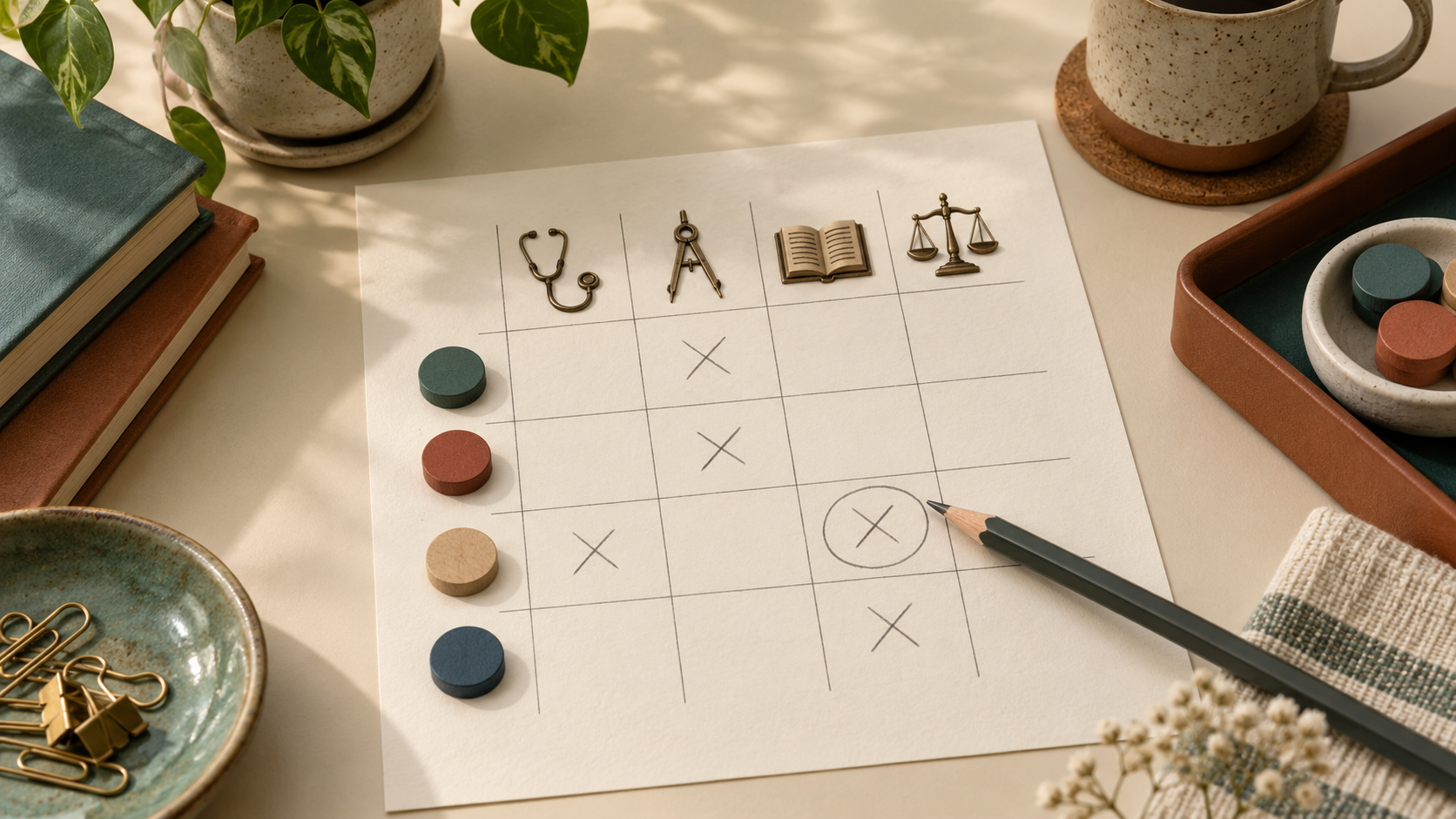
Four friends, four professions, a few clues: who does what? Logic matching puzzles ask you to reconstruct a complete one-to-one correspondence without guessing at random. The conversation that inspired this activity proposed fifty puzzle outlines and also showed why some clues needed correction: a sound puzzle must have exactly one solution. The interactive laboratory contains fifty puzzles built and checked from scratch, with four, five or six people.
The fundamental rule: one to one
Each person has one profession, and each profession belongs to one person. If four people must be matched with four jobs, there are initially 4! = 24 possible assignments. A clue rules out incompatible assignments; the puzzle is solved when only one remains. In the laboratory the people are always listed in row order, which also matters for order clues.
A simple example
Anna, Bruno and Carlo are a doctor, a lawyer and a teacher. We know that Bruno is the teacher and Anna is not the doctor. Bruno occupies the teacher column, so cross it out for Anna and Carlo. Anna has doctor and lawyer left, but doctor is excluded; therefore Anna is the lawyer. The only profession remaining for Carlo is doctor. The solution is Anna–lawyer, Bruno–teacher, Carlo–doctor.
How to use a grid
Put people in rows and professions in columns. Mark × when a match is impossible and ✓ when it is certain. After a ✓, all other cells in the same row and column become ×. If only one cell remains possible in a row, it must be ✓; the same applies to a column. In the laboratory you can click a cell repeatedly to cycle from blank to × and then ✓.
Clues beyond simple exclusions
“Anna is not the doctor” eliminates one cell. “Anna is either the doctor or the lawyer” leaves two possibilities. “If Anna is the doctor, then Bruno is the engineer” is an implication: when the first part is true, the second must also be true; when it is false, this clue alone says nothing about Bruno’s profession. “Anna is the doctor if and only if Bruno is the engineer” is an equivalence: the two statements are both true or both false. “Exactly one is true” expresses an exclusive choice. Some puzzles also use the order of the names: “the doctor appears before the lawyer” refers to the rows of the grid.
Why uniqueness must be checked
It is not enough for all clues to be true. If they allow two different assignments, the player cannot know which one the author intended. Each of the fifty laboratory puzzles was therefore tested against every possible permutation; each leaves just one compatible assignment. The first twenty-five challenges mainly use exclusions; later ones combine alternatives, conditions, equivalences and order relations. The number of people grows from four to six, but more people do not always mean a harder puzzle: the quality of the clues matters too.
Working in the laboratory
Open the logic matching laboratory, choose one of the fifty puzzles and read its clues. Fill the grid, then press “Check” to test every match. “Hint” adds a useful exclusion; “Show solution” completes the grid and shows how many assignments remained after each clue. Before marking a × or a ✓, try to justify it with a clue or the one-to-one rule: that is the real logic exercise.