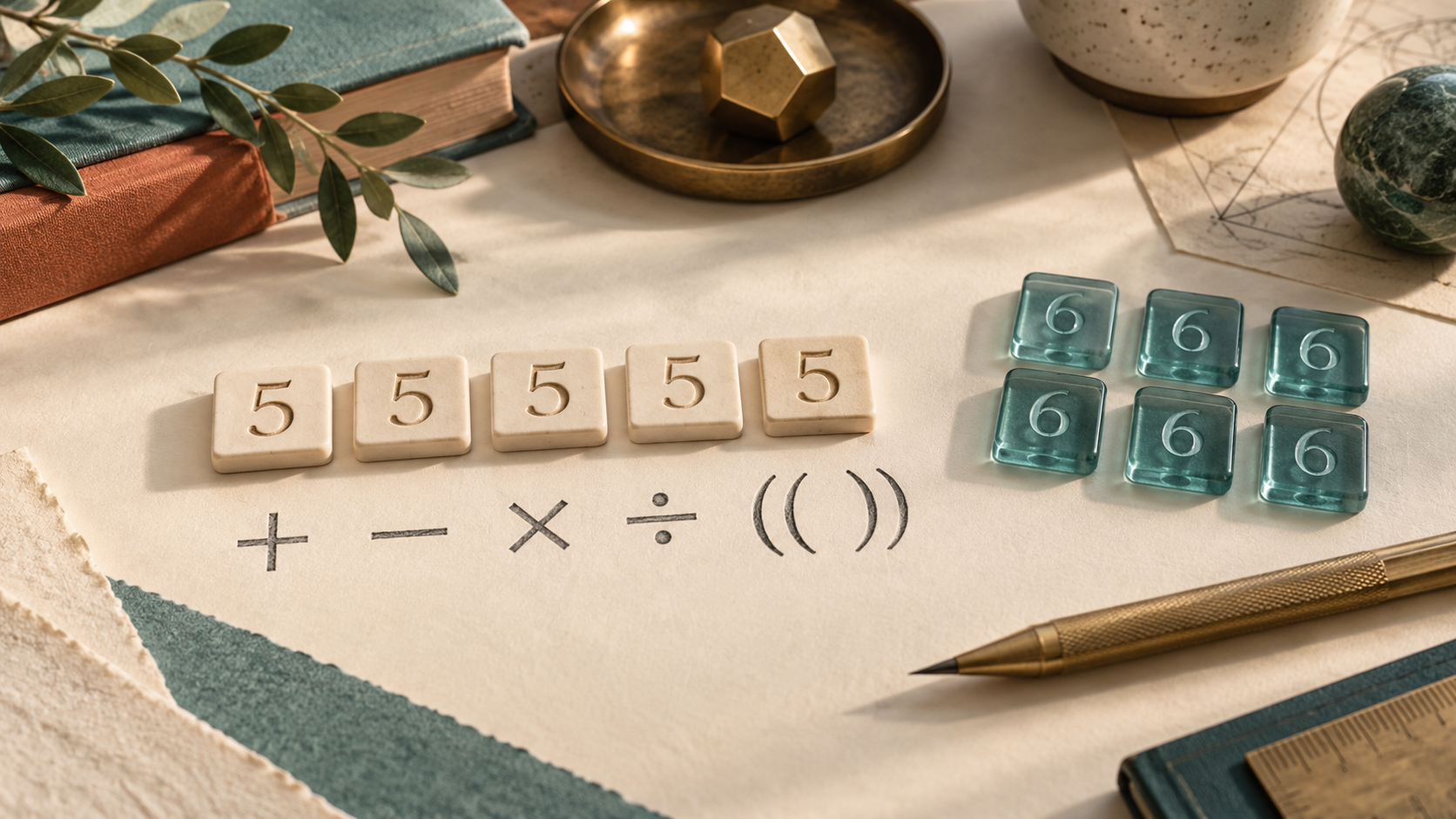
How many results can you make by repeating just one digit? Try to make 5 with exactly five 5s, or 6 with exactly six 6s. Reaching the target is only half the task: you must also use precisely the required number of digits. The repeated-digits laboratory has forty ready-made targets and a workspace for creating your own.
Agree on the rules first
You may use addition, subtraction, multiplication, division and parentheses. You may also join digits: 55 counts as two 5s, while 555 counts as three. In the laboratory you can turn this option off for a stricter challenge. Powers, roots, factorials and decimal points are not allowed: the point is to reason with the four arithmetic operations. Every written digit must be the chosen one, used exactly the required number of times.
Three useful tools: zero, one and parentheses
The difference 5−5 is zero and uses two digits; the quotient 5÷5 is one. These are useful building blocks because A+0=A and A×1=A. For example, 5+(5−5)+(5−5)=5 uses exactly five 5s. Likewise, 6+(6−6)×(6+6−6)=6 uses exactly six 6s. Parentheses make the order of operations explicit: without them the same line of symbols can give a different result.
A five-5 example, step by step
Suppose the target is 10. The expression 5+5+(5−5)×5 contains five 5s. First calculate 5−5=0, then 0×5=0, and finally 5+5+0=10. If the target were 1, you could use (5÷5)+(5−5)×5=1: division makes one, while the remaining part makes zero.
A six-6 example, step by step
Suppose the target is 12. Write 6+6+(6−6)×(6−6). Both differences are zero; their product is zero; 6+6=12 remains. There are exactly six 6s. To make 0, one possibility is (6−6)+(6−6)+(6−6)=0.
Joining digits changes the game
Writing 55 does not introduce a new symbol: it uses the digit 5 twice to form a two-digit number. This can open new paths, but you must keep counting digits: 55÷5=11 uses three 5s, not two. That is why the laboratory checks both the exact value and the digit count. Division is checked as a fraction, with no rounding errors.
From puzzle to strategy
- Write down the target and count the available digits.
- First make a value close to the target with one or two digits.
- Use
d−dord÷dto spend remaining digits without changing the value, when possible. - If that fails, change the operation order or form a number such as 55 or 66.
- Always check both the result and the digit count.
Try the laboratory
The interactive laboratory offers twenty targets for five 5s and twenty for six 6s. Choose a target, enter an expression and press “Check”. You can ask for a hint or reveal a verified solution. In the custom workspace, choose a digit from 1 to 9, four to six uses, and a target between −100 and 100. Not every invented target is necessarily reachable: discovering why a route fails is part of the game too.