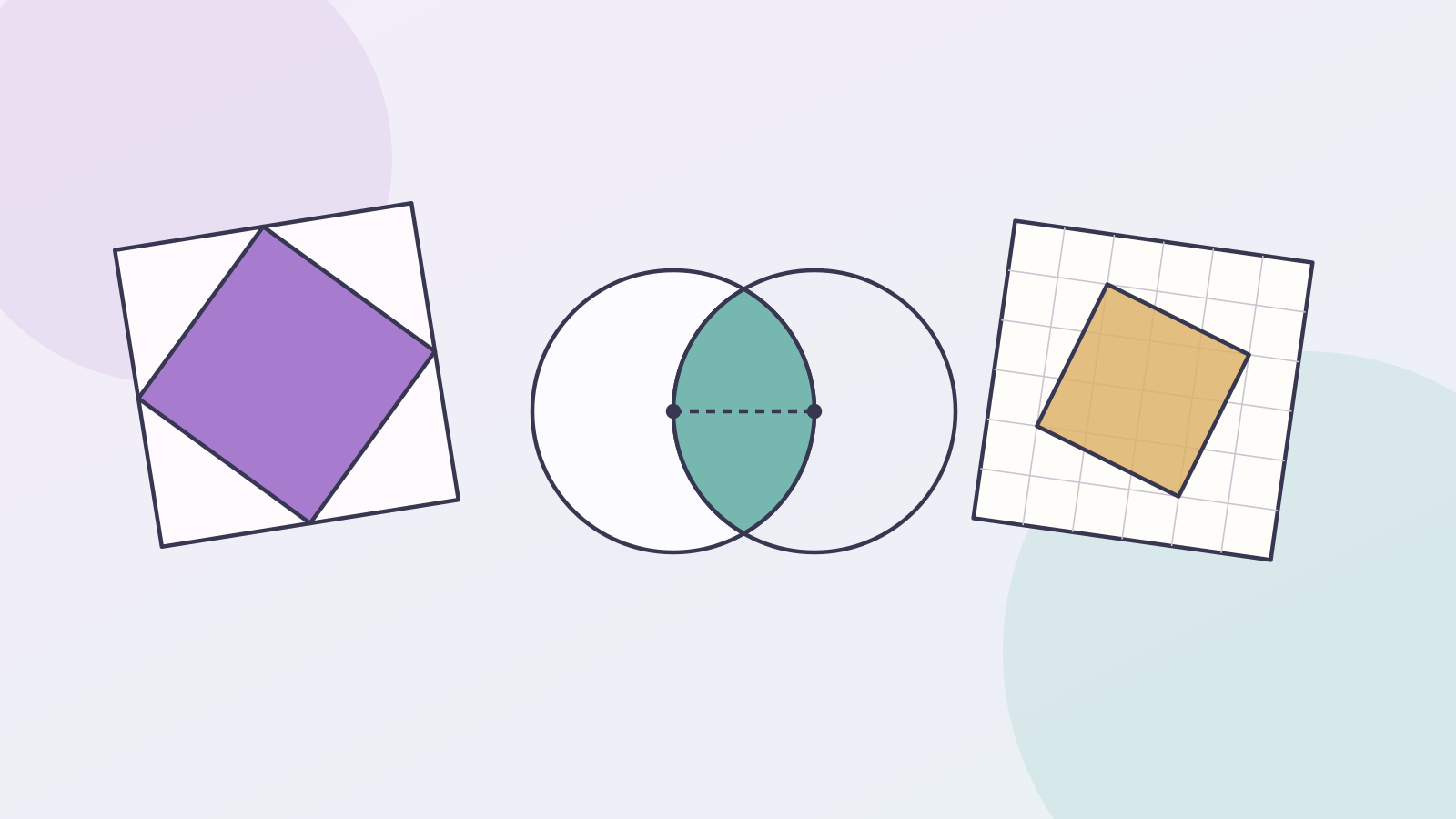
Which part of the figure is purple? Before looking for a formula, decide whether to measure that region directly, split it into simpler pieces or work out what remains after removing the white parts.
Three ways to get started
- Complete and subtract. If the purple part is difficult to measure, find the area of the whole figure and subtract the white parts.
- Split and add. If you can divide the purple region into non-overlapping rectangles, triangles or sectors, calculate and add their areas.
- Watch for overlaps. To find the area covered by at least one of two shapes, subtract their overlap once from the sum. For the area covered by just one of the shapes, subtract it twice.
A sector of radius r and central angle α takes up the fraction α/360° of a disc: its area is (α/360°) × πr². Keep π in your calculations and round only at the end. Use the dimensions in the question, not a ruler on the screen.
Problems 1–20 and their diagrams are adapted from the Italian geometry workbook «20 problemi sulle aree colorate» (pp. 1–10). Problems 21–30 are new.
Choose a group of problems
Try each problem yourself, then open its worked solution to check the steps.
- 1–6. Squares, rectangles and triangles
- 7–14. Circles, rings and sectors
- 15–20. Composite and overlapping shapes
- 21–30. Ten new problems
1–6. Squares, rectangles and triangles
1. The triangle in the square
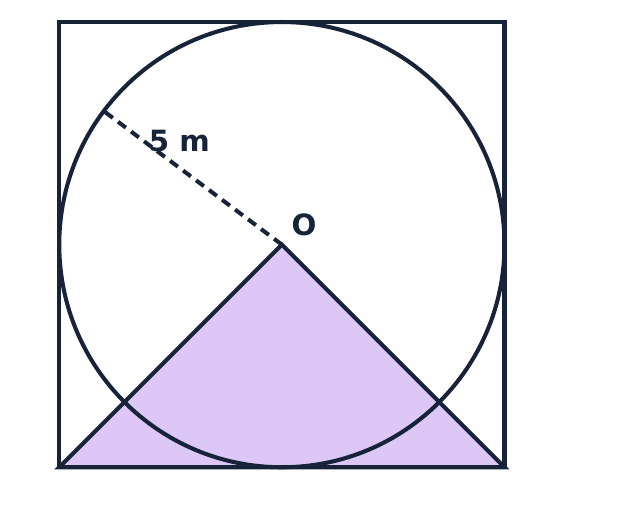
A circle with radius 5 m is inscribed in a square. Join its centre O to the two bottom vertices of the square. Find the area of the purple triangle.
Show solution · 1
The square’s side is the circle’s diameter: 2 × 5 = 10 m. The perpendicular distance from the centre to the bottom side is 5 m. Multiply base by height and divide by two.
10 × 5 ÷ 2 = 25 m²
2. The midpoint square
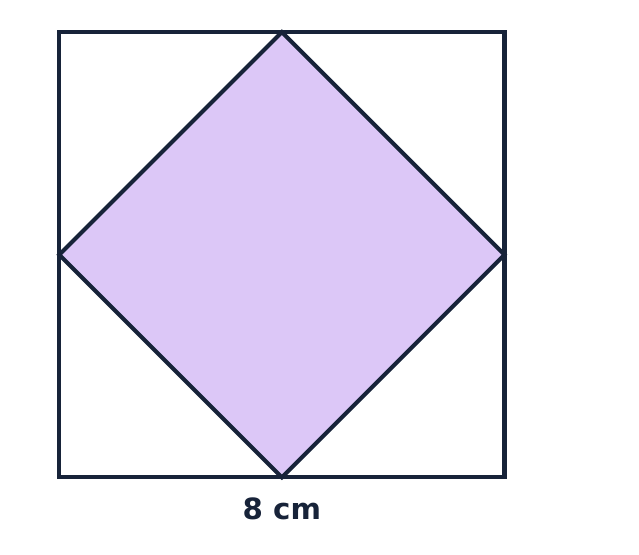
Join the midpoints of the four sides of a square of side 8 cm in order. Find the area of the inner purple square.
Show solution · 2
Four right triangles remain at the corners, each with legs of 4 cm and 4 cm. Each has area 4 × 4 ÷ 2 = 8 cm². Subtract these four areas from the square’s 64 cm².
64 − 4 × 8 = 32 cm²
3. The slanted strip
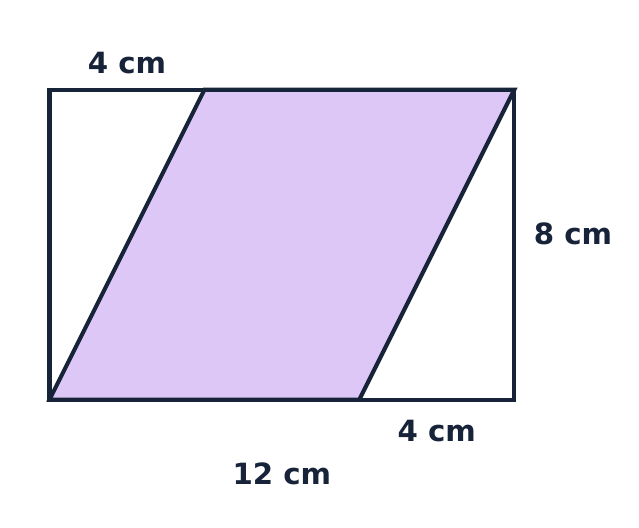
In a 12 × 8 cm rectangle mark P on the top side 4 cm from the left and Q on the bottom side 4 cm from the right. Join P to the bottom-left vertex and Q to the top-right vertex. Find the area between the two cuts.
Show solution · 3
Each white triangle has base 4 cm and height 8 cm, so each occupies 16 cm². Subtract both white triangles from the rectangle’s area of 96 cm².
96 − 2 × 16 = 64 cm²
4. Three corners to subtract
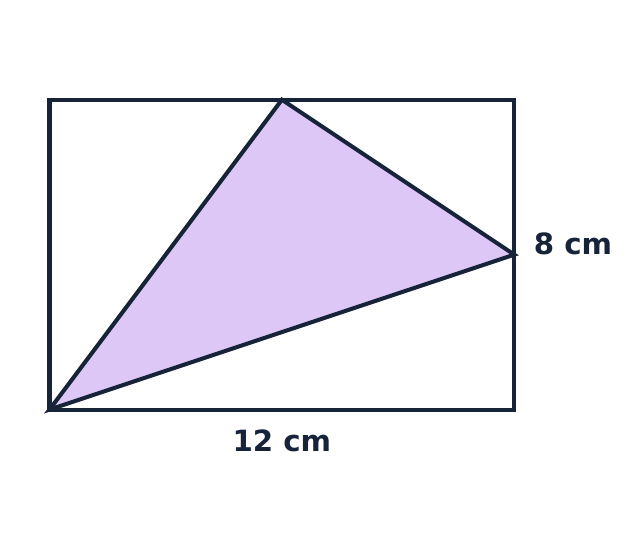
In a 12 × 8 cm rectangle, join the bottom-left vertex to the midpoints of the top and right sides; join those midpoints too. Find the area of the purple triangle.
Show solution · 4
The white triangles have perpendicular legs 6 and 8, 6 and 4, and 12 and 4 cm respectively. Their areas are 24, 12 and 24 cm². Subtract them from the rectangle’s 96 cm².
96 − (24 + 12 + 24) = 36 cm²
5. The rhombus in the rectangle
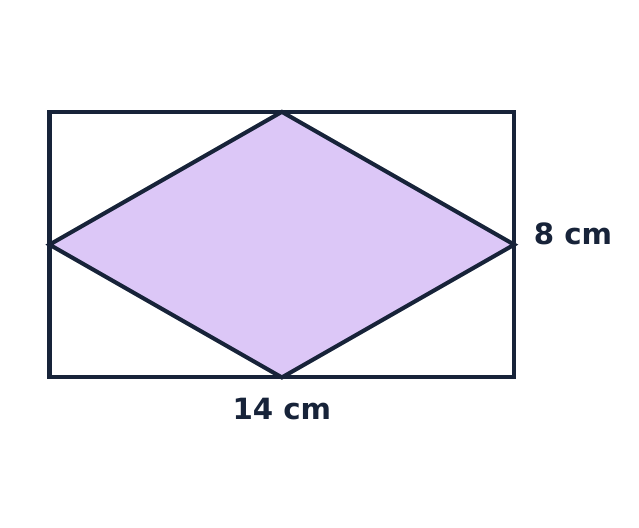
In a 14 × 8 cm rectangle, join the side midpoints in order. Find the area of the purple rhombus.
Show solution · 5
The rhombus diagonals join opposite midpoints and measure 14 cm and 8 cm. Its area is half the product of the diagonals.
14 × 8 ÷ 2 = 56 cm²
6. The square frame
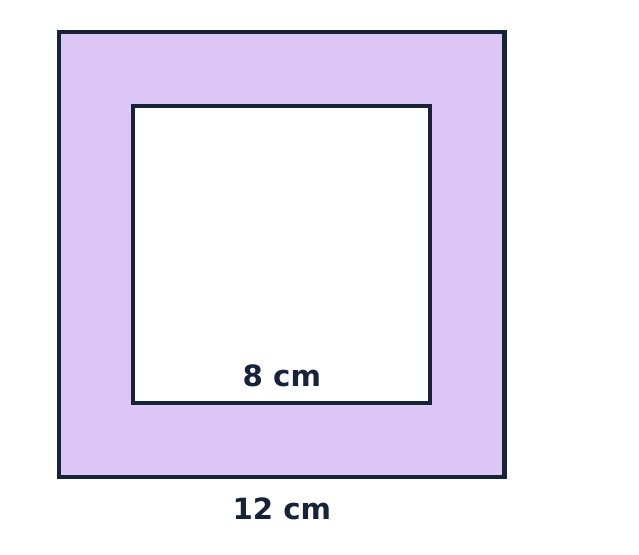
Two concentric squares with parallel sides have side lengths 12 cm and 8 cm. Find the area of the purple frame between them.
Show solution · 6
The outer square has area 12 × 12 = 144 cm². The inner square has area 8 × 8 = 64 cm². The frame is their difference.
144 − 64 = 80 cm²
7–14. Circles, rings and sectors
7 · 8 · 9 · 10 · 11 · 12 · 13 · 14
7. The four corners of the square
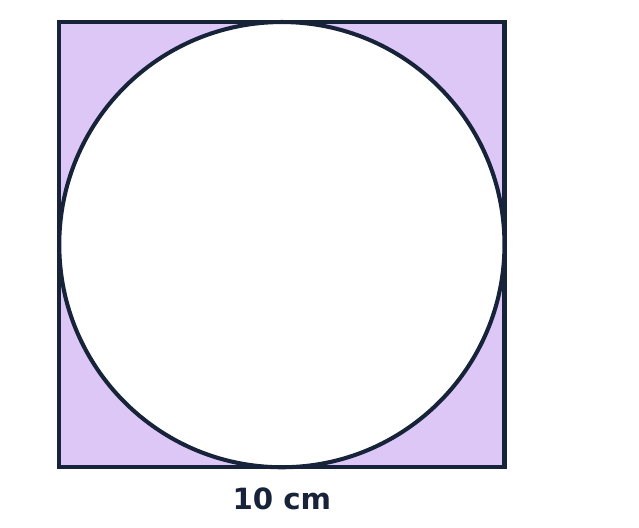
A circle is inscribed in a square of side 10 cm. Find the total area of the four purple corners outside the circle.
Show solution · 7
The circle has diameter 10 cm, so its radius is 5 cm and its area is 25π cm². Subtract this from the square’s 100 cm².
A = (100 − 25π) cm²
A ≈ 21.46 cm²
8. The square inside the circle
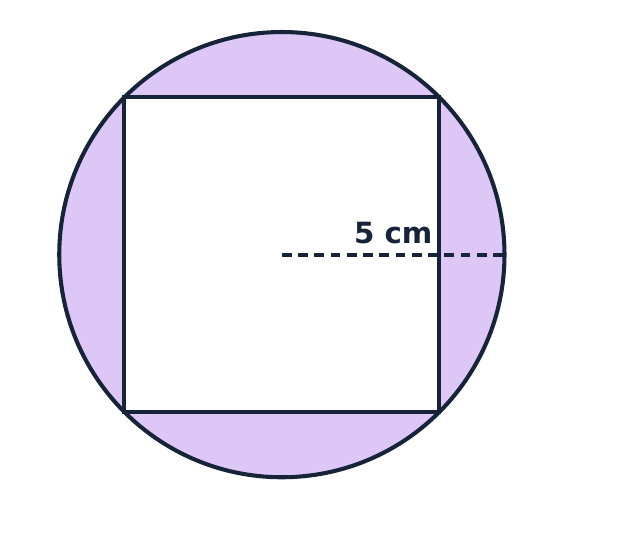
A square is inscribed in a circle with radius 5 cm. Find the purple area inside the circle and outside the square.
Show solution · 8
The square’s diagonals are diameters of length 10 cm. The square’s area is 10 × 10 ÷ 2 = 50 cm², and the disc’s is 25π cm². Find their difference.
A = (25π − 50) cm²
A ≈ 28.54 cm²
9. Above the semicircle
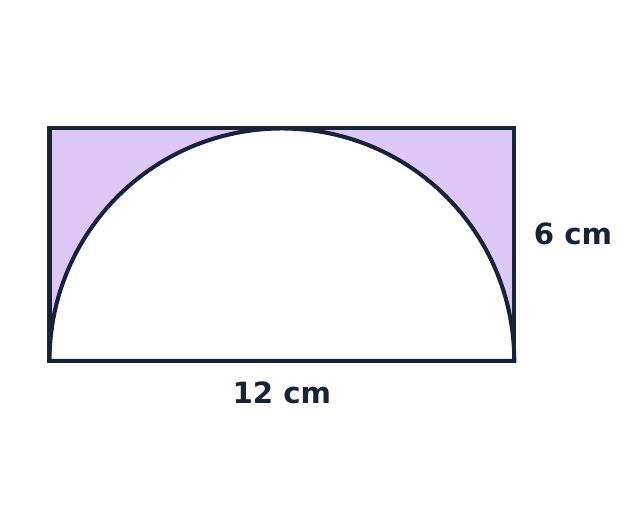
In a 12 × 6 cm rectangle draw the internal semicircle whose diameter is the 12 cm bottom side. Find the purple area inside the rectangle and outside the semicircle.
Show solution · 9
The semicircle has radius 6 cm, so its area is 36π ÷ 2 = 18π cm². The rectangle has area 72 cm².
A = (72 − 18π) cm²
A ≈ 15.45 cm²
10. Beyond the quarter circle
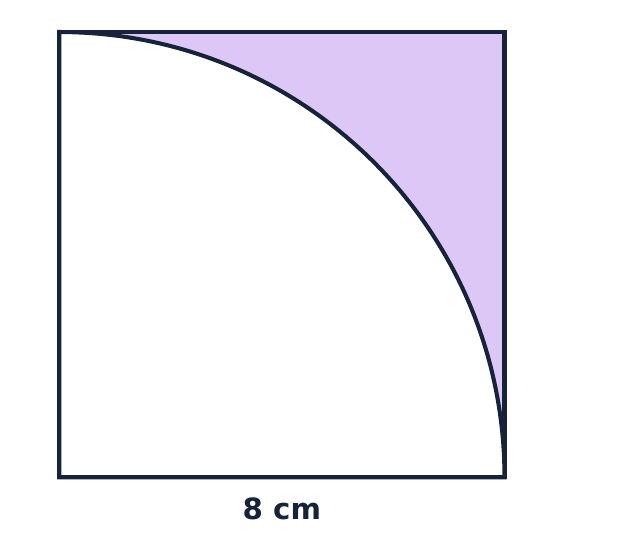
Remove a quarter circle of radius 8 cm from a square of side 8 cm, with its centre at the bottom-left vertex. Find the remaining purple area.
Show solution · 10
The square occupies 64 cm². The sector is a quarter of a disc of area 64π cm², so it occupies 16π cm².
A = (64 − 16π) cm²
A ≈ 13.73 cm²
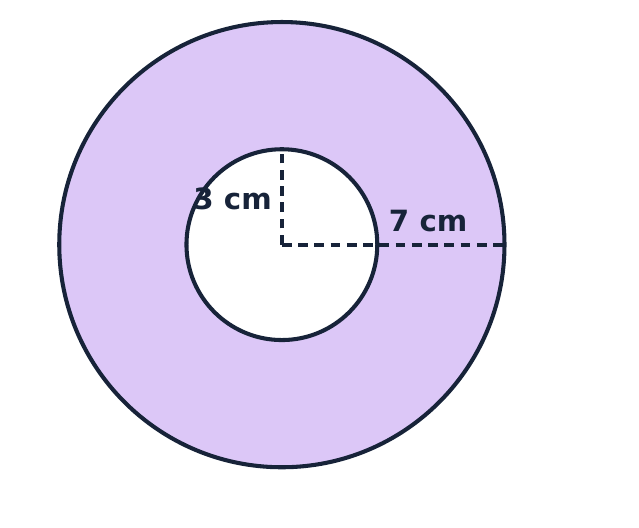
11. The circular ring
Two concentric circles have radii 7 cm and 3 cm. Find the purple area between the circles.
Show solution · 11
The discs of radii 7 cm and 3 cm have areas 49π and 9π cm². Subtract the area of the inner disc.
A = (49π − 9π) cm² = 40π cm²
A ≈ 125.66 cm²
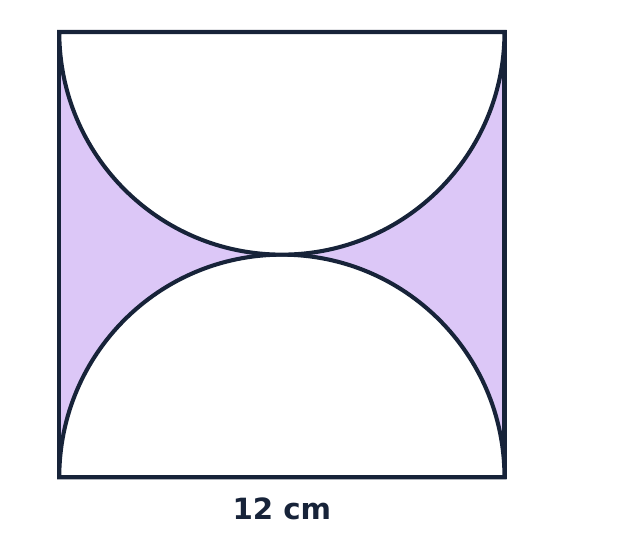
12. The two semicircles
In a square of side 12 cm, draw two internal semicircles with the top and bottom sides as their diameters. Find the purple area outside both.
Show solution · 12
The semicircles have radius 6 cm and touch only at one point. Together their area is that of one full disc, 36π cm². The square occupies 144 cm².
A = (144 − 36π) cm²
A ≈ 30.90 cm²
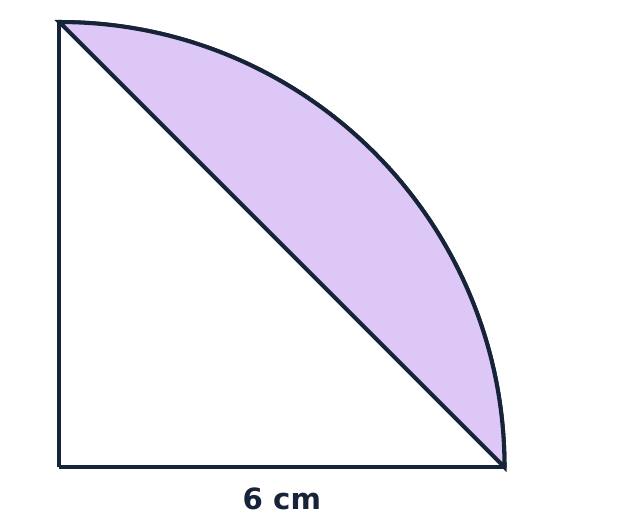
13. The segment of a quarter circle
A quarter circle has radius 6 cm. Join the endpoints of its radii with a chord. Find the purple area between the chord and the arc.
Show solution · 13
The sector has area 36π ÷ 4 = 9π cm². The right triangle between the radii has area 6 × 6 ÷ 2 = 18 cm². Subtract the triangle from the sector.
A = (9π − 18) cm²
A ≈ 10.27 cm²
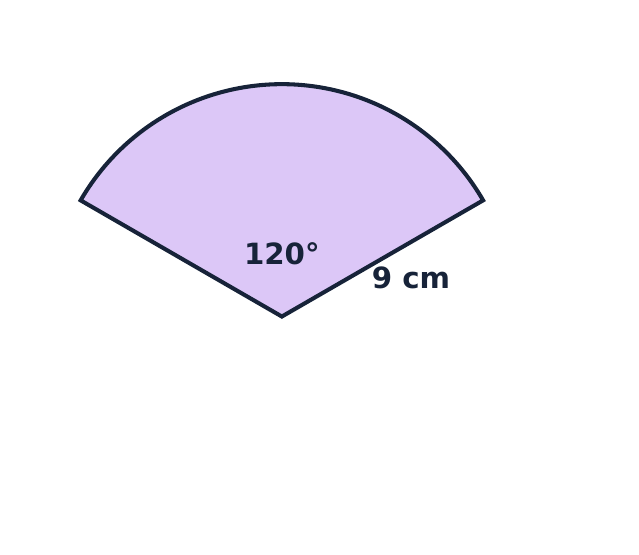
14. The one-third sector
A purple circular sector has radius 9 cm and central angle 120°. Find its area.
Show solution · 14
Since 120° ÷ 360° = 1/3, the sector occupies a third of the disc. The disc has area 81π cm².
A = (81π ÷ 3) cm² = 27π cm²
A ≈ 84.82 cm²
15–20. Composite and overlapping shapes
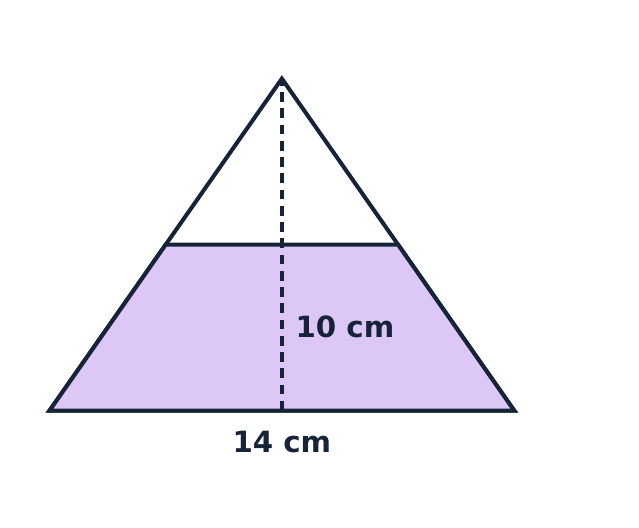
15. The triangle cut halfway up
A triangle has base 14 cm and height 10 cm. Join the midpoints of the two sloping sides. Find the area of the purple trapezium below that segment.
Show solution · 15
The large triangle has area 14 × 10 ÷ 2 = 70 cm². The white triangle has half the base and half the height, so it has a quarter of the area. The trapezium occupies the remaining three quarters.
70 × 3 ÷ 4 = 52.5 cm²
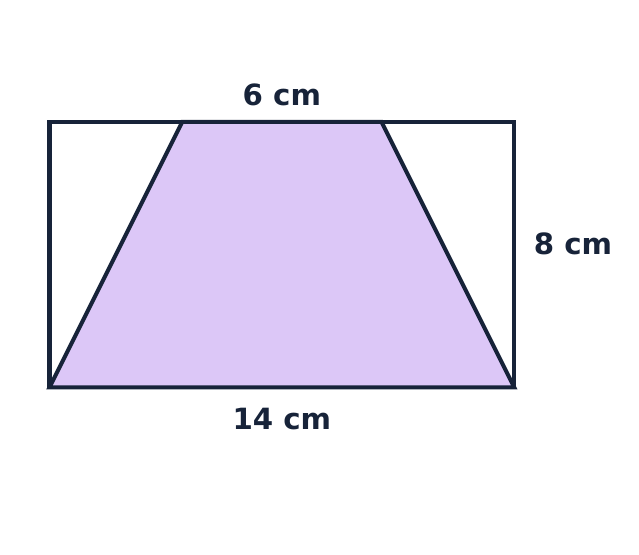
16. The trapezium in the rectangle
In a 14 × 8 cm rectangle, the longer base of a purple trapezium is the bottom side. The shorter base is a 6 cm segment on the top side. Find the purple area.
Show solution · 16
The parallel bases measure 14 and 6 cm and are 8 cm apart. Their average is (14 + 6) ÷ 2 = 10 cm. Multiply it by the height.
10 × 8 = 80 cm²
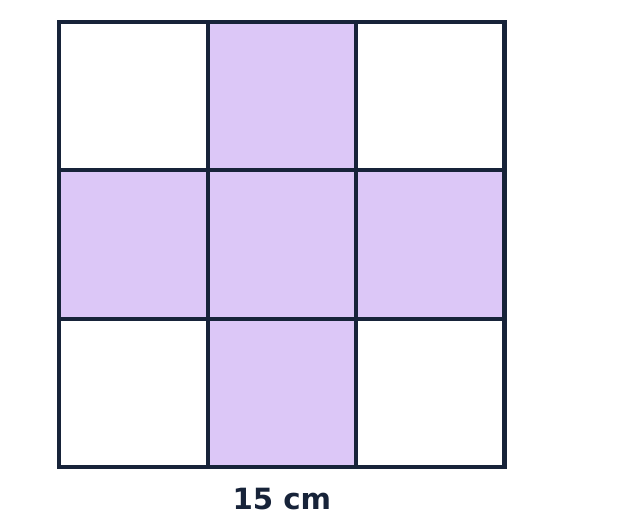
17. The cross in the grid
A square of side 15 cm is split into nine equal squares. Colour the middle row and middle column. Find the area of the purple cross.
Show solution · 17
Each small square has side 15 ÷ 3 = 5 cm and area 25 cm². The cross contains five: 3 + 3 − 1, since the middle square is shared.
5 × 25 = 125 cm²
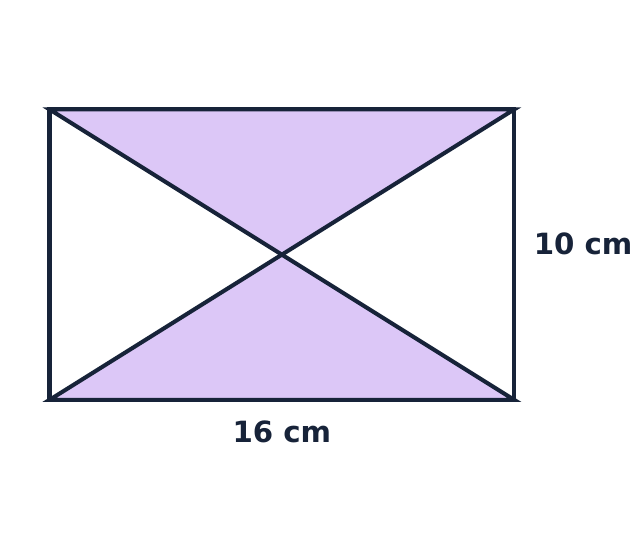
18. The two diagonals of the rectangle
The diagonals split a 16 × 10 cm rectangle into four triangles. Find the total area of the purple ones at the top and bottom.
Show solution · 18
The diagonals meet at the centre. Each coloured triangle has base 16 cm and height 5 cm, so its area is 40 cm².
40 + 40 = 80 cm²
19. The crossing strips
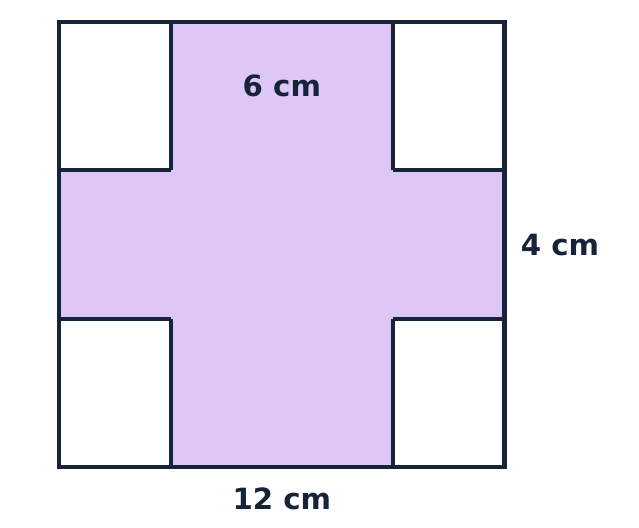
In a square of side 12 cm, a 4 cm wide horizontal strip crosses a 6 cm wide vertical strip. Find the purple area covered by at least one strip.
Show solution · 19
The strips have areas 12 × 4 = 48 cm² and 12 × 6 = 72 cm². Their overlap is 4 × 6 = 24 cm². Subtract it once because it was counted twice in the sum.
48 + 72 − 24 = 96 cm²
20. The lens between two arcs
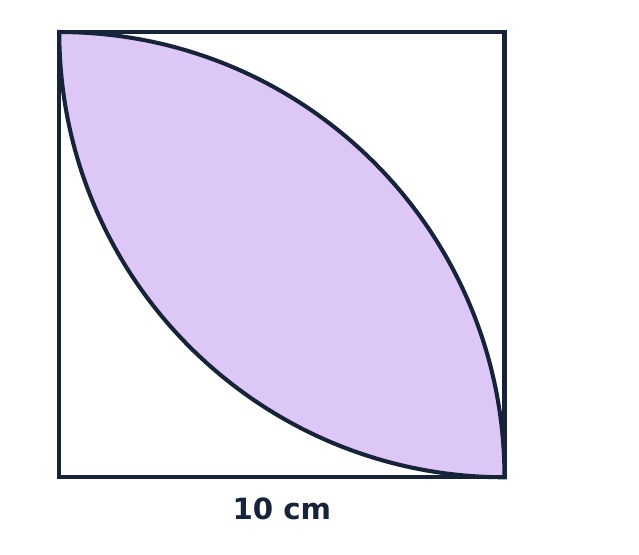
In a square of side 10 cm draw two quarter circles of radius 10 cm, centred at opposite vertices. Find the purple area common to both sectors.
Show solution · 20
Each sector contains the triangle bounded by its radii and chord. The two triangles fill the square, so the union of the sectors has area 100 cm². Each sector occupies 25π cm²; their sum counts the lens twice.
A = (25π + 25π − 100) cm² = (50π − 100) cm²
A ≈ 57.08 cm²
21–30. Ten new problems
21 · 22 · 23 · 24 · 25 · 26 · 27 · 28 · 29 · 30
21. An L-shaped rectangle
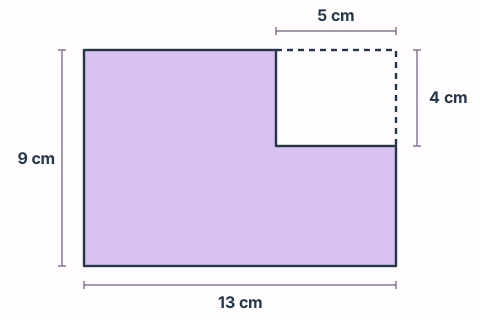
Remove a 5 cm wide and 4 cm high rectangle from the top-right corner of a 13 × 9 cm rectangle. Find the remaining purple area.
Show solution · 21
The whole rectangle has area 117 cm² and the cut-out has area 20 cm². Subtract only the white part.
117 − 20 = 97 cm²
22. A sliding vertex
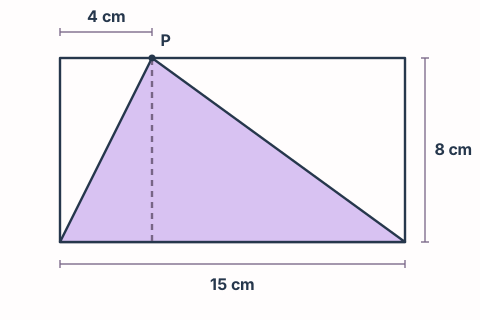
A rectangle measures 15 × 8 cm. A point P on its top side is 4 cm from the top-left vertex. Join P to the two bottom vertices and find the purple triangle’s area. Would it change if P moved along the same side?
Show solution · 22
The base is 15 cm and the perpendicular height is the distance between the parallel sides, 8 cm. The 4 cm fixes P’s position but not the height; sliding P does not change the area.
15 × 8 ÷ 2 = 60 cm²
23. The quadrilateral on the grid
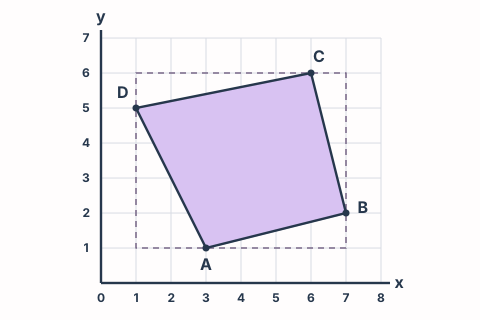
On a grid of 1 cm squares, join A(3, 1), B(7, 2), C(6, 6), D(1, 5) in order and return to A. Find the area of the purple quadrilateral.
Show solution · 23
The smallest grid-aligned rectangle containing the quadrilateral measures 6 × 5 cm. The four corner triangles have legs 4 and 1, 1 and 4, 5 and 1, and 2 and 4 cm; their areas are 2, 2, 2.5 and 4 cm². Subtract them from 30 cm².
30 − (2 + 2 + 2.5 + 4) = 19.5 cm²
24. Three semicircles on one side
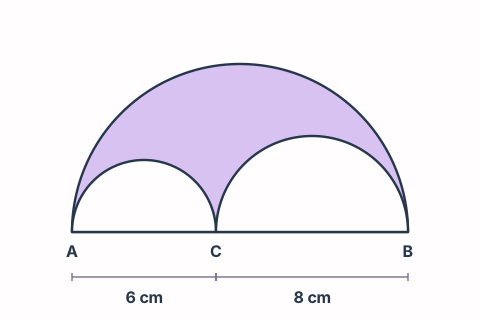
Point C divides a 14 cm segment AB into AC = 6 cm and CB = 8 cm. Draw three semicircles on the same side with diameters AB, AC and CB. Find the purple area inside the large semicircle and outside the two smaller ones.
Show solution · 24
The three radii are 7, 3 and 4 cm. The small semicircles lie inside the large one and touch only at C. Subtract their areas from the large semicircle, using π times the radius squared divided by two.
A = ((49 − 9 − 16) × π ÷ 2) cm² = 12π cm²
A ≈ 37.70 cm²
25. Two discs in a rectangle
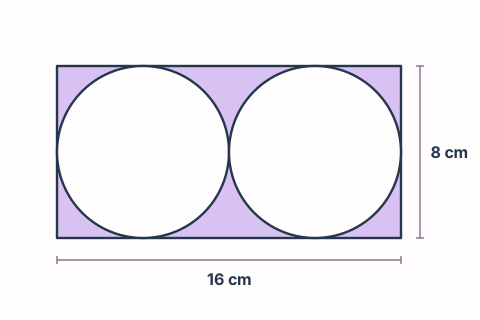
Two discs of radius 4 cm are placed side by side and touch in a 16 × 8 cm rectangle. Each touches both horizontal sides and the nearer vertical side. Find the purple area outside both discs.
Show solution · 25
The rectangle has area 128 cm². Each disc has area 16π cm², and their overlap has no positive area. Subtract 32π cm².
A = (128 − 32π) cm²
A ≈ 27.47 cm²
26. The 60° circular segment
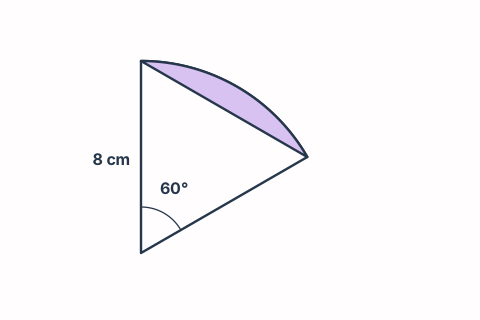
In a circle of radius 8 cm, two radii form an angle of 60°. Draw the chord joining their endpoints. Find the purple area between the chord and the shorter arc.
Show solution · 26
The sector is 1/6 of the disc and has area 64π ÷ 6 = 32π/3 cm². The triangle formed by the radii is isosceles with a 60° apex angle, so it is equilateral, with side 8 cm and height 4√3 cm. Its area is 16√3 cm².
A = (32π/3 − 16√3) cm²
A ≈ 5.80 cm²
27. The stadium-shaped track
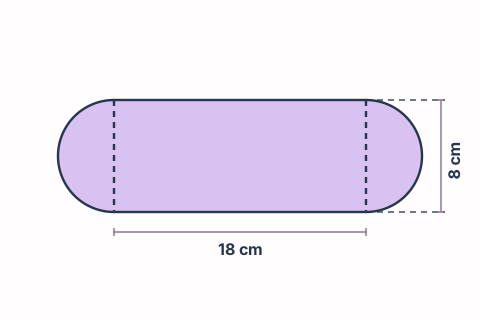
Add a semicircle outside each short side of an 18 × 8 cm rectangle, using that side as its diameter. Find the total purple area.
Show solution · 27
The rectangle occupies 144 cm². Together the two semicircles of radius 4 cm have the area of a whole disc, 16π cm². Add the three non-overlapping pieces.
A = (144 + 16π) cm²
A ≈ 194.27 cm²
28. Coloured exactly once
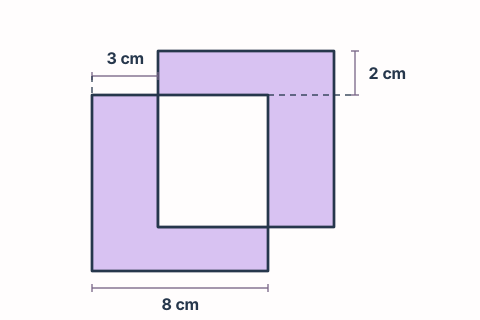
Two squares of side 8 cm have parallel sides. The second is shifted 3 cm to the right and 2 cm upwards from the first. Find the purple area belonging to exactly one square.
Show solution · 28
The shared rectangle has area (8 − 3) × (8 − 2) = 30 cm². In 64 + 64 it appears twice. We want it excluded completely, so subtract 30 twice.
64 + 64 − 2 × 30 = 68 cm²
29. The lens of two circles
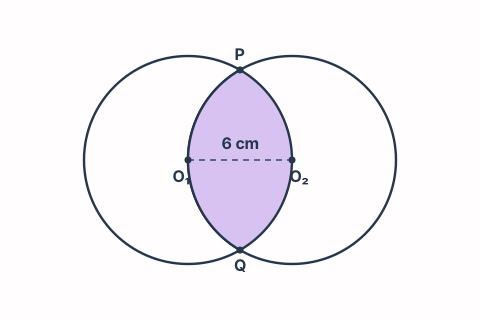
Two circles of radius 6 cm have centres 6 cm apart. Find the purple area common to the two discs.
Show solution · 29
Let P and Q be the intersections. Together with the two centres they form two equilateral triangles of side 6 cm, one on each side of the line joining the centres. The chord PQ divides the lens into two circular segments. From either centre, the angle between the radii to P and Q is 60° + 60° = 120°, so each sector has area 12π cm². To find each segment, subtract from its sector the triangle with base PQ and apex at the centre. The two triangles subtracted form the same rhombus as the two equilateral triangles, with area 2 × 9√3 = 18√3 cm².
A = (12π + 12π − 18√3) cm² = (24π − 18√3) cm²
A ≈ 44.22 cm²
30. The incircle of a right triangle
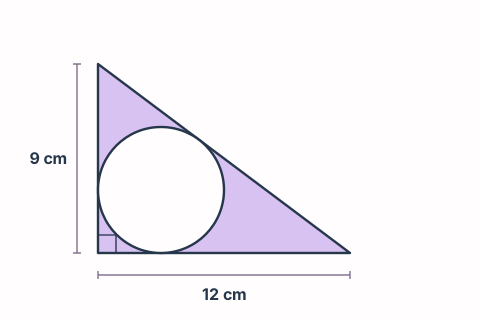
A right triangle has legs of 9 cm and 12 cm. Draw its incircle, tangent to all three sides. Find the purple area inside the triangle and outside the disc.
Show solution · 30
The hypotenuse is √(9² + 12²) = 15 cm and the triangle’s area is 54 cm². Joining the centre to the vertices gives three triangles of the same height r, the radius. Thus 54 = (9 + 12 + 15) × r ÷ 2 and r = 3 cm. Subtract the disc area, 9π cm².
A = (54 − 9π) cm²
A ≈ 25.73 cm²
A final check
An area cannot be negative. A region inside another figure cannot have a greater area than the whole figure. When converting units, square the length conversion factor: 1 m² = 10,000 cm².