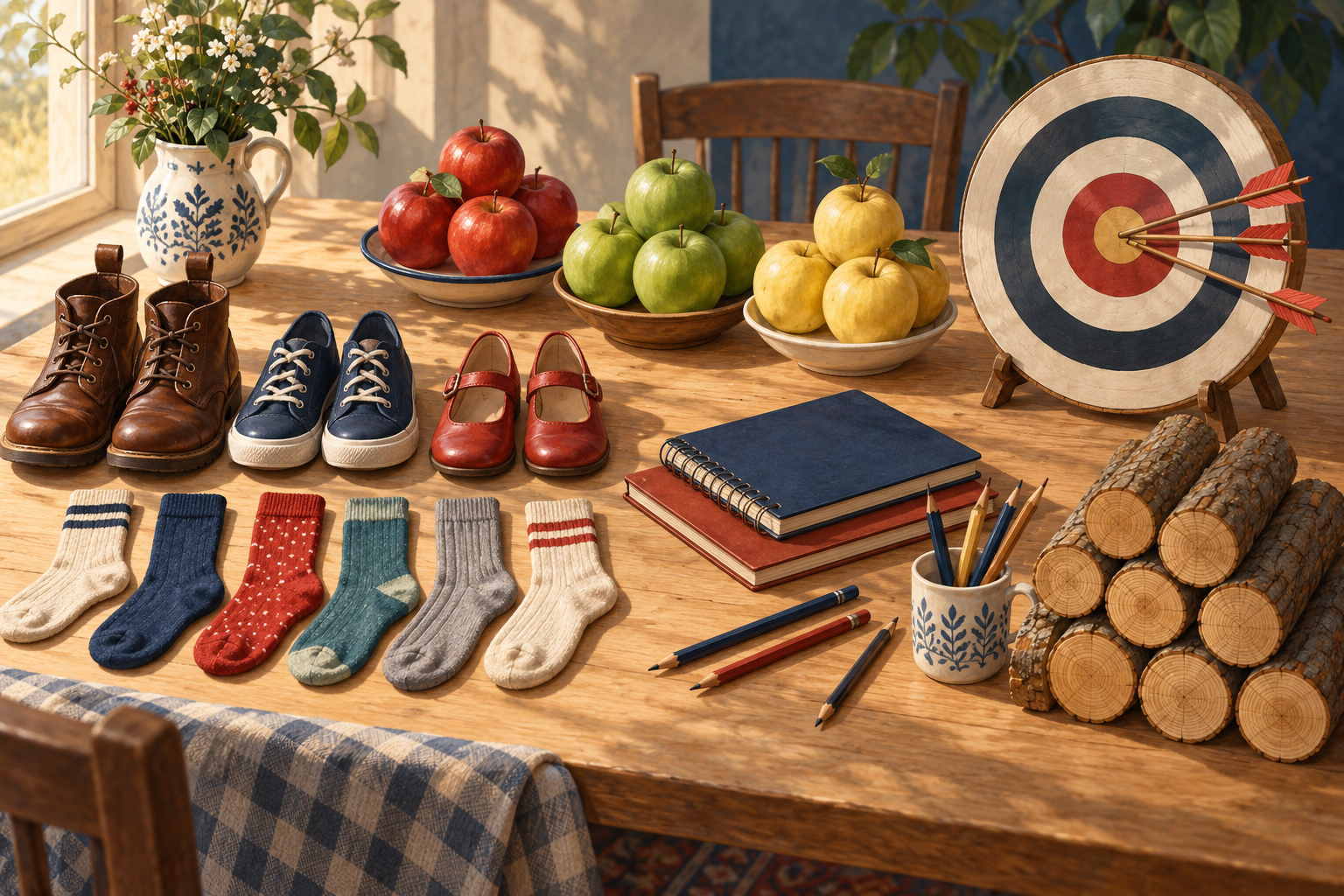
How much can we discover without long calculations? These six puzzles ask us to examine the worst case, compare two deviations, arrange data and spot an arithmetic property. Read each problem and try it before opening the hint and then the solution.
This collection reworks problems 258, 259, 261, 263, 264 and 267 by Boris A. Kordemsky (1907–1999), Gli enigmi di Mosca, chapter IX, “Mathematics (almost) without calculation”. The statements have been rewritten and the answers explained for teaching.
1. Shoes and socks — problem 258
In the dark you find six shoes belonging to three different pairs, and socks in two colours, black and brown. How many shoes must you take to be certain of a matching pair? And how many socks to have two of the same colour?
Hint
Imagine the unluckiest case: you could take one shoe from each of the three pairs without completing any pair; you could take one sock of each colour without having two alike.
Step-by-step solution
The first three shoes could belong to three different pairs. The fourth shoe must complete one of them, because there is no fourth pair. With two colours, the first two socks may differ, but the third sock must repeat one colour. Thus certainty requires 4 shoes and 3 socks. We are not calculating the chance of succeeding earlier: we want a guarantee even in the worst case.
2. The apples — problem 259
A crate contains apples of three varieties, with enough of each. Without looking, how many apples must you draw to be certain of having at least two of one variety? And at least three of one variety?
Hint
Before two alike become unavoidable you may draw one of each variety. Before three alike become unavoidable you may draw two of each.
Step-by-step solution
First you may draw three different apples: the fourth repeats a variety. For the second question you may draw 2 + 2 + 2 = 6 apples without having three alike: the seventh raises one variety to three. This is the pigeonhole principle: with three categories, certainty arrives one draw after the worst case that still avoids it.
3. The tree-planting day — problem 261
Two classes each have an assigned area to plant. The younger class mistakenly plants five trees in the older class’s area; then it moves and finishes its own area. In return, the older class plants five trees in the younger class’s area and then another five. Relative to their respective assignments, is the older class ahead by five or ten trees?
Hint
Count separately what each class was supposed to plant and what it actually planted. The difference between a positive deviation and a negative one is not five.
Step-by-step solution
The younger class made five plantings in the wrong area, so it is five below its own assigned quota in the comparison of contributions. The older class completed its own area except for the five trees already planted there by the younger class, and planted ten in the younger class’s area: it is five above its quota. Comparing the deviations gives +5 − (−5) = 10. The relative advantage is therefore ten trees, not five. Without knowing the original quotas, however, we cannot conclude that the older class planted ten more trees in absolute terms.
4. A shooting contest — problem 263
Three boys fire six shots each and score 71 points apiece. The eighteen shots have these values: one 50; two 25s; three 20s; three 10s; two 5s; two 3s; two 2s; three 1s. Andryusha’s first two shots total 22 points. Volodya’s first shot scores 2. Who hit the 50-point centre?
Hint
Partition the eighteen scores into three sets of six totalling 71. Then find the set that can start with 20 + 2 = 22.
Step-by-step solution
The partition consistent with the data is:
| Set | Six scores | Total |
|---|---|---|
| A | 25, 20, 20, 3, 2, 1 | 71 |
| B | 25, 20, 10, 10, 5, 1 | 71 |
| C | 50, 10, 5, 3, 2, 1 | 71 |
Only A contains two shots adding up to 22: 20 + 2. So A belongs to Andryusha. Because Volodya’s first shot scores 2 and B has no 2, Volodya has C. Volodya hit the 50-point centre; B belongs to Borya. The table organizes the scores, but the clues about shot order identify the boys.
5. An impossible purchase — problem 264
A purchase consists of two pencils at 2 kopecks each, five pencils at 4 kopecks each, eight notebooks at one common price and eight coloured sheets at one common price. Someone claims the total is 1.70 rubles, or 170 kopecks. Can you refute this without knowing the prices of notebooks and sheets?
Hint
Check whether every part of the bill is divisible by 4, assuming integer prices in kopecks.
Step-by-step solution
The pencils cost 2 × 2 = 4 and 5 × 4 = 20 kopecks. Eight notebooks cost 8q and eight sheets cost 8f, where q and f are integer prices in kopecks. The total 4 + 20 + 8q + 8f = 4(6 + 2q + 2f) must be divisible by 4. But 170 = 4 × 42 + 2 is not divisible by 4. The bill is therefore impossible under the stated conditions. The unknown prices are unnecessary: divisibility is an invariant.
6. The volunteers and the logs — problem 267
Three pairs saw logs into half-metre pieces. Volodya and Misha work on 2-metre logs; Petya and Kostya on 1.5-metre logs; Vasya and Fedya on 1-metre logs. The leaders of the three pairs are Volodya, Petya and Vasya. In a report the teams are led respectively by Lavrov, Galkin and Medvedev: Lavrov and Kotov made 26 pieces; Galkin and Pastukhov 27; Medvedev and Yevdokimov 28. What is Pastukhov’s first name?
Hint
Each 2-metre log yields 4 pieces; each 1.5-metre log yields 3; each 1-metre log yields 2. Which pair could have produced 27 pieces?
Step-by-step solution
Any total from 2-metre logs is a multiple of 4; from 1.5-metre logs a multiple of 3; from 1-metre logs a multiple of 2. The total 27 is odd and not a multiple of 4, so it belongs to the 1.5-metre team, Petya and Kostya. Its leader is Petya. The report identifies Galkin as leader of the 27-piece team, so Petya is Galkin and Pastukhov is Kostya.
The common lesson
With shoes and apples we seek certainty in the worst case. With trees we compare deviations from different quotas. For shooting and logs we organize the data before assigning names. In the purchase we spot what cannot change: divisibility by 4. The decisive question is not “which operation should I perform?” but “what structure do the data conceal?”.
Source of the puzzles: Boris A. Kordemsky, Gli enigmi di Mosca, chapter IX “Mathematics (almost) without calculation”, problems 258, 259, 261, 263, 264 and 267; in the consulted edition, statements on pp. 142–146 and solutions on pp. 344–346. This page is an original teaching adaptation, not a photographic reproduction of the book.