A good puzzle asks for more than a number: it invites us to find the right viewpoint. In these six problems we can work backwards, change reference frame, compare times and build a table. Try each question before opening its hint and solution.
This collection reworks six problems by Boris A. Kordemsky (1907–1999), Gli enigmi di Mosca, chapter VIII, “With and without algebra”, numbers 217, 218, 219, 222, 225 and 227. The answers were checked against the book; the statements and explanations below were rewritten for teaching.
1. The bridge and the coins — problem 218
A man crosses a bridge three times. On each crossing the coins in his pocket double, but immediately afterwards he pays 24 coins. After the third payment he has nothing left. How many coins did he have before the first crossing?
Hint
Start from zero after the last payment. Just before paying he had 24 coins: how many did he have before the bridge doubled them?
Step-by-step solution
Before the third crossing he had 24 / 2 = 12 coins. Before the second payment he had 12 + 24 = 36, so before the second crossing 36 / 2 = 18. Before the first payment he had 18 + 24 = 42, so at the beginning 42 / 2 = 21.
Forward check: 21 → 42 → 18 → 36 → 12 → 24 → 0. The answer is 21 coins. The general strategy is to reverse the operations in the opposite order: first add 24, then divide by 2.
2. The average number of pages — problem 222
Vera completes the first half of a manuscript at 10 pages per day and the second half at 30 pages per day. She claims to have averaged 20 pages per day because (10 + 30) / 2 = 20. Is she right?
Hint
The two halves contain the same number of pages, but they do not take the same amount of time. Imagine 60 pages in each half.
Step-by-step solution
Sixty pages at 10 per day take 6 days; another 60 pages at 30 per day take 2 days. That is 120 pages in 8 days: 120 / 8 = 15 pages per day. For a manuscript of P pages, the time is P/20 + P/60 = P/15 days, so the average is always 15 pages per day.
The arithmetic mean 20 would be appropriate if Vera spent the same time at each rate. Here she completes the same amount of work at each rate. To achieve an overall rate of 20 after doing half the work at 10, the second half would have to take zero time, which is impossible at any finite rate.
3. The swimmer and the hat — problem 225
A hat falls from a bridge and drifts with the current. At the same moment a swimmer leaves the bridge swimming upstream. After 10 minutes he turns around, swims towards the hat and catches it beneath a second bridge, 1,000 metres downstream from the first. His speed relative to the water is constant. What is the speed of the current?
Hint
Picture the scene while floating on the hat. Relative to you, the current carries the hat and the swimmer in the same way.
Step-by-step solution
In the reference frame of the water the hat is stationary. The swimmer moves away for 10 minutes at his speed through the water and takes another 10 minutes to cover the same distance on the way back. The hat therefore drifts for 20 minutes. The current carries it 1,000 metres: 1,000 / 20 = 50 metres per minute, or 3 km/h. We do not need to know the swimmer’s speed.
4. Two meetings on the lake — problem 227
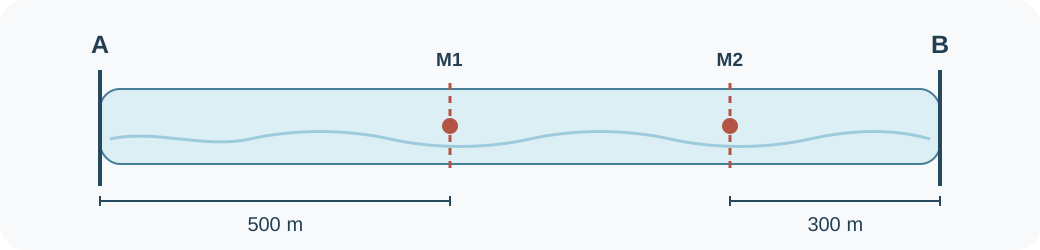
Two motorboats leave opposite shores of a lake at the same time and keep constant speeds. They first meet 500 metres from shore A. On reaching the opposite shores, each immediately turns back. They meet a second time 300 metres from shore B. How wide is the lake? What is the ratio of their speeds?
Hint
By the first meeting they have travelled one lake width between them. By the second they have travelled three. How far has the boat from A travelled?
Step-by-step solution
The second meeting occurs after three times as much time as the first: together the boats have travelled 3D rather than D, where D is the lake width. The boat from A has therefore travelled 3 × 500 = 1,500 metres. It crossed the whole lake and came back 300 metres: D + 300 = 1,500, so D = 1,200 metres.
At the first meeting the boat from A had travelled 500 metres and the other 1,200 − 500 = 700 metres in the same time. Their speed ratio is thus 500 : 700 = 5 : 7.
5. Three tractor depots — problem 217
Three depots help one another in sequence. First depot A gives B and C as many tractors as each already has; then B does the same for A and C; finally C does the same for A and B. At the end all three have 24 tractors. How many did each have initially?
Hint
Work backwards from the last transfer. If A and B have 24 after C gives them tractors, how many did they have just before? How many did C have?
Step-by-step solution
In the last step C doubled the holdings of A and B: before C gave anything, the state was (12, 12, 48). Before B gave anything, A and C held half their later amounts: (6, 42, 24). Before A gave anything, B and C again held half: (39, 21, 12). The total stays at 72 tractors throughout.
Check: (39, 21, 12) → (6, 42, 24) → (12, 12, 48) → (24, 24, 24). Initially A had 39, B 21 and C 12 tractors.
6. Three siblings and 24 apples — problem 219
Three siblings receive 24 apples in all: each initially receives a number of apples equal to their age minus 3. In order, the youngest, the middle child and the eldest keep half the apples they hold at that moment and split the other half equally between the other two. At the end each has 8 apples. How old are they?
Hint
Undo the last move. The eldest kept 8 apples, so had 16 just before giving the others their shares. How many did the other two have before receiving 4 apples each?
Step-by-step solution
The final state is (8, 8, 8), ordered youngest, middle, eldest. Before the eldest moved it was (4, 4, 16): the eldest gave 4 to each sibling. Before the middle child moved it was (2, 8, 14): the middle child gave 2 to each. Before the youngest moved it was (4, 7, 13): the youngest gave 1 to each.
These were the original apple counts. Adding 3 to each gives their ages: 7, 10 and 16 years. Check: (4, 7, 13) → (2, 8, 14) → (4, 4, 16) → (8, 8, 8).
What links these puzzles?
Problems 217, 218 and 219 become simple when we reverse the moves. In 225 it helps to change reference frame; in 227 to follow total time and distance; in 222 to distinguish equal quantities from equal times. Algebra is useful for checking and generalising, but the first achievement is recognising the structure of a problem.
Source of the puzzles: Boris A. Kordemsky, Gli enigmi di Mosca, chapter VIII, “With and without algebra”, problems 217, 218, 219, 222, 225 and 227; in the edition consulted, statements on pp. 124–130 and solutions on pp. 326–329. The texts and illustrations on this page are original adaptations, not reproductions of the book pages.