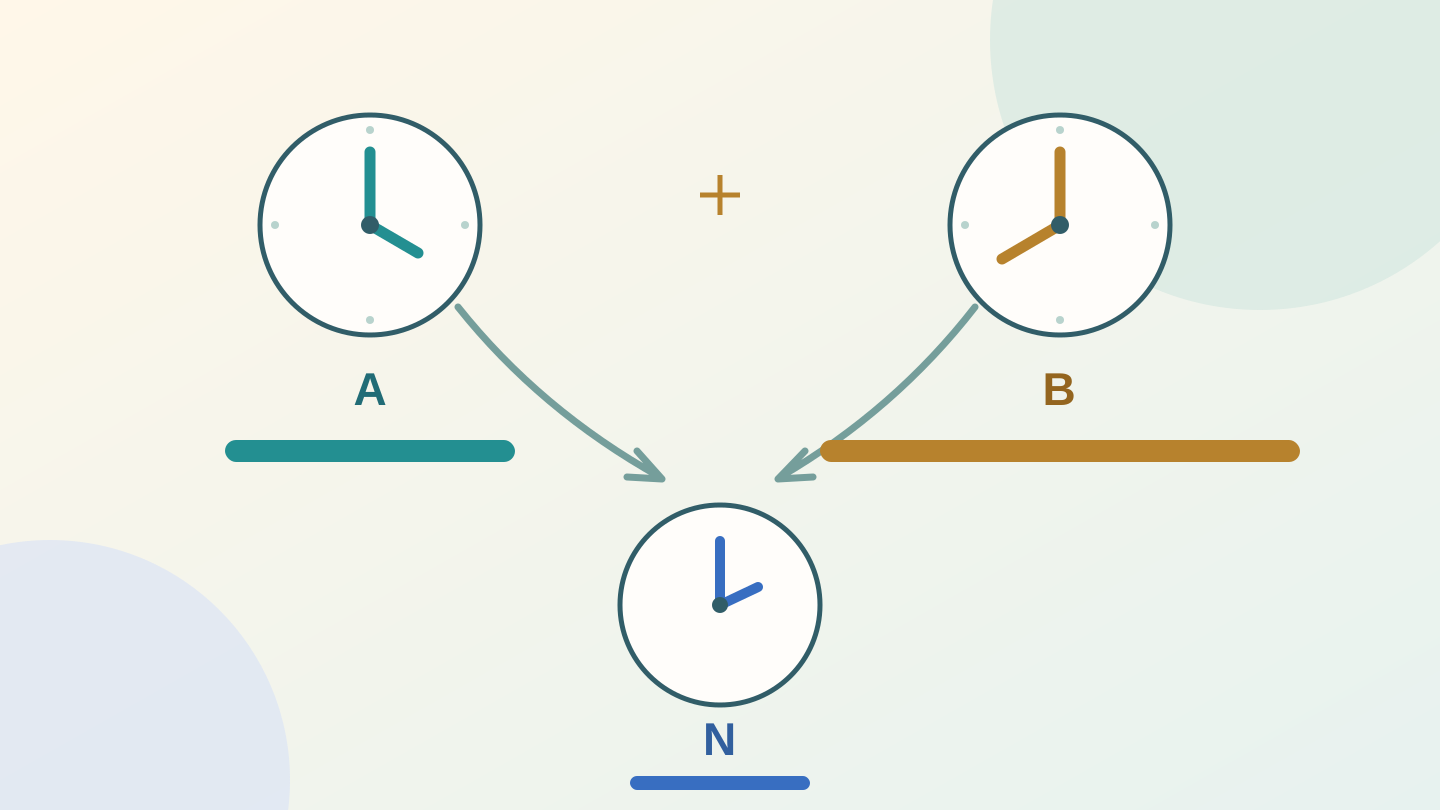
We start from the formula derived in the AI and Thought article If I ask someone to help, why should the job take longer?.

We develop three problems with the same two people, Aldo and Beniamino. The known data change, not the work model. In the third case we rewrite the ratio between the times using the relation from the second: A = B + T.
The task is always the same complete job. Both start together, work at constant rates, can share the task and do not obstruct each other. A, B and N are positive times; each calculation uses one consistent unit, hours or minutes.
Before we begin: the symbols
| Symbol | Meaning |
|---|---|
| A | Aldo’s time to finish the job alone |
| B | Beniamino’s time to finish the job alone |
| N | Time needed when they work together |
| T | Signed difference A − B, in the same unit as the times |
| t1, t2 | Positive numbers expressing the ratio between A and B; the ratio has no unit |
If T > 0, Aldo takes longer; if T < 0, Aldo takes less time; if T = 0, both times are equal. In problem 2, “T more” corresponds to T ≥ 0. The formulas also hold for a negative difference, which we will need in problem 3.
Problem 1: the individual times are known
Aldo finishes a job alone in A hours. Beniamino finishes the same job alone in B hours. How much time N do they need when working together?
Choose one unit, for example the hour, and let A and B be the numerical values of the times. To avoid fractions during the reasoning, imagine an interval of A × B hours.
- Aldo completes one job every A hours. In A × B hours he completes B jobs.
- Beniamino completes one job every B hours. In A × B hours he completes A jobs.
- Together, in the same interval of A × B hours, they complete A + B jobs.
- To find the time for one job, divide the total time A × B by the number of jobs A + B.
Formula for problem 1
N = (A × B) / (A + B)
Example already discussed in the AI article: A = 3 hours, B = 4 hours
With A = 3 hours and B = 4 hours, choose a 12-hour interval. Aldo completes 4 jobs and Beniamino 3: together they complete 7 jobs in 12 hours. One job therefore takes 12/7 of an hour.
Now apply the formula to the two times:
N = (3 × 4) / (3 + 4) = 12/7
The result is 12/7 of an hour, approximately 1 hour, 42 minutes and 51 seconds. It is not the average of the two individual times.
With two positive contributions, the joint time is shorter than both individual times. If A = B, the formula gives N = A/2.
Problem 2: the joint time and the difference are known
Working together, Aldo and Beniamino finish a job in N hours. Working alone, Aldo would take T hours longer than Beniamino to finish the same job. How long would Aldo take alone? How long would Beniamino take?
The data are N and T; the unknowns are A and B. The parametric system is:
(A × B) / (A + B) = N
A = B + T
From the second relation we get B = A − T and substitute it into the first. Multiplying out and rearranging gives a quadratic equation:
B = A − T
A(A − T) / (2A − T) = N
A² − AT = 2NA − NT
A² − (T + 2N)A + NT = 0
The discriminant simplifies as follows:
Δ = (T + 2N)² − 4NT = T² + 4N²
Choose the + sign before the square root: it is the only branch giving two positive times. The − sign would not give two physically acceptable durations. The parametric solutions are:
Formulas for problem 2
A = (2N + T + √(T² + 4N²)) / 2
B = (2N − T + √(T² + 4N²)) / 2
Also keep the equivalent equation in B: we will use it to reduce problem 3 to the same algebraic case.
B² + (T − 2N)B − NT = 0
These formulas hold for N > 0 and any real difference T. If T = 0, they give A = B = 2N. Make hours and minutes consistent before substituting the data.
Two examples of problem 2
Example 2a: N = 4/3 of an hour, T = 2 hours
Aldo and Beniamino finish a job together in one and one third hours, so N = 4/3 of an hour. Alone, Aldo takes 2 hours longer than Beniamino. How long does each take alone?
The statement uses hours; we will calculate in minutes. First convert both given times:
N = (4/3) h = (4/3) × 60 min = 80 min
T = 2 h = 2 × 60 min = 120 min
√(120² + 4 × 80²) = √40000 = 200
A = (2 × 80 + 120 + 200) / 2 = 240
B = (2 × 80 − 120 + 200) / 2 = 120
The formula results are in minutes: Aldo takes 240 minutes and Beniamino 120 minutes.
Only now convert the results to hours by dividing by 60:
A = 240 min = (240/60) h = 4 h
B = 120 min = (120/60) h = 2 h
Aldo therefore takes 4 hours and Beniamino 2 hours. Check both the joint time and the difference in minutes:
(240 × 120) / (240 + 120) = 80
240 − 120 = 120
Example 2b: N = 36 minutes, T = 30 minutes
Together they finish in 36 minutes; alone, Aldo takes 30 minutes longer. Apply the same formulas:
√(30² + 4 × 36²) = √6084 = 78
A = (2 × 36 + 30 + 78) / 2 = 90
B = (2 × 36 − 30 + 78) / 2 = 60
Aldo takes 90 minutes and Beniamino 60 minutes. Check:
(90 × 60) / (90 + 60) = 36
90 − 60 = 30
Problem 3: the joint time and the ratio are known
Working together, Aldo and Beniamino finish a job in N hours. Alone, Aldo would take t1/t2 times as long as Beniamino. How long would Aldo take alone? How long would Beniamino take?
The data are now N and the ratio t1/t2. The relation between the times is A = (t1/t2)B, with t1 > 0 and t2 > 0. The system is:
(A × B) / (A + B) = N
A = (t1/t2)B
Transform the relation, not the problem
We want to rewrite A = (t1/t2)B as A = B + T. Subtract B and factor out B:
T = A − B = (t1/t2)B − B
T = ((t1 − t2)/t2)B = B(t1 − t2)/t2
A = B + ((t1 − t2)/t2)B = B + T
T is not a newly assigned number: it remains an expression involving the unknown B. The algebraic transformation requires t2 ≠ 0. We cannot replace T with just the ratio (t1 − t2)/t2: that ratio must be multiplied by B.
Now use the equation in B from problem 2 and substitute this expression for T. Multiplying by t2 and factoring out B gives:
B² + (T − 2N)B − NT = 0
B² + [((t1 − t2)/t2)B − 2N]B − N[(t1 − t2)/t2]B = 0
t2 B² + (t1 − t2)B² − 2Nt2 B − N(t1 − t2)B = 0
t1 B² − N(t1 + t2)B = 0
B[t1 B − N(t1 + t2)] = 0
Discard B = 0 because a working time must be positive. Find B, then A from the original ratio. These are the parametric solutions of problem 3:
Formulas for problem 3
A = N(t1 + t2)/t2
B = N(t1 + t2)/t1
We have reduced the relation from case 3 to the form used in case 2 while retaining T = B(t1 − t2)/t2. If t1 < t2, T is negative; if t1 > t2, it is positive.
Example of problem 3: B = A/2
Return to the same example: Aldo and Beniamino finish a job together in one and one third hours, so N = 4/3 of an hour. Alone, Beniamino takes half as long as Aldo: B = A/2. How long does each take alone?
Start from B = A/2. Multiply by 2 to write A = 2B: in the general relation A = (t1/t2)B we therefore have t1 = 2 and t2 = 1. Rewrite the ratio in the form used in problem 2:
B = A/2
A = 2B = B + B = B + T
T = B(2 − 1)/1 = B
Convert the joint time to minutes and substitute the values into the formulas for problem 3:
N = (4/3) h = (4/3) × 60 min = 80 min
A = 80 × (2 + 1) / 1 = 240
B = 80 × (2 + 1) / 2 = 120
The formulas give A = 240 minutes and B = 120 minutes. Then convert both results to hours:
A = 240 min = (240/60) h = 4 h
B = 120 min = (120/60) h = 2 h
We recover A = 4 hours and B = 2 hours, just as in example 2a. This time the initial datum was the ratio B = A/2, not the difference. After finding the times, also check T = 120 minutes, or 2 hours:
T = 240 − 120 = 120 min = 2 h
(240 × 120) / (240 + 120) = 80
120 = 240/2
The formulas at a glance
| Case | Known data | Times to find |
|---|---|---|
| 1 | A and B | N |
| 2 | N and T = A − B | A and B |
| 3 | N and ratio t1/t2 | A and B; T remains linked to B |
In the first case we calculate the joint time. In the second we reconstruct the individual times from their difference. In the third we rewrite the ratio relation in the same form A = B + T while retaining its dependence on B.
1) N = (A × B) / (A + B)
2) A = (2N + T + √(T² + 4N²)) / 2
2) B = (2N − T + √(T² + 4N²)) / 2
3) A = N(t1 + t2)/t2
3) B = N(t1 + t2)/t1
3 → 2: T = B(t1 − t2)/t2
From reasoning to a formula
A formula is useful when we know which data are given, which quantities we are seeking and which relations must still be respected. Moving from a ratio to a difference illustrates this: we can change the form of a relation without changing the problem.
Read the AI and Thought lesson from which the working-together formula comes.