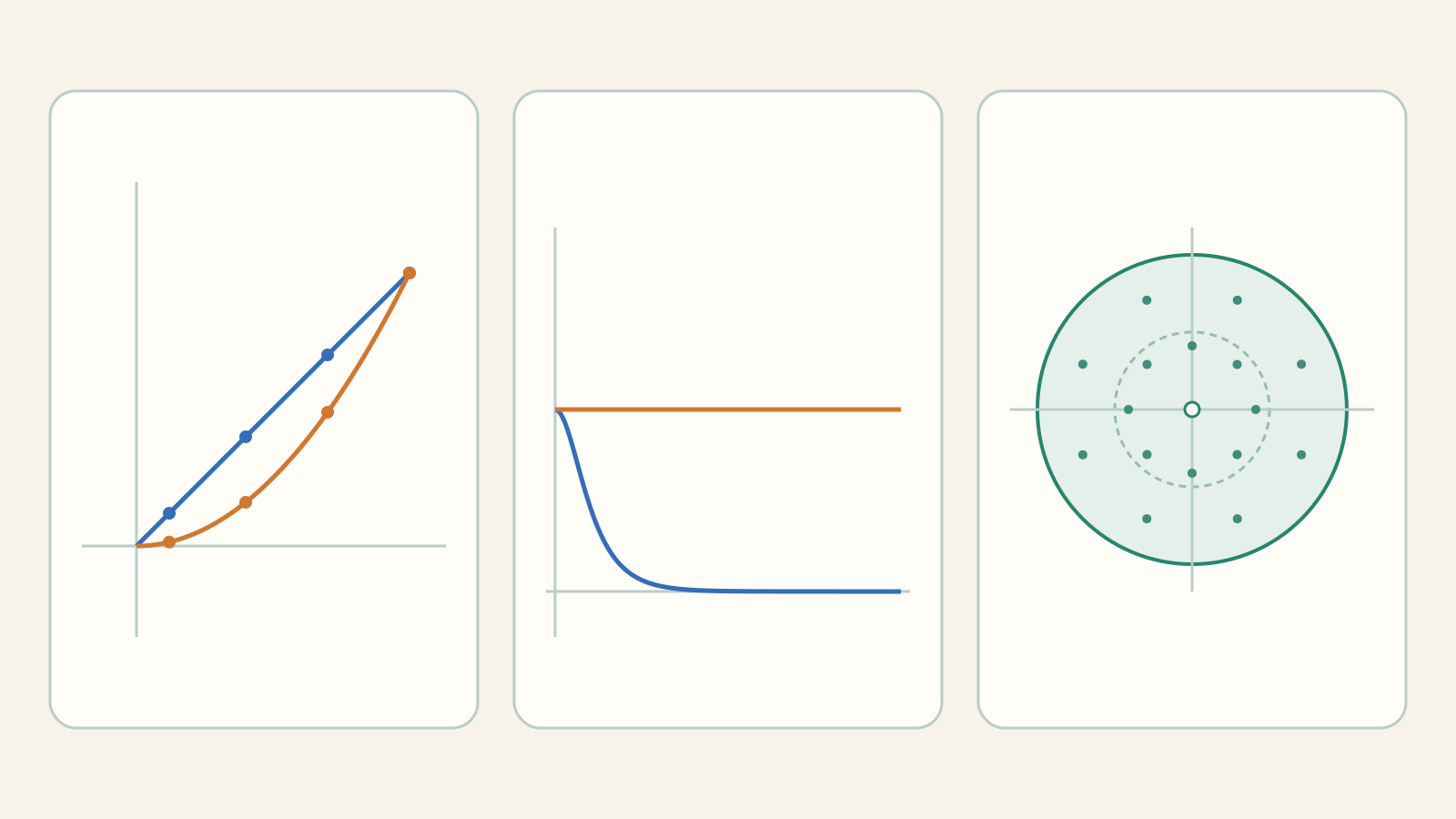
In one variable we approach from two sides. In the plane we can follow lines, parabolas and infinitely many other paths. A limit must describe every nearby domain point, not just those selected for a plot. Stage 20 joins geometric intuition, counterexamples and proofs: learn both to disprove a limit and to establish one.
Lab: multivariable limits and continuity · Learning-path index
1. Approaching in the plane: distance and domain
P=(x,y), P₀=(a,b)
r=‖P−P₀‖=√((x−a)²+(y−b)²)
P→P₀ ⇔ r→0
Both coordinates must approach their targets, not necessarily at the same speed. Along P=(t,t²), x tends to zero as t and y as t². Distance is t√(1+t²) for t>0: t is not r.
Limits are relative to D. P₀ must be an accumulation point: distinct domain points must exist arbitrarily near it. P₀ need not belong to D, and f(P₀) is not needed to define the limit.
2. The ε–δ definition: one guarantee for every point
lim_(x,y)→(a,b) f(x,y)=L
∀ε>0 ∃δ>0 ∀(x,y)∈D:
0<√((x−a)²+(y−b)²)<δ ⇒ |f(x,y)−L|<ε
ε is output accuracy; δ is input proximity. The disk excludes its center: the assigned point value does not enter. One δ must work for every allowed point in the disk, not a different δ for each point or path.
One ε,δ pair does not prove a limit. We need a rule supplying a suitable δ for every ε>0, or an applicable theorem. Finitely many samples do not control all disk points.
3. First choice: continuity and substitution
Polynomials in x,y are continuous on ℝ². Sums, products and compositions of continuous functions remain continuous where defined; quotients need a nonzero denominator at the point. Do not invent path tests when these theorems already solve the problem.
lim_(x,y)→(1,2)(x²+2y²)=1+2·4=9
lim_(x,y)→(1,1)(x+y)/(1+x²+y²)=2/3
At the origin a 0/0 expression supplies no answer: a limit may exist or fail. Analyze the structure; 0/0 is not a number.
4. Paths: powerful to disprove, insufficient to prove
If the joint limit L exists, every admissible approaching path must give L. Two paths with different limits disprove it. Two, ten or a thousand agreeing paths do not prove it: others may behave differently.
P_n,Q_n∈D∖{P₀}, P_n→P₀, Q_n→P₀
f(P_n)→L₁, f(Q_n)→L₂, L₁≠L₂ ⇒ ∄lim_(P→P₀)f(P)
The sequential criterion is stronger: the limit is L exactly when every sequence of domain points, avoiding the center and approaching it, has function values tending to L. “Every” cannot be replaced by a few plots.
5. Axes agree, the diagonal disagrees
f(x,y)=xy/(x²+y²), (x,y)≠(0,0)
f(t,0)=0; f(0,t)=0
f(t,t)=t²/(2t²)=1/2
f(t,mt)=m/(1+m²)
Both axes suggest 0, but the diagonal gives 1/2 for every t≠0. The joint limit fails. The line formula depends continuously on slope m: direction matters.
Assigning f(0,0)=0 makes both axis restrictions continuous. In fact the function is separately continuous in each variable but not jointly continuous at the origin. Separate continuity does not imply joint continuity.
6. The decisive counterexample: every line gives 0
g(x,y)=x²y/(x⁴+y²), (x,y)≠(0,0)
g(t,mt)=mt/(t²+m²)→0 (m≠0)
g(t,0)=0; g(0,t)=0
g(t,ct²)=c/(1+c²)
c=1 ⇒ g(t,t²)=1/2
All lines through the origin, including the vertical axis, give 0. Yet parabola y=x² stays at height 1/2. Adding more slopes will not help: the missing family of curved paths is the issue.
ε=1/4; δ>0
0<t<min(1,δ/√2)
0<√(t²+t⁴)<√2·t<δ
|g(t,t²)−0|=1/2>ε
This rigorously refutes the definition for candidate 0: every δ fails. The path y=0 rules out other candidates, since any joint limit would have to be 0. Nonexistence is proved, not merely observed.
7. Iterated limits: different from the joint limit
h(x,y)=(x²−y²)/(x²+y²)
lim_x→0[lim_y→0 h(x,y)]=1
lim_y→0[lim_x→0 h(x,y)]=−1
For the inner limit hold the other variable fixed and nonzero, then let it approach zero. Here order changes the answer and the joint limit fails. Equal iterated limits do not guarantee a joint limit either.
For xy/(x²+y²), both iterated limits are 0 even though the joint limit fails. Do not replace one problem with another without proving their relationship.
8. Proving a limit requires a bound for every point
r=√(x²+y²)
|x|≤r; |y|≤r
0≤x²+2y²≤2r²
δ=√(ε/2) ⇒ 0<r<δ ⇒ |x²+2y²|<ε
The polynomial now has a direct proof of limit 0 at the origin. For ε=0.02, δ=0.1 suffices. This controls the entire disk, not one trajectory.
u(x,y)=x²y/(x²+y²)
|u|=(x²/(x²+y²))|y|≤|y|≤r
δ=ε ⇒ 0<r<δ ⇒ |u|<ε
This quotient also tends to 0; for ε=0.02 choose δ=0.02. A denominator tending to zero does not by itself imply failure: numerator and a uniform bound decide. A sufficient δ need not be the largest possible.
9. Polar coordinates: r tends to zero, θ is not fixed
x=r cosθ; y=r sinθ; r>0
xy/(x²+y²)=cosθ sinθ
x²y/(x²+y²)=r cos²θ sinθ
The first expression depends on θ and different directions yield different values. The second has |cos²θ sinθ|≤1, giving |u|≤r independently of angle: exactly the joint-limit requirement.
x²y/(x⁴+y²)=r cos²θ sinθ/(r²cos⁴θ+sin²θ)
For every fixed θ the final expression tends to 0, yet it stays 1/2 on y=x². That path’s angle varies as r shrinks. “Every fixed angle” is not “uniformly in angle”: a polar proof needs an angle-independent bound.
10. Oscillations and a nonzero limit
v(x,y)=r sin(1/r), r>0
|v|≤r ⇒ lim_(x,y)→(0,0)v=0
δ=ε
Oscillations get faster near the origin, but their amplitude is at most r and vanishes. A sampled graph may miss oscillations without affecting the proof: the bound guarantees convergence.
w(x,y)=sin r/r, r>0
|sin r−r|=|∫₀ʳ(cos u−1)du|≤∫₀ʳu²/2 du=r³/6
|w−1|≤r²/6
δ=√(6ε) ⇒ 0<r<δ ⇒ |w−1|<ε
Use 1−cos u≤u²/2 for all real u. Dividing by r>0 gives a global bound and limit 1. The original formula is undefined at the origin; assigning 1 gives a continuous extension.
11. Boundary limits: stay inside the domain
f(x,y)=√y; D={(x,y):y≥0}
0≤y≤r ⇒ |f−0|=√y≤√r
δ=ε² ⇒ 0<r<δ, (x,y)∈D ⇒ |f|<ε
No full disk centered at the origin lies inside D, yet the relative limit is 0 and f is continuous at that boundary point. The definition tests only disk points belonging to D. For ε=0.1, δ=0.01 suffices.
The branch (t,−t), t>0 lies outside D and cannot refute the limit. Paths (0,t), (t,0) and (t,t²) are admissible. Check path admissibility before comparing values.
12. Continuity and extension: three separate checks
P₀∈D; f(P₀)∈ℝ
∃L∈ℝ:lim_(P→P₀, P∈D)f(P)=L
lim_(P→P₀, P∈D)f(P)=f(P₀)
At an accumulation point of D these are the three continuity checks. If the point is outside D, continuity there is not a property of the original function: ask whether a continuous extension exists.
For x²y/(x²+y²), limit 0 means assignment 0 repairs the missing point; assignment 1 leaves a discontinuity. For sin r/r assign 1, not 0. When no limit exists, no isolated assignment repairs it: changing the center does not change nearby values.
13. Numerical example: same start, different limits
g(x,y)=x²y/(x⁴+y²)
A(t)=(t,t); g(A(t))=t/(1+t²)
B(t)=(t,t²); g(B(t))=1/2
t=1: A→0.5, B→0.5
t=0.1: A→0.0990099…, B→0.5
t=0.01: A→0.009999…, B→0.5
t=0.001: A→0.000999999…, B→0.5
Both paths start at (1,1) with value 1/2, then diverge. The first row alone would be misleading. In the animation A falls toward 0 and B remains at 1/2, while both plane points approach the origin.
Decimals illustrate behavior; they do not prove it. The exact formulas and their different limits do. Never substitute t=0 into the original expressions.
14. The lab and a reusable method
Choose eight cases. Path A is a line or vertical axis; B a parabola, inverse-coordinate parabola or cubic. Parameter t stays positive. Displayed path limits are analytical, not estimated from the final sample. If selected paths agree in a no-limit case, a proved counterexample remains visible.
For convergent cases change ε,δ and compare B(δ) with ε. The button supplies a sufficient δ from the proof. Failure to certify a chosen δ does not prove it wrong: the bound may be nonoptimal. The formula for every ε proves the limit; checking one pair merely applies it.
Surfaces and plots are sampled and can miss thin ridges or oscillations; they are not proofs. Method: domain and accumulation point; substitution when legal; paths for contradictions; path-independent bound for proof; finally compare with f(P₀). Next come partial derivatives, gradient and tangent plane.
Exercises: try before revealing
1. What is the ε–δ quantifier order?
Show the explained answer
For every ε>0 there exists δ>0 working for all domain points with 0<r<δ. δ may depend on ε and the target point, not on each selected disk point.
2. Must f(0,0) be defined for a limit?
Show the explained answer
No. A limit concerns nearby points other than the origin. Continuity there requires domain membership and the value to match the limit at an accumulation point.
3. For xy/(x²+y²), are axes enough?
Show the explained answer
No. Axes give 0, diagonal y=x gives 1/2. Different path limits prove the joint limit fails.
4. All lines give 0 for x²y/(x⁴+y²). Conclusion?
Show the explained answer
Insufficient. On y=x² the value is x⁴/(2x⁴)=1/2 for x≠0. No joint limit exists despite agreement on all lines.
5. For x²+2y² and ε=0.08 find a sufficient δ.
Show the explained answer
|f|≤2r². δ=√(0.08/2)=0.2: r<0.2 gives |f|<2·0.04=0.08 throughout the disk.
6. Prove the limit of x²y/(x²+y²) at ε=0.05.
Show the explained answer
|f|≤|y|≤r. Choose δ=0.05: every 0<r<δ gives |f|<0.05. Rule δ=ε works for every ε>0 and proves limit 0.
7. Do increasingly fast oscillations prevent a limit?
Show the explained answer
Not necessarily. r sin(1/r) oscillates but absolute value ≤r tends to 0. Vanishing amplitude guarantees the limit even if plots miss oscillations.
8. Which origin value should be assigned to sin r/r?
Show the explained answer
1. Bound |sin r/r−1|≤r²/6 proves limit 1. Assigning 0 is not continuous. For ε=0.01, δ=√0.06 suffices.
9. For √y at the origin, find sufficient δ for ε=0.1.
Show the explained answer
On y≥0, √y≤√r. Choose δ=ε²=0.01. Points with y<0 are outside the domain and do not enter the relative limit.
10. Do two iterated limits equal to 0 prove a joint limit?
Show the explained answer
No. xy/(x²+y²) has both iterated limits 0 but diagonal values 1/2. Agreement is insufficient.
11. Does assigning 2 at the origin repair x²y/(x²+y²)?
Show the explained answer
No. Limit remains 0, different from value 2. Assign 0 for a continuous extension. Changing one point does not change the nearby-point limit.
12. For √y, may I use (t,−t) with t>0?
Show the explained answer
No: y=−t<0 makes that branch inadmissible. Undefined real values do not refute a limit relative to y≥0. Use (0,t) or (t,t²).
Before: functions of two variables · Learning-path index