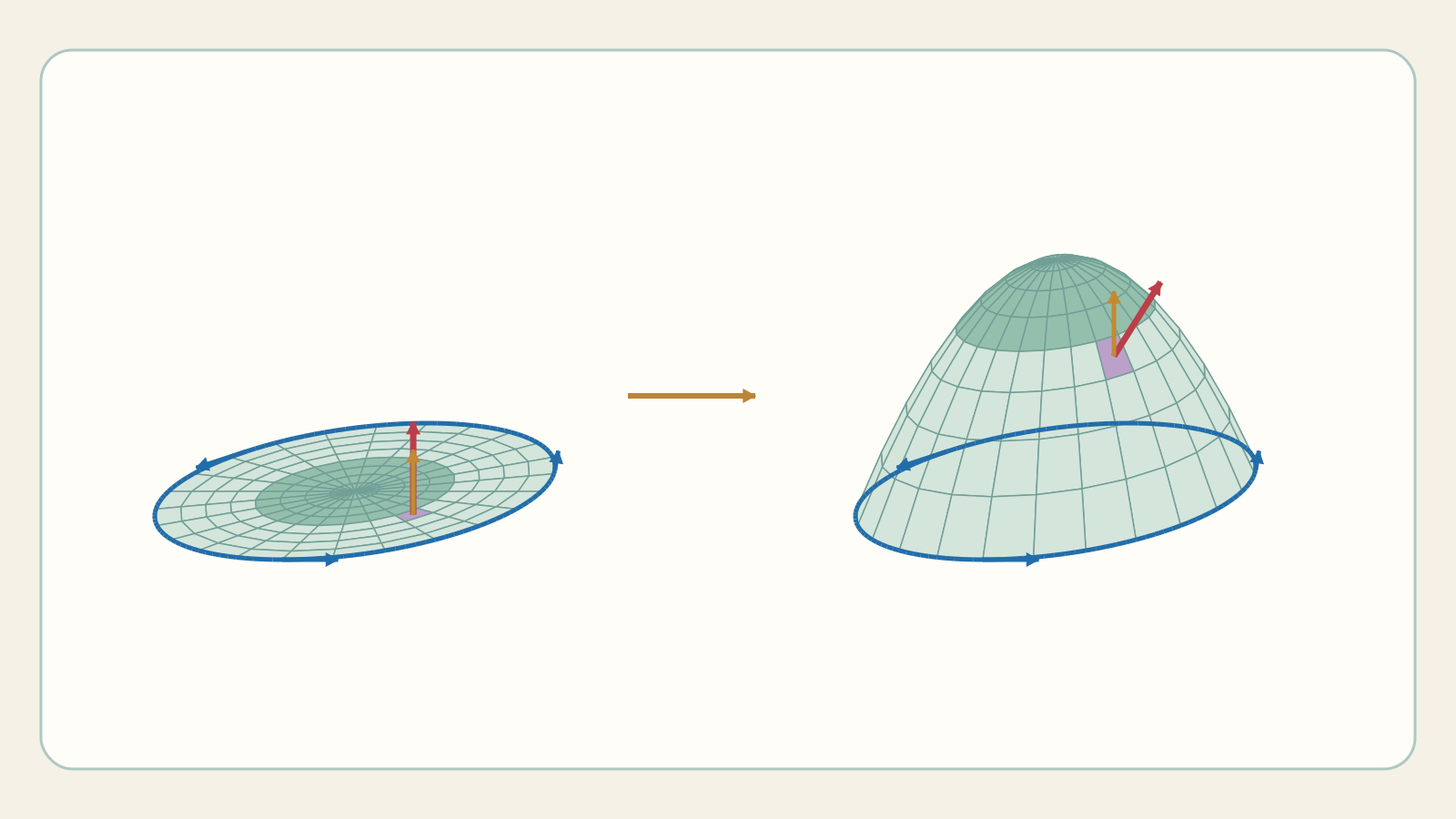
Gauss compared flux across a volume boundary with divergence inside. Stokes instead connects circulation along a curve to curl flux through a surface bounded by that curve. The objects and assumptions differ. This stage completes the planned stages 24–29 of Block 4, not all of Analysis.
Stokes: circulation and curl · Learning-path index
1. Curl: three derivative differences
For F=(P,Q,R), divergence was scalar. Curl is a vector: its components describe circulation density relative to three normal directions. The notation ∇×F resembles a cross product, but derivatives act on the field components.
rot F=∇×F=(R_y−Q_z, P_z−R_x, Q_x−P_y)
F=(z,x,y)
R_y−Q_z=1−0=1
P_z−R_x=1−0=1
Q_x−P_y=1−0=1
rot F=(1,1,1)
Signs and variable order matter. For F=(−y/2,x/2,0), curl is (0,0,1) while divergence is zero: circulation can occur without local expansion. Curl is neither field magnitude nor a tangent to a trajectory.
2. A small loop reveals the normal component
Around a point, take a small planar region with unit normal n̂ and right-hand boundary orientation. Under regularity assumptions, circulation divided by area tends to rot F·n̂ as the region shrinks regularly to that point. The normal fixes the sign.
rot F(p)·n̂=lim[ε→0] (∮∂Dε F·dr)/Area(Dε)
Do not automatically read curl magnitude as the angular speed of an arbitrary object. For rigid rotation F=(−ωy,ωx,0), angular speed is ω but curl is (0,0,2ω). Both derivatives contribute the factor two.
3. Stokes needs orientation and regularity
S is an orientable piecewise smooth surface with piecewise regular boundary C=∂S. F has continuous first partial derivatives on an open neighbourhood of all S, not only C. Normal and boundary directions must agree. Include every boundary component with its induced orientation.
L=∮∂S F·dr
I=∬S rot F·n̂ dS
L=I
Point the right thumb along the normal; curled fingers indicate positive boundary traversal. For an upward-oriented surface, the outer boundary is counterclockwise from above. Reversing just one orientation breaks compatibility; reversing both changes both signs and preserves Stokes. A Möbius strip has no continuous global normal; our surfaces are orientable.
4. The disk: both calculations in full
Choose F=(−y/2,x/2,0), a radius-R disk in z=0 and upward normal. Parametrize its boundary counterclockwise. Since t runs from 0 to 1, the derivative contains 2π.
c(t)=(R cos(2πt),R sin(2πt),0)
c′(t)=(−2πR sin(2πt),2πR cos(2πt),0)
F(c)=(−R sin(2πt)/2,R cos(2πt)/2,0)
F(c)·c′=πR²[sin²(2πt)+cos²(2πt)]=πR²
L=∫₀¹πR²dt=πR²
rot F=(0,0,1); n̂=(0,0,1)
I=∬S1 dS=πR²
R=2 → L=I=4π
Here I equals area because normal curl equals one, not for arbitrary fields. L is not boundary length 2πR. At R=2 those numbers happen to agree; change R to see the distinction.
5. A genuinely three-dimensional example
r(u,v)=(au,bv,hu), 0≤u,v≤1
r_u=(a,0,h); r_v=(0,b,0)
N=r_u×r_v=(−bh,0,ab)
F=(z,x,y); rot F=(1,1,1)
rot F·N=−bh+ab=b(a−h)
I=∫₀¹∫₀¹b(a−h)dv du=b(a−h)
The boundary follows (0,0,0),(a,0,h),(a,b,h),(0,b,0),then closes. Parametrizing each side from t=0 to 1 gives the four contributions below; the ah/2 terms cancel.
L₁=ah/2; L₂=ab; L₃=−ah/2−bh; L₄=0
L=b(a−h)=I
a=2,b=1,h=1 → L=I=1
a=2,b=1,h=3 → L=I=−1
Area(S)=b√(a²+h²)
Curl has all positive components, yet its flux may be negative: its dot product with the normal matters. Area stays positive and differs from this integral. Using F=(−y/2,x/2,0) on the same plane instead gives ab, independent of h.
6. Same boundary, different surfaces
Keep the circle x²+y²=R²,z=0 and F=(−y/2,x/2,0). Choose a disk, the dome z=h(1−(x²+y²)/R²), or an upper hemisphere. They share the oriented boundary, and the field is regular near each. Stokes gives the same curl flux πR² for all three.
Disco: Area=πR², I=πR²
Calotta, R=1,h=1: Area=π(5√5−1)/6, I=π
Emisfero: Area=2πR², I=πR²
Areas are not equal. On tilted pieces, vertical curl crosses only through its normal component: inclination and area weight compensate in flux, not in area. Surface replacement needs the same boundary, compatible orientations and field regularity near both surfaces. Similar-looking drawings are insufficient.
7. Curl varying from point to point
F=(−y³/3,x³/3,0)
rot F=(0,0,x²+y²)
I=∫₀²π∫₀ᴿ ρ²ρ dρ dθ=πR⁴/2
L=(R⁴/3)∫₀²π(sin⁴θ+cos⁴θ)dθ=πR⁴/2
R=2 → L=I=8π
The first integral uses the disk; the dome with that boundary gives the same result. The polar formula includes ρ² from curl and ρ from the area factor. In the line calculation the full-turn averages of sin⁴θ and cos⁴θ are both 3/8.
Lab quadratures are independent. A few boundary samples can alias the trigonometric terms, while the surface has a different error. Convergence tables separate analytic and numerical values; L=I is not imposed artificially.
8. Why Stokes extends Green
For a surface described by a regular C² chart r(u,v) over planar D, define scalars A=F(r)·r_u and B=F(r)·r_v. The boundary line integral becomes the integral of A du+B dv over ∂D with induced orientation.
B_u−A_v=(DF(r)r_u)·r_v−(DF(r)r_v)·r_u+F(r)·(r_vu−r_uv)
r_vu=r_uv
B_u−A_v=(R_y−Q_z)(y_u z_v−z_u y_v)
          +(P_z−R_x)(z_u x_v−x_u z_v)
          +(Q_x−P_y)(x_u y_v−y_u x_v)
        =rot F(r)·(r_u×r_v)
∮∂D A du+B dv=∬D(B_u−A_v)du dv=∬S rot F·n̂ dS
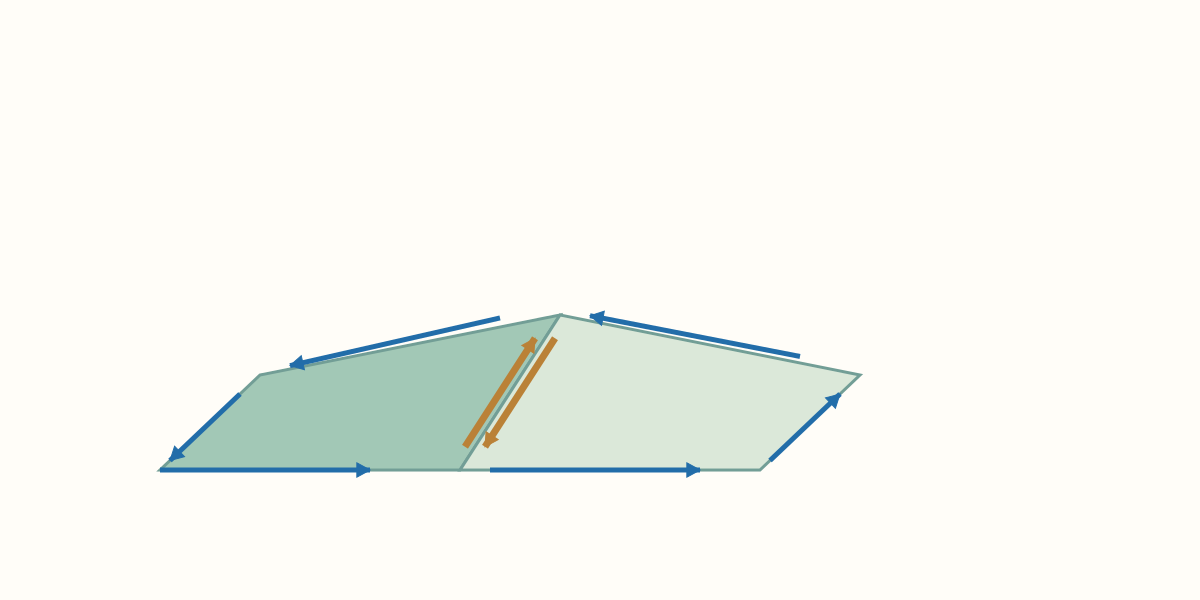
DF is the field’s derivative matrix. Mixed surface derivatives cancel, and Green on parameter space proves this case. With multiple charts or pieces, shared edges are traversed oppositely and cancel. The picture illustrates the idea, not all technical details of the general construction.
9. A surface with a hole has two boundaries
Consider the planar annulus r≤√(x²+y²)≤R with upward normal and F=(−y/(x²+y²),x/(x²+y²),0). The field is undefined on the z-axis, but that axis misses the annulus. Curl vanishes near the surface and Stokes applies.
L_ext=2π, senso antiorario
L_int=−2π, senso orario
L=2π−2π=0=∬S0 dS
The inner circle runs clockwise with upward surface normal. The annulus normal does not switch between boundaries; the induced tangent direction changes. Omitting the inner circle makes C different from ∂S and invalidates the comparison.
10. The filled disk is not a valid alternative
The same angular field has circulation 2π around the outer circle. Filling its hole with a disk makes the surface meet the z-axis at the origin, violating C¹ regularity near all S. One cannot use zero curl away from the axis to assert zero disk curl flux and claim a contradiction.
Simply choosing a hemisphere does not solve it: this field is singular along the whole z-axis, which also meets the hemisphere’s pole. The lab disables the disk’s surface check before sampling; a grid that misses the origin cannot restore the assumptions.
11. When the surface has no boundary
A whole sphere is closed: its boundary is empty, not a hidden circle. In general Stokes the empty-boundary integral is zero. A field regular near the surface therefore has zero curl flux through the sphere.
∂S=∅ → ∮∂S F·dr=0
F=(z,x,y); rot F=(1,1,1)
∬[sfera] (1,1,1)·n̂ dS=0
Curl is nonzero; positive and negative flux contributions cancel. Stokes asks regularity near the surface, Gauss near the whole volume. A closed curve is not a closed surface: a disk has a closed boundary curve but is not boundaryless.
12. Keep Green, Gauss and Stokes distinct
| Theorem | Boundary | Interior / surface |
|---|---|---|
| Green | ∮∂D Pdx+Qdy | ∬D(Q_x−P_y)dA |
| Gauss | ∬∂V F·n̂ dS | ∭V div F dV |
| Stokes | ∮∂S F·dr | ∬S rot F·n̂ dS |
Green’s circulation form is planar Stokes with vertical normal. Gauss relates a closed surface to a volume using divergence. Stokes relates a curve to a surface using curl. Its right-hand side is flux of curl F, not flux of F: an essential distinction.
For a C² potential, curl(∇φ)=0; F=(2x,2y,2z) is an example. Zero curl does not always imply a global potential: the angular field on an annulus shows the domain’s role. For C² fields div(curl F)=0 too, but that identity does not replace Stokes’s domain and orientation checks.
13. Use the lab and complete Block 4
Start with the disk, then dome and hemisphere sharing its boundary. Compare geometric area and curl flux: only the latter stays invariant. Try the tilted plane with nonvertical curl. Orientation controls are independent; matching them restores compatibility rather than altering formulas to hide an error.
ΔL=F(c(t*))·c′(t*) Δt
ΔI=rot F(r(u*,v*))·N(u*,v*)/n²
N=±(r_u×r_v)
Independent midpoint sums add one boundary term per step while advancing surface strips; partial sums need not agree because the pieces may not bound each other. On the boundaryless sphere animation adds surface cells directly. Weights come from derivatives, not drawn polygons.
Numerical convergence is not a proof or certified error bound. Guided-case assumptions are checked analytically: wrong orientation, missing inner loop and singularity are flagged. All six planned stages 24–29 of Block 4 are now available; further extensions will be chosen and added to the same index later.
Exercises: try before revealing
1. Compute curl of F=(z,x,y).
Show the explained answer
The differences R_y−Q_z,P_z−R_x,Q_x−P_y are all 1−0. Curl is (1,1,1). Divergence is instead 0, a different operation.
2. For F=(−3y,3x,0), find curl and rigid angular speed.
Show the explained answer
ω=3, while Q_x−P_y=3−(−3)=6. Curl is (0,0,6), not (0,0,3); its magnitude is not the angular speed.
3. Disk R=2 with F=(−y/2,x/2,0): compute L and I.
Show the explained answer
F(c)·c′=4π throughout t∈[0,1], so L=4π. Curl is (0,0,1); upward normal makes I equal disk area 4π.
4. Does reversing only the normal preserve the oriented equality?
Show the explained answer
No. L stays 4π and I becomes −4π, an incompatible pair. Reverse the boundary too to get L=I=−4π; geometric area remains 4π.
5. On r=(2u,v,u), F=(z,x,y), find curl flux.
Show the explained answer
Tangents (2,0,1),(0,1,0) give N=(−1,0,2). Curl (1,1,1) gives dot product 1. Parameter square area 1 yields I=L=1; surface area is √5.
6. For a=2,b=1,h=3, why can flux be negative?
Show the explained answer
N=(−3,0,2), curl (1,1,1), hence dot product −1. L=I=−1 but area √13 is positive. Relative orientation matters, not signs of individual curl components.
7. Do a radius-2 disk and hemisphere have the same curl flux?
Show the explained answer
For F=(−y/2,x/2,0), yes: both 4π with standard orientations. Areas differ, 4π and 8π. They share a boundary and F is regular near both.
8. Cubic field on radius-2 dome: what is the exact result?
Show the explained answer
Curl is (0,0,x²+y²). On the equivalent disk I=2π∫₀²ρ³dρ=8π. Shared boundary and regular field give the same dome value, independent of h.
9. Why is the outer circle insufficient for an annulus?
Show the explained answer
Upward normal gives outer circulation 2π and clockwise inner −2π. Complete boundary gives zero like zero-curl flux. Omitting the inner circle changes the boundary without changing the surface.
10. On the angular-field disk, does zero curl off the axis imply L=0?
Show the explained answer
No. The field is not C¹ near all the surface because the axis intersects it. Circle circulation is 2π. Stokes does not apply to that disk; sampling away from the axis cannot fix it.
11. Whole sphere, F=(z,x,y): why is curl flux zero?
Show the explained answer
∂S is empty with integral zero. Stokes gives zero flux of nonzero curl (1,1,1). Surface contributions cancel; do not invent an equatorial boundary for the whole sphere.
12. Which theorem uses curl and which divergence?
Show the explained answer
Stokes: boundary line integral of F equals curl flux on S. Gauss: flux of F across ∂V equals volume integral of div F. Green circulation is planar Stokes. Check orientation and regularity in every case.
Before: Gauss · Learning-path index