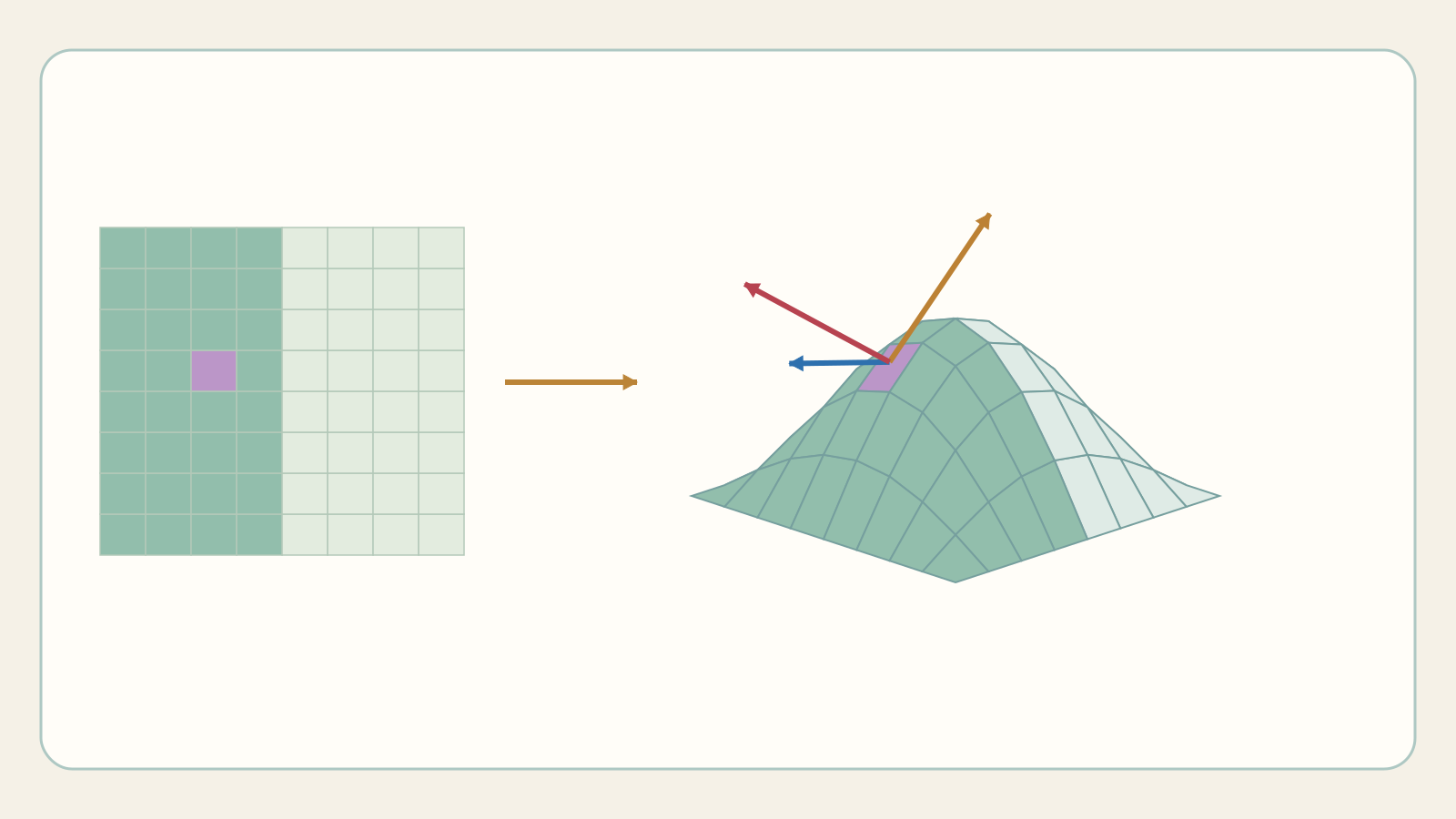
After Green we move from the plane into space. A sail, membrane or curved wall needs two coordinates to locate a point. We can measure its area, add a density over it or count how much of a field passes through it: three different questions. We build the geometry before the formulas, without assuming Gauss’s or Stokes’s theorem.
Surfaces: area, mass and flux · Learning-path index
1. Three questions, three quantities
Area tells us how much material covers the surface. A sheet’s mass adds its surface density, which may vary from point to point. Flux measures the component of a field passing through the surface relative to a chosen normal. A fast current parallel to a wall can have zero flux through that wall.
A=∬S 1 dS
M=∬S ρ dS
Φ=∬S F·n̂ dS
dS is an area element, not volume. With lengths in metres and ρ in kg/m², M is in kg. For velocity F in m/s, flux has units m³/s. Its sign distinguishes crossing directions; a nonnegative mass density does not produce negative mass.
2. A surface from two parameters
r(u,v)=(x(u,v),y(u,v),z(u,v)), (u,v)∈D⊂ℝ²
D is the planar parameter domain; S is its image in space. Parameters need not be Cartesian coordinates: they can be angles or heights. Fix v and vary u to obtain one curve on the surface; fix u and vary v for another. These families form a grid.
r(u,v)=(2u,v,u+v), 0≤u,v≤1
r(0,0)=(0,0,0); r(1,0)=(2,0,1)
r(0,1)=(0,1,1); r(1,1)=(2,1,2)
This is a tilted parallelogram, not the parameter square. At u=1/2,v=1/4 the point is (1,1/4,3/4). Saying only z=x/2+y does not specify the patch: the x and y ranges are needed too.
3. Two tangents and a normal
The derivatives r_u and r_v are tangent to the coordinate curves. Their cross product is perpendicular to both. Its magnitude is the area of their parallelogram, not the product of their magnitudes unless they are perpendicular.
U=(U₁,U₂,U₃), V=(V₁,V₂,V₃)
U×V=(U₂V₃−U₃V₂, U₃V₁−U₁V₃, U₁V₂−U₂V₁)
r_u=(2,0,1), r_v=(0,1,1)
r_u×r_v=(0−1, 0−2, 2−0)=(−1,−2,2)
J=‖r_u×r_v‖=√(1+4+4)=3
n̂=(−1,−2,2)/3
The parametrization is regular wherever J≠0. The unit normal n̂ has length one; r_u×r_v also carries an area factor. Reversing the order of the two vectors reverses the product but not its magnitude.
4. Why area needs a weight
A small Δu×Δv cell has approximate image edges r_uΔu and r_vΔv, hence area JΔuΔv. Adding cells and taking a limit gives the formula. It is neither the projection’s area nor the area of the parameter rectangle.
dS=‖r_u×r_v‖ du dv=J du dv
A(S)=∬D J du dv
r=(2u,v,u+v), D=[0,1]² → A=∫₀¹∫₀¹3 dv du=3
Here the projection has area 2, the parameter square area 1 and the surface area 3. The lab computes J from derivatives, not from drawn quadrilaterals: graphical faces approximate the surface while quadrature uses the analytic weight.
5. A scalar integral: sheet mass
First compose density with the parametrization: ρ(x,y,z) becomes ρ(r(u,v)). Then multiply by J. For the previous plane use ρ=1+z in consistent units. Since z=u+v, density is 1+u+v and is positive everywhere.
∬S f dS=∬D f(r(u,v))J du dv
M=∫₀¹∫₀¹3(1+u+v)dv du
 =3∫₀¹(3/2+u)du=3(3/2+1/2)=6
The area-weighted average density is M/A=2. In general one cannot sample an arbitrary point’s density and multiply by area. A scalar integral of a signed function may be negative; it is the mass interpretation with ρ≥0 that ensures M≥0.
6. A graph z=g(x,y) is not a volume
r(x,y)=(x,y,g(x,y))
r_x=(1,0,g_x), r_y=(0,1,g_y)
r_x×r_y=(−g_x,−g_y,1)
dS=√(1+g_x²+g_y²) dx dy
For z=x²+y² above the unit disk, g_x=2x,g_y=2y. Use polar coordinates in the planar domain: x=t cosθ,y=t sinθ. The factor t is the polar Jacobian; √(1+4t²) accounts for the slope. Both are required.
A=∫₀²π∫₀¹ t√(1+4t²)dt dθ
 =2π[(1+4t²)^(3/2)/12]₀¹
 =π(5√5−1)/6
V=∬[x²+y²≤1] (x²+y²)dx dy=π/2
A measures the curved skin; V measures the volume between it and z=0. They have different units and meanings. Do not replace √(1+g_x²+g_y²) by g in the area formula.
7. Cylinder: lateral wall and caps
r(θ,z)=(R cosθ,R sinθ,z), 0≤θ≤2π, 0≤z≤H
r_θ=(−R sinθ,R cosθ,0), r_z=(0,0,1)
r_θ×r_z=(R cosθ,R sinθ,0), J=R
A_laterale=∫₀ᴴ∫₀²π R dθ dz=2πRH
The resulting normal points outward. This parametrization includes only the lateral wall, not the two disks. With R=2,H=3, lateral area is 12π and closed-cylinder area is 12π+2·4π=20π. Identify the requested surface before integrating.
The lines θ=0 and θ=2π coincide: a seam, not a second covering of the whole wall. Boundary overlap does not alter the integral. Letting 0≤θ≤4π covers every patch twice and doubles the parametrized result.
8. The sphere and parameter poles
r(φ,θ)=(R sinφ cosθ,R sinφ sinθ,R cosφ)
0≤φ≤π, 0≤θ≤2π
r_φ×r_θ=R²sinφ (sinφ cosθ,sinφ sinθ,cosφ)
J=R²sinφ
A=∫₀²π∫₀π R²sinφ dφ dθ=4πR²
The vector in parentheses is a unit outward normal. At the poles sinφ=0, so this chart is not regular there; the sphere itself has no sharp points. This is a coordinate defect that other charts resolve. For these integrals seams and poles have zero area, and the formula applies on regular parts with boundary limits.
For the upper hemisphere use 0≤φ≤π/2, giving area 2πR². Density ρ=1+z/R=1+cosφ gives mass 2πR²∫₀^(π/2)(1+cosφ)sinφ dφ=3πR². Density ranges from 1 at the equator to 2 at the pole; its area-weighted mean is 3/2, not an unweighted mean of arbitrary samples.
9. Flux: the normal component matters
Choose a field continuous on the surface and a continuous normal, at least on each oriented piece. Since n̂=(r_u×r_v)/J and dS=Jdu dv, the factors J cancel. This explains the compact formula: do not multiply by J a second time.
Φ=∬S F·n̂ dS=∬D F(r(u,v))·(r_u×r_v)du dv
r=(2u,v,u+v), F=(0,0,1)
F·(r_u×r_v)=(0,0,1)·(−1,−2,2)=2
Φ=∫₀¹∫₀¹2 dv du=2
On a cylinder vertical F=(0,0,1) has zero lateral flux because it is tangent to the wall. For F=(x,y,z), F·n̂=R on the wall, so Φ=2πR²H; R=2,H=3 gives 24π. Its z component contributes nothing there because the normal’s third component is zero.
On a sphere F=(x,y,z) gives F·n̂=R and Φ=4πR³. For the vertical field the halves contribute +πR² and −πR²: zero total does not mean zero at each point. The upper hemisphere alone retains +πR².
10. Cone and torus: two more examples
r(u,v)=(Ru cos(2πv),Ru sin(2πv),H(1−u)), 0≤u,v≤1
r_u×r_v=2πRu(H cos(2πv),H sin(2πv),R)
J=2πRu√(R²+H²)
A_cono=πR√(R²+H²); Φ_(F=(0,0,1))=πR²
This is the cone’s mantle without its base disk. The normal points out of the solid below it. At u=0 the cross product vanishes and there is a genuine geometric apex. Integrate regular parts and approach the apex by a limit; the excluded point has zero area. R=1,H=2 gives area π√5 and vertical flux π.
r(θ,φ)=((R+r cosφ)cosθ,(R+r cosφ)sinθ,r sinφ)
0≤θ,φ≤2π, 0<r<R
J=r(R+r cosφ)
A_toro=4π²Rr
R is the central-circle radius and r the tube radius. The condition r<R avoids degeneracy and self-intersection. With outward normal and F=(x,y,z), the dot product with r_θ×r_φ is r(R+r cosφ)(R cosφ+r). Integrating cosφ with mean zero and cos²φ with mean 1/2 gives Φ=6π²Rr². For R=2,r=1/2, A=4π² and Φ=3π². This is direct integration, not an early use of Gauss.
11. Orientation, boundaries and closed surfaces
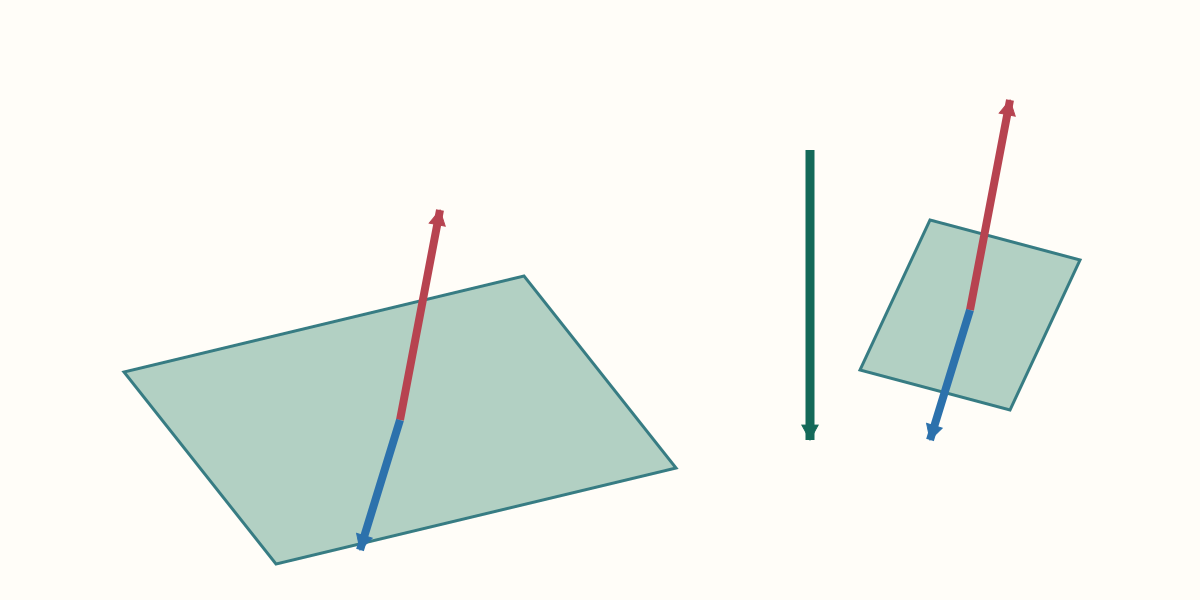
Reversing the normal changes Φ to −Φ but leaves area and the scalar integral of the same density unchanged. An orientable surface admits a continuous normal choice; a Möbius strip does not admit a global continuous normal. We use only orientable surfaces, possibly split into regular pieces.
A sphere and a torus are closed surfaces without boundary. A cylinder wall, a cone without its base and a hemisphere have boundaries: do not silently add missing caps. For a closed surface enclosing a solid we usually choose the outward normal. For an open surface, “outward” can be ambiguous; specify upward, downward or the cross-product direction instead.
When the boundary is oriented too, the right-hand rule relates it to the normal. For an upward-oriented surface, positive traversal appears counterclockwise from above. This prepares Stokes; it does not already turn an arbitrary flux into a boundary line integral.
12. Reparametrizing is not covering twice
Geometric formulas require a single covering, apart from zero-area overlaps between charts or at boundaries. A parameter integral counts multiplicity: covering the whole surface twice adds two copies. The two-turn cylinder lab distinguishes the geometric wall area from the area counted by the parametrization.
r̃(s,v)=r(s²,v), 0≤s,v≤1
r̃_s=2s r_u(s²,v); r̃_v=r_v(s²,v)
r̃_s×r̃_v=2s (r_u×r_v)(s²,v)
The substitution u=s² is increasing: it neither covers twice nor reverses the normal. It redistributes cells and introduces 2s. Its inverse is not regular at s=0, but the change is regular in the interior and that boundary has zero area in these examples. Numerical sums may change, while exact integrals remain equal. A change with negative determinant would reverse induced orientation.
13. Use the lab and check the result
Start with the plane: defaults give area 3, mass 6 and flux 2. One step highlights a parameter cell and its spatial image. The details list r_u,r_v,their cross product,J,the unit normal,ρ,F and the three contributions. Change view angles: the picture changes, not the calculations.
u_i=(i+1/2)/n, v_j=(j+1/2)/n, ΔuΔv=1/n²
ΔA=J(u_i,v_j)/n²
ΔM=ρ(r(u_i,v_j)) ΔA
ΔΦ=F(r(u_i,v_j))·N(u_i,v_j)/n²
N=±(r_u×r_v)
Next try a vertical field on the sphere: flux contributions have opposite signs and cancel. Reverse the normal and check that area and mass stay fixed. Increase n and compare errors to analytic references, without treating numerical agreement as proof. The lab uses midpoint quadrature, not a general symbolic solver or certified error bound.
Final checklist: correct surface and domain; single coverage; regular pieces; cross-product order; density composed with r; no duplicate J in flux; caps included only when requested. Next we can connect flux across a closed surface to what happens inside its volume: stage 28, divergence and Gauss.
Exercises: try before revealing
1. Where does u=1/2,v=1/4 go under r=(2u,v,u+v)?
Show the explained answer
Substitute in each coordinate: x=1,y=1/4,z=3/4. The spatial point is (1,1/4,3/4), not the parameter pair.
2. Find tangents, cross product and area of the initial plane.
Show the explained answer
r_u=(2,0,1),r_v=(0,1,1); their product is (−1,−2,2), of magnitude 3. D has area 1 and J is constant, so A=3.
3. Why is mass not 3 on the plane with ρ=1+z?
Show the explained answer
3 is area, corresponding to density 1. Here ρ(r)=1+u+v, so M=3∫₀¹∫₀¹(1+u+v)dv du=6. The weighted mean density is 2.
4. For F=(0,0,1), what are the plane’s two fluxes?
Show the explained answer
With N=(−1,−2,2), F·N=2 and Φ=2. Opposite normal gives −2. Do not multiply again by J=3, already contained in N. Area 3 and mass 6 stay fixed.
5. Unit paraboloid: are curved area and vertical flux equal?
Show the explained answer
No. Area is π(5√5−1)/6; upward vertical flux is ∫∫D1 dxdy=π. Flux counts oriented projection; area includes slope.
6. Cylinder R=2,H=3: lateral area, closed area and radial flux.
Show the explained answer
Lateral area 12π; caps add 8π, giving 20π. For F=(x,y,z) the lateral normal component is R=2, hence wall-only flux 24π.
7. How can a cylinder have positive area and zero flux?
Show the explained answer
For F=(0,0,1), the wall normal has zero third component. Thus F·n̂=0 everywhere on the wall, while A=2πRH>0. The field is tangent, not zero.
8. Sphere R=2: compare radial and vertical fields.
Show the explained answer
Area is 16π. Radial F=(x,y,z) has normal component 2, giving Φ=32π. Vertical F gives 4π on the upper half and −4π on the lower half: total zero.
9. Hemisphere R=2 with ρ=1+z/R: area, mass and vertical flux.
Show the explained answer
A=8π,M=12π,Φ=4π with outward normal. This is the upper shell alone, without equatorial disk. Normal reversal changes only flux to −4π.
10. Torus R=2,r=1/2: area and flux of F=(x,y,z).
Show the explained answer
A=4π²Rr=4π². Outward Φ=6π²Rr²=3π². r<R holds; the two radii play different roles.
11. Do two cylinder turns double its geometric wall?
Show the explained answer
No. The set of wall points is unchanged. The parameter integral counts two coverings: 4πRH versus geometric 2πRH. A one-turn seam instead has zero area.
12. Why can numerical sums change under u=s²?
Show the explained answer
Midpoints in s do not become equally spaced midpoints in u. The factor 2s enters the first tangent and cross product. The exact integral is unchanged; quadrature error at fixed n may change. Do not compare pictures while ignoring weights.
Before: Green’s theorem · Learning-path index