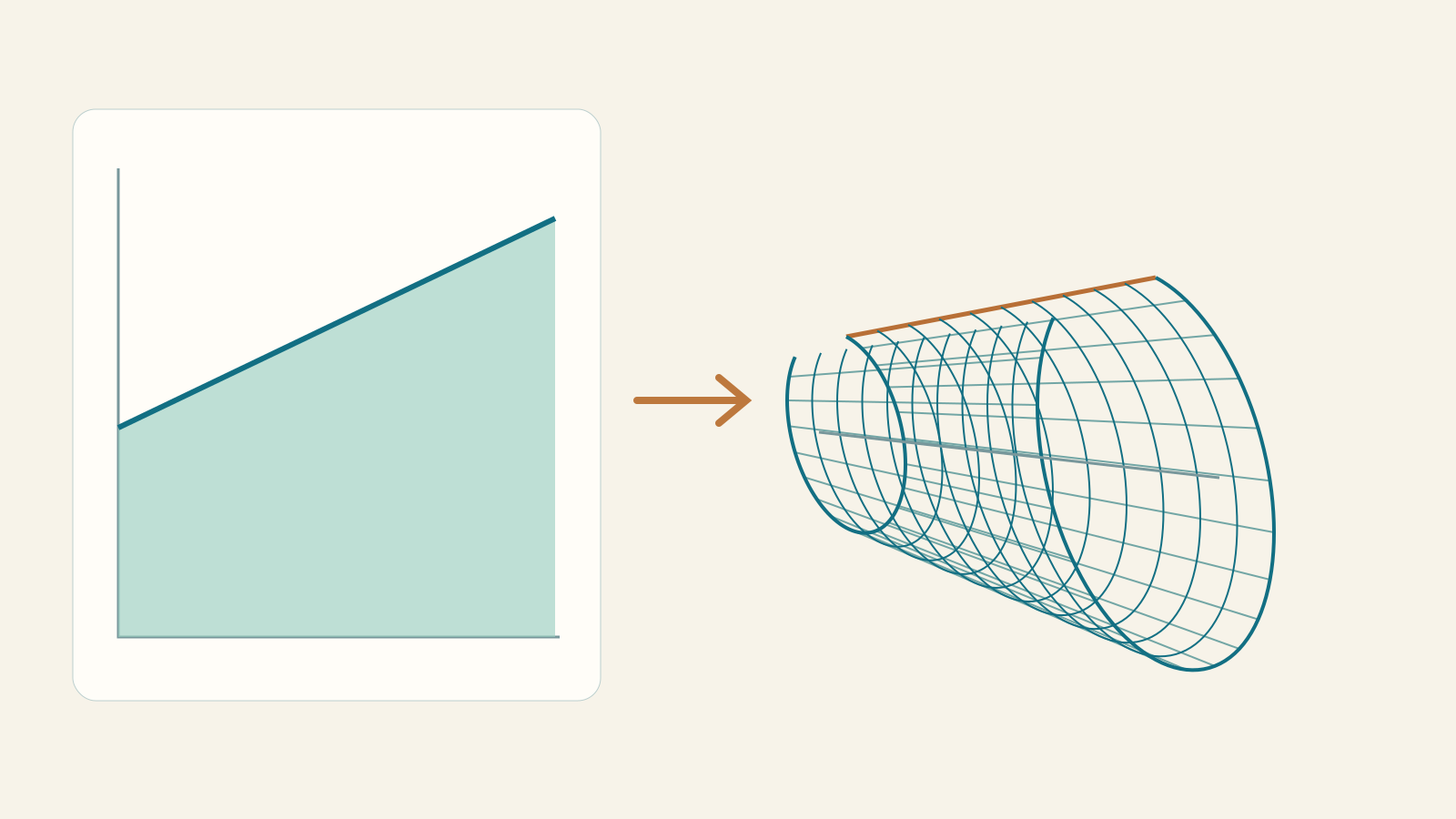
An antiderivative is a function; a definite integral is a number. We start with this distinction to measure accumulation and areas, then turn to rotations. Rotating a region produces a solid whose volume we calculate; rotating a curve produces a surface whose area we calculate. These are related tasks, but their formulas and units differ.
A number associated with a function and two endpoints
∫ₐᵇ f(x) dx is the definite integral of f from a to b. f is the integrand, a and b are the limits and x is the integration variable. The result is a number, not a family F+C.
If f is continuous on [a,b], a<b, the integral exists. Continuity is sufficient, not necessary: some discontinuous functions are integrable too. The domain and meaning of the integral must still be specified.
Riemann sums: from strips to a limit
Divide [a,b] into n intervals of width Δx=(b-a)/n. Choose xᵢ* in each and sum Σ f(xᵢ*)Δx. Midpoints give rectangles; endpoint values and line segments give trapezoids.
∫ₐᵇ f(x) dx = lim Σ f(xᵢ*)Δx, when the limit is well defined as the partition is refined.
For f(x)=x on [0,2], the result is 2. Midpoint sums are already exact for this line, but finite rectangle sums are not exact for every function. The lab compares midpoint, trapezoidal and Simpson rules.
Signed integrals are not always geometric areas
Parts above the x axis contribute positively; parts below contribute negatively. For f(x)=x on [-1,1], two triangles cancel: ∫₋₁¹ x dx=0. Their total area, however, is 1/2+1/2=1.
A = ∫ₐᵇ |f(x)| dx, for a<b.
In general |∫f|≠∫|f|. Find zeros and split intervals when f changes sign. For sin x on [0,2π], the integral is 0 but the total area is 4.
Orientation, additivity and linearity
∫ₐᵃ f=0 and ∫ᵦₐ f=-∫ₐᵇ f. Also ∫ₐᶜ f+∫ᶜᵦ f=∫ₐᵇ f when the relevant integrals exist in the required sense.
Linearity gives ∫(αf+βg)=α∫f+β∫g over the same limits. If f≤g on [a,b], then ∫f≤∫g. A geometric area or volume does not become negative when endpoints are relabelled: it is measured over the ordered interval.
The fundamental theorem links accumulation and derivatives
If f is continuous, the accumulation function G(x)=∫ₐˣ f(t) dt satisfies G′(x)=f(x). Accumulation thus supplies an antiderivative.
If F is an antiderivative of f on an interval containing [a,b], under the theorem’s hypotheses:
∫ₐᵇ f(x) dx = F(b)-F(a)
Do not append +C to the final number: [F(b)+C]-[F(a)+C]=F(b)-F(a). The constant cancels; it has not been forgotten.
Step-by-step calculation and substitution
∫₀¹ x² dx=[x³/3]₀¹=1/3-0=1/3. The brackets mean the upper-endpoint value minus the lower-endpoint value.
For ∫₀¹ 2x(x²+1)³ dx, set u=x²+1 and du=2x dx. Change the limits: x=0 gives u=1 and x=1 gives u=2. Thus ∫₁² u³ du=[u⁴/4]₁²=(16-1)/4=15/4.
Alternatively, return to x before evaluating. Never mix an integrand in u with limits still referring to x. Definite integration by parts reads ∫ₐᵇ u v′ dx=[uv]ₐᵇ-∫ₐᵇ u′v dx.
Area between two curves
If f≥g on [a,b], A=∫ₐᵇ [f(x)-g(x)] dx: upper minus lower height. When the curves exchange positions, use:
A = ∫ₐᵇ |f(x)-g(x)| dx
Between y=x and y=x² on [0,1], x≥x² and A=[x²/2-x³/3]₀¹=1/2-1/3=1/6. Find intersections first, then determine the upper curve on each piece. Subtracting two integrals and taking the absolute value is insufficient if cancellation occurs.
Average value and units
For a<b, the average value is f_average=(1/(b-a))∫ₐᵇ f(x) dx. For x² on [0,1], it is 1/3: a rectangle of width 1 and height 1/3 has the same integral.
If f is velocity in m/s and x is time in seconds, the integral is displacement in metres; distance travelled requires integrating absolute velocity. In geometric diagrams both coordinates are lengths, so the integral has area units.
Watch for poles and improper endpoints
F(b)-F(a) does not authorise crossing a point where the integrand is undefined. ∫₋₁¹ 1/x dx does not exist as an ordinary improper integral: the two separate parts diverge. Symmetric cancellation gives a principal value, a different concept.
By contrast, ∫₀¹ 1/√x dx=lim(t→0⁺)[2√x]ₜ¹=2. Improper integrals are defined through limits and may converge or diverge. The free lab requires functions evaluable throughout the interval: rejection indicates a tool limitation, not proof of divergence.
What does “area of rotation” mean?
| Object | Quantity | Units |
|---|---|---|
| Plane region | Area A | u² |
| Region rotated about an axis | Solid volume V | u³ |
| Curve rotated about an axis | Generated surface area S | u² |
Before choosing a formula, specify the axis, interval, rotating figure and desired measurement. Rotating a curve does not automatically fill the enclosed volume: it describes a skin.
Volume about the x axis: disks
Rotate the region between y=f(x) and the x axis. Each perpendicular section is a disk of radius |f(x)|, with thin volume approximately πf(x)²Δx.
V = π∫ₐᵇ f(x)² dx
Cylinder: f=2 on [0,3], so V=π∫₀³4 dx=12π. Cone: f=x on [0,2], so V=π[x³/3]₀²=8π/3, matching πr²h/3 with r=h=2.
This is not π(∫f dx)²: integrate the squared radius, not the square of the plane area.
A cavity: the washer method
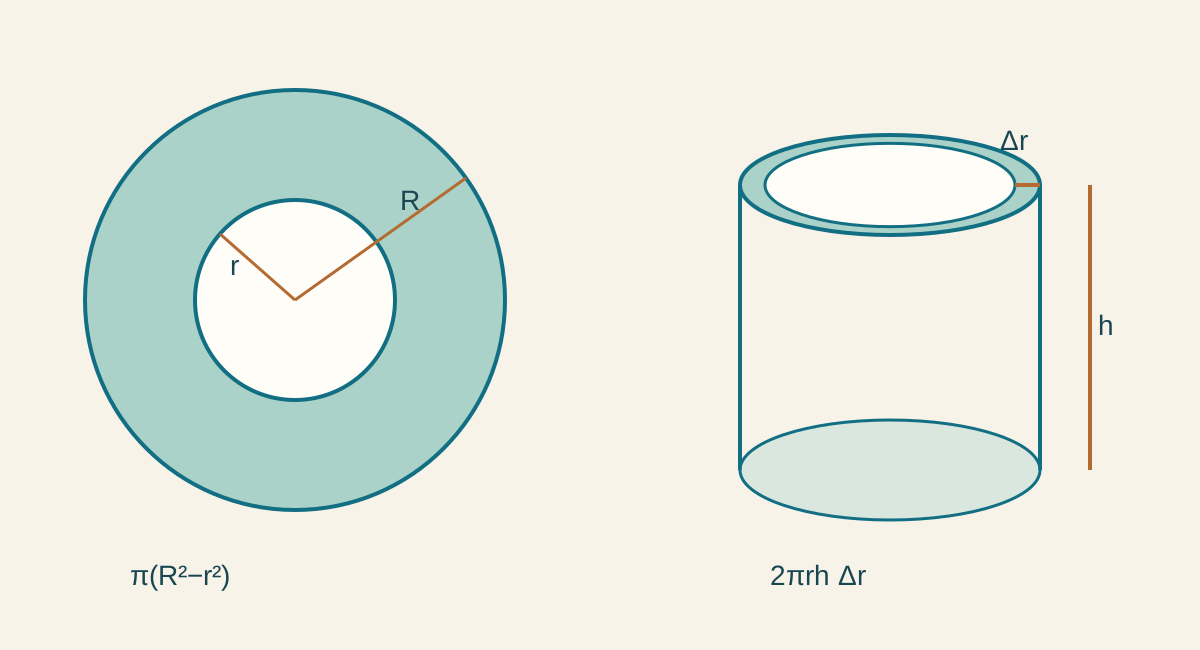
When rotating a region with 0≤g(x)≤f(x) about x, each section has outer radius R=f and inner radius r=g:
V = π∫ₐᵇ [R(x)²-r(x)²] dx
Between y=2 and y=1 on [0,3], V=π∫₀³(4-1) dx=9π. Between x and x² on [0,1], V=π∫₀¹(x²-x⁴) dx=π(1/3-1/5)=2π/15.
Do not use π(R-r)². For an axis y=h, measure distances from that axis and reconstruct the radii geometrically; if the axis crosses the region, blindly applying the formula fails.
About the y axis: cylindrical shells
A vertical strip at x≥0 between f≥g rotates about y into a shell: circumference 2πx, height f-g and thickness Δx.
V = 2π∫ₐᵇ x[f(x)-g(x)] dx
For f=2-x, g=0 on [0,2], V=2π[x²-x³/3]₀²=8π/3. A washer alternative uses horizontal sections and integration in y.
Shell strips are parallel to the axis; disk/washer strips are perpendicular. If the region crosses y, merely using |x| may count the same volume twice: split and analyse the geometry. The shell lab requires x≥0.
Generated surface area: the derivative appears
A short curve segment has length ds≈√(1+f′(x)²) dx. Rotation creates a band with area approximately circumference times sloping length, not merely horizontal width.
S_x = 2π∫ₐᵇ |f(x)|√(1+f′(x)²) dx
This holds for sufficiently regular curves; regular pieces and convergent limits can be treated separately. About y, for x≥0, S_y=2π∫ₐᵇ x√(1+f′(x)²) dx.
For f=x on [0,2], f′=1 and S_x=2π√2∫₀²x dx=4π√2. This is the cone’s lateral area πrℓ with r=2 and slant height ℓ=2√2. Omitting the derivative factor gives an incorrect surface area.
Lateral area, end caps and total area
Rotating y=2 on [0,3] about x generates only the cylinder’s lateral surface: S_lateral=2π·2·3=12π. That curve does not generate the bases.
Closing the full solid adds πf(a)²+πf(b)², here 8π. The total area is 20π. The earlier cone has one nonzero base and S_total=4π√2+4π.
With a cavity, end caps are annuli and an inner wall may also be needed: the outer curve alone is insufficient. The lab’s add-bases option applies only to a single curve rotated about x.
The sphere: one profile, different volume and area
Rotating the semicircle f(x)=√(R²-x²) on [-R,R] about x generates a sphere. Its volume is V=π∫₋ᴿᴿ(R²-x²) dx=4πR³/3.
Inside the interval, f′=-x/√(R²-x²) and f√(1+f′²)=R. Thus S=2π∫₋ᴿᴿR dx=4πR², interpreting endpoints by limits: the derivative is not finite at ±R, but the product simplifies and extends continuously.
For R=1 the lab compares V=4π/3 with S=4π. The guided case uses the simplified form, not the indeterminate numerical product 0·∞. Both end caps have zero radius.
A reliable procedure
- Draw the region, curves, limits and axis.
- Select signed integral, area, volume or surface area.
- Identify zeros, intersections, cavities and excluded points.
- Build the correct integrand: f, |f-g|, π(R²-r²), 2πrh or 2πr√(1+f′²).
- Find an antiderivative or choose numerical quadrature; check hypotheses.
- Evaluate endpoints or limits and attach units.
- Compare geometric formulas where possible and refine numerically.
The difference between n and 2n subdivisions is an indicator, not a guaranteed error bound. Oscillations and narrow peaks may mislead sampling.
The lab: strips, rotations and comparison
Twelve guided cases and free formulas; six modes, three quadratures and 8 to 512 subdivisions. The graph shows the region and selected layer; rotation modes add a 3D preview of how the solid or surface is built.
The angle slider and Play/Pause display construction. Calculations always refer to a full 360° turn, even during a partial preview. Bases, if requested for surface area about x, are counted separately.
Numerical values and n versus 2n comparisons are not proofs of existence or exactness. Exact references belong only to unmodified prepared cases. The lab does not solve all improper integrals automatically; it handles the sphere using explicit analytic simplification.
Review antiderivatives · Indefinite integrals lab
Sixteen exercises with hidden solutions
1. Calculate ∫₀¹ x² dx.
Show the explained solution
An antiderivative is x³/3: [x³/3]₀¹=1/3. This is a number; do not append +C.
2. Integrate x on [-1,1].
Show the explained solution
[x²/2]₋₁¹=1/2-1/2=0: opposite signed contributions cancel.
3. Find the area between x and the axis on [-1,1].
Show the explained solution
Integrate |x| or add two triangles of area 1/2. The area is 1, not zero.
4. Find the area between sin x and the axis on [0,2π].
Show the explained solution
Area on [0,π] is 2 and on [π,2π] it is another 2. Total 4, while the signed integral is 0.
5. Find the area between x and x² on [0,1].
Show the explained solution
x≥x², so [x²/2-x³/3]₀¹=1/6. Intersections are 0 and 1.
6. What changes when integrating x from 2 to 0?
Show the explained solution
The sign reverses: ∫₂⁰x dx=[x²/2]₂⁰=-2. The geometric area remains 2.
7. Rotate a rectangle of height 2 and length 3 about x. Find the volume.
8. Rotate the region below x on [0,2] about x.
9. Rotate the region between y=2 and y=1 on [0,3] about x.
10. Rotate the region between x and x² on [0,1] about x.
11. Rotate the region below 2-x on [0,2] about y.
Show the explained solution
Shell radius x and height 2-x give V=2π∫₀²x(2-x)dx=8π/3.
12. Rotate the region between x and x² on [0,1] about y.
Show the explained solution
V=2π∫₀¹x(x-x²)dx=2π(1/3-1/4)=π/6. A different axis gives a different solid.
13. Find the lateral area of a cylinder of radius 2 and length 3.
Show the explained solution
f′=0, so S=2π∫₀³2dx=12π square units. Adding both bases gives 20π.
14. Find the area generated by rotating y=x on [0,2] about x.
Show the explained solution
f′=1, so S=2π√2∫₀²x dx=4π√2. This is lateral area; the base adds 4π.
15. Find the unit sphere volume from a semicircle.
Show the explained solution
V=π∫₋₁¹(1-x²)dx=4π/3. Do not confuse it with surface area 4π.
16. Find the unit sphere area and justify endpoint treatment.
Show the explained solution
Inside the interval f√(1+f′²)=1; continuous limiting extension gives S=2π∫₋₁¹1dx=4π. Do not evaluate 0·∞ at endpoints.