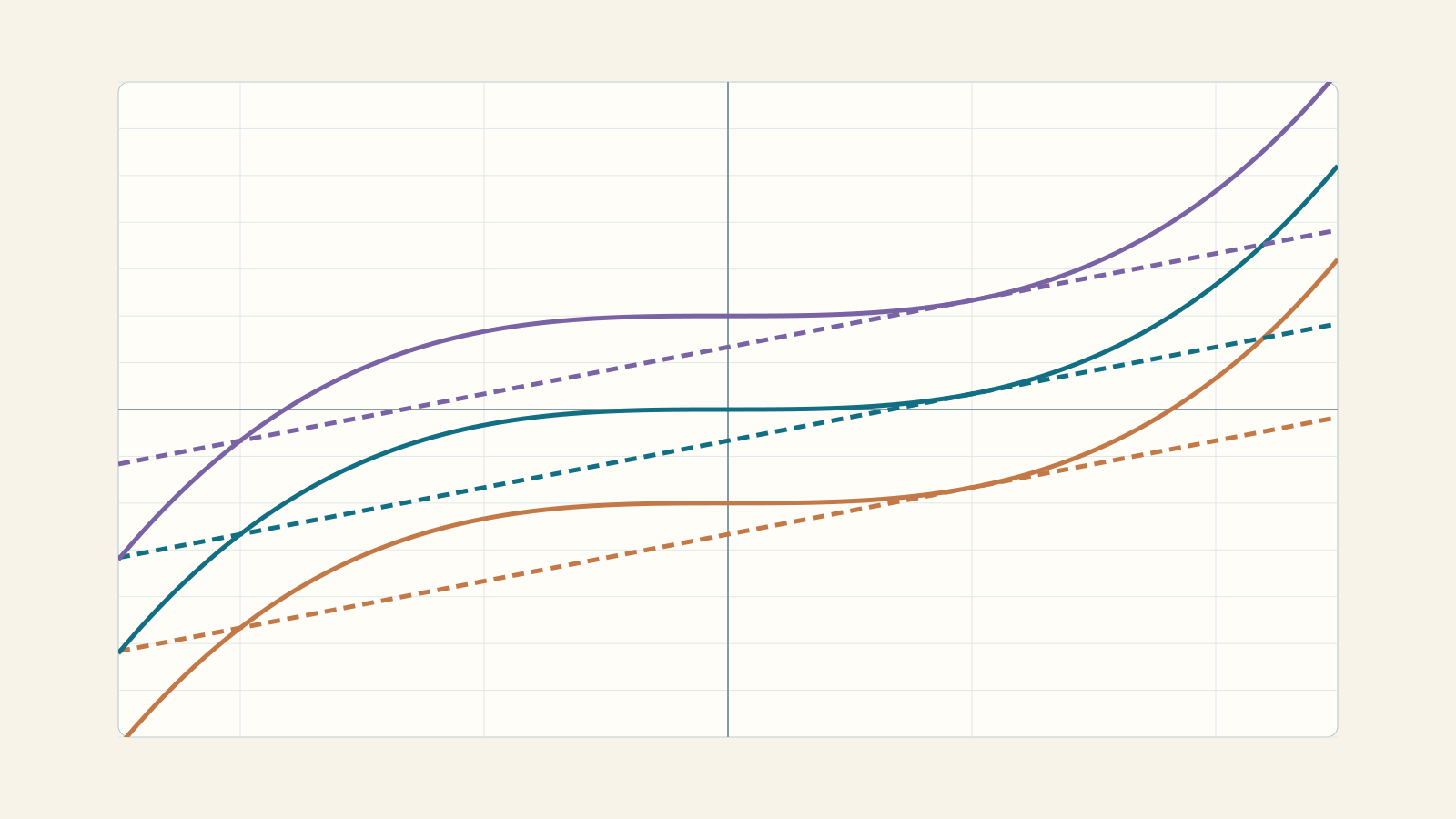
With derivatives we started with a function and found its rate of change. Now we reverse the journey: given f, we seek a function F whose derivative is f. The answer is generally a family, not a single function. This chapter concerns indefinite integrals; areas and definite integrals are a separate next step.
What does finding an antiderivative mean?
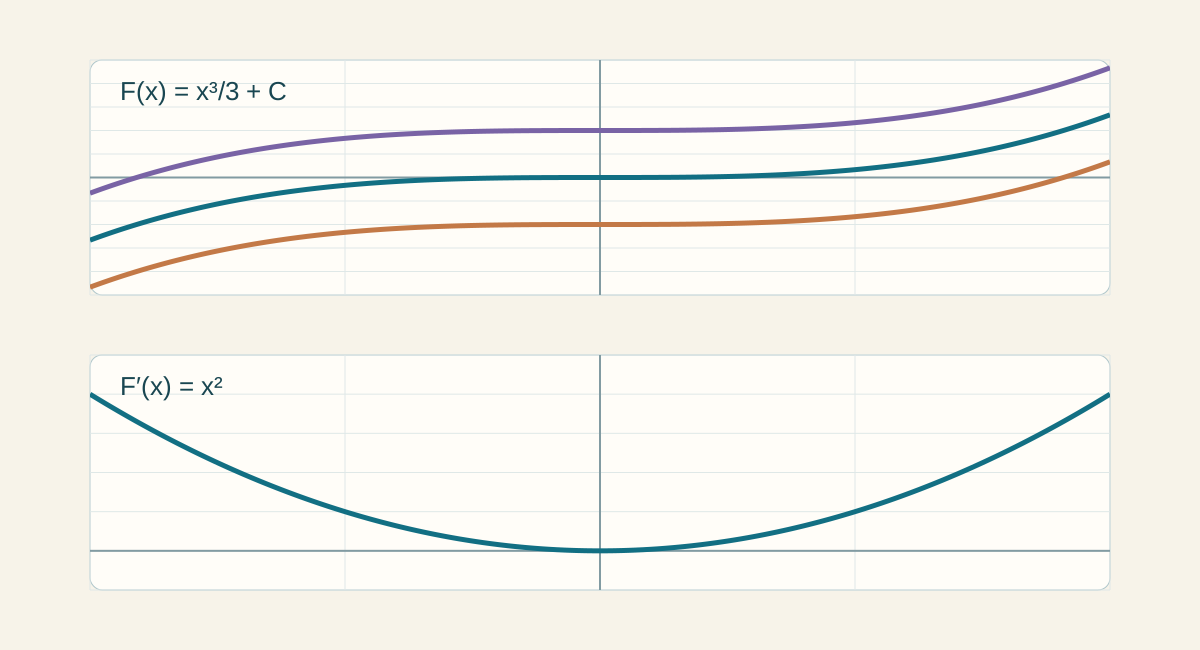
F is an antiderivative of f on an interval I if it is differentiable at every point of I and F′(x)=f(x) on I. For instance, x³/3 is an antiderivative of x² because (x³/3)′=x².
∫f(x) dx = F₀(x)+C, on an interval where F₀′=f.
f is the integrand; dx identifies the integration variable. We are not multiplying a function by a mysterious number dx: the notation identifies an operation and the variable involved.
Why +C is needed and describes every antiderivative on an interval
x³/3, x³/3+2 and x³/3-7 all have derivative x² because the derivative of a constant is zero. One antiderivative is therefore not the full answer.
If F and G are antiderivatives of the same f on I, (F-G)′=0. By the mean value theorem, a function with zero derivative on an interval is constant: F-G=C. This justifies the entire family F₀+C, not just a few examples.
C is an arbitrary real constant. It is not x and must not be differentiated as a varying function.
Domain matters: ln|x| and independent constants
∫1/x dx=ln|x|+C on any interval not crossing zero. For x>0, ln|x|=ln x; for x<0, ln|x|=ln(-x), whose derivative is (1/(-x))·(-1)=1/x.
ℝ∖{0} has two components. The most general family on the whole domain uses ln(-x)+C₋ for x<0 and ln x+C₊ for x>0, with independent constants. A single shared C describes only some of the possibilities on the union.
The lab lets you choose a branch: changing C on one interval does not force another branch to use the same constant. No invented continuous curve bridges an excluded point.
Indefinite and definite: different kinds of answer
∫f(x) dx denotes a family of functions. ∫ₐᵇ f(x) dx, when defined, is instead a number associated with an interval; the connection through the fundamental theorem requires its hypotheses.
Here we do not compute an area between endpoints. We learn to find F₀ and check its derivative. Although the formulas are related, the result types must not be confused: a function with +C versus a number.
Read the derivative table backwards
| Integrand | One antiderivative F₀ | Conditions |
|---|---|---|
| k | kx | Constant k |
| xⁿ | x^(n+1)/(n+1) | n≠-1; appropriate domain |
| 1/x | ln|x| | x≠0, on an interval |
| 1/√x | 2√x | x>0 |
| eˣ | eˣ | ℝ |
| bˣ | bˣ/ln b | b>0, b≠1 |
| sin x | -cos x | Radians |
| cos x | sin x | Radians |
| 1/cos²x | tan x | Intervals without zeros of cos x |
| 1/(1+x²) | arctan x | ℝ |
| 1/√(1-x²) | arcsin x | -1<x<1 |
Add C to each entry. For real powers the formula certainly holds on x>0; any larger domain requires checking. The exception n=-1 is essential: division by n+1=0 is impossible.
Linearity: sums and constant factors
Integrate sums term by term and take constant factors outside: ∫(af+bg) dx=a∫f dx+b∫g dx, interpreting arbitrary constants in the final family.
∫(3x²-4x+2) dx=3·x³/3-4·x²/2+2x+C=x³-2x²+2x+C. Differentiation gives 3x²-4x+2 again.
There is no similar rule turning the integral of a product into a product of integrals, or a quotient into a quotient of antiderivatives.
Recognise the chain rule backwards and the missing factors
For a≠0, ∫e^(ax+b) dx=e^(ax+b)/a+C, since differentiating the exponential introduces a. Likewise ∫cos(ax+b) dx=sin(ax+b)/a+C.
For example, ∫e^(2x+1) dx=(1/2)e^(2x+1)+C. Simply copying e^(2x+1) fails: its derivative is twice the integrand. When a=0 the integrand is constant and must be handled separately.
Substitution: a consistent change of variable
If you recognise g(u(x))u′(x), set u=u(x). The notation du=u′(x) dx summarises the change of variable justified by the chain rule; it is not arbitrary cancellation of symbols.
For ∫2x(x²+1)³ dx, choose u=x²+1, so du=2x dx. Then ∫u³ du=u⁴/4+C. Return to x:
F(x)=(x²+1)⁴/4+C
Check: F′=(1/4)·4(x²+1)³·2x=2x(x²+1)³. Every factor and the final variable must be consistent.
The u′/u pattern and absolute value
On intervals where u is differentiable and nonzero, ∫u′(x)/u(x) dx=ln|u(x)|+C. Absolute value also allows negative u, but does not allow u=0.
For ∫2x/(x²+1) dx, u=x²+1 is always positive: F₀=ln(x²+1) and F₀′=2x/(x²+1). For ∫1/(x-2) dx we need ln|x-2|+C, separately on the two intervals.
Integration by parts: reverse the product rule
From (uv)′=u′v+uv′ we obtain:
∫u dv = uv - ∫v du
For ∫x eˣ dx, choose u=x and dv=eˣdx, hence du=dx and v=eˣ. Then x eˣ-∫eˣ dx=(x-1)eˣ+C. Its derivative is eˣ+(x-1)eˣ=x eˣ.
For ∫ln x dx, with x>0, write ln x·1: u=ln x, dv=dx and v=x. This gives x ln x-∫1 dx=x ln x-x+C.
When to repeat parts and how to choose
Choose u so that differentiation simplifies it and dv so it can be integrated. This is not foolproof: check whether the new integral is genuinely simpler.
∫x²eˣ dx=x²eˣ-2∫x eˣ dx=eˣ(x²-2x+2)+C. Repeating parts lowers the polynomial degree. The product rule confirms that the derivative is x²eˣ.
For ∫x cos x dx, u=x and dv=cos x dx give x sin x+cos x+C. The final sign is positive because ∫sin x dx=-cos x.
Rational functions: division and partial fractions
If the numerator degree is at least the denominator degree, start with division. For instance x²/(x-1)=x+1+1/(x-1), so an antiderivative is x²/2+x+ln|x-1|, for x≠1.
For 1/(x²-1), write A/(x-1)+B/(x+1). Combining gives 1=(A+B)x+(A-B); thus A+B=0 and A-B=1, so A=1/2 and B=-1/2.
F₀=(1/2)ln|x-1|-(1/2)ln|x+1|=(1/2)ln|(x-1)/(x+1)|. Work on each of the three intervals separated by -1 and 1, using independent constants.
Transform first: an identity may simplify the task
Not every trigonometric integral is standard in its original form. Use sin²x=(1-cos 2x)/2:
∫sin²x dx=x/2-sin(2x)/4+C. The 1/4 accounts for both the initial half and the derivative of 2x. Differentiation gives 1/2-(1/2)cos 2x=sin²x.
The choice between identities, substitution and parts depends on structure; the presence of a sine does not automatically determine the method.
Roots and substitutions: keep the domain
For ∫x/√(1+x²) dx, set u=1+x² and du=2x dx. Then (1/2)∫u^(-1/2) du=√u+C, hence F₀=√(1+x²).
The radicand 1+x² is always positive, so the domain is ℝ. By contrast 1/√x requires x>0; zero is excluded by the denominator. The root sign alone does not decide the interval.
An initial condition selects a single antiderivative
If F′(x)=x², then F(x)=x³/3+C. Requiring F(1)=2 gives 1/3+C=2, hence C=5/3.
In general, for F=F₀+C and F(x₀)=y₀:
C = y₀-F₀(x₀)
The point must lie in the antiderivative’s interval. On a disconnected domain, a condition on one component does not determine the other constants.
Existence and an elementary formula are different questions
Every continuous function on an interval has antiderivatives there. This does not guarantee a formula built from a finite number of polynomials, roots, exponentials, logarithms and trigonometric functions.
e^(-x²) is continuous on ℝ and has antiderivatives, but none is elementary. Special functions or other tools may be used. Failure of a school method or a software tool to find a formula does not prove nonexistence.
Continuity is sufficient, not necessary. Conversely, a function with a jump cannot be a derivative on an interval containing the jump: derivatives have the intermediate value property.
The final check: differentiate on the correct domain
After proposing F₀, calculate F₀′, simplify and verify F₀′=f throughout the declared interval. Check coefficients, signs, inner factors and exclusions. This decides whether a proposal is an antiderivative.
For ∫cos(3x) dx, sin(3x) is wrong: its derivative is 3cos(3x). The proposal sin(3x)/3 is correct. Adding C cannot repair an incorrect derivative.
Checking some numerical values can reveal mistakes or suggest compatibility, but cannot prove a general identity. Even equivalent formulas may behave differently numerically near difficult points.
A selection strategy and common mistakes
- Identify the domain and the interval where you seek an antiderivative.
- Simplify and split sums without removing exclusions.
- Compare standard integrals and look for a reversed chain rule.
- Try a consistent substitution; consider parts for a suitable product.
- For rational functions consider division and partial fractions; for trigonometric functions consider identities.
- Return to the original variable and add C.
- Differentiate and compare with the integrand.
Common errors: forgetting C, applying the power rule to n=-1, losing a substitution factor, using the wrong sign in parts, or imposing one constant on independent components.
The lab: families, methods and verification
Choose one of twenty examples to read the method and steps. Move C: antiderivatives shift vertically while F₀′ remains overlaid on f. Where the domain has several components, select an interval and set its independent constant.
You can impose passage through (x₀,y₀), or freely propose f and F₀. Automatic suggestions recognise the prepared cases and integrate rational-coefficient polynomials of degree up to 8; this is not a general symbolic integrator. Free verification is numerical and is not presented as proof.
Enter F₀ without +C: the slider handles the constant. Use x, radians and decimal points. Syntax, window and complexity limits keep the calculation bounded.
Review derivatives · Open the derivatives lab
Sixteen exercises: try before revealing the answer
1. x^4
Find the family of antiderivatives.
Show the explained solution
The power rule gives x⁵/5+C. Differentiation returns x⁴; the domain is ℝ.
2. 6*x^2-4*x+3
Use linearity.
Show the explained solution
Integrate term by term: 2x³-2x²+3x+C. Its derivative is 6x²-4x+3.
3. 1/x
Why is ln x insufficient for x<0?
Show the explained solution
ln x is not real for x<0. ln|x| has derivative 1/x for x≠0; use independent constants on (-∞,0) and (0,+∞).
4. 1/sqrt(x)
Give the formula and domain.
Show the explained solution
x^(-1/2) integrates to 2√x+C on x>0. The integrand excludes zero.
5. exp(3*x)
Correct the chain-rule factor.
Show the explained solution
An antiderivative is e^(3x)/3. Differentiation multiplies by 3 and returns e^(3x); add C.
6. cos(2*x)
Find and check an antiderivative.
Show the explained solution
sin(2x)/2+C; the chain rule introduces 2, giving cos(2x).
7. 2*x/(x^2+4)
Recognise u′/u.
Show the explained solution
Set u=x²+4>0, du=2x dx. An antiderivative is ln(x²+4) on ℝ. Add C.
8. 3*x^2*exp(x^3)
Use substitution.
Show the explained solution
u=x³ and du=3x² dx give ∫e^u du. The answer is e^(x³)+C; check with the chain rule.
9. x*exp(x)
Use parts.
10. ln(x)
Integrate ln x as a product with 1.
11. x*cos(x)
Check the sign after parts.
Show the explained solution
x sin x-∫sin x dx=x sin x+cos x+C. Its derivative is x cos x.
12. 1/(x^2-1)
Use partial fractions and state the intervals.
Show the explained solution
1/[2(x-1)]-1/[2(x+1)] gives (1/2)ln|(x-1)/(x+1)|+C on each component of ℝ∖{-1,1}. The three constants may differ.
13. sin(x)^2
Use a trigonometric identity.
Show the explained solution
sin²x=(1-cos 2x)/2, hence x/2-sin(2x)/4+C. Differentiation returns sin²x.
14. x/sqrt(1+x^2)
Handle the root and the factor 2.
Show the explained solution
u=1+x² and du=2x dx give √(1+x²)+C. The derivative is x/√(1+x²) on ℝ.
15. x^2
If F′=x² and F(1)=2, find C.
16. x^2*exp(x)
Repeat integration by parts.
Show the explained solution
∫x²eˣdx=x²eˣ-2∫x eˣdx=eˣ(x²-2x+2)+C. Checking with the product rule cancels the extra terms.