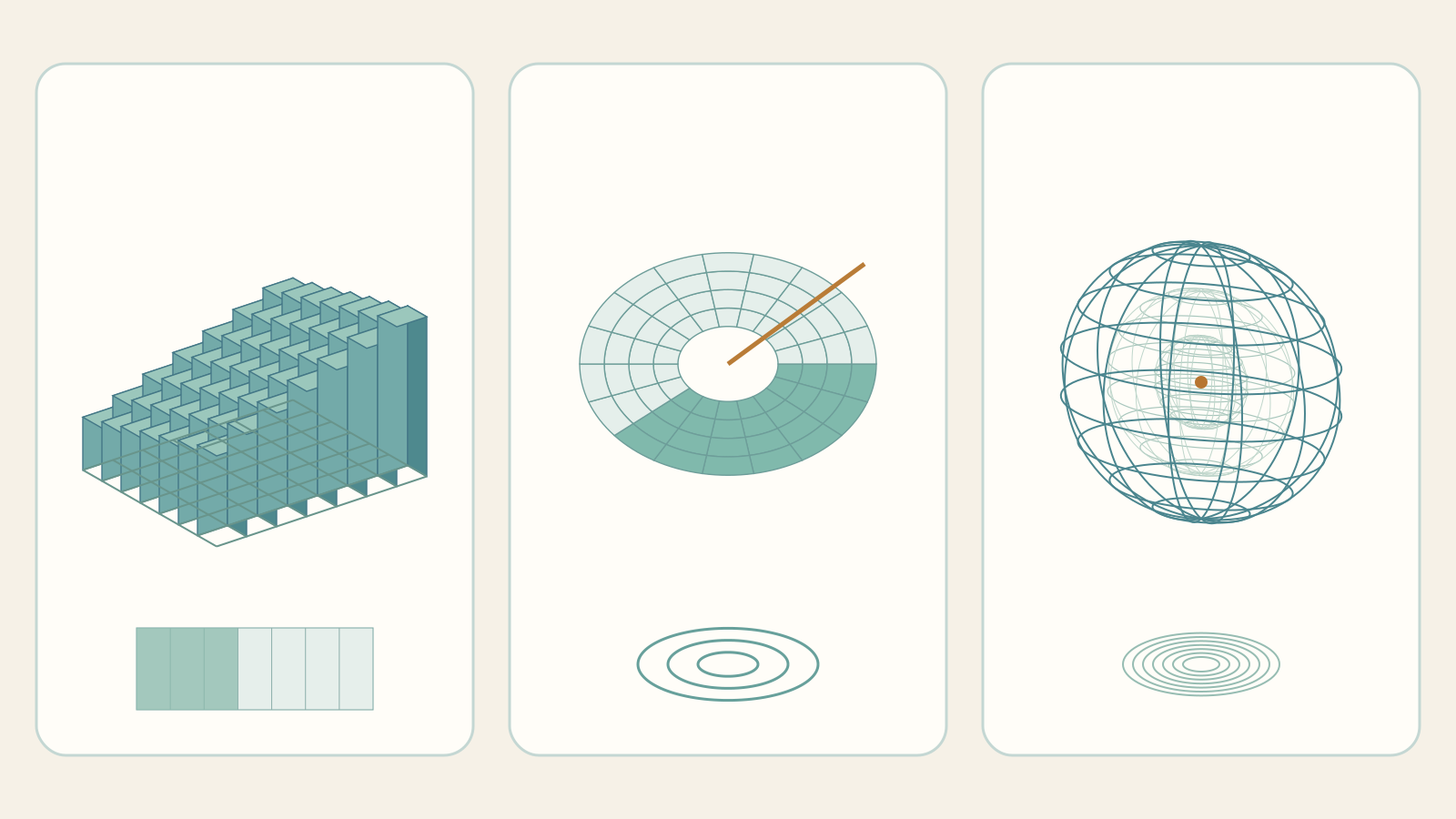
A single-variable integral adds contributions across an interval. A double integral sums over a planar region; a triple integral over a solid. The key is not learning extra integral signs, but understanding what is added, over which set and with which area or volume element. Stage 23 completes the planned multivariable block, not all of Analysis.
Double and triple integrals: laboratory · Learning-path index
1. What does a multiple integral measure?
If f≥0 is a height above a planar region D, ∬D f dA is the volume below the graph and above D. If f=1 we obtain the area of D instead. If f is surface mass density, the result is a mass. The symbol alone does not determine meaning: the function and its units do.
Area(D)=∬D 1 dA
Vol(E)=∭E 1 dV
M=∬D σ(x,y) dA; M=∭E δ(x,y,z) dV
A triple integral sums quantities distributed in space: volumetric density times elemental volume, for example kg/m³ times m³. A double integral is not automatically an area, nor a triple integral automatically a mass. State the integrand’s meaning before calculating.
2. Small sums, limits and Fubini’s theorem
Partition D into small cells, choose a point in each, and add f at the point times the cell’s area. For sufficiently regular functions and regions, the limit as the partition is refined is the double integral. Cells need not be squares: their actual areas matter.
S=Σ f(xᵢ*,yⱼ*) ΔAᵢⱼ
∬[a,b]×[c,d] f dA = ∫ₐᵇ [∫𝚌ᵈ f(x,y) dy] dx
For f continuous on a closed rectangle, Fubini allows iterated integration in either order. More generally absolute integrability suffices; for nonnegative functions Tonelli allows interchange even with infinite value. Do not blindly interchange improper integrals with changing signs or singularities: orders can disagree when hypotheses fail.
3. First example: a rectangle
Compute ∬D(x+2y)dA on D=[0,L]×[0,L], L>0. In the inner integral treat the other variable as constant. Differentials indicate order: dy dx means y first, then x. Keep L symbolic and substitute a number only at the end.
∫₀ᴸ [∫₀ᴸ (x+2y) dy] dx
=∫₀ᴸ [xy+y²]ᵧ₌₀ᵧ₌ᴸ dx
=∫₀ᴸ (Lx+L²) dx
=L³/2+L³=3L³/2
For L=2 the result is 12. Reversing gives inner integral ∫₀ᴸ(x+2y)dx=L²/2+2Ly and the outer integral again gives 12. This is not numerical coincidence: it follows from Fubini. Compare both orders in the lab.
4. Simple regions: reading a domain
An x-simple domain has a≤x≤b and α(x)≤y≤β(x): each vertical slice meets one interval of D. In dy dx, inner limits may depend on x; outer limits are numbers a,b. If a slice meets multiple intervals, split those intervals or split the domain.
D={a≤x≤b, α(x)≤y≤β(x)}
∬D f dA=∫ₐᵇ ∫[α(x),β(x)] f(x,y) dy dx
D△={x≥0,y≥0,x+y≤L}
∫₀ᴸ ∫₀ᴸ⁻ˣ (x+2y) dy dx = ∫₀ᴸ L(L−x) dx=L³/2
The triangle’s area is L²/2, but the integral of x+2y is L³/2: these are different quantities. For L=2 they are 2 and 4 respectively. Draw vertices (0,0),(L,0),(0,L), then derive bounds from x+y=L.
5. Reversing order means more than swapping letters
For the same triangle, horizontal slices give 0≤y≤L and 0≤x≤L−y. Bounds and differentials change, not the domain’s points or the function. Exact values agree; numerical approximations on different grids may have different errors.
∫₀ᴸ ∫₀ᴸ⁻ʸ (x+2y) dx dy
=∫₀ᴸ [(L−y)²/2+2y(L−y)] dy=L³/2
Changing order may make a difficult integral elementary. For I=∫₀¹∫ₓ¹ exp(y²)dy dx, do not seek an elementary antiderivative of exp(y²). The domain is 0≤x≤y≤1: first x ranges from 0 to y, then y from 0 to 1.
I=∫₀¹ ∫₀ʸ exp(y²) dx dy
=∫₀¹ y exp(y²) dy=(e−1)/2
6. Polar coordinates: why r appears
A small sector at radius r has approximate side lengths Δr and rΔθ. Its area is about rΔrΔθ, not ΔrΔθ. The transformation x=r cosθ,y=r sinθ gives the same factor through its determinant. The angle θ is in radians.
J=det[ cosθ  −r sinθ ; sinθ  r cosθ ]=r
dA=|J| dr dθ=r dr dθ
∬x²+y²≤L² (L²−x²−y²)dA
=∫₀ᴸ∫₀²π (L²−r²)r dθ dr
=2π[L²r²/2−r⁴/4]₀ᴸ=πL⁴/2
For the annulus L/2≤r≤L,0≤θ≤2π, integrating 1 gives ∫ᴸ/₂ᴸ2πr dr=3πL²/4. Do not forget the hole. Sectors or translated disks require appropriate bounds and, if needed, a shifted coordinate center.
7. Signed integrals and geometric volume
Take f=x on D=[−L,L]×[0,L]. Negative-x contributions cancel positive-x ones, so the integral is 0. This does not mean the surface is flat or that the volume between graph and z=0 is zero. That geometric volume requires |f|.
∬D x dA=0
∬D |x| dA=L∫₋ᴸᴸ|x|dx=L³
V=∬D |f₂−f₁| dA
If f₂≥f₁ throughout D, drop the absolute value and integrate f₂−f₁. If the surfaces switch order, split D along their intersection. The lab uses different colors above and below z=0 and displays both signed and absolute sums.
8. Average value, mass and centroid
For a region of positive area, the average value of f is its integral divided by area, not generally the average of a few point measurements. On the preceding triangle, (L³/2)/(L²/2)=L. This agrees with geometric centroid (L/3,L/3): since f is linear, its centroid value is L.
f̄=(1/Area(D))∬D f dA
M=∬D σ dA>0
x̄=(1/M)∬D xσ dA, ȳ=(1/M)∬D yσ dA
Ordinary mass density σ must be nonnegative. For constant density the factor cancels in centroid coordinates; for variable density it does not. In three dimensions add z̄=(1/M)∭E zδ dV. Symmetries of both domain and density may cancel moments; symmetry of the domain alone is insufficient.
9. Triple integrals: a box with variable density
A triple integral uses small volume elements ΔV. On E=[0,L]³ with mathematical density δ=1+z, integrate z first while x,y remain constant. Coordinates here are dimensionless; a physical density model needs coefficients with consistent units.
M=∫₀ᴸ∫₀ᴸ∫₀ᴸ(1+z) dz dy dx
=∫₀ᴸ∫₀ᴸ(L+L²/2) dy dx
=L³+L⁴/2
Vol(E)=L³, δ̄=M/Vol(E)=1+L/2
For L=2 volume is 8 and mathematical mass is 16: different meanings. Constant density 1 would have made mass numerically equal to volume; this example separates the concepts. Fubini permits other orders because the integrand is continuous on the cube.
10. A nonrectangular solid: the tetrahedron
Let E={x,y,z≥0,x+y+z≤L}. For fixed x,y, z ranges from 0 to L−x−y. Its xy projection is triangle x≥0,y≥0,x+y≤L. Thus after choosing x from 0 to L, y cannot exceed L−x.
Vol(E)=∫₀ᴸ∫₀ᴸ⁻ˣ∫₀ᴸ⁻ˣ⁻ʸ 1 dz dy dx
=∫₀ᴸ∫₀ᴸ⁻ˣ(L−x−y) dy dx
=∫₀ᴸ (L−x)²/2 dx=L³/6
The x=t section is a right triangle with legs L−t and area (L−t)²/2. Integrating this area in x gives volume, linking to Cavalieri’s principle. For L=3 volume is 27/6=4.5. Three independent intervals [0,L] describe a cube, not this tetrahedron.
11. Cylindrical coordinates: polar plus height
With symmetry about the z-axis use x=r cosθ,y=r sinθ and retain z. The volume element is r dr dθ dz: each small base sector is multiplied by a height. The factor r does not disappear in three dimensions.
E={x²+y²≤L², 0≤z≤L}
∭E z dV=∫₀ᴸ∫₀²π∫₀ᴸ z r dz dθ dr
=∫₀ᴸ∫₀²π (L²/2)r dθ dr=πL⁴/2
Vol(E)=πL³
For L=2 both the integral and cylinder volume are 8π because average z happens to be 1. Generally average z is L/2 and the quantities differ. If the roof were z=L²−r², the upper z bound would depend on r; z≤L would no longer describe the solid.
12. Spherical coordinates: declare angle conventions
Use ρ≥0 for distance from origin, θ for azimuth in the xy-plane and φ for angle from positive z. For the full sphere: 0≤θ≤2π,0≤φ≤π. Some books swap the angle names: do not memorize which symbol goes inside sine without checking conventions.
x=ρ sinφ cosθ, y=ρ sinφ sinθ, z=ρ cosφ
dV=ρ² sinφ dρ dφ dθ
Vol(BL)=∫₀ᴸ∫₀π∫₀²π ρ² sinφ dθ dφ dρ
=(L³/3)·2·2π=4πL³/3
The factor ρ² sinφ accounts for changing small volumes: two lengths grow with radius, and longitudes converge near the poles. For an upper hemisphere use 0≤φ≤π/2; for a shell change the ρ interval. Never alter the Jacobian to force an expected result.
13. Changes of variables and absolute Jacobians
For a C¹ transformation invertible between domain interiors, with nonzero determinant and suitable regularity, local area is scaled by |det DT|. Transform function, domain and measure together. Polar and spherical coordinates degenerate on axes and origin; in these standard cases measure-zero exceptional sets do not change the integral, but do not justify arbitrary transformations.
∬D f(x,y)dxdy=∬U f(x(u,v),y(u,v)) |∂(x,y)/∂(u,v)| dudv
x=au, y=bv, a,b>0 → |J|=ab
x²/a²+y²/b²≤1 → u²+v²≤1
Area=ab∬u²+v²≤1 1 dudv=πab
Absolute value prevents an orientation-reversing map from creating negative area. If a map covers a region more than once, multiplicity cannot be ignored. Three dimensions use a 3×3 determinant. A common mistake is transforming f but leaving dxdy or dxdydz unchanged.
14. A practical workflow and the laboratory
Define the quantity, draw the domain or projection, choose coordinates and order, write bounds from inside to outside, insert the Jacobian, integrate, then check sign, units, scaling and symmetry. Doubling L scales area as L² and volume as L³; an L-dependent integrand can change the final power.
The lab offers nine guided cases, not a general symbolic solver. Choose L and n subdivisions per coordinate: n² cells for doubles, n³ for triples. Midpoint quadrature uses normalized u,v,w in [0,1], so its numeric Jacobian includes interval scaling. Each cell contributes f(T(u*,v*,w*))|J|/nᵈ, with d=2 or 3.
Press Play to add one strip or shell each second. The partial total shows what has accumulated; the outer-integral graph shows what remains. Compare exact value, quadrature and error as n increases. Graphics use an explicitly reduced grid; computation uses all nᵈ cells. Error is measured against the available exact formula, not a rigorous bound for arbitrary functions.
Exercises: try before revealing
1. Integrate x+2y on [0,2]×[0,2].
Show the explained answer
With L=2, 3L³/2=12. First ∫₀²(x+2y)dy=2x+4, then ∫₀²(2x+4)dx=12. Domain area is instead 4.
2. Area of triangle x,y≥0, x+y≤3.
Show the explained answer
Integrate 1, not x+2y: ∫₀³∫₀³⁻ˣ1 dy dx=∫₀³(3−x)dx=9/2, also base×height/2=3×3/2.
3. Integrate x+2y on that triangle in both orders.
Show the explained answer
dy dx: ∫₀³3(3−x)dx=27/2. dx dy: ∫₀³[(3−y)²/2+2y(3−y)]dy=27/2. Inner bound becomes 3−y after reversal.
4. Compute ∫₀¹∫ₓ¹ exp(y²) dy dx by reversing order.
Show the explained answer
Domain 0≤x≤y≤1 gives ∫₀¹∫₀ʸ exp(y²)dxdy=∫₀¹y exp(y²)dy. Substitute t=y²,dt=2y dy to obtain (e−1)/2.
5. Volume below 4−x²−y² on radius-2 disk.
Show the explained answer
Polar: 2π∫₀²(4−r²)rdr=8π. Formula πL⁴/2 with L=2 confirms 8π. Base area is 4π, not 8π.
6. Area of annulus 1≤r≤2: where is the Jacobian needed?
Show the explained answer
∫₁²∫₀²πr dθdr=π(4−1)=3π. Omitting r would incorrectly give 2π. Physical integrand 1 becomes transformed integrand r.
7. f=x on [−2,2]×[0,2]: integral and volume.
Show the explained answer
Integral is 0 by oddness in x. Volume between graph and z=0 is ∫∫|x|dA=L³=8. Geometric contributions do not cancel.
8. Average x+2y on the triangle of size L.
Show the explained answer
Divide integral by area: (L³/2)/(L²/2)=L. At L=2 average is 2 but integral is 4. Normalization by domain measure is essential.
9. Mass of cube [0,2]³ with density 1+z.
Show the explained answer
M=L³+L⁴/2=8+8=16. Volume is 8 and mean density 16/8=2. Integrate 1+z rather than replacing it with 1.
10. Volume of x,y,z≥0,x+y+z≤3.
Show the explained answer
Integrate 1 with z from 0 to 3−x−y, y from 0 to 3−x, x from 0 to 3. Result L³/6=27/6=4.5. Section area at x is (3−x)²/2.
11. Volume of radius-3 ball in spherical coordinates.
Show the explained answer
With φ from z-axis: ∫₀³ρ²dρ=9, ∫₀πsinφdφ=2, ∫₀²πdθ=2π. Product 36π. Omitting sinφ or ρ² changes result and geometry.
12. Area of ellipse x²/9+y²/4≤1.
Show the explained answer
Set x=3u,y=2v: domain becomes unit disk and |J|=6. Hence area=6π. Transforming the domain alone without Jacobian would give π, not ellipse area.
Before: free and constrained extrema · Learning-path index