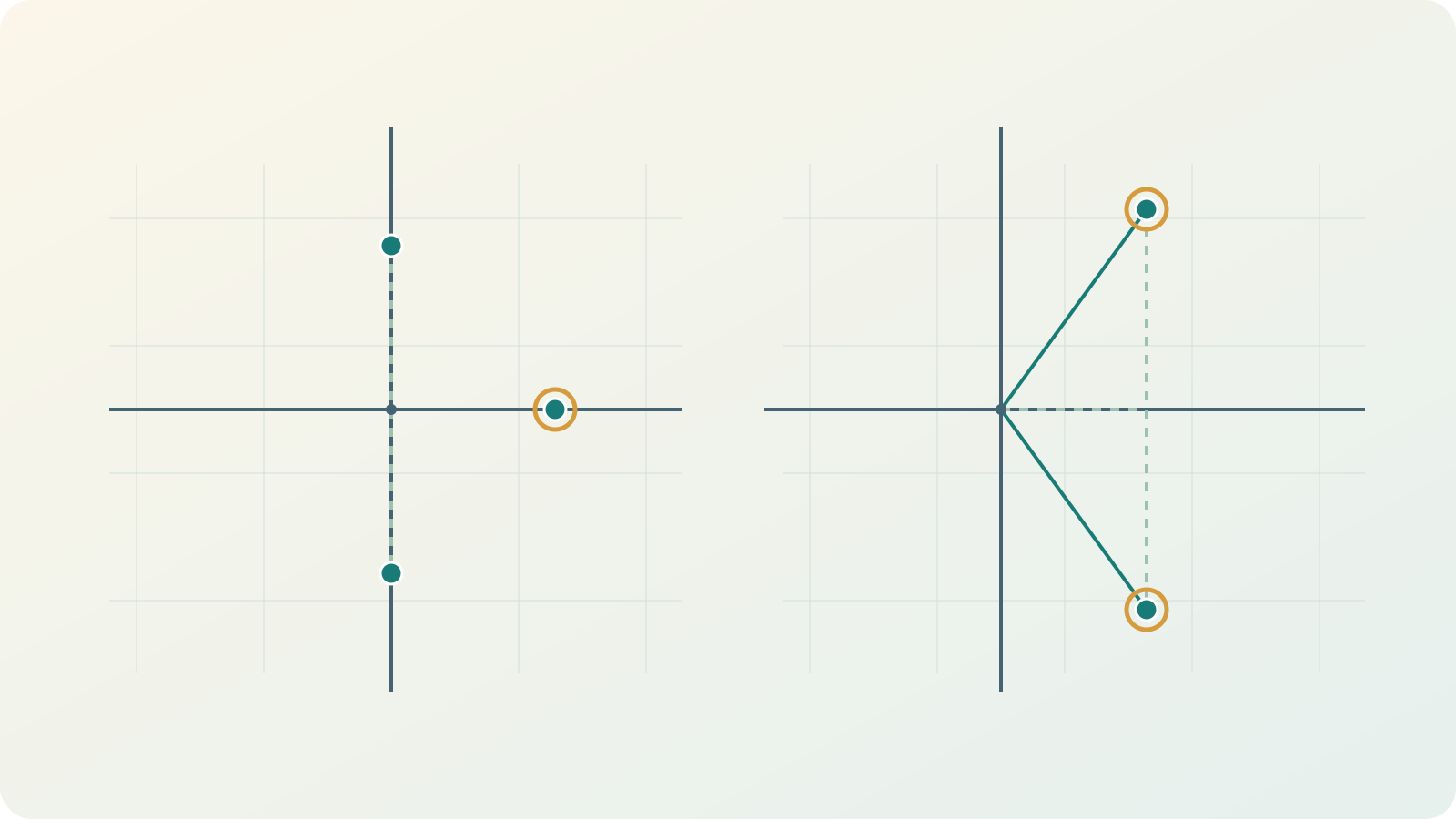
Must a degree-four polynomial have four different solutions? No: a root can occur more than once. This stage connects three views of the same object: an equation to solve, a product of factors and points in the complex plane.
Learning-path index · Lab: equations, factors and multiplicities · Stage 6: all complex roots
1. What are we solving?
A polynomial is P(z)=a_n zⁿ+a_(n−1)z^(n−1)+…+a₁z+a₀, with complex coefficients and a_n≠0. Its degree n is the largest exponent with nonzero coefficient. A root r satisfies P(r)=0. Using z reminds us to seek solutions outside the real line too.
No real number makes P(z)=z²+1 zero, but i and −i do. The polynomial is not impossible; we must specify the domain of the equation. Polynomial exponents are nonnegative integers: 1/z and √z are not polynomial terms.
2. From a root to a factor
Dividing P(z) by z−r gives P(z)=(z−r)Q(z)+c with constant remainder c. Substitute z=r: P(r)=c. Therefore:
P(r)=0 ⇔ P(z)=(z−r)Q(z).
This is the factor theorem. A point merely looking like a root in a plot is not enough: the remainder must be zero. For z²+1, root i corresponds to factor z−i and root −i to z+i: (z−i)(z+i)=z²−i²=z²+1. The sign in the factor is opposite to the root’s sign.
3. The fundamental theorem of algebra
Every nonconstant polynomial with complex coefficients has at least one complex root. We state this theorem without proving it: its proof needs further tools. We can deduce factorization: find one root and divide by its factor, reducing the degree by one. Repetition eventually leaves a nonzero constant.
P(z)=a_n∏(z−r_j)^(m_j), with ∑m_j=n.
The r_j are distinct roots and the positive integers m_j their multiplicities. Degree counts roots with repetitions, not necessarily different points. The theorem guarantees existence, not a simple formula or an immediate algorithm for finding them.
4. Quadratics, including negative discriminants
For Az²+Bz+C=0 with real A,B,C and A≠0, multiply by 4A and complete the square: (2Az+B)²=B²−4AC=Δ. If Δ≥0 use real square roots; if Δ<0, its square roots are ±i√(−Δ).
z₁,₂=(−B±√Δ)/(2A)
For Δ<0: z₁,₂=(−B±i√(−Δ))/(2A).
Example: z²−2z+5=0. Δ=4−20=−16, so z=(2±4i)/2=1±2i. Factorization: [z−(1+2i)][z−(1−2i)]. When Δ=0 there is one distinct root −B/(2A), of multiplicity two. If A=0 the equation is no longer quadratic: handle the linear or constant case.
5. A double root is not two points
Problem: solve P(z)=(z−1)²(z²+1)=0. A product is zero if at least one factor is zero. Root 1 has multiplicity 2; i and −i have multiplicity 1. There are three distinct solutions but 2+1+1=4 roots counted with multiplicity, matching the degree.
Expanding gives P(z)=z⁴−2z³+2z²−2z+1. The multiplicity m of r is the largest exponent for which (z−r)^m divides P: P(z)=(z−r)^m Q(z), with Q(r)≠0. Plot one point for r and mark m=2, not two separate or slightly displaced points.
6. How to measure multiplicity
Repeatedly divide by z−r while the remainder is zero. For P(z)=z⁴−2z³+2z²−2z+1 and r=1, the first quotient is z³−z²+z−1; the second is z²+1; the third attempt has remainder 2. Thus 1 is exactly double, not triple.
The final nonzero remainder matters: without it we would know only that multiplicity is at least two. Alternatively, for a nonzero polynomial, r has multiplicity m if P(r)=P′(r)=…=P^(m−1)(r)=0 but P^(m)(r)≠0. Here P′(1)=0 and P″(1)=4≠0. Lab divisions use exact fractions, not numerical tolerances to classify zero remainders.
7. Why conjugates appear
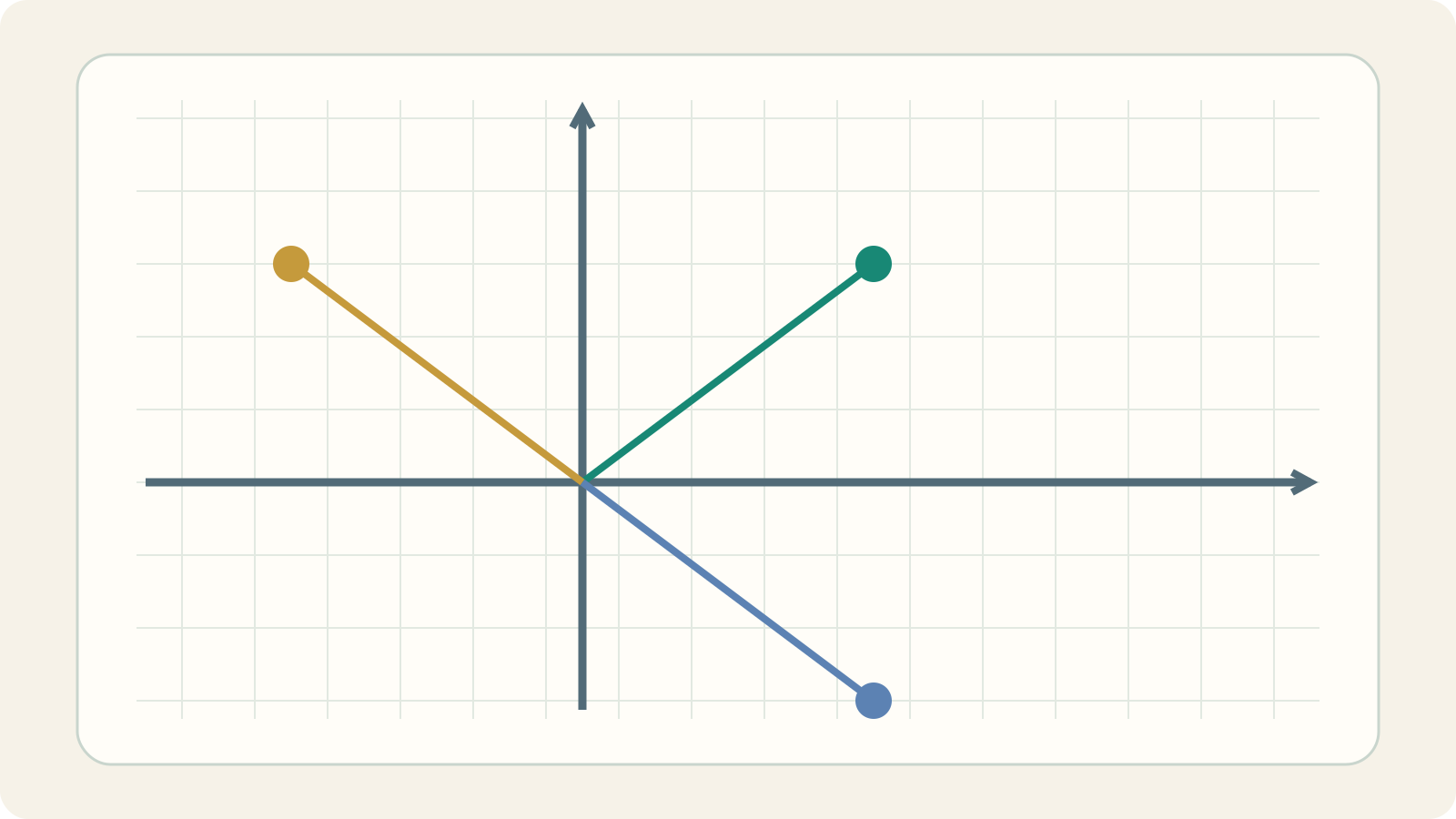
If all coefficients of P are real, P(conj(z))=conj(P(z)): conjugation preserves sums and products and fixes real coefficients. Thus P(r)=0 implies P(conj(r))=0. Nonreal roots occur in conjugate pairs with equal multiplicities: conjugating a factorization preserves the exponents of its factors.
For r=a+bi with b≠0, its conjugate is a−bi: the same a, opposite b. A real root equals its own conjugate and must not be doubled. Real coefficients are essential: P(z)=z−i has constant coefficient −i and root i, but not −i. Build this counterexample in the lab.
8. Factor over ℂ or over ℝ
Over ℂ every nonconstant polynomial factors into linear factors. Over ℝ, irreducible quadratic factors may remain. Group a conjugate pair as:
[z−(a+bi)][z−(a−bi)]=z²−2az+(a²+b²).
For b≠0 the discriminant is −4b²<0, so this factor has no real roots. Roots 1±2i give z²−2z+5. Therefore “cannot be factored” needs a domain: which coefficients are permitted in the factors? For real coefficients, real linear factors and these quadratic pairs reconstruct the whole polynomial, retaining its leading coefficient.
9. Sum and product: watch the signs
Expanding (z−r₁)(z−r₂) gives z²−(r₁+r₂)z+r₁r₂. Thus roots of z²+bz+c have sum −b and product c. For z²+5z+6 the roots are −2 and −3, not 2 and 3. Its factors are (z+2)(z+3).
∑r_j=−a_(n−1)/a_n; ∏r_j=(−1)ⁿa₀/a_n.
These Vieta formulas count roots with repetitions. For (z−1)²(z²+1), the sum is 1+1+i−i=2 and product 1·1·i·(−i)=1, matching the coefficients. These are useful checks, but for degrees above two, sum and product alone cannot certify all roots.
10. Horner: multiply, add and check
Problem: test r=1 for P(z)=z³−z²+z−1. List coefficients in descending order: 1,−1,1,−1. Bring down 1; then repeatedly multiply the latest result by r and add the next coefficient. The results are 1,0,1,0. The last is the remainder P(1)=0; the preceding values are coefficients of Q(z)=z²+1.
Thus P(z)=(z−1)(z²+1)=(z−1)(z−i)(z+i). Do not skip zero coefficients: z³+1 needs the list 1,0,0,1. The same algorithm works for complex r using complex addition and multiplication. Follow each operation in the lab and repeat division on the quotient.
11. Find roots without guessing
Look for structure first. For z⁴+5z²+4=0 set t=z²: t²+5t+4=(t+1)(t+4)=0. Thus z²=−1 or z²=−4, giving z=±i,±2i. Factorization is (z²+1)(z²+4), or four linear factors over ℂ. Reconstruct these factors and check coefficients in the lab.
With integer coefficients, a rational root p/q in lowest terms has p dividing the constant term and q dividing the leading coefficient. These are only candidates to test; first factor out any power of z if the constant term is zero. Failure to find rational candidates does not mean no real or complex roots exist. For zⁿ=w use stage 6 directly.
12. What the lab certifies
Three activities: solve all real-coefficient equations of degree at most two within the input limits; construct a polynomial from chosen rational complex roots and multiplicities; exactly test a candidate root for a real rational-coefficient polynomial of degree at most eight. The last activity does not claim to find every other root: a remaining quotient is labelled as not yet factored.
A small nonzero remainder does not certify a root. For example z²−2z+9999/10000=(z−99/100)(z−101/100) has two nearby distinct roots, not a double root. Fractions distinguish these cases exactly. The zero polynomial vanishes at every z and has no finite multiplicity to assign at each point; a nonzero constant has no roots. Correct counting includes these cases.
Twelve exercises to try
1. Solve z²+5z+6=0 and check the signs.
Show the explained solution
Roots: −2 and −3; sum −5, product 6. Factors: (z+2)(z+3), not (z−2)(z−3).
2. Solve z²−4z+13=0.
Show the explained solution
Δ=16−52=−36. z=(4±6i)/2=2±3i. Thus P(z)=[z−(2+3i)][z−(2−3i)]. The root product is 13.
3. How many distinct solutions does (z+2)³(z−i)²=0 have?
Show the explained solution
Two: −2 of multiplicity 3 and i of multiplicity 2. Counting repetitions gives 5, the degree. Do not automatically add −i: coefficients are not all real.
4. Build the monic polynomial with double root 1 and simple roots ±i.
Show the explained solution
P=(z−1)²(z−i)(z+i)=(z−1)²(z²+1)=z⁴−2z³+2z²−2z+1. Multiplicities sum to 4; the leading coefficient is 1.
5. A real polynomial has double root 3−2i: what follows?
Show the explained solution
3+2i is double too. Degree is at least 4 and [(z−3)²+4]²=(z²−6z+13)² divides P. Other roots may exist.
6. Apply Horner to z³+1 at r=−1.
Show the explained solution
Coefficients 1,0,0,1 give 1,−1,1,0. Quotient z²−z+1, remainder 0. Thus P=(z+1)(z²−z+1), with further roots (1±i√3)/2.
7. Solve z⁴+5z²+4=0.
Show the explained solution
Set t=z²: (t+1)(t+4)=0. Equations z²=−1 and z²=−4 give i,−i,2i,−2i, all simple. Real factorization: (z²+1)(z²+4).
8. Do P(2)=0 and P′(2)=0 prove an exactly double root?
Show the explained solution
No: for a nonzero polynomial they imply at least double. Require P″(2)≠0, or two exact divisions followed by a nonzero remainder. For (z−2)³, P″(2)=0 too.
9. Build P with leading coefficient 2 and roots ±i.
Show the explained solution
P=2(z−i)(z+i)=2z²+2. Keep the factor 2: roots alone determine a polynomial only up to a nonzero constant factor.
10. Is remainder 1/100000 zero for the factor theorem?
Show the explained solution
No. It is positive and nonzero, so the candidate is not an exact root. Numerical approximation is a separate statement and cannot certify multiplicity.
11. Compare constant polynomials P(z)=0 and P(z)=7.
Show the explained solution
The equation P(z)=0 is an identity in the first case: every z solves it, without a usual finite multiplicity. The second asks 7=0 and has no solutions. The fundamental theorem concerns nonconstant polynomials.
12. For P(z)=z⁵−3z⁴+2, find the root sum and product.
Show the explained solution
Counting repetitions, sum −(−3)/1=3 and product (−1)⁵·2=−2. These data alone do not give individual roots or multiplicities.
Learning-path index · Lab: equations, factors and multiplicities