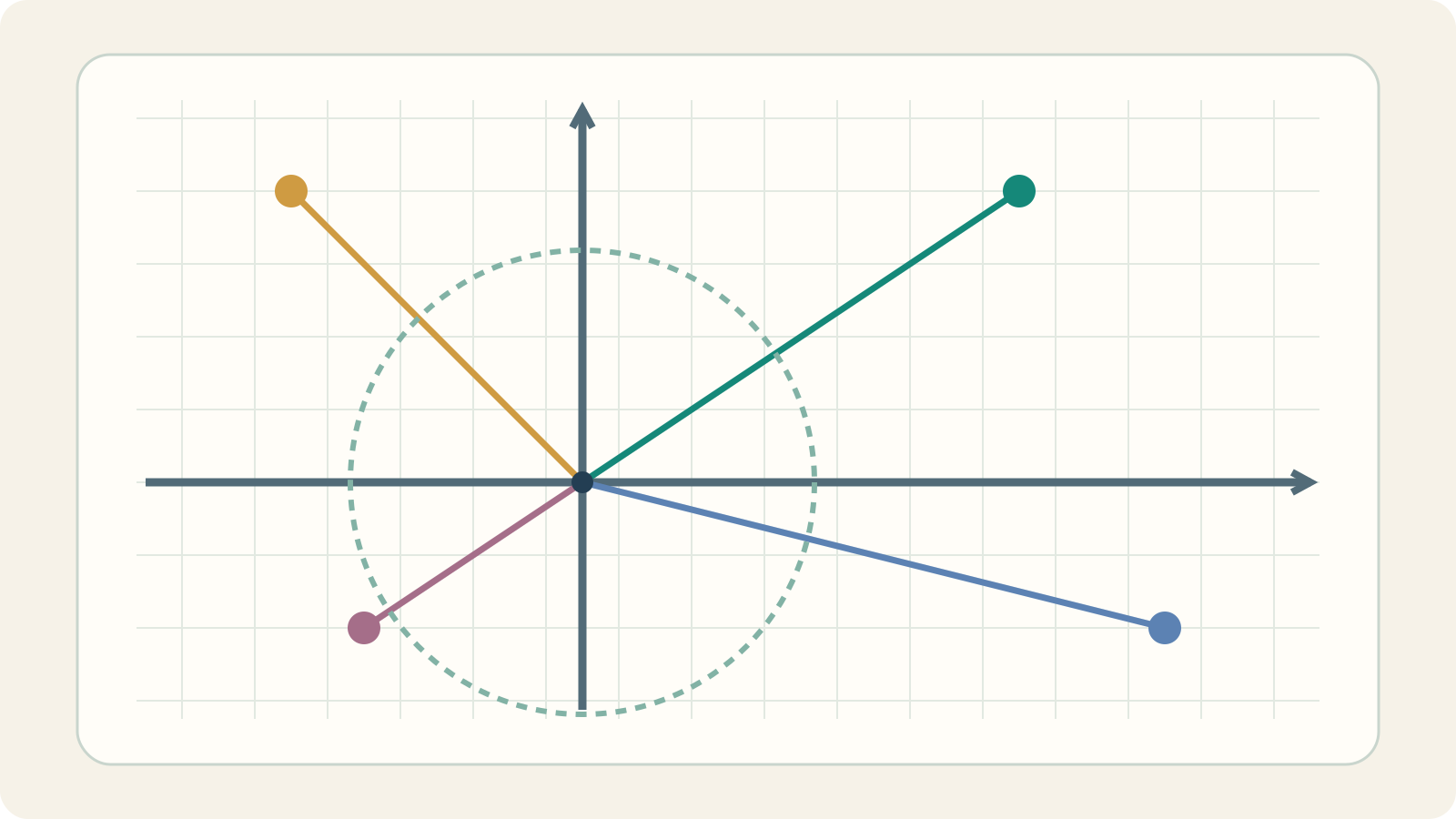
A complex number can be read as an algebraic expression or as a point in the plane. This path connects both views: why new numbers are needed, how their rules work, and how products, powers and roots have geometric meanings. We start from the beginning, with no assumed trigonometry.
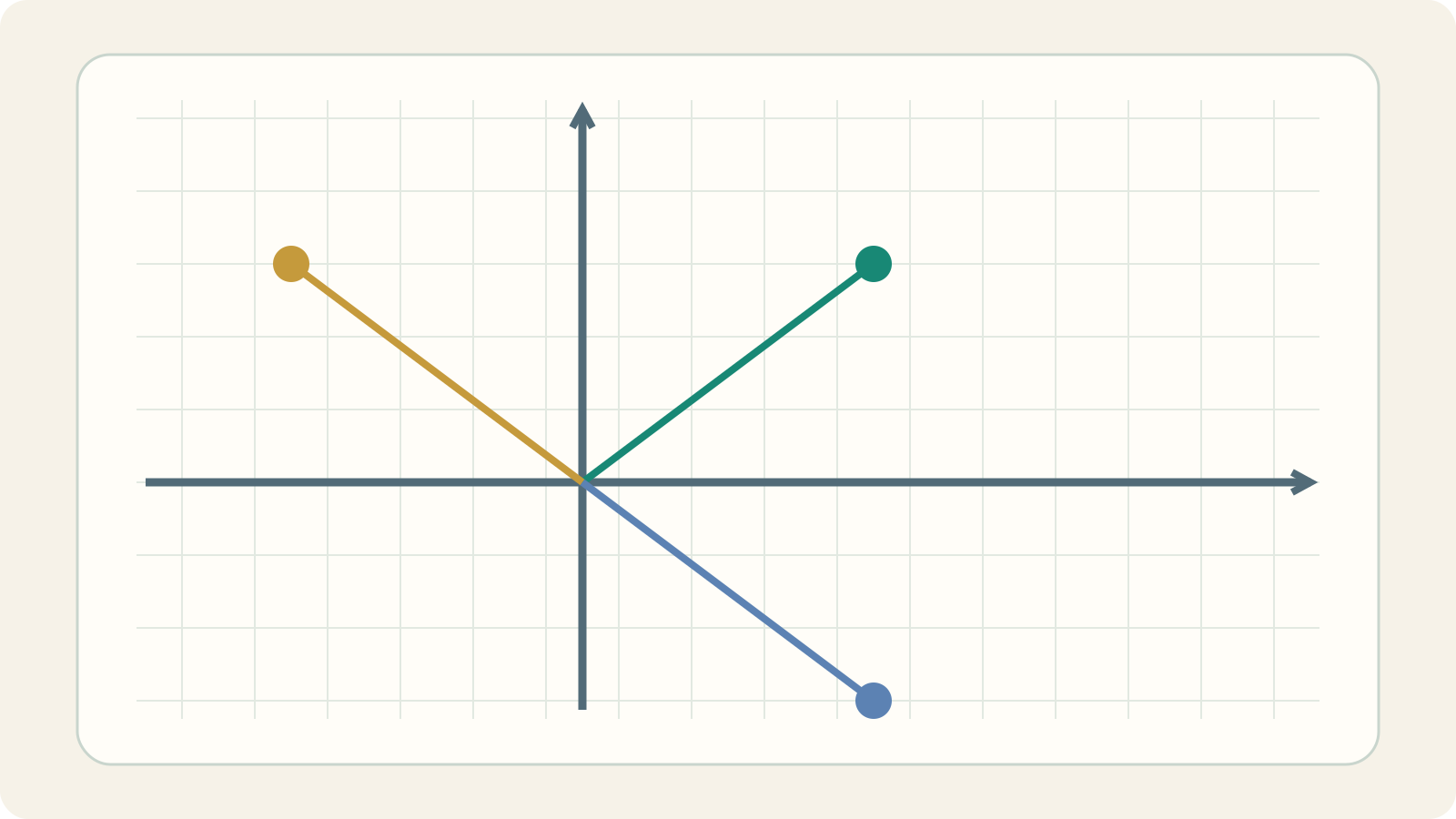
Stage 1: Why complex numbers arise · Lab
Stage 2: Calculating with complex numbers · Lab
Stage 3: Modulus, distance and argument · Lab
Stage 4: Trigonometric form and rotations · Lab
What this path is for
The aim is more than remembering i²=−1. We want to explain a and b in a+bi, verify calculations, move between representations and distinguish an equation’s solutions from a principal root selected by convention. Drawings support reasoning; formulas make it precise.
Before you begin
You need signed numbers, fractions, powers, simple equations and Cartesian coordinates. Stage 1 reviews the essentials. Angles, sine, cosine and exponentials will be introduced when needed, not treated as explanations you already know. Every stage begins with a concrete problem.
The eight stages
1. Why complex numbers arise
From x²+1=0 to i²=−1, a+bi, real and imaginary parts and the complex plane.
Lab: Draggable point and comparison of real and imaginary solutions.
2. Calculating with complex numbers
Sum, difference, product, conjugate, division and powers of i.
Lab: Two editable numbers, calculations and checks at every step.
3. Modulus, distance and argument
Distance from the origin, angles and their ambiguity; zero has no argument.
Lab: Link coordinates, length and angle by moving a point.
4. Trigonometric form and rotations
Convert a+bi to r(cosθ+i sinθ); interpret products and quotients as transformations.
Lab: Rotate and scale a vector while comparing drawing and calculation.
5. Euler, exponential form and De Moivre
Understand e^(iθ), its connection to sine and cosine, and complex powers.
Lab: Explore the unit circle and successive powers.
Planned, not yet available
6. All complex roots
Solve zⁿ=w, distinguishing all solutions from the principal root.
Lab: Construct roots of unity and regular polygons.
Planned, not yet available
7. Equations and polynomials
Solutions, multiplicity, conjugate roots for real coefficients and the fundamental theorem of algebra.
Lab: Solve guided cases and verify factorizations and solutions.
Planned, not yet available
8. Transformations and applications
Connect the complex plane to oscillations, geometric transformations and fractals.
Lab: Explore simple maps and connections to existing labs.
Planned, not yet available
How to study: problem, formula and picture
For each stage, read the opening question, try an example, compare calculations with the lab drawing, then attempt the exercises before revealing solutions. The answers explain why each step is valid, rather than merely listing results. If a picture surprises you, change one input and observe the effect.
Where to start and what is available
Stages 1, 2, 3 and 4, each with its article and lab, are available. Stages 5–8 describe the programme: they are not published and have no links. This same index will be updated as they become ready. The path covers complex-number foundations and initial applications, not a complete course in complex analysis.
Stage 1 · Stage 2 · Stage 3 · Stage 4