Trying to solve x²+1=0 in the real numbers produces no solution. The equation is not wrong: our chosen number system is too small. This first stage builds the language slowly: the problem, then i, then a+bi and its point in the plane. No trigonometry or calculus is required.
Complex-number path index · Lab: first steps with complex numbers
1. When a number system is too small
The equation x+3=1 has no natural-number solution, but in the integers x=−2 works. The equation 2x=1 needs the rational number x=1/2. The equation x²=2 needs irrational real numbers. Each extension retains the earlier numbers and answers new questions.
Now ask for x²=−1. No real number works: the square of a positive, negative or zero real number is nonnegative. In particular, (−1)²=1, not −1. To answer this question we extend the system again.
2. The imaginary unit: the rule i²=−1
Introduce a new number called the imaginary unit, denoted i. Its defining rule is:
i² = −1
i is not a real number: it is the imaginary unit. Its opposite −i also has square −1: (−i)²=(−1)²i²=1·(−1)=−1. Therefore x²+1=0 has two complex solutions:
x = i or x = −i
Check each: i²+1=−1+1=0; (−i)²+1=−1+1=0. Writing √(−1)=i selects the principal square root by convention; it does not remove the equation’s second solution.
3. The form a+bi: two real components, one complex number
A complex number is written z=a+bi, where a and b are real. The symbol z denotes the whole number, not one component. The set of complex numbers is denoted ℂ.
z = a+bi; a,b ∈ ℝ
Re(z) = a; Im(z) = b
For z=3+2i, the real part is 3 and the imaginary part is 2, not 2i. The imaginary term is 2i. Rewrite z=−4−5i as −4+(−5)i: its real part is −4 and its imaginary part is −5. Both parts are real numbers, even when z itself is not real.
4. Real numbers remain: special cases
If b=0, then z=a+0i=a is real: every real number is also complex. If a=0 and b≠0, then z=bi is purely imaginary. If a=b=0, then z=0 is the origin, with both parts zero. Here “purely imaginary” means nonzero.
- 5=5+0i: real.
- −3i=0−3i: purely imaginary.
- i=0+1i and −i=0−1i.
- 2−i=2+(−1)i: neither real nor purely imaginary.
We have ℕ⊂ℤ⊂ℚ⊂ℝ⊂ℂ. Writing a number in a larger system does not change it: 5 and 5+0i are the same number.
5. From the real line to the complex plane
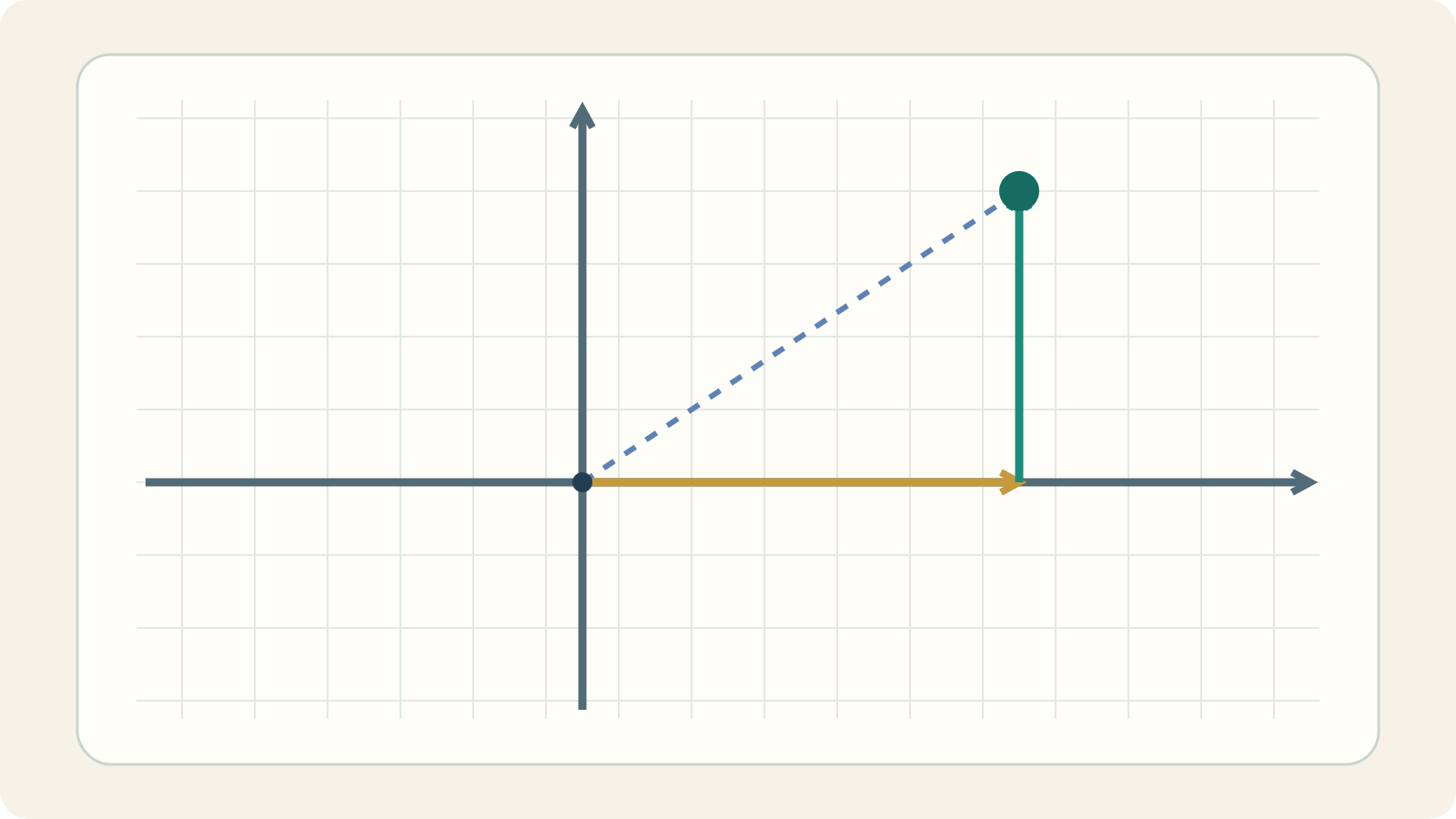
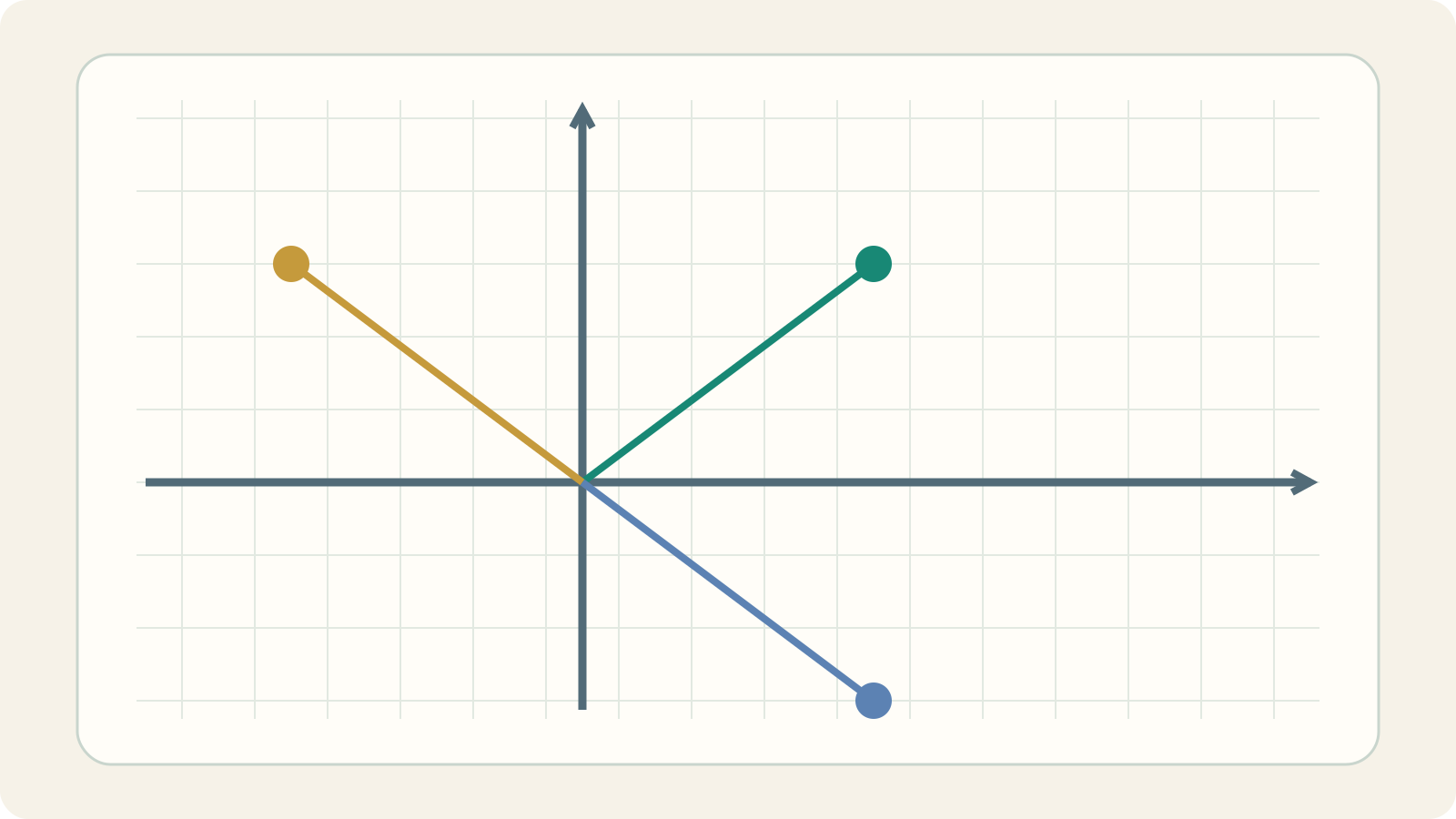
Represent a+bi by the point (a,b). The horizontal axis shows a, the real part; the vertical axis shows b, the imaginary part. These are two real coordinates of the same point, not “imaginary metres”. This representation is the complex plane, also called an Argand diagram.
For 3+2i: start at (0,0), move 3 units right and 2 up, arriving at (3,2). For −2+3i: move 2 left and 3 up. For 3−4i: move 3 right and 4 down. Real numbers lie on the horizontal axis; nonzero purely imaginary numbers lie on the vertical axis.
a+bi ↔ (a,b)
In the lab you can tap the plane, drag the point, edit a and b or build the displacement one step at a time. The coordinates and algebraic form stay connected.
Lab: first steps with complex numbers
6. When two complex numbers are equal
Two points coincide only when both coordinates match. Thus, for real a,b,c,d:
a+bi = c+di ⇔ a=c and b=d
If 2+ki=2−3i, the imaginary parts give k=−3. If x+4i=7+yi, both x=7 and y=4 must hold. But 2+3i and 3+2i are different: swapping coordinates changes the point.
Equality is different from an ordering such as “greater than”. There is no total order on ℂ compatible with addition and multiplication as on ℝ: every square in an ordered field is nonnegative, but i²=−1. We can compare coordinates or distances, provided we specify the criterion.
7. A complete example: x²+9=0
We want every solution, not one selected root. From x²+9=0 we get x²=−9. Since (3i)²=3²i²=9×(−1)=−9, x=3i works. Also (−3i)²=(−3)²i²=−9, so x=−3i works.
x²+9=0 ⇒ x=3i or x=−3i
There are no further solutions: x²+9=(x−3i)(x+3i), so a zero product requires x−3i=0 or x+3i=0. The points (0,3) and (0,−3) lie on the imaginary axis. In contrast, √(−9)=3i denotes only the principal root.
In the lab compare x²+c=0 for c=−9, c=0 and c=9. You obtain two real solutions, only zero, and two purely imaginary solutions respectively. This shows exactly what the complex numbers add.
Lab: first steps with complex numbers
8. Why this is more than a symbol trick
We can construct complex numbers as real pairs. Identify a+bi with (a,b), i with (0,1), and each real a with (a,0). Define:
(a,b)+(c,d) = (a+c,b+d)
(a,b)·(c,d) = (ac−bd,ad+bc)
Then (0,1)·(0,1)=(−1,0), giving i²=−1. On pairs (a,0), these rules reproduce real arithmetic exactly. This explicit construction satisfies the usual field laws; it has not made any real square negative. The next stage will explain and use these operations individually.
“Imaginary” is a historical name, not a judgement of usefulness. A mathematical extension needs consistent rules: we cannot simply assign any desired property to a symbol.
9. Mistakes to avoid from the start
- i²=−1 does not mean i=−1: (−1)² is 1.
- Im(2−3i)=−3, not −3i.
- 5 is complex because 5=5+0i.
- x²+4=0 has solutions ±2i, not only 2i.
- Do not apply √u√v=√(uv) indiscriminately to principal complex roots: for u=v=−1, the left side is i·i=−1, whereas √1=1.
- A zero imaginary part means a real number, not necessarily the number zero.
The radical warning matters: real formulas have assumptions. Changing the number system does not remove them.
Twelve exercises with hidden solutions
1. Why does x²+1=0 have no real solutions?
Show the solution
Every real x satisfies x²≥0, so x²+1≥1>0. The left side cannot be zero. In ℂ, i and −i work because both square to −1.
2. Find Re(z) and Im(z) for z=−7+4i.
Show the solution
Re(z)=−7; Im(z)=4. The imaginary term is 4i, but the imaginary part is the real coefficient 4.
3. What is the imaginary part of 2−i?
Show the solution
Write 2+(−1)i: the imaginary part is −1, not −i. The real part is 2.
4. Does 6 belong to ℂ? Where do you plot it?
Show the solution
Yes: 6=6+0i. Plot (6,0) on the real axis. Being real does not prevent a number from being complex.
5. Plot −3−2i, specifying both displacements.
Show the solution
Start at the origin, move 3 units left and 2 down, reaching (−3,−2). Both coordinates are negative.
6. Which complex number is represented by (−2,5)?
Show the solution
The first coordinate is the real part and the second the imaginary part: z=−2+5i, not 5−2i, which would be (5,−2).
7. Find every solution of x²+16=0 and verify one.
Show the solution
x=4i or x=−4i. Check: (4i)²+16=16i²+16=−16+16=0. In contrast, √(−16)=4i names only the principal root.
8. If x+yi=−5+3i, what are the real numbers x and y?
Show the solution
Match coordinates separately: x=−5 and y=3. Both conditions are required.
9. A complex number has imaginary part zero. Must it be zero?
Show the solution
No. It is real, for example 8+0i=8. Zero requires both real and imaginary parts to vanish.
10. Are 2+3i and 3+2i the same number?
Show the solution
No: they represent (2,3) and (3,2). Equality would require 2=3 for the real parts and 3=2 for the imaginary parts.
11. Why can’t √(−1)√(−1) be replaced by √1?
Show the solution
Using principal roots, the left product is i·i=−1, while √1=1. The real rule √u√v=√(uv), valid for u,v≥0, does not extend unconditionally to ℂ.
12. Compare −i² and (−i)²: do the parentheses matter?
Show the solution
Yes. −i²=−(i²)=−(−1)=1, whereas (−i)²=(−1)²i²=−1. In the first expression negation follows squaring; in the second the minus sign is part of the base.
Complex-number path index · Lab: first steps with complex numbers