Stage 1 introduced z=a+bi and the point (a,b). Now we calculate. The new rule remains i²=−1; distribution, brackets and fractions need the same care as in algebra. For each operation we explain the question, derive the formula and check the answer.
Path index · Lab: complex-number arithmetic · Review stage 1
1. Before calculating: what the letters mean
Write z=a+bi and w=c+di with real a,b,c,d. a and c are the real parts; b and d are the imaginary parts, not bi and di. We always rewrite the answer as A+Bi with real A and B. Capitals simply name the result’s coefficients; they are not new kinds of numbers.
For z=3+2i, a=3 and b=2; for w=1−4i, c=1 and d=−4. Keeping d’s sign matters. Every lab example has a full problem statement. Edit all four coefficients, including fractions such as 1/2, and follow exact calculations.
2. Addition: match real and imaginary parts
Problem: calculate (3+2i)+(1−4i). Remove brackets and collect like terms: 3+1+2i−4i=(3+1)+(2−4)i=4−2i. Do not combine 3 and 2i as like terms: 3+2i is one complex number, but not one real term.
(a+bi)+(c+di) = (a+c)+(b+d)i
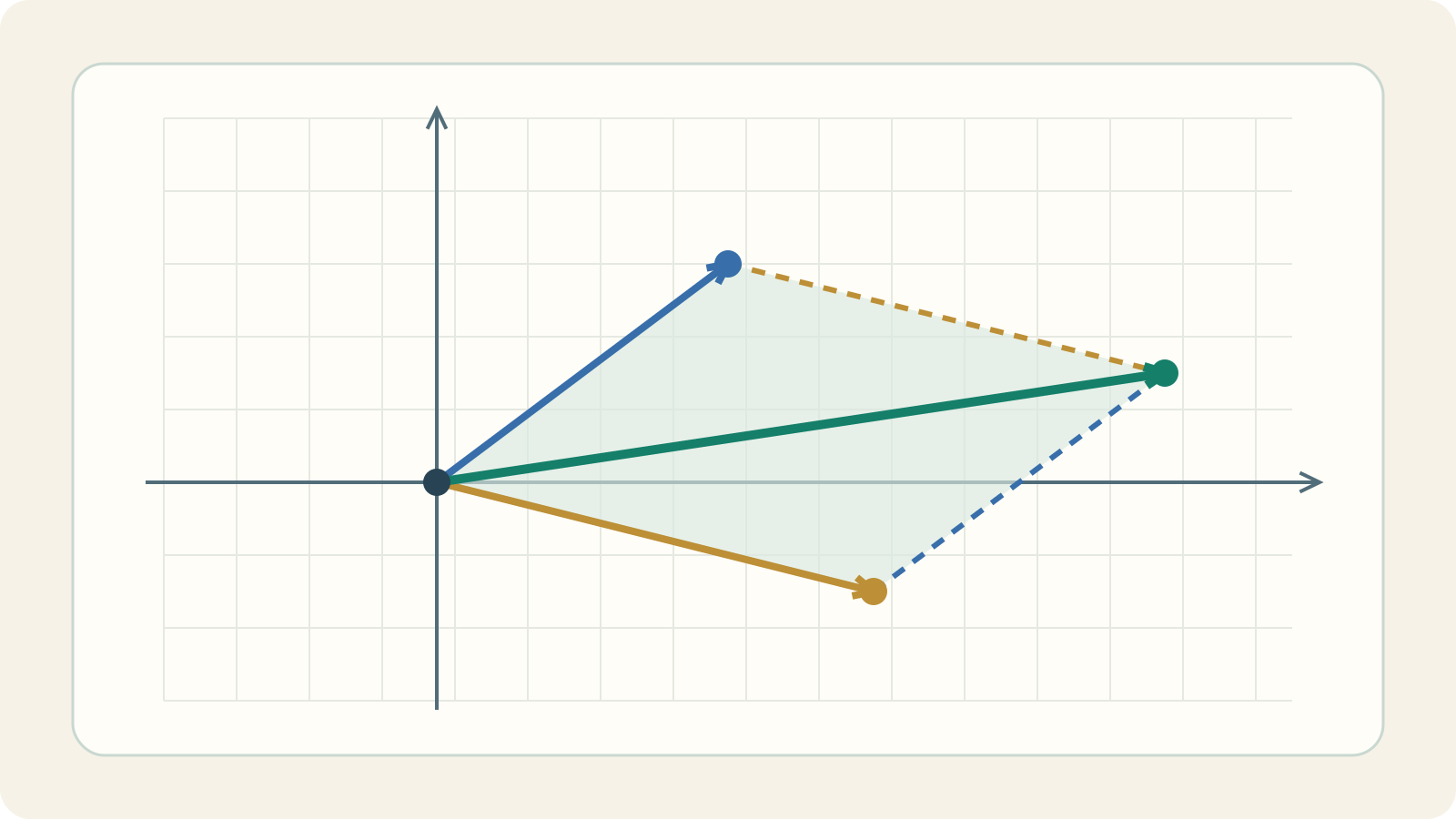
Distribution gives bi+di=(b+d)i. In the plane, add coordinates: (a,b)+(c,d)=(a+c,b+d). The parallelogram takes (3,2) and (1,−4) to (4,−2). Reverse check: (4−2i)−(1−4i)=3+2i.
3. Subtraction: the minus changes both signs
Problem: calculate (3+2i)−(1−4i). The minus before the second bracket affects every term: 3+2i−1+4i=(3−1)+(2+4)i=2+6i. The opposite of w=c+di is −w=−c−di.
(a+bi)−(c+di) = (a−c)+(b−d)i
With d=−4, the imaginary part is b−d=2−(−4)=6, not 2−4. Geometrically, add the opposite of w to z. Check: (2+6i)+(1−4i)=3+2i. Addition and subtraction check each other.
4. Multiplication: four products, then i²=−1
Problem: calculate (2+3i)(4−i). Distribute each term in the first bracket over each term in the second:
(2+3i)(4−i)=2×4+2×(−i)+3i×4+3i×(−i)
=8−2i+12i−3i²
=8−2i+12i+3
=11+10i.
The final term is +3 because −3i²=−3×(−1)=3. In general:
(a+bi)(c+di) = ac+adi+bci+bdi²
= (ac−bd)+(ad+bc)i
Multiplying a by c and b by d alone loses both cross terms. For example, (1+i)²=1+2i+i²=2i, not 1−1=0. The square of a sum includes twice the product.
| × | 4 | −i |
|---|---|---|
| 2 | 8 | −2i |
| 3i | 12i | −3i²=3 |
5. The conjugate is not the opposite
The conjugate of z=a+bi is written z̄ and changes only the imaginary part’s sign. The opposite −z changes both signs.
z̄ = a−bi; −z = −a−bi
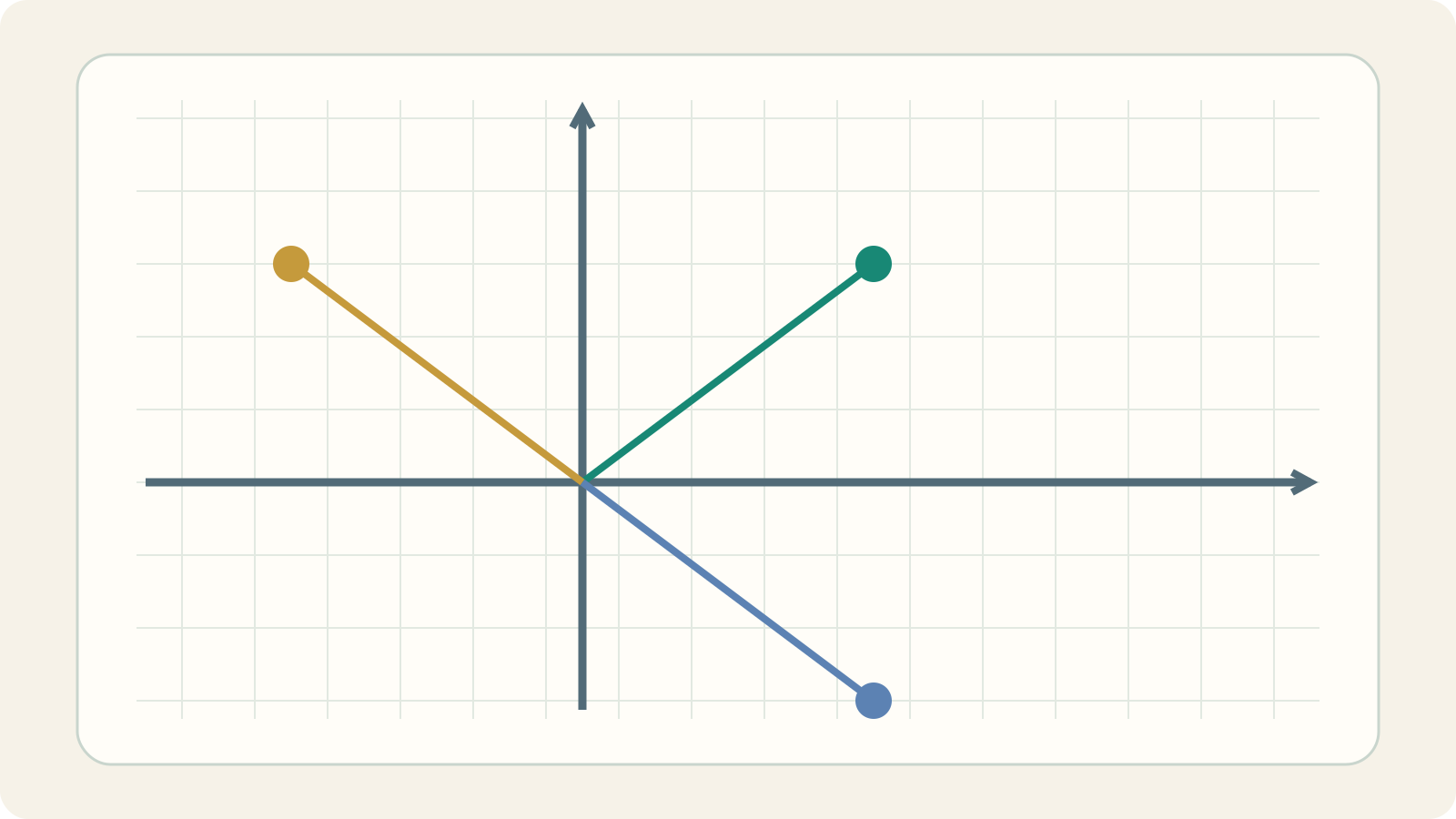
Problem: find the conjugate and opposite of 3−4i. Conjugate: 3+4i; opposite: −3+4i. The conjugate reflects across the real axis; the opposite reflects through the origin. Conjugating twice returns z. Also z+z̄=2a and z−z̄=2bi.
The key identity for division is:
(a+bi)(a−bi)=a²−abi+abi−b²i²=a²+b²
This is real and nonnegative, and is zero only when a=b=0. For 3−4i, (3−4i)(3+4i)=9+16=25. This does not say z²=a²+b²: the factors here are conjugates, not identical.
6. Division: why multiply by the conjugate
Problem: calculate (3+2i)/(1−2i). Division by any nonzero complex number is allowed, including a purely imaginary number. Only zero is forbidden. Multiply numerator and denominator by the denominator’s conjugate, 1+2i. This preserves the fraction because (1+2i)/(1+2i)=1.
Numerator: (3+2i)(1+2i)=3+6i+2i+4i²=−1+8i.
Denominator: (1−2i)(1+2i)=1+4=5.
Quotient: (−1+8i)/5=−1/5+(8/5)i.
(a+bi)/(c+di) = [(ac+bd)+(bc−ad)i]/(c²+d²)
= (ac+bd)/(c²+d²) + [(bc−ad)/(c²+d²)]i
c+di ≠ 0
The signs +bd and −ad come from multiplying by c−di, not from an arbitrary exception. c²+d² is positive because c and d are not both zero. Check: [−1/5+(8/5)i](1−2i)=3+2i. Multiplying the quotient by the divisor must recover the dividend.
7. The case 1/i and complex reciprocals
Problem: calculate 1/i. The conjugate of i is −i, so 1/i=(−i)/(i×(−i))=(−i)/1=−i. Check immediately: (−i)i=−i²=1. Division by i is allowed and is not the same as multiplication by i.
1/i = −i
1/(a+bi) = (a−bi)/(a²+b²), with a+bi≠0
For example, 1/(2+i)=(2−i)/5=2/5−(1/5)i. But 1/0 is undefined: no number multiplied by zero gives 1. Also 0/0 is undefined because it does not specify a unique quotient.
8. Powers of i: a cycle of four values
Start with i⁰=1 because i is nonzero. Repeated multiplication by i gives i¹=i; i²=−1; i³=i²i=−i; i⁴=i²i²=1. The cycle repeats. For an integer n≥0, write n=4q+r with r=0,1,2,3:
i^n = (i^4)^q · i^r = i^r
r=0 → 1; r=1 → i; r=2 → −1; r=3 → −i
Problem: calculate i²⁰²⁶. Division gives 2026=4×506+2, hence i²⁰²⁶=i²=−1. No need for 2026 multiplications. For i⁴⁰⁰¹, the remainder is 1 and the result is i.
9. Negative exponents: the same cycle, carefully
A negative exponent means a reciprocal: i⁻¹=1/i=−i and i⁻²=1/i²=−1. The remainder rule still works for every integer n if the remainder is nonnegative: n=4q+r with 0≤r<4.
Problem: calculate i⁻⁵. Write −5=4×(−2)+3. Then i⁻⁵=(i⁴)⁻²i³=1×(−i)=−i. Check: i⁵=i, so i⁻⁵=1/i=−i.
In some programming languages, % returns a negative remainder for a negative dividend; check the convention rather than copying it blindly. The lab displays q and r and checks n=4q+r with r from 0 to 3. Do not confuse i⁻²=−1 with −i²=1: the latter minus sign is outside the power.
10. A reusable procedure
- Identify the operation and keep coefficient signs.
- Write the formula before substituting values.
- Distribute every product or change every required sign.
- Replace i² by −1 and collect real and imaginary parts.
- Reduce fractions; use decimals only as approximations.
- Check with the inverse operation whenever possible.
The lab uses exact fractions for results and steps; only the drawing uses approximate decimal coordinates. Sums and differences have a checking parallelogram; conjugation has a reflection. For products and quotients the plot compares points: their full geometric interpretation comes in stage 4. Next comes modulus, distance and argument.
Twelve exercises: try before revealing the solution
1. Calculate (2−3i)+(−5+7i).
Show the solution
Add matching parts: (2−5)+(−3+7)i=−3+4i. The result’s imaginary part is 4.
2. Calculate (1+2i)−(−3−4i).
Show the solution
Change both signs in the second bracket: 1+2i+3+4i=4+6i. Check: (4+6i)+(−3−4i)=1+2i.
3. Calculate (2+i)(3−2i).
Show the solution
Distribute: 6−4i+3i−2i²=6−i+2=8−i. The term −2i² contributes +2.
4. Is (1+i)²=0?
Show the solution
No: (1+i)²=1+2i+i²=2i. The mistake is omitting the cross term 2i.
5. Find the conjugate and opposite of −2+5i.
Show the solution
Conjugate: −2−5i, changing only the imaginary sign. Opposite: 2−5i, changing both signs.
6. Calculate (−2+5i)(−2−5i).
Show the solution
They are conjugates: the product is (−2)²+5²=4+25=29. It is not the square of the first factor.
7. Calculate (2+i)/(1−i).
Show the solution
Multiply top and bottom by 1+i. Numerator: (2+i)(1+i)=2+3i+i²=1+3i. Denominator: 1+1=2. Result: 1/2+(3/2)i.
8. Calculate 1/i and check it.
Show the solution
1/i=−i. Check: (−i)i=−i²=1. Since i is nonzero, division is allowed.
9. Calculate (3+2i)/0 and 0/0.
Show the solution
Both are undefined. No quotient multiplied by zero gives 3+2i; for 0/0 every number would give zero, so no unique quotient exists. Assign neither zero nor infinity.
10. Calculate i^2026 and i^4001.
Show the solution
2026=4×506+2, so i^2026=i²=−1. 4001=4×1000+1, so i^4001=i. Use the remainder on division by 4.
11. Calculate i^(-5) without using a negative remainder.
Show the solution
−5=4×(−2)+3. Therefore i^(-5)=(i⁴)^(-2)i³=−i. Alternatively, i⁵=i, so its reciprocal is 1/i=−i.
12. Calculate [1/2+(1/3)i]/(1−i).
Show the solution
Multiply by 1+i. Numerator real part: 1/2−1/3=1/6; imaginary part: 1/2+1/3=5/6. Denominator: 2. The result is 1/12+(5/12)i. Multiplying by 1−i recovers 1/2+(1/3)i.
Path index · Lab: complex-number arithmetic