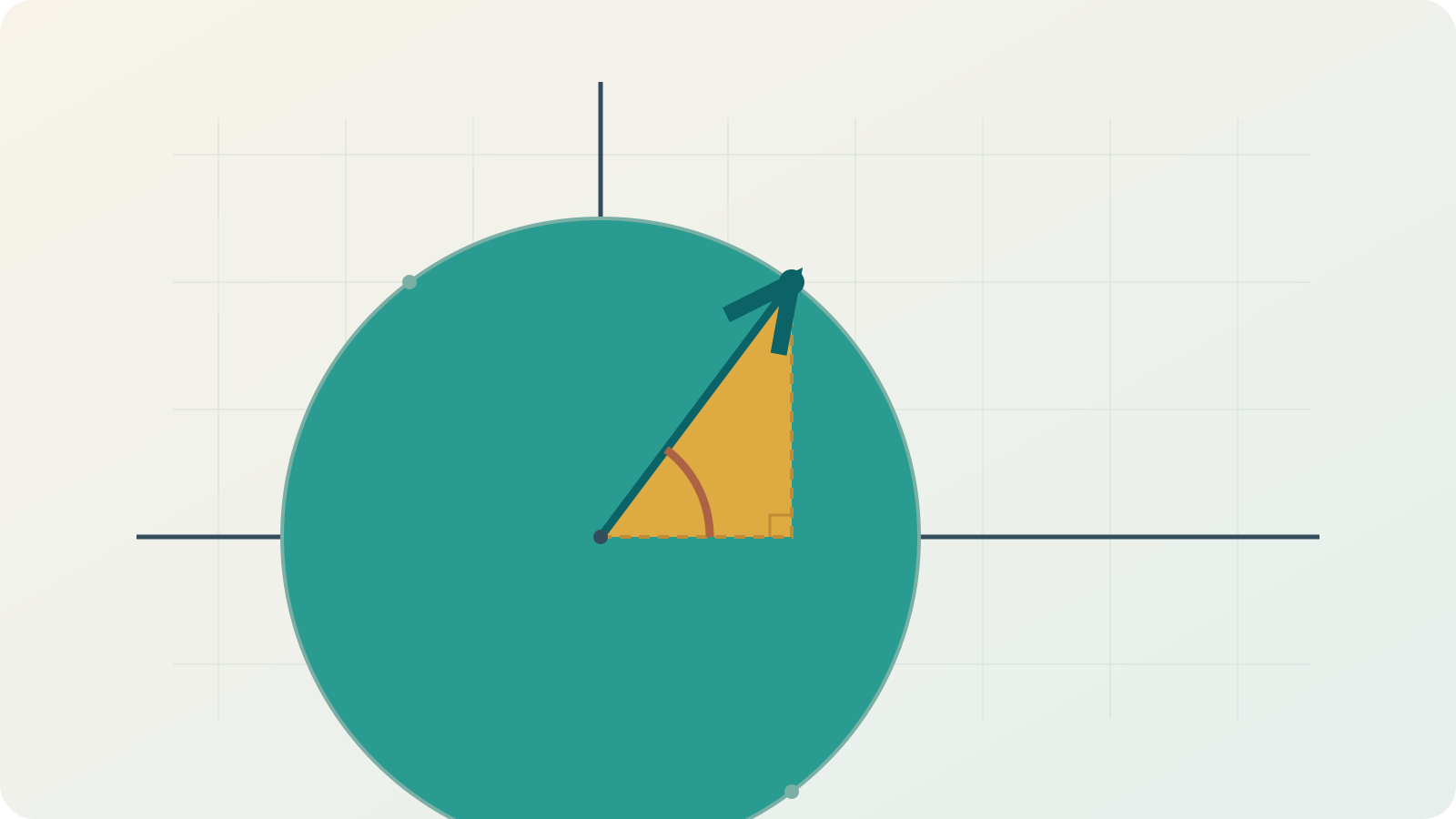
A complex number is more than an expression to simplify. The point z=a+bi has a distance from the origin and, unless it is zero, a direction. These are its modulus and argument. With a second point we can measure distance between numbers, recognize circles and disks, and see why angles need more care than lengths.
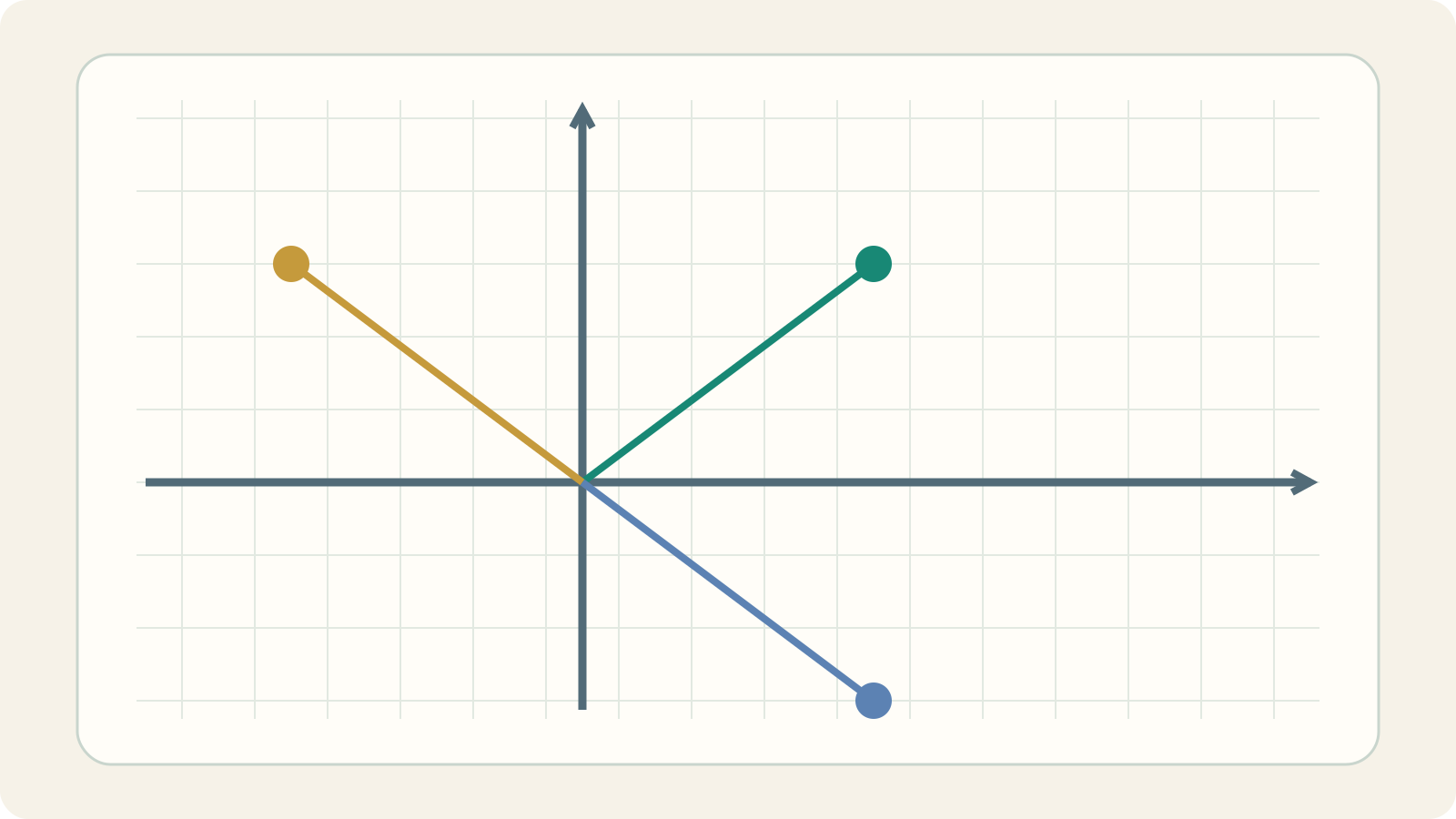
Path index · Lab: modulus, distance and argument · Review stage 2
1. Two different questions about one point
The point for z=a+bi is (a,b). We may ask how far it is from the origin or in which direction it lies. The first answer is a nonnegative real number; the second is an angle with a declared measurement convention. Neither is the imaginary part b.
Reach 3+4i by moving 3 right and 4 up. The straight segment does not have length 3+4=7: that is the broken coordinate path. The direct segment has length 5. Its angle is neither 3 nor 4; measure it counterclockwise from the positive real axis.
2. Modulus from Pythagoras
The right-triangle legs have lengths |a| and |b|. Pythagoras gives hypotenuse squared a²+b². Choose the nonnegative square root because this is a length.
|z| = √(a²+b²)
|z| ≥ 0; |z|=0 ⇔ z=0
Problem: find the modulus of 3+4i. Substitute a=3, b=4: |3+4i|=√(3²+4²)=√(9+16)=√25=5. Both 3−4i and −3−4i also have modulus 5: signs change position, not the squares. The modulus is not ±5 or a non-real number.
For z=−6, write −6+0i: |z|=√36=6. Complex modulus extends real absolute value.
3. Do not confuse |z|² with z²
Stage 2 showed z z̄=a²+b². Hence |z|²=z z̄, but usually |z|²≠z². For z=3+4i, |z|²=25, whereas z²=(3+4i)²=9+24i+16i²=−7+24i.
|z|² = z z̄ = a²+b²
The conjugate z̄ and opposite −z have the same modulus as z: reflecting across the real axis or origin preserves distance from the origin. Different numbers can have equal modulus, so |z| alone does not determine z.
4. Distance between numbers is the modulus of their difference
Let z=a+bi and w=c+di. The difference z−w=(a−c)+(b−d)i describes displacement from w to z. Its modulus is the length of the joining segment.
d(z,w)=|z−w|=√((a−c)²+(b−d)²)
Problem: find the distance between z=3+2i and w=−1−i. First subtract: z−w=(3−(−1))+(2−(−1))i=4+3i. Then |z−w|=√(4²+3²)=5.
Do not use |z|−|w| as distance. For z=3+4i and w=−3−4i, both moduli are 5, but |z−w|=|6+8i|=10, not zero. Zero distance means identical points; equal moduli mean only equal distance from the origin.
5. Oriented angles, degrees and radians
Measure direction from the positive real axis. Counterclockwise is positive and clockwise negative. A quarter turn is 90°, half a turn 180°, a full turn 360°.
One radian subtends an arc whose length equals the circle’s radius. More generally θ=s/r, with oriented arc length s and radius r. A full circumference is 2πr, hence one turn is 2π radians.
180° = π rad; 90° = π/2 rad; 360° = 2π rad
θ in radians = (θ in degrees) × π/180
Thus 45°=π/4 and −90°=−π/2. A value such as 1.57 without units can mislead: 1.57 radians is about 90°, not 1.57°. The lab shows both units.
6. Argument and principal argument are different
If θ gives the direction of a nonzero number, θ+2π, θ−2π and all θ+2kπ give the same direction. For 1+i, 45°, 405° and −315° work. The argument is therefore not unique.
arg(z) = {Arg(z)+2kπ : k∈ℤ}, with z≠0
Choose the principal argument Arg(z) in (−π,π], or (−180°,180°]. For 1+i it is π/4; for −1 it is π, not −π under this convention. Other texts may choose another interval: it must be stated.
For z=0, the modulus is zero but the argument is undefined: a zero segment has no direction. Do not assign 0° automatically. The fact that r=0 gives the origin for every angle does not select a preferred direction.
7. Finding the angle: the quadrant matters
For z≠0 and r=|z|, the ratios a/r and b/r give horizontal and vertical projections onto the unit circle. These are cosine and sine: cosθ=a/r, sinθ=b/r. Together they determine the direction.
Using only arctan(b/a) can select the wrong quadrant. For −1+i, b/a=−1 and arctan(−1)=−45°, but the point is upper left and its principal argument is 135°. Also b/a is undefined when a=0, although i and −i have clear directions.
Arg(a+bi) = atan2(b,a), using (−π,π]
atan2 uses both signs. Its first argument is the vertical coordinate b and the second the horizontal coordinate a. On the negative real axis normalize −π to π; at the origin stop and report “undefined”.
8. Three examples: exact and approximate values
z=−1+i. Modulus √(1+1)=√2. Equal legs and a point in quadrant II give Arg(z)=135°=3π/4. All arguments are 3π/4+2kπ.
z=1−i. The same modulus √2, but quadrant IV: Arg(z)=−45°=−π/4. The angle 315° is a valid argument, not the chosen principal one.
z=3+4i. Its modulus is exactly 5. atan2(4,3) gives approximately 53.130102°, or approximately 0.927295 radians. Keep ≈ rather than =: a rounded decimal is not the exact value.
The lab checks squared coordinates and circle/disk membership with exact fractions. Numerical angles are approximate. On axes and diagonals it also recognizes simple exact multiples of π.
9. The principal-argument jump
Consider −3+0.1i and −3−0.1i. These points are close, at distance 0.2, but one principal argument is near +180° and the other near −180°. The point has not nearly completed a turn: the chosen representative jumps at the interval boundary.
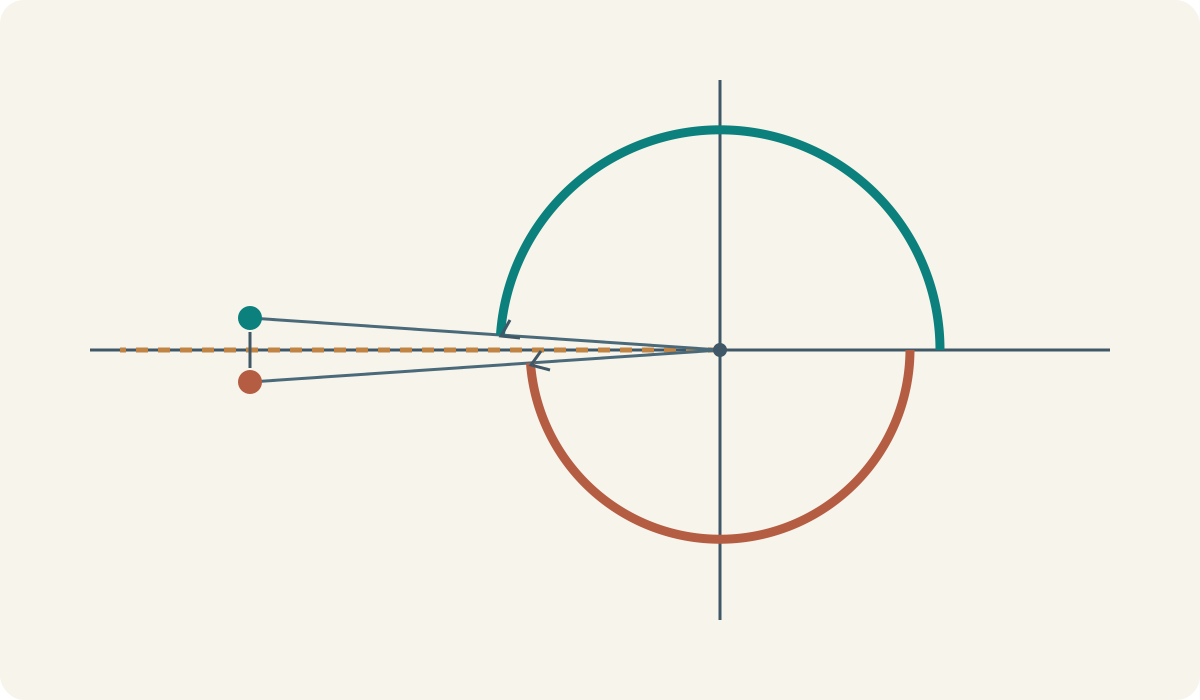
This boundary is often called the cut of the principal representation. On the negative axis we use π. Choosing [0,2π) moves the jump to the positive real axis: no choice gives one continuous argument on the entire punctured plane.
Conjugation reflects across the real axis and changes θ to −θ, after which the angle must be normalized. The conjugate of −2 is −2 and both have Arg=π, so Arg(z̄)=−Arg(z) needs this qualification.
10. Circles, disks and rays as sets of numbers
The condition |z−w|=R with R>0 describes every point at distance R from centre w: a circle. The inequality |z−w|≤R includes the interior, giving a closed disk. The centre need not be the origin.
|z−(1+i)|=2: centre (1,1), radius 2
|z−(1+i)|≤2: same boundary, including the interior
For R=0 both conditions give only the centre. A negative radius is not geometric; an equation requiring negative distance has no solution.
In contrast, “θ is an argument of z”, for fixed θ and z≠0, describes a ray from the origin with the origin excluded, not a full line: the opposite point differs in direction by π. For example π/4 describes z=t+ti with t>0, not arbitrary real t.
11. An inequality visible in the picture
The direct path between two points is no longer than a broken path through a third. Applied to vector addition, this is the triangle inequality:
|z+w| ≤ |z|+|w|
||z|−|w|| ≤ |z−w|
For z=3 and w=4i, |z+w|=5 while |z|+|w|=7, so equality is not automatic. The second formula is only a lower bound on distance, not its exact value; for opposite points of modulus 5 it gives 0≤10.
We compare lengths, which are real numbers. This does not order the complex numbers themselves. Geometry helps check answers: a negative distance or modulus signals a mistake.
12. A reusable method
- Write z=a+bi and, if needed, w=c+di.
- Use Pythagoras for a length; subtract first for two points.
- Check z≠0 before finding an angle.
- Inspect quadrants and axes; do not use b/a blindly.
- State angle units and the principal interval.
- Distinguish exact π/4 or √2 from approximate decimals.
Choose modulus/argument, distance or circle/disk in the lab. Editing data updates the statement, formulas and drawing. The next stage will use these tools for trigonometric form and interpret products and quotients as transformations.
Twelve exercises: try before revealing the solution
1. Find |5−12i|.
Show the solution
√(5²+(−12)²)=√169=13. The negative sign disappears in the square, not in the point’s position.
2. Compare |−6| and |−6i|.
Show the solution
Both equal 6: √(36+0) and √(0+36). Same distance, different directions.
3. Find the modulus of 1/2+(1/3)i.
Show the solution
|z|²=1/4+1/9=13/36. Thus |z|=√13/6≈0.600925. The square root is not 1/2+1/3.
4. Distance between −2+i and 1+5i?
Show the solution
Subtract: z−w=−3−4i. Distance √(9+16)=5; reversing the points changes the vector, not its length.
5. Find Arg(−1−i) and two other arguments.
Show the solution
Third quadrant: Arg=−3π/4=−135°. Add and subtract 2π: 5π/4 and −11π/4. All describe the same direction.
6. Why is Arg(−2)=π, not −π, in our convention?
Show the solution
The interval (−π,π] includes π and excludes −π. −π is still a valid argument, but not the chosen principal one.
7. What are the modulus and argument of zero?
Show the solution
Modulus is 0. Argument is undefined: there is no direction from the origin to a distinct point. Do not assign 0°.
8. Convert 150° to radians and −π/3 to degrees.
Show the solution
150×π/180=5π/6 rad. (−π/3)×180/π=−60°. Conversion factors follow from π rad=180°.
9. Does |z|=|w| imply z=w?
Show the solution
No: z=1 and w=−1 both have modulus 1 but distance 2. Same circle, different points.
10. Does z=2+i belong to |z−(1+i)|=2? To the disk ≤2?
Show the solution
Distance from the centre is |1|=1. Not on the radius-2 boundary, but inside the closed disk.
11. Describe points with argument π/4.
Show the solution
They are z=t+ti with t>0: a ray without its origin. t<0 gives the opposite direction; t=0 has no argument.
12. Check the triangle inequality for z=3 and w=4i.
Show the solution
|z+w|=5 and |z|+|w|=7, so 5≤7. Equality is not a general rule: a direct segment may be shorter than a broken path.
Path index · Lab: modulus, distance and argument