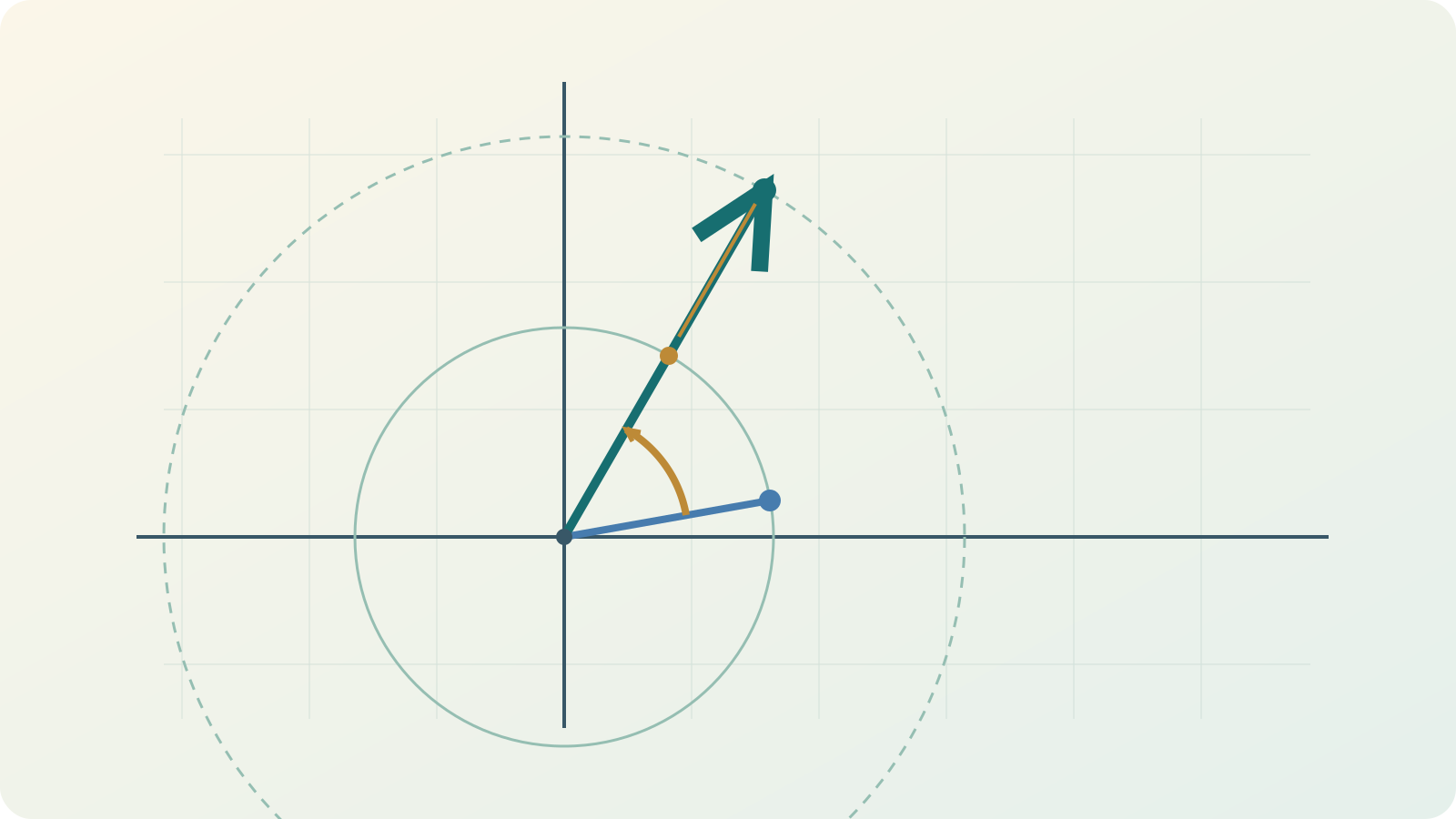
Stage 2 taught us to multiply a+bi; stage 3 measured lengths and angles. Now we connect them. Trigonometric form shows that a product is more than arithmetic: a fixed multiplier applies the same rotation and scale factor to every point about the origin. We will prove why, state the exceptions and move the centre.
Path index · Lab: trigonometric form and rotations · Review modulus and argument
1. A visible product: multiplying by i
Start with z=3+2i. Multiplying by i gives i(3+2i)=3i+2i²=−2+3i. The point moves from (3,2) to (−2,3): coordinates swap and one sign changes.
Both distances from the origin are √13. The final vector is perpendicular to the initial one, a quarter turn counterclockwise. This is no coincidence: i(a+bi)=−b+ai for any real a,b. We want to understand why this is a 90° rotation and what happens with other multipliers.
2. Trigonometric form comes from projections
For z≠0 put r=|z| and choose an argument θ. Dividing coordinates by r gives a point on the unit circle: cosθ=a/r and sinθ=b/r. Sine and cosine are signed coordinates, not necessarily positive lengths.
a = r cosθ; b = r sinθ
z = a+bi = r(cosθ+i sinθ), r=|z|>0
Factoring out r changes representation, not the number. Angles θ+2kπ give the same point. Zero has modulus 0 and formally 0(cosθ+i sinθ)=0 for any θ, but that does not assign an argument to zero.
3. From coordinates to trigonometric form
Problem: write −1+i in trigonometric form. First r=√((−1)²+1²)=√2. Next the point is in quadrant II and its components have equal absolute values. The reference angle is 45°, so θ=180°−45°=135°=3π/4.
−1+i = √2[cos(3π/4)+i sin(3π/4)]
Check: cos(3π/4)=−√2/2 and sin(3π/4)=√2/2; multiplying by √2 recovers −1 and 1. arctan(b/a) alone gives the wrong quadrant. The lab uses atan2(b,a) with principal interval (−π,π].
4. The reverse journey: r and θ to a+bi
Problem: find the coordinates of 4[cos(π/6)+i sin(π/6)]. Since π/6=30°, cos(π/6)=√3/2 and sin(π/6)=1/2. Distribute 4: a=4×√3/2=2√3, b=4×1/2=2.
4[cos(π/6)+i sin(π/6)] = 2√3+2i
This is exact. Decimal approximations of √3 give approximate coordinates instead. Do not enter 30 into a function expecting radians: 30°=π/6 rad, not 30 rad. In the lab choose degrees or multiples of π: enter 1/6 and select the latter for π/6.
5. Why moduli multiply and angles add
Let z=r(cosθ+i sinθ) and w=ρ(cosφ+i sinφ), both nonzero. Expand all four terms and use i²=−1:
zw = rρ[cosθ cosφ − sinθ sinφ + i(sinθ cosφ + cosθ sinφ)]
The angle-addition identities give cos(θ+φ)=cosθ cosφ−sinθ sinφ and sin(θ+φ)=sinθ cosφ+cosθ sinφ. Substitute to recognize trigonometric form again:
zw = rρ[cos(θ+φ)+i sin(θ+φ)]
|zw| = |z| |w|
The modulus rule also holds if a factor is zero; adding arguments requires both factors nonzero. The geometric rule follows from algebra and trigonometric identities, not a new convention.
6. A fixed multiplier transforms the whole plane
Fix w=ρ(cosφ+i sinφ), with ρ>0. Every z rotates by φ and its distance from the origin is multiplied by ρ. The centre stays fixed. This is a rule for every point, not just selected examples.
z ↦ wz: rotation φ + scale factor ρ
ρ=1: pure rotation; 01: enlarge
For w=i, φ=90° and ρ=1; for w=−i, φ=−90°. For w=−1, φ=180°, not reflection in an axis. For w=2i rotate 90° then double the length: (3+2i)2i=−4+6i. Rotation and scaling about the same centre may be performed in reverse order with the same result.
7. Worked example: (1+i)(1+i)
Each 1+i has modulus √2 and argument π/4. The product has modulus √2×√2=2 and an argument π/4+π/4=π/2.
(1+i)(1+i) = 2[cos(π/2)+i sin(π/2)] = 2i
Algebraic check: 1+i+i+i²=1+2i−1=2i. Geometrically the second factor rotates the first by 45° and scales its length by √2. Addition instead gives (1+i)+(1+i)=2+2i: these operations must not be confused.
8. The sum need not be the principal argument
The principal argument of −1+i is 135°. Its square has an argument 270° because 135°+135°=270°. But 270° is outside (−180°,180°]; the same point has principal argument −90°.
(−1+i)² = −2i
Arg(zw) ≡ Arg(z)+Arg(w) (mod 2π), z,w≠0
Here ≡ means “differ by an integer number of turns”, not equality as real numbers. The lab shows both the unnormalized angle and the final principal argument. If a factor is zero, do not add undefined arguments.
9. Division reverses rotation and scale
If w=ρ(cosφ+i sinφ)≠0, its inverse has modulus 1/ρ and argument −φ. For z≠0 this gives:
z/w = (r/ρ)[cos(θ−φ)+i sin(θ−φ)]
Problem: divide 3+2i by i. The divisor has modulus 1 and argument π/2, so rotate −90° without changing length. Algebraically 1/i=−i and (3+2i)(−i)=2−3i. Multiplying by i recovers 3+2i.
For z=0 and w≠0 the quotient is 0, with no argument. Division by w=0 is undefined: assign neither zero nor infinity.
10. Rotating about another centre
Simple multiplication wz fixes the origin. For another centre c use three steps: subtract c to bring the centre to the origin, multiply by w, then add c to move it back.
z′ = c+w(z−c)
Problem: rotate z=3+i through 90° about c=1+i. First z−c=2; then i×2=2i; finally z′=(1+i)+2i=1+3i. Distance from the centre stays 2. Using iz instead gives −1+3i, a rotation about the wrong centre. The lab lets you edit c and combine rotation with a scale λ≥0.
11. Rotation, reflection and degenerate cases
Adding a fixed complex number translates; it does not use the product’s angle-addition rule. Conjugation reflects in the real axis: 2+i becomes 2−i. Multiplication by i gives −1+2i instead. Both preserve lengths, but they are different maps.
For w≠0 multiplication preserves orientation and scales areas by |w|²: it is not reflection. For w=0 every point collapses to the origin; about c, c+0(z−c) sends everything to c. Zero has no argument to determine a rotation. A negative real multiplier such as −2 has positive modulus 2 and a 180° rotation, not modulus −2.
12. Keeping formulas and the lab meaningful
- Distinguish conversion, multiplication, division and a map about c.
- Find modulus and check for zero before arguments.
- State degrees or radians and use the correct quadrant.
- Multiply moduli and add angles for products; divide and subtract for quotients.
- Normalize the principal angle only at the end.
- Check coordinates and distance from the correct centre.
The animation separates rotation from linear scaling: a teaching path between endpoints, not a time law inherent in multiplication. A zero multiplier shows only collapse. Cartesian products with fractions are exact; generic trigonometric coordinates and drawings are approximate. Stage 5 will cover Euler and De Moivre; they are not prerequisites for this proof.
Twelve exercises: try before revealing the solution
1. Write 2−2i in trigonometric form.
Show the solution
r=√8=2√2. Quadrant IV gives θ=−π/4. Thus 2−2i=2√2[cos(−π/4)+i sin(−π/4)].
2. Convert 6[cos(π/3)+i sin(π/3)].
Show the solution
cos(π/3)=1/2 and sin(π/3)=√3/2. Multiplying both by 6 gives 3+3√3i.
3. Calculate i(2−i) and interpret it.
Show the solution
2i−i²=1+2i. (2,−1) becomes (1,2): counterclockwise 90°, unchanged modulus √5.
4. Calculate (−i)(2−i).
Show the solution
−2i+i²=−1−2i. A clockwise 90° turn sends (2,−1) to (−1,−2).
5. What does 2i do to 2−i?
Show the solution
(2i)(2−i)=2+4i. Rotate 90° and double: modulus changes from √5 to 2√5, not √5+2.
6. Why is Arg((−1+i)²) not 270°?
Show the solution
The square is −2i. 135°+135°=270° is a valid argument, but its principal representative in (−180°,180°] is 270°−360°=−90°.
7. Multiply 3[cos(π/6)+i sin(π/6)] by 2[cos(−π/3)+i sin(−π/3)].
Show the solution
Modulus 3×2=6, angle π/6−π/3=−π/6. Result 6[cos(−π/6)+i sin(−π/6)]=3√3−3i.
8. Divide modulus 4, angle π/3 by modulus 2, angle π/6.
Show the solution
Modulus 4/2=2, angle π/3−π/6=π/6. Quotient 2[cos(π/6)+i sin(π/6)]=√3+i.
9. Is multiplication by 1+i a pure rotation?
Show the solution
No. The angle is 45°, but the multiplier has modulus √2, not 1: there is also scaling by √2.
10. Rotate 3+i by 90° about 1+i.
Show the solution
Subtract the centre: 2. Multiply by i: 2i. Add the centre: (1+i)+2i=1+3i. Both distances from the centre are 2.
11. Compare the conjugate of 2+i with i(2+i).
Show the solution
The conjugate is 2−i, reflection in the real axis. i(2+i)=−1+2i is a 90° rotation. Same length √5, different points and maps.
12. What rotation does multiplication by zero describe?
Show the solution
No determined rotation: zero has no argument. The map sends every point to 0 and is not invertible. A collapse animation is only a way to show that result.
Path index · Lab: trigonometric form and rotations