Trigonometric form turned products into rotations and scaling. We now introduce the shorter notation r e^(iθ), first explaining imaginary exponents. Euler connects the exponential to sine and cosine; De Moivre computes powers without long multiplication chains. We distinguish exact identities, finite sums and numerical results.
Path index · Lab: Euler, De Moivre and powers · Review trigonometric form
1. A concrete question: how can we compute (1+i)^20?
We could multiply twenty times, but sign errors would be easy. We already know that 1+i has modulus √2 and argument π/4. Repeated multiplication repeats the same scaling and rotation twenty times.
The final modulus is (√2)^20=2^10=1024 and an argument is 20×π/4=5π. Five half-turns finish on the negative real axis: the answer is −1024. This chapter makes the shortcut precise rather than merely asking you to memorize it.
2. What does e to a complex power mean?
The real exponential e^x is familiar for real x. We extend it to complex z using a series, the limit of increasingly long sums:
e^z = 1+z+z²/2!+z³/3!+… = ∑m=0∞ z^m/m!
The factorial m! is 1×2×…×m, with 0!=1; for example 3!=6 and 4!=24. The initial term is defined as 1 even at z=0; this does not evaluate the separate expression 0^0. This series converges absolutely for every complex number and agrees with the usual real exponential. We are not making i real or requiring e^(iθ) to be positive: the function has an extended domain.
3. Euler’s formula, step by step
Substitute z=iθ, with real θ measured in radians. Powers of i cycle through 1,i,−1,−i. Even terms are real and odd terms are multiples of i. Absolute convergence lets us separate them:
e^(iθ) = [1−θ²/2!+θ⁴/4!−…] + i[θ−θ³/3!+θ⁵/5!−…]
The brackets are exactly the cosine and sine series, giving an identity for every real θ:
e^(iθ) = cosθ+i sinθ
Radians are essential in these series. Convert 30° to π/6 first; substituting θ=30 means 30 radians. A sum stopped after a few terms is not already the exact value.
4. The unit circle and e^(iπ)+1=0
The coordinates of e^(iθ) are (cosθ,sinθ), so its modulus is √(cos²θ+sin²θ)=1. It is not always on the imaginary axis: at 0 it is 1, at π/2 it is i, at π it is −1, at 3π/2 it is −i and at 2π it returns to 1.
e^(iπ) = −1; hence e^(iπ)+1=0
e^(i(θ+2kπ)) = e^(iθ), k∈ℤ
The real part is cosθ and the imaginary part is sinθ, not i sinθ. Conjugation gives e^(−iθ). A computer may return a tiny residual instead of zero from approximate sine and cosine; that does not refute the identity. The lab also recognizes axis angles exactly.
5. Exponential form of a complex number
For z≠0 choose r=|z|>0 and an argument θ. The previous stage gave z=r(cosθ+i sinθ). Euler abbreviates it:
z = r e^(iθ), r>0
For −1+i, r=√2 and θ=3π/4, so −1+i=√2 e^(3πi/4). For −2 use r=2 and θ=π, not modulus −2. Angles θ+2kπ describe the same number.
Formally zero is 0×e^(iθ) for any θ, but it has no argument. Also e^w is never zero, so zero cannot be a lone exponential with finite complex exponent.
6. Why exponents add
Euler and the sine/cosine addition identities give e^(iα)e^(iβ)=e^(i(α+β)), the geometric rule proved in stage 4 written more briefly.
(r e^(iθ))(ρ e^(iφ)) = rρ e^(i(θ+φ))
(r e^(iθ))/(ρ e^(iφ)) = (r/ρ)e^(i(θ−φ)), ρ>0
For example e^(iπ/3)e^(iπ/6)=e^(iπ/2)=i. These are equalities of complex numbers. To find the principal argument, the angle may need normalization to (−π,π]. Periodicity of the exponential does not make all the corresponding real angles equal.
7. De Moivre for integer powers
For a positive integer n, multiplying n copies of r e^(iθ) gives n factors r and adds θ n times. Induction makes this precise: n=1 is immediate; multiplying the n case by z changes r^n to r^(n+1) and nθ to (n+1)θ.
z^n = r^n e^(inθ) = r^n[cos(nθ)+i sin(nθ)]
With r=1 this is [cosθ+i sinθ]^n=cos(nθ)+i sin(nθ). For z≠0 it extends to every integer, including zero and negatives as explained next. It is not an unrestricted rule for fractional exponents.
8. Two examples using only the formula
(1+i)^20. Write 1+i=√2 e^(iπ/4). Then (1+i)^20=(√2)^20 e^(i5π)=1024(−1)=−1024, exactly on the negative real axis, not with a small imaginary component.
(√3+i)^6. Modulus √(3+1)=2; quadrant I and angle π/6. Thus (√3+i)^6=2^6 e^(iπ)=−64. In the lab choose a polar base, r=2 and θ=(1/6)π, without entering a radical in a coordinate field.
In both cases raise the modulus to the power, not multiply it by n. Calculate nθ before normalizing the final argument.
9. Zero exponent, negative exponents and zero base
For z≠0, z^0=1. If n=−m with positive m, z^(−m)=1/z^m=r^(−m)e^(−imθ). Taking the reciprocal reverses the angle and inverts the modulus.
Problem: calculate (1+i)^(−2). Since (1+i)²=2i, its reciprocal is 1/(2i)=−i/2. De Moivre gives r^(−2)=1/2 and −2θ=−π/2, hence (1/2)e^(−iπ/2)=−i/2.
For zero base and positive n, 0^n=0 without an argument. Negative exponents require division by zero and are disallowed. This path and lab do not assign a value to 0^0; for zero base only k≥1 steps are shown, without inventing 0^0=1 as an initial step.
10. Powers as a sequence of points
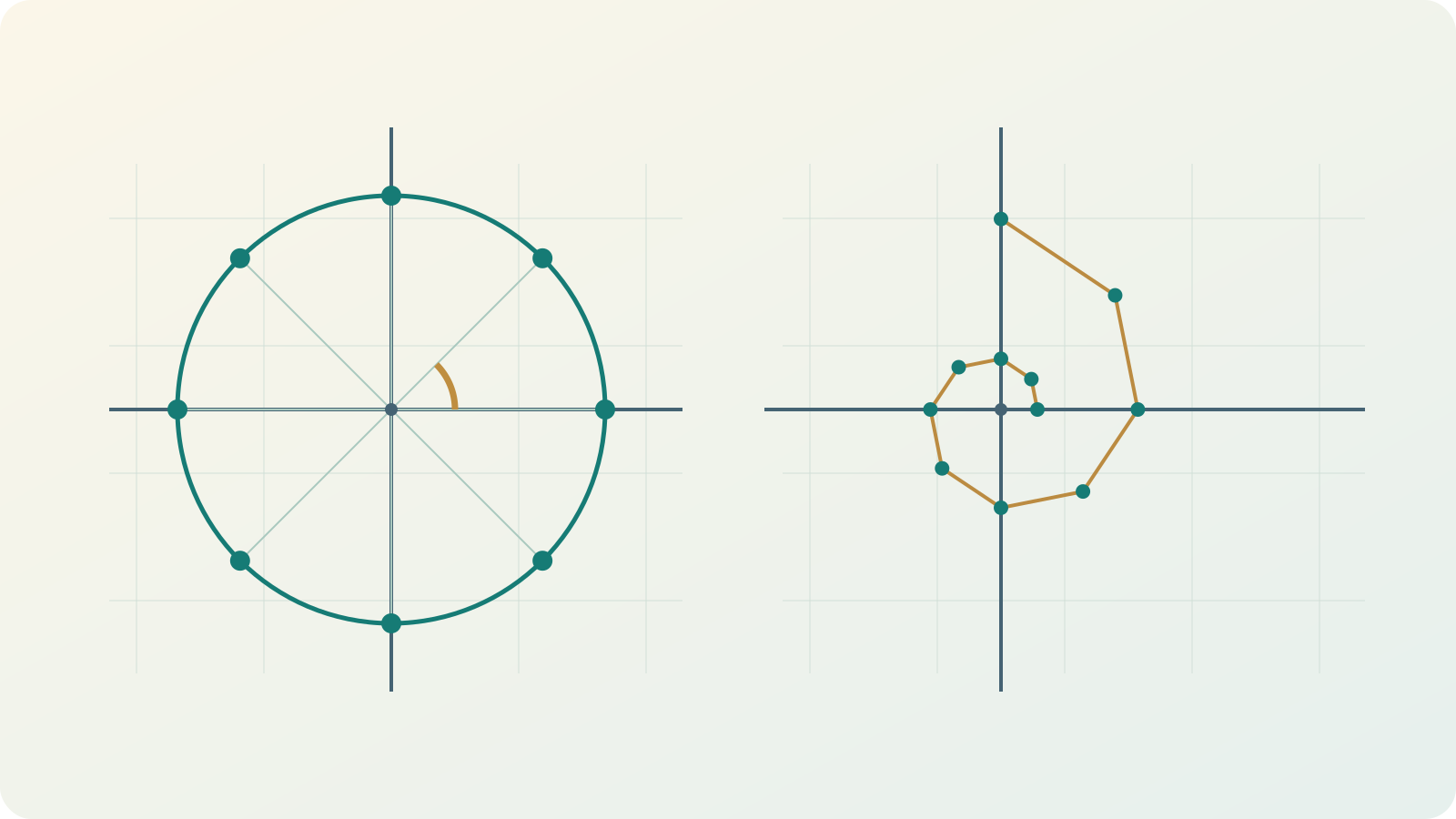
For z=r e^(iθ), z^k has modulus r^k and an argument kθ. Each step multiplies by z again. If r=1 all points stay on the unit circle; for i the cycle is 1,i,−1,−i,1. If r>1 positive-power moduli grow; if 0
Negative exponents follow powers of the reciprocal. Each lab position is an integer exponent, not a hidden fractional power. Connecting segments are visual guides, not extra integer powers.
Widely different lengths compress some points near the origin on a common scale. “Directions only” maps nonzero points to the unit circle to compare angles, not moduli. Zero stays at the origin and gains no direction.
11. A finite sum is not Euler’s identity
Let S_M sum from m=0 through M: it contains M+1 terms. For θ=π/2 and M=3, S_3=(1−π²/8)+i(π/2−π³/48)≈−0.23370055+0.92483223i, whereas the exact value is i. The sum’s point need not yet lie on the unit circle.
S_M = ∑m=0M (iθ)^m/m!
|e^(iθ)−S_M| ≤ e^|θ| |θ|^(M+1)/(M+1)!
The bound comes from the absolute tail: after the first factorial, subsequent denominator products are at least the corresponding factorials. It bounds theoretical truncation error, not computer rounding. The lab displays this separately from observed numerical discrepancy. “Zero at calculation precision” does not mean mathematically zero error.
12. The scope of the rule and how to use it
Integer n makes the argument choice harmless: replacing θ by θ+2kπ adds an integer number of turns to nθ. Fractional exponents do not share this property. For −1, arguments π and −π become i and −i when halved. These are the two solutions of x²=−1; the principal root requires an extra choice. Roots are the next stage.
A general exponent gives e^(u+iv)=e^u(cosv+i sinv): its real part sets modulus e^u and its imaginary part sets angle v. For u=0 this is the unit circle.
- Check zero base and exponent.
- Find positive modulus and an argument of a nonzero base.
- Raise modulus to n and multiply angle by n.
- Normalize only at the end.
- Check using Cartesian products where possible.
- For finite series use ≈ and distinguish truncation from rounding.
Twelve exercises: try before revealing the solution
1. Find e^(iπ/2) and e^(−iπ/2).
Show the solution
Euler gives cos(π/2)+i sin(π/2)=i. For the negative angle cosine is 0 and sine is −1, giving −i.
2. Why is e^(iπ)+1=0 exact?
Show the solution
cosπ=−1 and sinπ=0 exactly, so e^(iπ)=−1. A computer residual belongs to approximate calculation, not the identity.
3. Write 1−i in exponential form.
Show the solution
Modulus √2 and principal argument −π/4 give 1−i=√2 e^(−iπ/4). Adding 2kπ to the angle gives the same number.
4. Calculate (1+i)^8.
Show the solution
r=√2 and θ=π/4. r^8=16 and 8θ=2π, so (1+i)^8=16 e^(2πi)=16.
5. Calculate (1−i)^6.
Show the solution
r^6=(√2)^6=8 and 6θ=−3π/2, equivalent to π/2. The result is 8i.
6. Calculate [2e^(iπ/3)]^3.
Show the solution
Cube 2 and multiply the angle by 3: 8e^(iπ)=−8. The modulus is 8, not 2×3=6.
7. Calculate (1+i)^(−2).
Show the solution
(1+i)^2=2i. Invert: 1/(2i)=−i/2. In polar form: (√2)^(−2)e^(−iπ/2)=(1/2)(−i).
8. Compare (2i)^0, 0^4, 0^(−1) and 0^0.
Show the solution
(2i)^0=1 because the base is nonzero; 0^4=0. 0^(−1) requires division by zero. This path leaves 0^0 unassigned; the nonzero-base rule does not apply automatically.
9. Find the sixth power of (1/2)e^(iπ/3).
Show the solution
Modulus (1/2)^6=1/64, angle 6×π/3=2π. Result 1/64: the direction returns to the positive real axis, much closer to the origin.
10. Why do θ and θ+2π give the same integer power?
Show the solution
After multiplication by n the angles differ by 2nπ, an integer number of turns. For n=1/2 the difference is π and may change the point; roots need separate treatment.
11. Write S_2 for θ=π/2: how many terms?
Show the solution
S_2=1+iπ/2+(iπ/2)^2/2!=1−π²/8+iπ/2. Three terms: m=0,1,2. It is not already equal to i, the infinite-series value.
12. Does numerical discrepancy 0 prove S_M=e^(iθ) exactly?
Show the solution
No: distinct values can round to the same number. Distinguish mathematical identity, truncation and calculation precision. At the special case θ=0, however, the series really is 1 from the initial term because all later terms vanish.
Path index · Lab: Euler, De Moivre and powers
Sources and further reading
OpenStax · Polar Form of Complex Numbers
NIST DLMF · Exponential function · NIST DLMF · Sine and cosine series