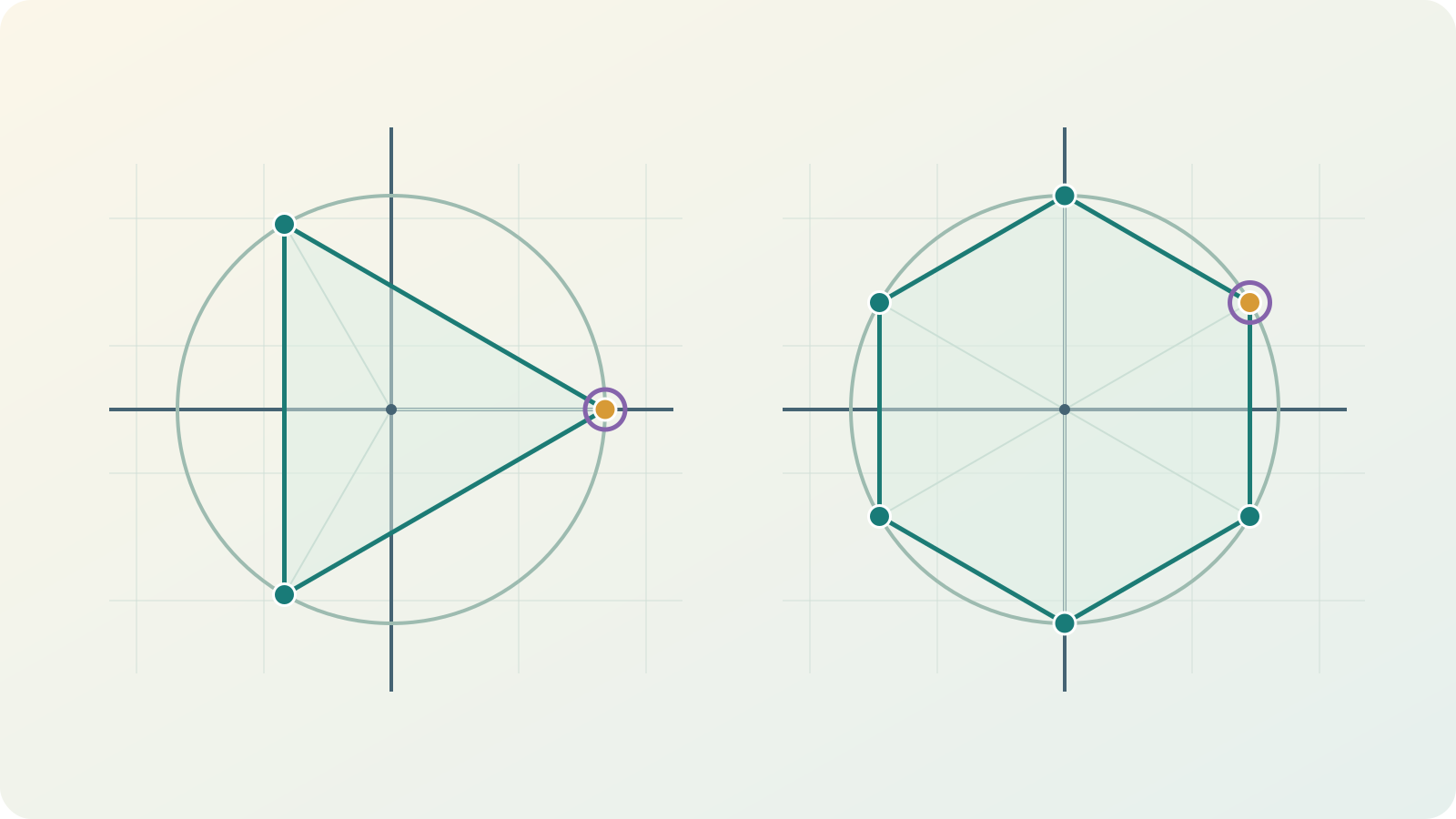
The real cube root of 8 is 2. But over the complex numbers, z³=8 has three solutions. We find all of them by separating length and angle, without settling for a calculator’s selected answer.
Learning-path index · Lab: all complex roots · Stage 5: Euler and De Moivre
1. Reverse a power
Given w and an integer n≥1, find every number z such that zⁿ=w. Each is an nth root of w. We want the whole solution set, not just one principal value.
For example, z²=9 has solutions 3 and −3; z²=−9 has solutions 3i and −3i, since (±3i)²=9i²=−9. Writing only 3i loses half the answer. Our general formula applies to w≠0; zero is handled separately.
2. Prepare modulus and argument
For w=a+bi≠0 set R=√(a²+b²)>0 and choose an argument φ: w=R(cos φ+i sin φ)=R e^(iφ). The quadrant matters: tan φ=b/a alone cannot distinguish opposite directions. The lab uses atan2(b,a) to obtain the principal argument in (−π,π].
For w=3+4i, R=5 and φ≈0.927295218 rad≈53.13010235°. For −16 choose φ=π. All angles φ+2πm, with integer m, represent the same w. Exponential formulas use radians.
3. Derive the formula
Write z=ρ e^(iθ), ρ>0. De Moivre gives zⁿ=ρⁿ e^(inθ). To obtain w=R e^(iφ), match moduli and directions: ρⁿ=R and nθ=φ+2kπ for an integer k. The first condition gives the unique positive real ρ=R^(1/n); the second gives θ=(φ+2kπ)/n.
z_k=R^(1/n)[cos((φ+2kπ)/n)+i sin((φ+2kπ)/n)]
=R^(1/n)e^(i(φ+2kπ)/n), k=0,1,…,n−1.
In degrees: θ_k=(φ_deg+360°k)/n. Dividing only φ by n finds one root but loses the others: add full turns first, then divide everything by n.
4. Why exactly n
Verification: z_kⁿ=R e^(i(φ+2kπ))=R e^(iφ)=w. Every candidate is a solution. Two candidates z_j,z_k coincide only if 2π(j−k)/n is an integer multiple of 2π, so j−k=nℓ. For 0≤j,k≤n−1 this forces j=k: they are distinct.
Every solution must satisfy our modulus and angle conditions, hence comes from an integer k. The remainder r when k is divided by n lies between 0 and n−1; replacing k by r changes the angle only by full turns. Our list is complete and has no duplicates. This proves the result without presupposing the fundamental theorem of algebra.
5. Two square roots, also off the axes
Problem: solve z²=−9. R=9, φ=π, ρ=3. Angles π/2 and 3π/2 give 3i and −3i: two opposite points.
Second problem: solve z²=3+4i. R=5, ρ=√5; the angles are φ/2 and φ/2+π. The exact coordinates are 2+i and −2−i. Indeed (2+i)²=4+4i+i²=3+4i and (−2−i)²=(2+i)². Both have modulus √5. Polar form explains the symmetry; the Cartesian check confirms it without rounding.
6. The three cube roots of 8
Problem: solve z³=8. R=8, φ=0, ρ=∛8=2; spacing 2π/3=120°. For k=0,1,2 the angles are 0, 2π/3, 4π/3.
z₀=2; z₁=−1+i√3; z₂=−1−i√3.
Check: (−1+i√3)²=−2−2i√3. Multiplying again by −1+i√3 cancels the imaginary terms and leaves 2+6=8. The conjugate root works too. The three points form an equilateral triangle of radius 2 centred at the origin. The real number 2 is only one of the three complex solutions.
7. The fourth roots of −16
Problem: solve z⁴=−16. R=16, φ=π, ρ=2. Angles θ_k=π/4+kπ/2 are 45°, 135°, 225°, 315°.
√2+i√2; −√2+i√2; −√2−i√2; √2−i√2.
The modulus is 2, not √2: the latter is each coordinate’s absolute value. For the first point, [√2(1+i)]²=4i and [√2(1+i)]⁴=(4i)²=−16. Multiplying the other angles by 4 gives π plus full turns, so those points are solutions too. The square is rotated 45° relative to the axes.
8. Roots of unity and geometry
For zⁿ=1: ζ_k=e^(2kπi/n). Set ζ=e^(2πi/n); then ζ_k=ζ^k, so each multiplication by ζ rotates by 2π/n. Not all have order n: −1 is a sixth root of unity, yet its square is already 1.
For w≠0, multiply any one root by all nth roots of unity to get all its roots. Equal radius and spacing 2π/n give a regular polygon for n≥3, opposite points for n=2, one point for n=1. For n>1 their sum is 0: (1−ζ)(1+ζ+…+ζ^(n−1))=1−ζ^n=0 and ζ≠1.
9. One principal root, not all roots
We adopt Arg(w)∈(−π,π]. The complex principal root of w≠0 is R^(1/n)e^(i Arg(w)/n). It is z₀ when φ=Arg(w); for other arguments its index can differ. Replacing φ by φ+2πm shifts indices but not the point set: add turns in the lab to see this.
For z³=−8 the real cube root is −2, but the complex principal root under this convention is 2e^(iπ/3)=1+i√3. The solutions are 1+i√3, −2, 1−i√3. Clarify the symbol w^(1/n): a principal value or the set of all roots?
10. Zero and boundary cases
If w=0, |z|ⁿ=0 forces |z|=0, so z=0 is the only distinct solution. Zero has no argument; we do not draw n overlapping points as if they were different. As a root of the polynomial zⁿ, zero has multiplicity n: a different kind of count.
If n=1, z=w: just one point, no polygon. Zero, negative and noninteger exponents are outside this problem and rejected by the lab, without assigning a value to 0⁰. The limit n≤24 is only for readability; the theory holds for every integer n≥1.
11. Cartesian square-root formula
For z²=a+bi set z=x+iy: x²−y²=a and 2xy=b. Also x²+y²=|z|²=|w|=R. Adding gives 2x²=R+a; subtracting gives 2y²=R−a. If b≠0 one root is:
x=√((R+a)/2), y=sgn(b)√((R−a)/2).
The other is −x−iy.
The sign of y must satisfy 2xy=b; it is not independent of x’s sign. For a=3,b=4,R=5 we get x=2,y=1. If b=0 and a>0, roots are ±√a; if b=0 and a<0, they are ±i√(−a). If a=0 too, the only root is 0.
12. Method, checks and pitfalls
Procedure: validate n; separate w=0; calculate R and an argument φ; find ρ=R^(1/n); list θ_k=(φ+2kπ)/n for k=0,…,n−1; convert to coordinates if helpful; check z_kⁿ=w. The lab separates exact polar formulas, approximate coordinates and recognized exact Cartesian checks. A small numerical residual does not replace the proof.
Real-root rules do not automatically extend to complex principal roots: √(−1)√(−1)=i·i=−1, but √((-1)(-1))=√1=1. Check the assumptions before simplifying. The next stage uses roots for equations and polynomials; the problem zⁿ=w is already solved completely here.
Twelve exercises: try before revealing
1. Solve z²=−25.
Show the explained solution
R=25, φ=π, ρ=5. Angles π/2 and 3π/2 give 5i and −5i. Both square to −25.
2. Find all three roots of z³=27.
Show the explained solution
ρ=3, angles 0, 2π/3, 4π/3: 3, −3/2+(3√3/2)i, −3/2−(3√3/2)i. De Moivre gives 27 for each.
3. Solve z⁴=1.
Show the explained solution
ρ=1; angles 0, π/2, π, 3π/2. The roots are 1,i,−1,−i. Each raised to the fourth power is 1; their sum is 0.
4. Solve z²=−3+4i with exact coordinates.
Show the explained solution
R=5; x=√((5−3)/2)=1 and y=√((5+3)/2)=2. Roots: 1+2i and −1−2i. (1+2i)²=1+4i−4=−3+4i.
5. Solve z³=i in polar form.
Show the explained solution
R=1, φ=π/2. θ_k=π/6+2kπ/3. Angles: π/6, 5π/6, 3π/2; roots: √3/2+i/2, −√3/2+i/2, −i.
6. For z⁶=64 find radius and spacing.
Show the explained solution
ρ=64^(1/6)=2, spacing 2π/6=π/3=60°. z_k=2e^(ikπ/3), k=0,…,5. The radius is not 64/6: take a root, not a quotient.
7. Why does k=n repeat k=0?
Show the explained solution
The angle difference is 2nπ/n=2π, one full turn. Equal modulus and direction give the same number. Any n consecutive indices suffice.
8. Change φ=0 to φ=2π for z³=8.
Show the explained solution
Angles become 2π/3,4π/3,2π: same points, different order. The principal root 2 now has k=2, not k=0.
9. Do the real and principal cube roots of −8 agree?
Show the explained solution
No, with Arg∈(−π,π]. The real cube root is −2; the complex principal root is 1+i√3. Both solve z³=−8; the third root is 1−i√3.
10. How many distinct solutions does z⁷=0 have?
Show the explained solution
One: z=0, because |z|⁷=0 forces |z|=0. Its multiplicity is 7 but it is one point, with no argument.
11. Solve z⁵=32e^(iπ/3).
Show the explained solution
ρ=2; θ_k=π/15+2kπ/5, k=0,…,4. In degrees: 12°,84°,156°,228°,300°. Raising to the fifth power gives modulus 32 and angles π/3 plus full turns.
12. Does √u√v=√(uv) always hold for complex principal roots?
Show the explained solution
No: u=v=−1 gives i·i=−1 on the left but √1=1 on the right. A principal-value choice does not automatically preserve positive-real root rules.
Learning-path index · Lab: all complex roots