Studying a function is not a ritual list of calculations. It is an investigation: where is the function defined, what values does it take, how does it change, and what happens near critical locations and far from the origin? Each step answers a question and adds information to the drawing.
Why study a function?
A graph tells several stories at once, but it may hide a hole, a tiny interval or behaviour outside the chosen window. Analytical work explains the drawing rather than copying it.
We write y = f(x): x is the independent variable and y the associated value. Our goal may be finding maxima or minima, comparing trends or predicting behaviour. The ordered route is domain; symmetry and intercepts; sign; limits and continuity; asymptotes; first derivative; second derivative; graphical synthesis.
Domain: establish where the expression makes sense
The domain D consists of real x values for which the original expression is meaningful. All conditions must hold simultaneously: take their intersection.
- Polynomials:
D = ℝ. - Fractions: every denominator is non-zero.
- Even-index roots: non-negative radicand, strictly positive if the root is in a denominator.
- Logarithms: strictly positive argument.
- Tangent:
cos(x) ≠ 0, sox ≠ π/2 + nπ.
For ln(x - 1)/√(4 - x), require x - 1 > 0 and 4 - x > 0, giving D = (1,4). Merely excluding 1 and 4 is insufficient.
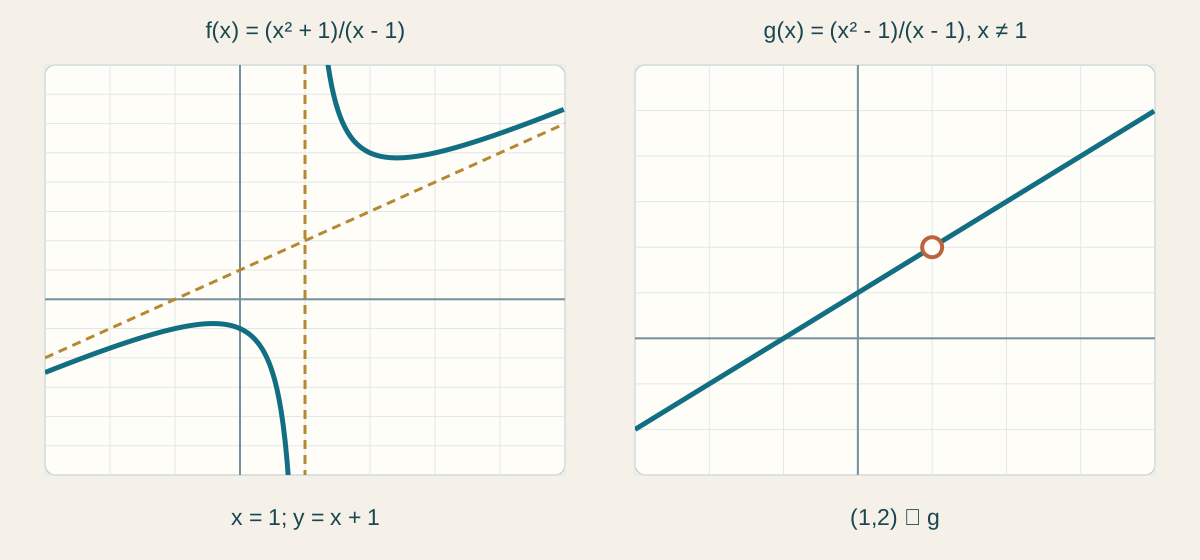
Simplifying must not erase exclusions: (x² - 1)/(x - 1) = x + 1 holds only for x ≠ 1. The missing point stays missing.
Symmetry and periodicity: less work without lost information
To be even or odd, the domain must be symmetric about zero. If f(-x) = f(x), f is even and its graph is symmetric about the y-axis. If f(-x) = -f(x), it is odd and symmetric about the origin.
x² is even; x³ - 3x is odd. (x - 1)² - 4 is neither, but has symmetry axis x = 1. These are different notions.
A positive T is a period when the domain is compatible with translation and f(x + T) = f(x). For sine, T = 2π: study one period and repeat it. Similar-looking values at a few points do not prove periodicity.
Intercepts and signs: where does the graph go?
Find zeros by solving f(x) = 0 and keeping only solutions in D. The y-intercept is (0,f(0)), only when 0 belongs to the domain.
The sign asks where f(x) > 0 or f(x) < 0. Zeros and excluded points split the real line into intervals. Factor where useful and make a sign chart.
For f(x) = (x - 2)/(x + 1), D = ℝ ∖ {-1}, x = 2 is a zero and f(0) = -2. The sign is positive for x < -1 and x > 2, negative for -1 < x < 2. A factor of even multiplicity does not change sign across its zero: x² is not negative for negative x.
Limits: what happens as we approach?
A limit describes f(x) as x approaches a location, not necessarily the value at that location. lim f(x) = L means we can make f(x) as close to L as required by taking x sufficiently close, within the domain and different from the location itself.
Study interval boundaries and, for an unbounded domain, x → +∞ and x → -∞. Left-hand limits use smaller x values; right-hand limits use larger ones. An ordinary two-sided limit requires both sides of the domain and the same result.
For 1/x, lim(x→0⁻) 1/x = -∞ and lim(x→0⁺) 1/x = +∞: there is no single two-sided limit. For ln(x) at zero, only the right-hand limit is relevant because x > 0.
0/0 and ∞/∞ are indeterminate forms, not answers. Further transformations are needed. Also, +∞ is not a number to substitute into an expression.
Continuity, holes and joins
f is continuous at an interior domain point x₀ when the finite limit exists and equals its value: lim(x→x₀) f(x) = f(x₀). At included endpoints, use the available one-sided limit.
For (x² - 1)/(x - 1), the limit at 1 is 2 but f(1) is undefined. There is a hole at (1,2). Assigning f(1) = 2 creates a continuous extension: a function with a different domain.
For piecewise functions, compare the limits of the two branches and the assigned value. Different finite one-sided limits produce a jump. Continuity does not guarantee differentiability: |x| is continuous at zero but has a corner.
Vertical, horizontal and slant asymptotes
Vertical: x = c is a vertical asymptote if at least one one-sided limit at c is +∞ or -∞. A zero denominator alone is insufficient: there may be a hole.
Horizontal: y = L when lim(x→+∞) f(x) = L or lim(x→-∞) f(x) = L, with finite L. Study each direction separately; they may give different lines.
Slant: y = mx + q, with finite non-zero m, when lim [f(x) - (mx + q)] = 0 in the direction considered. Calculate m = lim f(x)/x and then q = lim [f(x) - mx], checking that both are finite.
A graph can cross a horizontal or slant asymptote. It describes distance at infinity, not an uncrossable wall.
For rational functions, degrees help: lower numerator degree gives y = 0; equal degrees give the ratio of leading coefficients; degree difference one suggests polynomial division and a slant asymptote. Finite exclusions still need separate study.
First derivative: the meaning of slope
The derivative at x₀ is f′(x₀) = lim(h→0) [f(x₀+h)-f(x₀)]/h, when this limit exists and is finite. It measures tangent slope, not graph height.
Basic rules: (xⁿ)′ = nx^(n-1), (uv)′ = u′v + uv′, (u/v)′ = (u′v - uv′)/v², (g(u))′ = g′(u)u′. Also, (sin x)′ = cos x, (eˣ)′ = eˣ and (ln x)′ = 1/x on their respective domains.
For f(x) = (x - 1)² - 4, f′(x) = 2(x - 1): the tangent slopes down left of 1 and up right of 1. f and f′ are different functions; f′(x) > 0 does not mean f(x) > 0.
Increasing, decreasing, maxima and minima
On a differentiability interval, positive f′ implies increase and negative f′ decrease. Domain boundaries and locations where the derivative fails split the problem into intervals: do not cross a hole as though it were absent.
To find extrema, consider f′(x) = 0, non-differentiable domain points and included domain endpoints. A change from positive to negative f′ gives a local maximum; negative to positive gives a local minimum.
f′ = 0 alone is insufficient: x³ has zero derivative at zero but keeps increasing. |x| has a minimum at zero without a derivative. √(x+2) has an absolute minimum at endpoint x = -2, where the interior stationary-point condition does not apply.
A local maximum compares nearby values; an absolute maximum compares the whole domain. Global questions also require checking boundaries and limits.
Second derivative and inflections: look for a change
f″ describes how slope varies. On an interval, f″ > 0 indicates convexity or upward concavity; f″ < 0 indicates downward concavity. Terminology varies, so we always include the upward/downward description.
An inflection requires a genuine change of concavity at a point on the graph. Points with zero or undefined f″ are candidates to check, not automatic answers. For x⁴, f″ = 12x² vanishes at zero but is positive on both sides: no inflection. For x³, f″ = 6x changes sign: an inflection occurs at zero.
A sign change across an excluded point is not an inflection: there is no graph point there. An inflection need not have a horizontal tangent; vertical-tangent inflections can also occur.
Worked study: f(x) = x³ - 3x
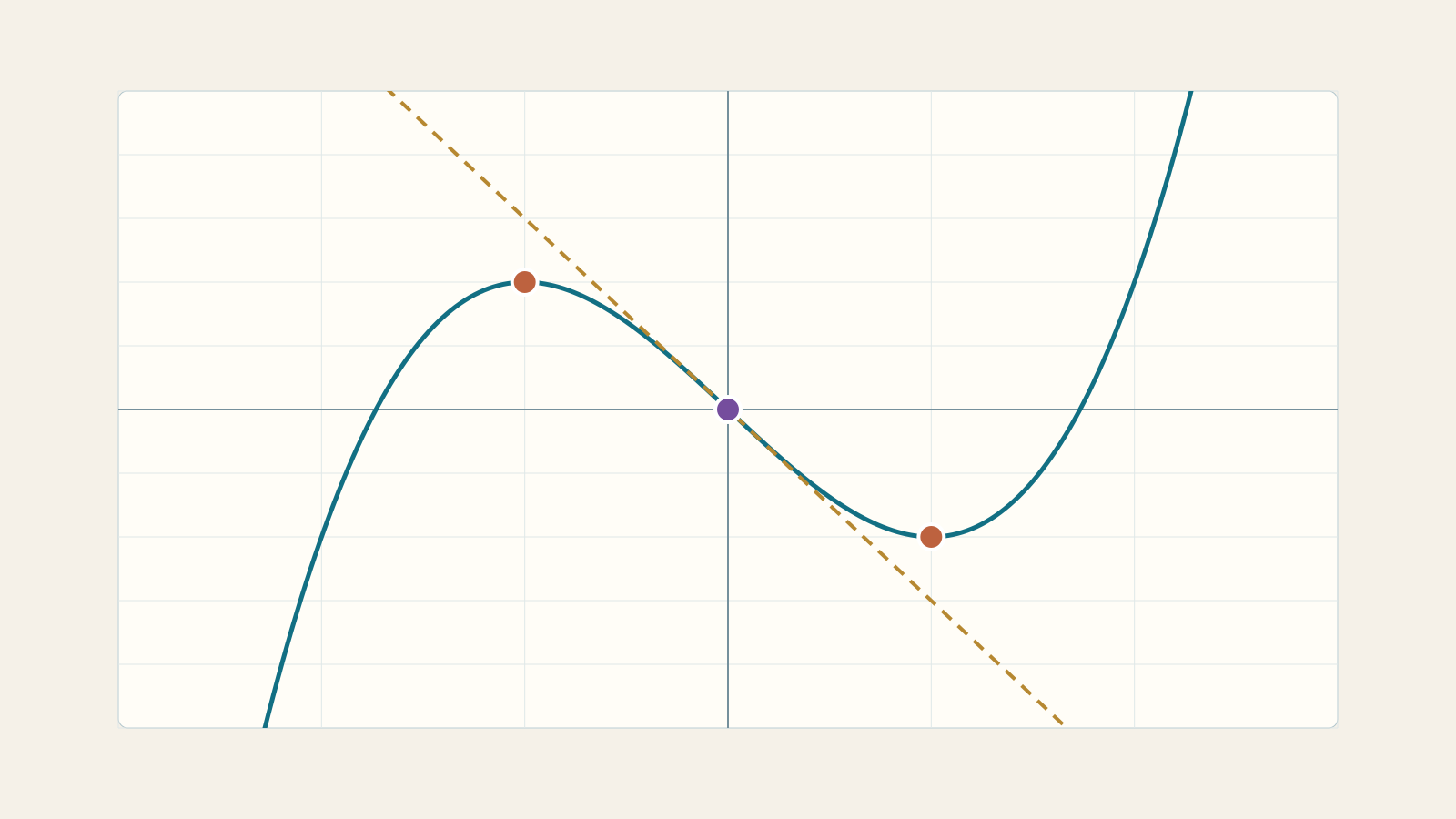
Domain ℝ; odd function. Zeros satisfy x(x² - 3) = 0, so they are -√3, 0, √3. Signs: negative on (-∞,-√3), positive on (-√3,0), negative on (0,√3), positive on (√3,+∞). The left end tends to -∞ and the right to +∞; there are no straight-line asymptotes.
f′ = 3x² - 3 = 3(x-1)(x+1) is positive for |x| > 1 and negative for |x| < 1. At x = -1 it changes + to -: local maximum (-1,2). At x = 1 it changes - to +: local minimum (1,-2).
f″ = 6x: downward concavity for x < 0, upward for x > 0. The inflection is (0,0), with slope f′(0) = -3. Its tangent is y = -3x, not horizontal. Combine these facts while respecting origin symmetry.
Worked study: f(x) = (x² + 1)/(x - 1)
The domain is ℝ ∖ {1}. The numerator is always positive, so there are no zeros; f(0) = -1. f is negative for x < 1 and positive for x > 1.
Division gives f(x) = x + 1 + 2/(x - 1). The left-hand limit at 1 is -∞ and the right-hand limit +∞: vertical asymptote x = 1. Since 2/(x - 1) → 0 as x → ±∞, the slant asymptote is y = x + 1.
f′ = 1 - 2/(x - 1)². Setting it to zero gives (x - 1)² = 2, hence x = 1 ± √2. f′ is positive on (-∞,1-√2) and (1+√2,+∞), negative on (1-√2,1) and (1,1+√2). Local extrema are maximum (1-√2, 2-2√2) and minimum (1+√2, 2+2√2).
f″ = 4/(x - 1)³: concavity is down left of 1 and up right of it. No inflection at x = 1: it is outside the domain. Keep the two graph branches separate.
Other examples that separate the concepts
ln(x): domain x > 0, zero 1, right-sided vertical asymptote x = 0, increasing and concave down.√(x+2): domain [-2,+∞), initial point (-2,0), endpoint minimum and right-sided vertical tangent.exp(-x²): always positive, maximum (0,1), horizontal asymptote y = 0 in both directions, inflections atx = ±1/√2.sin(x): no limit at ±∞, period 2π; zeros and characteristic points repeat.|x|: a minimum and corner at zero; convex even though f″ is zero on the straight pieces and undefined at zero.
Function study: interactive graph laboratory
From results to a drawing and tangent
Start with axes and excluded points, then add zeros, the y-intercept and asymptotes. Mark extrema and inflections; draw branches respecting signs, monotonicity and concavity. Only then add more check points. Never connect branches across an excluded value.
If f is differentiable at x₀, the tangent is y = f(x₀) + f′(x₀)(x - x₀). Height is f(x₀), slope is f′(x₀). This finite-slope formula does not describe a vertical tangent.
Changing the window can greatly change the visual impression. An apparently flat curve may continue to grow, and two nearby points may look like one.
Using the laboratory
Choose one of twelve guided examples or enter a function. Polynomials, fractions, roots, exponentials, logarithms, trigonometric functions and absolute value are available. Trigonometric arguments use radians; log and ln mean natural logarithm, log10 base 10. Write cbrt(x) for cube roots.
Eight stages pair graph and explanation. Toggle f, f′, f″, zeros, extrema, inflections, asymptotes and tangent. Zoom, drag the plane and click an x-coordinate to inspect values. A sample table provides data without interacting with the drawing.
For a(x-h)²+k, vary the three parameters: a controls opening and direction, h horizontal position, k vertical position. At a = 0 the function is constant, not a parabola. The guided example updates this distinction too.
What the laboratory proves, and what it does not
Guided examples have prepared analytical properties and exact formulas; screen coordinates are numerical representations. In free entry, domain conditions preserve the original expression’s restrictions and derivatives use symbolic rules. An unevaluable derivative formula does not by itself prove non-differentiability: a simplification or separate analysis may be needed.
Free-entry zeros, extrema, inflections, signs and asymptote candidates are numerical searches inside the chosen window. They can miss touching zeros, closely spaced details and rapid oscillations. Large-x samples or near-boundary samples do not prove limits. Failed evaluation may indicate either an out-of-domain value or a number too large or small for calculation.
Variable-exponent powers mean u^v = exp(v ln u), requiring u > 0. Length, complexity and window bounds keep the device responsive. This is not a complete automated theorem prover and does not replace the reasoning in the article.
Exercises: try before opening the solution
1. x^2-4
Find the domain, zeros and extremum.
Show the explained solution
D = ℝ. Zeros ±2. f′ = 2x is negative left of zero and positive right of it: absolute minimum (0,-4). f″ = 2 gives upward concavity and no inflection.
2. (x^2-4)/(x-2)
Is x = 2 a vertical asymptote?
Show the explained solution
No. D = ℝ ∖ {2}; f(x) = x + 2 only for x ≠ 2. The limit at 2 is 4: hole (2,4). The only zero is -2, not +2.
3. x^3
Does the zero derivative at zero indicate an extremum?
Show the explained solution
No. f′ = 3x² is positive on both sides. f″ = 6x changes sign: stationary inflection (0,0), tangent y = 0.
4. x^4
f″(0) = 0: is there an inflection?
Show the explained solution
No. f″ = 12x² is positive on both sides. There is an absolute minimum at (0,0).
5. ln(x-1)
Find domain, zero and vertical asymptote.
Show the explained solution
D = (1,+∞). ln(x-1)=0 means x-1=1, so x=2. The limit as x→1⁺ is -∞: asymptote x=1. f′=1/(x-1)>0.
6. sqrt(4-x^2)
Study the domain and compare interior points with endpoints.
Show the explained solution
D = [-2,2], zeros ±2. Inside, f′=-x/√(4-x²): increasing up to 0 and decreasing afterwards. Absolute maximum (0,2), absolute endpoint minima (±2,0). f″=-4/(4-x²)^(3/2)<0: no inflection.
7. x+1/x
Find asymptotes and local extrema.
Show the explained solution
D = ℝ ∖ {0}; asymptotes x=0 and y=x. f′=1-1/x²: local maximum (-1,-2), local minimum (1,2). Neither is absolute on the full domain.
8. exp(x)
In which direction is y = 0 an asymptote?
Show the explained solution
Only as x→-∞. As x→+∞ the function diverges to +∞. It is positive, increasing and convex, without zeros or extrema.