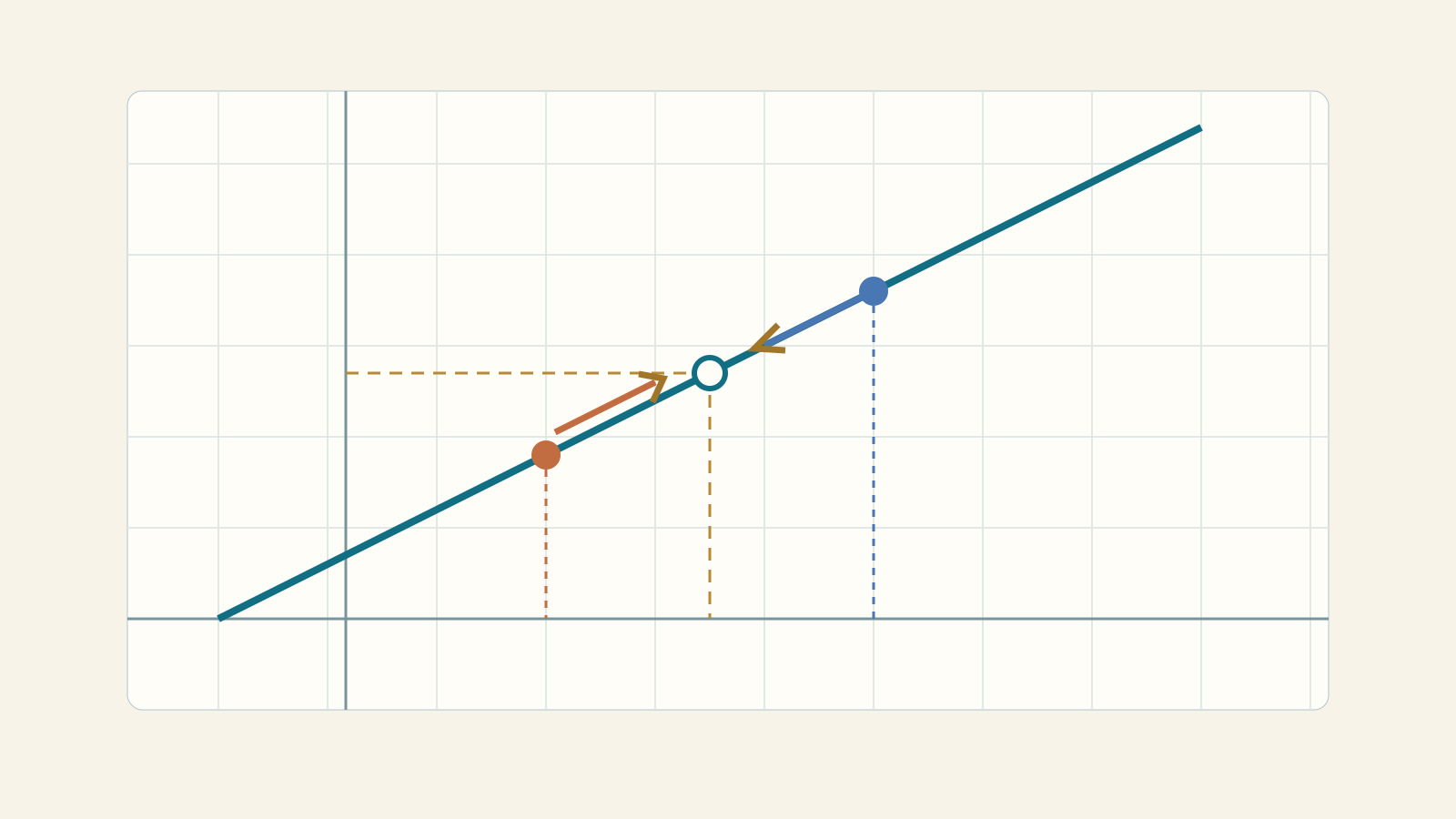
A limit answers this question: what behaviour does f(x) approach as x gets close to a point, or moves away without bound? It does not merely ask for the value at the point. We start with this distinction, then learn to calculate and justify our answers.
The idea first: approaching is not the same as arriving
Consider f(x)=2x+1 near x=2. From the left: x=1.9 → f(x)=4.8; x=1.99 → 4.98. From the right: x=2.1 → 5.2; x=2.01 → 5.02. The inputs approach 2 and the outputs approach 5.
lim(x→2) (2x+1)=5
The limit is not the last entry in a table: there is no «last number before 2». It describes what happens when we can get as close as we wish.
Reading limit notation
In lim(x→a) f(x)=L, a is the point approached by the input; L is the value approached by the output. These are different quantities and need not coincide. x→a⁻ means approaching with x<a; x→a⁺ means x>a.
The symbol ∞ is not a number to substitute. x→+∞ means x becomes arbitrarily large; x→-∞ means x becomes negative with arbitrarily large absolute value. In contrast, f(x)→+∞ concerns the outputs, not the inputs.
The limit and the value f(a) are different things
For f(x)=(x²-1)/(x-1), x=1 is excluded. For x≠1 we can factor and cancel: f(x)=(x-1)(x+1)/(x-1)=x+1. Therefore the limit at 1 is 2 even though f(1) is undefined.
If we define g by assigning g(1)=5 and keeping g(x)=x+1 for x≠1, the limit remains 2: changing just the point does not change nearby values. In the laboratory compare «Hole» and «Different assigned value»: an open circle and a filled point convey different information.
One-sided limits must tell the same story
When the domain permits approaching from both sides, the finite two-sided limit L exists if and only if the left-hand and right-hand limits both exist and equal L. An analogous comparison applies to a single infinite limit with the same sign.
For f(x)=-1 if x<0; f(x)=1 if x≥0, the left-hand limit at zero is -1 and the right-hand limit is 1. The two-sided limit does not exist even though f(0)=1. For 1/x at zero, the limits are -∞ on the left and +∞ on the right: we cannot simply call the result «infinity».
For 1/x², both sides approach +∞. We say the limit is +∞, distinguishing it from a finite limit.
Check the domain before approaching
Approach only through allowed inputs. The domain of √x is [0,+∞): at zero we study the right-hand limit, which is 0. We do not invent real square-root values for negative x. The domain of ln x is (0,+∞), and its right-hand limit at zero is -∞.
The point a must be an accumulation point of the domain: allowed inputs distinct from a must exist arbitrarily close to it. Exclusions remain valid after algebraic simplification. If only one side is available, state that side rather than assigning an approach to the other.
When substitution works: continuity
At an interior domain point, f is continuous at a when f(a) is defined and lim(x→a) f(x)=f(a). At included endpoints use the available side. Polynomials, exponentials and elementary trigonometric functions are continuous on their respective domains; sums, products and compositions preserve continuity where defined.
For lim(x→2)(x²+1), substitution gives 5. In a quotient we can substitute if the denominator is not zero at the point. Substitution follows from continuity; it is not a rule to apply without checking.
Calculation laws and their conditions
If f→L and g→M with finite L and M, then f+g→L+M, cf→cL and fg→LM. The quotient rule f/g→L/M requires M≠0. For roots and compositions check the domain and continuity of the outer function.
A denominator approaching zero does not by itself imply an infinite limit: the numerator may also vanish, the sign may change, or the behaviour may oscillate. Rules involving infinite quantities also require conditions; ∞-∞ is not ordinary subtraction.
Indeterminate forms are not answers
The main forms are 0/0, ∞/∞, ∞-∞, 0·∞, 1^∞, 0^0 and ∞^0. They describe the behaviour of the parts but do not determine the final result.
Near zero, x/x→1, x²/x→0, and x/x²=1/x has different one-sided limits: all begin with 0/0. An indeterminate form is a reason to transform the expression, not automatically to assign 0 or 1.
The power notations here denote limit forms, not assigned numerical values for 0⁰ or 1^∞.
First method: factor and cancel
Calculate lim(x→2)(x²-4)/(x-2). Substitution gives 0/0. Factor the numerator: x²-4=(x-2)(x+2). For x≠2 the quotient equals x+2, so the limit is 4.
We have not defined the original function at 2: we replaced it with an equal expression at nearby points other than 2, which suffice for the limit. Cancel common factors, not terms: you cannot cancel x in (x+1)/x.
Second method: use the conjugate
For lim(x→0)(√(1+x)-1)/x, substitution gives 0/0. Multiply the numerator and denominator by √(1+x)+1:
(√(1+x)-1)/x = [(1+x)-1]/[x(√(1+x)+1)] = 1/[√(1+x)+1], for x≠0 in the domain. Now substitute: limit 1/2.
The same idea handles √(x²+x)-x as x→+∞. Rationalising gives x/[√(x²+x)+x]=1/[√(1+1/x)+1]→1/2. This step uses x>0: for negative x remember √(x²)=|x|.
Limits at infinity and dominant terms
For (2x²+1)/(x²+3), divide every term by x²: (2+1/x²)/(1+3/x²)→2, both at +∞ and -∞. The line y=2 is a horizontal asymptote in both directions.
For polynomial quotients: lower numerator degree → limit 0; equal degrees → ratio of leading coefficients; higher numerator degree → examine the dominant power and its sign separately in each direction. For instance, x³/x²=x tends to +∞ on the right and -∞ on the left.
Exponentials and logarithms need their own comparisons: as x→+∞, for a>0 and b>1, ln x / x^a→0 and x^a / b^x→0. Do not compare «degrees» of non-polynomial functions.
Standard limits: recognise the structure
With angles in radians, lim(x→0) sin x / x=1. From 1-cos x=2 sin²(x/2), we obtain (1-cos x)/x²=(1/2)[sin(x/2)/(x/2)]²→1/2.
Other fundamental limits at x→0 are ln(1+x)/x→1, (e^x-1)/x→1 and (1+x)^(1/x)→e, within their domains. For fixed real α, [(1+x)^α-1]/x→α, with positive base near zero.
Example: sin(3x)/x=3·sin(3x)/(3x)→3. Similarly, pull out a factor of 3 in ln(1+3x)/x to obtain 3. Seeing a sine or logarithm is not enough: arguments, denominators and factors must match.
Comparison, oscillation and non-existent limits
Since |sin(1/x)|≤1, we have |x sin(1/x)|≤|x|. The bounds -|x| and |x| both tend to 0, so the squeeze theorem gives x sin(1/x)→0 despite the oscillation.
In contrast, sin(1/x) has no limit at zero. The positive sequences x_n=1/(π/2+2πn) and z_n=1/(3π/2+2πn) both approach 0, but their function values are always 1 and -1 respectively. Even the right-hand limit fails to exist; an analogous contradiction holds on the left.
This is a mathematical justification, stronger than a curve that merely looks restless. The laboratory also displays samples of these two sequences.
Why a table can mislead
A table has finitely many entries; a limit concerns all sufficiently nearby points. Poorly chosen samples may hide oscillation, holes or narrow features. Graphs also have finite resolution.
Computers round numbers too. In (1-cos x)/x², for very small x, cos x may round to 1 and the subtraction loses information. The equivalent expression 2[sin(x/2)/x]² is more stable. The guided example uses it; free input evaluates the expression as written and may reveal the problem. For an exponential at large negative inputs, a numerical 0 can be rounding rather than an exact zero.
The precise meaning: ε first, then δ
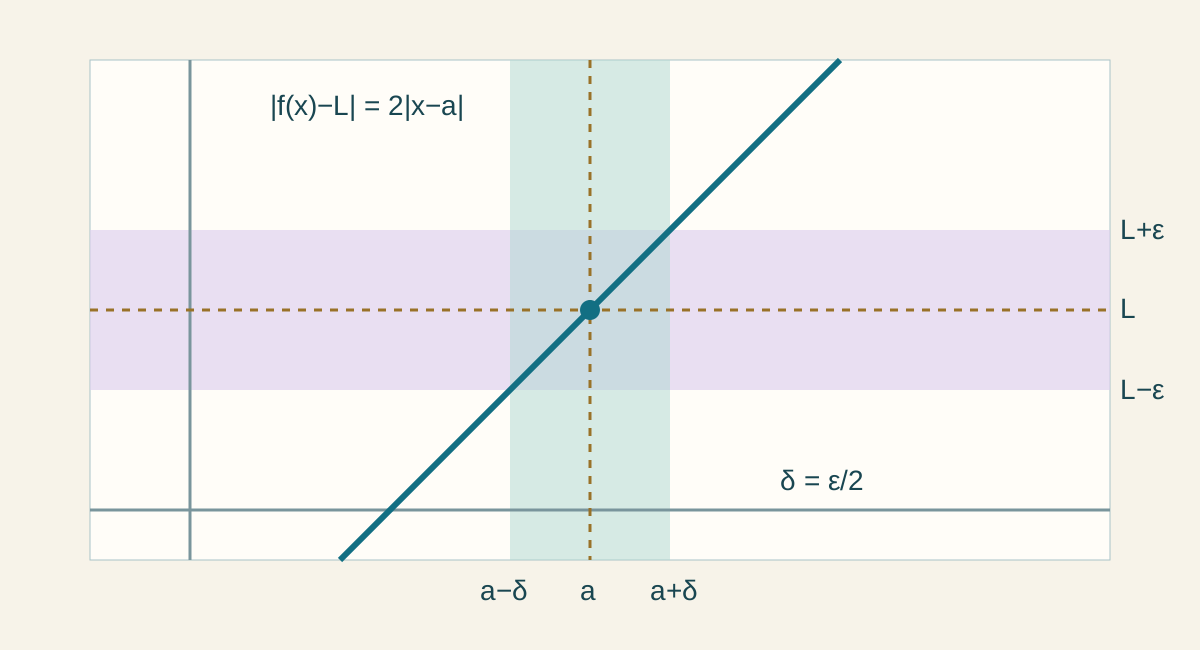
Writing lim(x→a) f(x)=L means: for every required output accuracy ε>0, we can find δ>0 such that, for every domain input with 0<|x-a|<δ, we have |f(x)-L|<ε.
The choice of δ may depend on ε, not on the individual x being checked. The condition 0<|x-a| excludes a itself. For f(x)=2x+1, a=2 and L=5, |f(x)-5|=2|x-2|. Choosing δ=ε/2 suffices. If ε=0.1, take δ=0.05.
The laboratory’s ε band visualises the requirement; testing a single sample against it is not a proof. In the linear example, the identity above guarantees every point in the interval.
A reasoned procedure without immediately using derivatives
- Identify the point or direction at infinity and the available domain.
- Separate the sides and check signs when necessary.
- Try substitution only when justified.
- Recognise any indeterminate form.
- Choose a transformation: factoring, conjugate, dominant term, standard limit or comparison.
- State the value, side and conditions; compare one-sided limits.
- Use the graph and table as checks, not as the only justification.
L’Hôpital’s rule uses derivatives and has precise assumptions; it is unnecessary for these first examples. We will return to it in the derivatives pathway.
Explore, then connect to function analysis
Choose one of sixteen guided cases and move the slider: near a finite point, x=a-h and x=a+h with decreasing h; at infinity, |x| grows. Start the animation, pause, and compare inputs, outputs and f(a). Infinity examples use a logarithmic scale for |x|, explicitly labelled on the axis.
Enable close-up zoom and change ε to display a band around the known finite limit. In free exploration, an optional L is only your hypothesis: the laboratory does not automatically certify a limit. Every guided case provides an analytic explanation alongside the samples.
Limits help analyse continuity, holes, asymptotes and domain boundaries in a function study. The derivative will itself arise from a limit: the difference quotient.
Function analysis: the complete pathway · Open the function-analysis laboratory
Twelve exercises: try before opening the solution
1. x^2+1
Calculate the limit as x→2 and explain why substitution is allowed.
Show the explained solution
This is a polynomial, continuous on ℝ: the limit is 2²+1=5 and equals f(2).
2. (x^2-4)/(x-2)
Calculate the limit as x→2 without filling the excluded point.
Show the explained solution
For x≠2 the quotient equals x+2, so the limit is 4. The original function remains undefined at 2.
3. (sqrt(1+x)-1)/x
Resolve the 0/0 form at zero.
Show the explained solution
Use the conjugate: for x≠0 the expression equals 1/(√(1+x)+1), which tends to 1/2.
4. abs(x)/x
Compare the one-sided limits at zero.
Show the explained solution
For x<0 the value is -1; for x>0 it is 1. Different one-sided limits mean the two-sided limit does not exist.
5. 1/(x-2)^2
What happens on the two sides of 2?
Show the explained solution
The denominator is positive and tends to 0 on both sides; the numerator is 1. Both one-sided limits and the two-sided limit are +∞. x=2 is a vertical asymptote.
6. (3*x^2-x)/(2*x^2+1)
Calculate the limit as x→+∞.
Show the explained solution
Divide by x²: (3-1/x)/(2+1/x²)→3/2. Do not substitute ∞ as though it were a number.
7. (1-cos(2*x))/x^2
Use a standard limit at zero.
Show the explained solution
1-cos(2x)=2sin²x. The quotient is 2(sin x/x)² and tends to 2. Numerically, the original expression may lose precision.
8. ln(1+3*x)/x
Recognise the structure at zero.
Show the explained solution
Write 3·ln(1+3x)/(3x). The second factor tends to 1, so the limit is 3; near zero the domain requires 1+3x>0.
9. x*sin(1/x)
Justify the limit despite oscillation.
Show the explained solution
|x sin(1/x)|≤|x|→0. Comparison proves the limit is 0; merely saying the oscillation looks small is insufficient.
10. sin(1/x)
Why are table samples insufficient here?
Show the explained solution
The positive sequences x_n=1/(π/2+2πn) and z_n=1/(3π/2+2πn) approach zero but give 1 and -1. The right-hand limit fails to exist, so the two-sided limit also fails.
11. 3*x-2
Prove the limit 1 as x→1 by choosing δ in terms of ε.
Show the explained solution
|3x-2-1|=3|x-1|. For every ε>0 choose δ=ε/3: 0<|x-1|<δ implies |f(x)-1|<ε.
12. sqrt(x^2+4*x)-x
Resolve ∞-∞ as x→+∞.
Show the explained solution
Rationalise: 4x/(√(x²+4x)+x)=4/(√(1+4/x)+1), for x>0. The limit is 2.