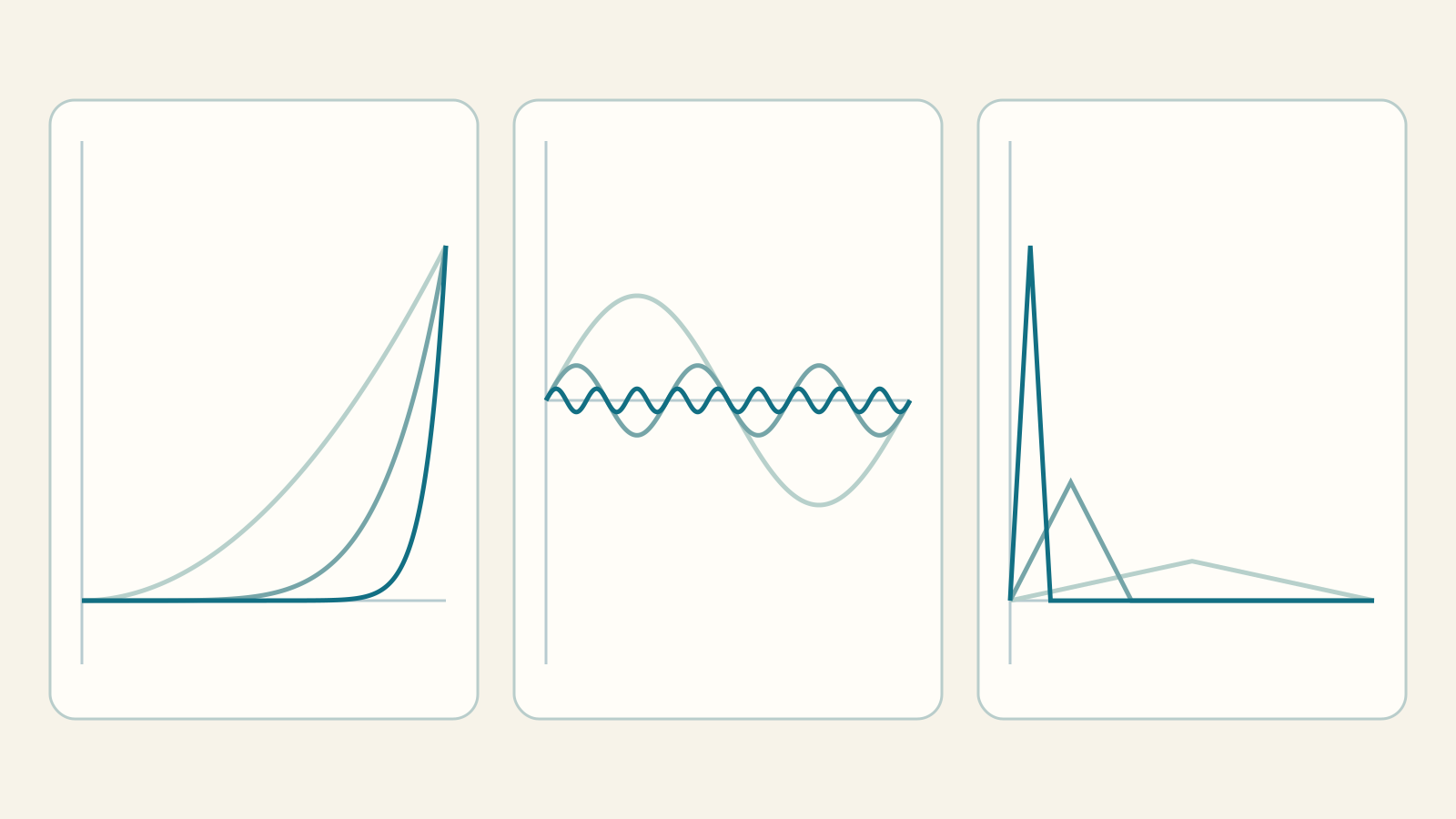
A sequence may consist of whole functions rather than numbers. Increasing n changes an entire graph: what does approaching a limit mean? Separately at every point, or simultaneously throughout the domain? The distinction determines which properties survive and when termwise integration or differentiation is justified. We use explicit formulas, successful examples and counterexamples explaining the assumptions. Numerical sequences, series, continuity, integrals and derivatives are useful prerequisites.
Lab: sequences and series of functions · Learning-path index
1. A sequence of graphs, not just numbers
f₁,f₂,…,fₙ,…; fₙ:D→ℝ
fₙ(x)=xⁿ
u₀(x),u₁(x),…; Sₙ(x)=Σₖ₌₀ⁿuₖ(x)
Variable x selects a location on a graph; index n selects the function. Fix x to obtain a numerical sequence. Fix n to obtain a function. For a function series we study partial sums Sₙ: checking only that the term uₙ becomes small is insufficient.
Geometric and exponential sums here start at k=0, so Sₙ has n+1 terms. The alternating harmonic series starts at k=1 and its partial sum has n terms. State the indexing before computing a remainder.
2. Pointwise and uniform: the order changes
∀x∈D ∀ε>0 ∃N=N(ε,x) ∀n≥N: |fₙ(x)−f(x)|<ε
∀ε>0 ∃N=N(ε) ∀n≥N ∀x∈D: |fₙ(x)−f(x)|<ε
Eₙ=supₓ∈D|fₙ(x)−f(x)|
Eₙ→0
For pointwise convergence every x may require its own N. For uniform convergence, after fixing ε one N must work for all points and all later indices. Eₙ measures worst error over the whole domain: it may be an attained maximum, an unattained supremum or +∞. A maximum over finitely many samples is only a lower bound for Eₙ.
Uniform convergence implies pointwise convergence, not conversely. To disprove uniformity, find ε₀>0 and, for arbitrarily large indices, points xₙ with error at least ε₀. These points may depend on n, which is why monitoring a fixed point is insufficient.
3. xⁿ: changing the domain changes the answer
D=[0,1]; fₙ(x)=xⁿ
f(x)=0 (0≤x<1); f(1)=1
Eₙ=1; xₙ=2^(−1/n)<1 ⇒ |fₙ(xₙ)−f(xₙ)|=1/2
For every x<1 the power tends to zero, while at x=1 it stays 1. The limit is discontinuous although every fₙ is continuous. Error is zero at x=1 but approaches 1 from the left: Eₙ=1 is unattained, not the error at the endpoint. The points xₙ directly disprove uniformity.
D=[0,r], 0<r<1; f=0
Eₙ=rⁿ→0
r=1/2, ε=0.01: n≥7 ⇒ Eₙ≤1/128<0.01
Removing a fixed neighborhood of 1 changes the conclusion: the worst error is at r and tends to zero. On [0,1) the limit is also 0, but convergence is not uniform because xₙ still lie in the domain. A continuous limit alone does not prove uniformity.
4. A spike disappearing pointwise, not in its integral
fₙ(x)=2n max(0,1−|2nx−1|), x∈[0,1]
fₙ(0)=0; x≥1/n ⇒ fₙ(x)=0
max fₙ=fₙ(1/(2n))=2n
∫₀¹fₙ(x)dx=(1/2)(1/n)(2n)=1
For fixed x>0, choosing n>1/x moves the spike entirely left of x, so fₙ(x)=0. Thus fₙ→0 pointwise, but Eₙ=2n grows and integrals stay 1 instead of approaching the limit integral 0. Each function is continuous: the issue is lack of uniform control, not discontinuous terms.
On 21 equally spaced nodes in [0,1], for n>20 every sample is zero: none lies inside the support [0,1/n]. The lab inserts the exact peak so this misleading grid zero is not mistaken for disappearance of the spike.
5. A uniform limit preserves continuity
If every fₙ is continuous on D and converges uniformly to f, then f is continuous on D; compactness is not required. Fix x₀ and ε, first choose m with uniform error <ε/3. Now m is fixed: use continuity of fₘ to choose δ making |fₘ(x)−fₘ(x₀)|<ε/3.
|f(x)−f(x₀)|≤|f(x)−fₘ(x)|+|fₘ(x)−fₘ(x₀)|+|fₘ(x₀)−f(x₀)|<ε
Do not confuse uniform convergence with uniform continuity. The first concerns a family as n varies; the second concerns one function and nearby input pairs. The constant sequence fₙ(x)=x² on ℝ converges uniformly with zero error, but its limit is not uniformly continuous. If each fₙ is uniformly continuous and convergence is uniform, then f is too: use a δ independent of x₀ in the same three-term argument.
6. When limits and integrals may be interchanged
On a closed bounded interval [a,b], if fₙ are Riemann integrable and converge uniformly to f, then f is integrable and their integrals converge. The key estimate is:
|∫ₐᵇfₙ−∫ₐᵇf|≤∫ₐᵇ|fₙ−f|≤(b−a)Eₙ→0
Why is f integrable? Fix an index with small Eₙ and a partition with a small upper-minus-lower sum for fₙ. For f this gap increases by at most 2(b−a)Eₙ. Making both contributions small proves integrability. If fₙ are continuous, integrability also follows from continuity of the uniform limit.
Uniformity is sufficient, not necessary: xⁿ on [0,1] has integrals 1/(n+1)→0, matching the limit integral despite nonuniform convergence. Section 4’s spike shows a failed interchange. On unbounded intervals even uniformity alone is insufficient, as the following broad low triangle shows.
gₙ(x)=max(0,1−|x|/n)/n, x∈ℝ
supℝ|gₙ|=1/n→0; ∫ℝgₙ=(1/2)(2n)(1/n)=1
7. Differentiation needs stronger assumptions
fₙ(x)=sin(nx)/n; D=ℝ; supℝ|fₙ|=1/n→0
fₙ′(x)=cos(nx); f′(x)=0
fₙ′(0)=1; fₙ′(π)=(−1)ⁿ
Small amplitude does not control slopes: derivatives at zero stay 1 while the limit’s derivative is 0; at π the derivative sequence does not converge. Uniform convergence of functions alone does not justify differentiation under the limit.
A practical theorem: let fₙ∈C¹([a,b]), fₙ′→g uniformly and fₙ(x₀)→ℓ at some x₀∈[a,b]. Then fₙ converges uniformly to f∈C¹ and f′=g. Indeed g is continuous as a uniform limit of continuous functions, and f can be defined by an integral:
f(x)=ℓ+∫ₓ₀ˣg(t)dt
fₙ(x)=fₙ(x₀)+∫ₓ₀ˣfₙ′(t)dt
sup|fₙ−f|≤|fₙ(x₀)−ℓ|+(b−a)sup|fₙ′−g|→0
The point condition fixes constants: fₙ(x)=n has zero derivatives converging uniformly to 0, but the functions do not converge. The theorem gives sufficient assumptions, not a characterization of every possible interchange.
8. Function series and the uniform Cauchy criterion
A series Σuₖ converges pointwise to S when its partial sums converge pointwise; it converges uniformly when sup|Sₙ−S|→0. To test convergence before S is known, use the Cauchy criterion: tails must be small simultaneously for all x.
∀ε>0 ∃N ∀p>q≥N ∀x∈D: |Σₖ₌q+1ᵖuₖ(x)|<ε
Why is it sufficient? For fixed x, partial sums are Cauchy in ℝ and have a limit S(x). Apply the uniform bound with ε/2 and let p tend to infinity: |S−S_q|≤ε/2<ε for every x. Uniform uₖ→0 is necessary since uₖ=Sₖ−Sₖ₋₁, but not sufficient: constant terms uₖ(x)=1/k tend uniformly to zero while the harmonic series diverges.
9. The Weierstrass M-test
|uₖ(x)|≤Mₖ ∀x∈D; Mₖ≥0; ΣMₖ<∞
|Σₖ₌q+1ᵖuₖ(x)|≤Σₖ₌q+1ᵖMₖ
If the numerical majorant series converges, its tails tend to zero independently of x. Cauchy then gives uniform convergence of the function series. Moreover Σ|uₖ(x)| converges at each x, and this absolute-value series also converges uniformly. Majorants must control the entire domain, not just a selected point.
The test is sufficient, not necessary. Failure to find a summable majorant does not prove nonuniformity. Pointwise absolute convergence and uniform convergence are distinct: the geometric series on [0,1) is absolutely convergent at every point but not uniform; the alternating harmonic series constant in x gives the opposite case.
10. Geometric series: exact remainder and domain
Sₙ(x)=1+x+⋯+xⁿ=(1−x^(n+1))/(1−x)
S(x)=1/(1−x); S(x)−Sₙ(x)=x^(n+1)/(1−x)
D=[0,r], r<1 ⇒ Eₙ=r^(n+1)/(1−r)
For fixed r<1 the global remainder tends to zero. With r=1/2 and ε=0.02, n=6 suffices: S₆ contains seven terms and error is 1/64=0.015625. This guarantees the whole interval [0,1/2], not just a probe point. The M-test confirms it with Mₖ=rᵏ.
On [0,1), every x has a finite sum, but for fixed n the remainder is unbounded near 1: Eₙ=+∞. All partial sums are bounded while the sum is not. The lab’s plotting window [0,r] does not change the mathematical domain [0,1).
11. Exponential series: a practical error bound
eˣ=Σₖ₌₀∞xᵏ/k!; Sₙ(x)=Σₖ₌₀ⁿxᵏ/k!; D=[−R,R]
|xᵏ/k!|≤Rᵏ/k!; Mₖ₊₁/Mₖ=R/(k+1)→0
Eₙ=eᴿ−Sₙ(R)=Σₖ₌n+1∞Rᵏ/k!
Eₙ≤Bₙ=eᴿR^(n+1)/(n+1)!→0
The ratio test proves the majorant series converges, so the M-test gives uniform absolute convergence on each fixed [−R,R]. The Eₙ equality follows because absolute remainder is bounded by the positive tail at R, attained at x=R. Bₙ is the Taylor–Lagrange remainder bound: convenient but possibly larger than the actual error.
Σₖ₌₁∞(xᵏ/k!)′=Σₖ₌₁∞x^(k−1)/(k−1)!=Σⱼ₌₀∞xʲ/j!=eˣ
The derivative series is also uniformly convergent on every [−R,R]: reindexing gives the same majorants. Termwise differentiation is therefore justified. To choose N require Bₙ<ε in the region where Bₙ decreases; the lab does not label a sufficient index as necessarily minimal.
12. Uniform does not mean absolute: a simple example
uₖ(x)=(−1)^(k+1)/k, x∈[−1,1]
Sₙ=Σₖ₌₁ⁿ(−1)^(k+1)/k
S=ln 2; |S−Sₙ|≤1/(n+1)
These functions are constant in x, so the issue is entirely numerical. The alternating harmonic remainder tends to zero with the same bound for every x, hence convergence is uniform. The absolute-value series is divergent Σ1/k: convergence is not absolute and the M-test cannot apply.
We can derive sum and remainder without infinite interchanges: integrate the finite geometric sum Σⱼ₌₀ⁿ⁻¹(−x)ʲ=(1−(−x)ⁿ)/(1+x) from 0 to 1. This yields the identity below; its final bound sends the remainder to zero and identifies the sum as ln 2.
ln 2−Sₙ=(−1)ⁿ∫₀¹xⁿ/(1+x)dx
|ln 2−Sₙ|≤∫₀¹xⁿdx=1/(n+1)
13. Locally uniform convergence and Dini’s theorem
Uniform convergence on every compact subset of a domain is weaker than uniform convergence on the whole domain. For xⁿ on [0,1), each compact subset lies in some [0,r] with r<1, so convergence there is uniform, but not globally. Inside a power series radius ρ there is uniform convergence on each closed [a−r,a+r] with r<ρ; not automatically on the full open interval or its endpoints.
Another criterion is Dini’s theorem: on compact K, if continuous fₙ are monotone in n in the same direction for every x and converge pointwise to continuous f, convergence is uniform. Monotonicity concerns index n, not whether each graph increases with x.
Proof idea for decreasing functions: gₙ=fₙ−f≥0 decreases to zero. Open sets {x:gₙ(x)<ε} increase and cover K; compactness gives a finite subcover, and nesting means one set suffices. From that index all errors are <ε. For xⁿ on [0,1], continuity of the limit is missing, so Dini does not apply.
14. Use the lab without being misled by a plot
Choose one of eight cases. Change n while keeping blue point x* fixed to observe pointwise convergence. Then compare Eₙ with the maximum on 21 nodes: only the formula-derived Eₙ describes the whole domain. The red control point is chosen analytically and may move with n. For xⁿ it does not attain supremum 1, but maintains error 1/2.
Powers and spikes allow critical-region zoom, which does not change the domain. For the geometric series on [0,1), r changes only the plotted window. Sine and exponential cases allow derivative overlays, contrasting failed and justified differentiation. The spike integral stays 1, obtained from the area formula, not grid quadrature.
The suggested N is sufficient from the bound, not necessarily minimal. If it exceeds 120, convergence may still be uniform: the bound requires more steps for this tolerance than the slider provides. Formulas justify results; finite animations and rounded values are exploratory tools.
Exercises: try before revealing
1. For fₙ(x)=xⁿ, what results from fixing x=1/2?
Show the explained answer
The numerical sequence 1/2,1/4,1/8,… tends to 0. This checks one point, not the whole domain. Fixing n=2 instead gives the function f₂(x)=x².
2. For xⁿ on [0,1], is Eₙ=1 the error at x=1?
Show the explained answer
No: at x=1 both fₙ and f equal 1, so error is 0. For x<1, error xⁿ approaches 1 as x→1⁻ without attaining it. Eₙ is unattained; xₙ=2^(−1/n) keeps error 1/2.
3. Find N for xⁿ on [0,1/2], ε=0.01.
Show the explained answer
Eₙ=(1/2)ⁿ. Since 1/64=0.015625>0.01 and 1/128=0.0078125<0.01, N=7 works for all n≥7 and every domain point.
4. For the spike at n=30, what does the 21-node grid see?
Show the explained answer
All zeros: support is [0,1/30] but positive nodes start at 1/20. The peak is at 1/60, height 60 and area 1. Sample maximum 0 underestimates E₃₀=60.
5. Why does Dini not give uniformity for xⁿ on [0,1]?
Show the explained answer
The domain is compact, functions continuous and decreasing in n, but the limit is discontinuous at 1. An essential assumption fails. On [0,r] with r<1, limit 0 is continuous and Dini applies.
6. Is uniformity enough to integrate the limit over ℝ?
Show the explained answer
No: gₙ(x)=max(0,1−|x|/n)/n has uniform error 1/n but area 1. The article’s theorem needs a finite interval; there integral error is ≤(b−a)Eₙ.
7. Can we differentiate the limit of sin(nx)/n without more assumptions?
Show the explained answer
No. Functions converge uniformly to 0 with Eₙ=1/n, but fₙ′=cos(nx). At 0 derivatives equal 1 while f′(0)=0; at π they do not even converge.
8. Why is convergence at one point needed in the derivative theorem?
Show the explained answer
Derivatives do not fix constants. For fₙ(x)=n all derivatives are 0 and converge uniformly, but functions diverge everywhere. The condition fₙ(x₀)→ℓ removes drifting constants.
9. Does uniform uₖ→0 suffice for convergence of Σuₖ?
Show the explained answer
No: uₖ(x)=1/k tends uniformly to zero on any domain, but partial sums are those of the divergent harmonic series. Control sum tails, not just individual terms.
10. Find the error of S₆=Σₖ₌₀⁶xᵏ on [0,1/2].
Show the explained answer
There are seven terms. Remainder x⁷/(1−x) increases on this interval: E₆=(1/2)⁷/(1/2)=1/64=0.015625. On [0,1) the same remainder is unbounded.
11. Is the M-test necessary for uniform convergence?
Show the explained answer
No. Constant functions (−1)^(k+1)/k sum uniformly to ln 2 with remainder ≤1/(n+1), but every global majorant is at least 1/k, so no such majorant series converges. Uniform, not absolute.
12. For eˣ on [−1,1], ε=0.01, compare sufficient and minimal indices.
Show the explained answer
Bound Bₙ=e/(n+1)! gives B₄≈0.02265 and B₅≈0.003775, so N=5 suffices. But exact E₄=e−65/24≈0.0099485 is already <0.01, so n=4 works; E₃≈0.051615>0.01 also proves it is minimal. A sufficient bound may be conservative.
Before: uniform continuity and Heine–Cantor · Learning-path index