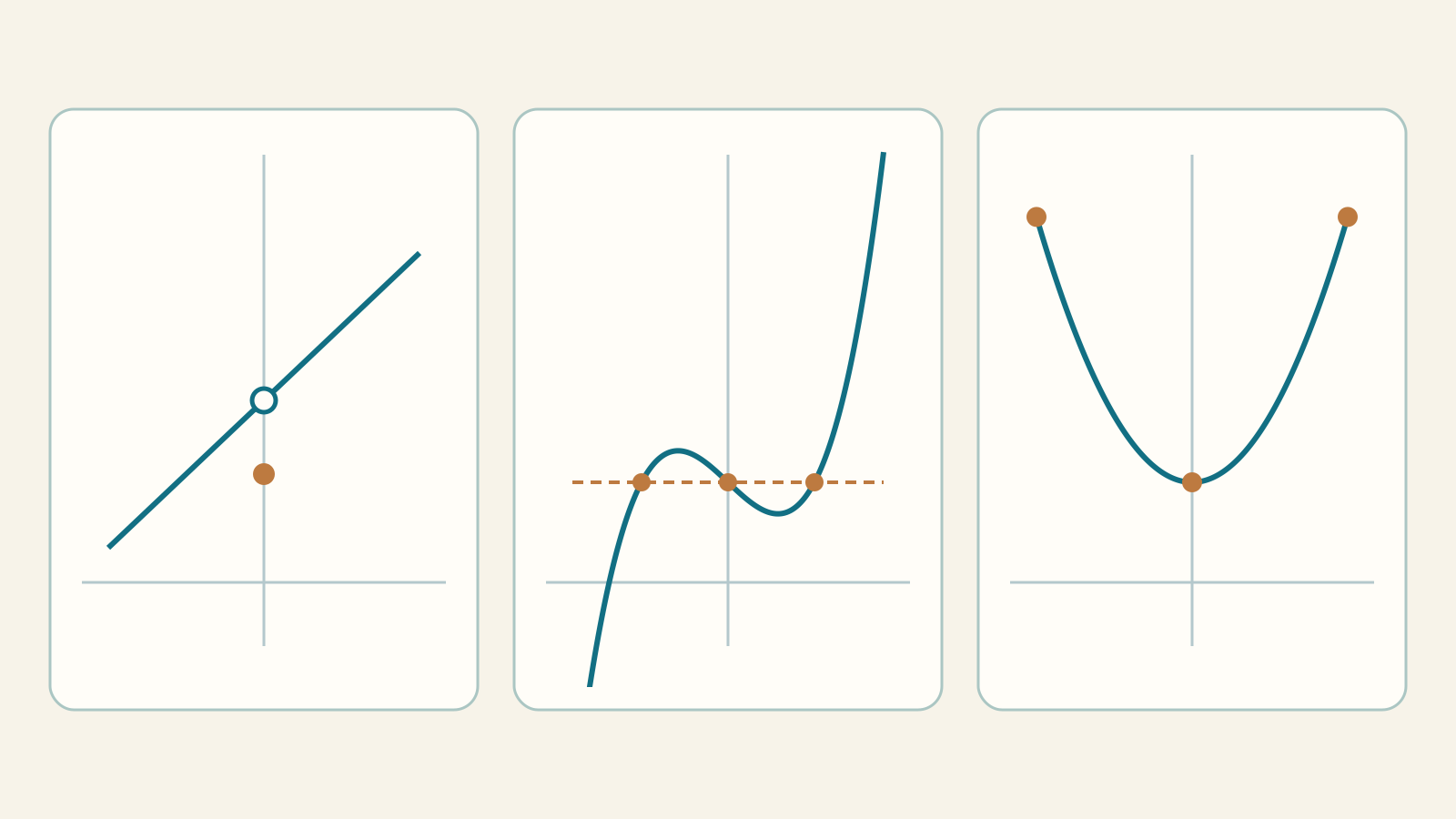
An unbroken curve is a useful first intuition, not a definition. We study what continuity means, which conclusions can be proved and why checking assumptions matters as much as applying a formula.
Continuity and theorems lab · Learning-path index
1. Three checks at a point
For f:D→ℝ and c in its domain, continuity means lim(x→c, x∈D) f(x)=f(c). The value f(c) must be defined, the domain-relative limit must exist and be finite, and these values must agree. At accumulation points these are the three practical checks. An isolated domain point is automatically a point of relative continuity.
For f(x)=x² at c=2, both f(2) and the limit are 4. For f(x)=x+1 when x≠1 and f(1)=0, the limit at 1 is 2 but the value is 0: continuity fails there. Changing only f(1) to 2 removes the discontinuity.
2. What ε and δ require
The precise definition is: for every ε>0 there is δ>0 such that, for every x∈D, |x−c|<δ ⇒ |f(x)−f(c)|<ε. ε is the output tolerance; δ controls the input. δ may depend on ε and c, but not on the individual x chosen afterwards.
For f(x)=2x+1, |f(x)−f(c)|=2|x−c|. Choose δ=ε/2: then 2|x−c|<2δ=ε. For ε=0.1, δ=0.05 suffices. The lab compares bands and gives an explicit counterexample when δ is too large. A sampled graph cannot prove the words “for every”.
3. Domain, endpoints and discontinuities
√x is continuous at 0 relative to [0,+∞): only approach from the right is needed. 1/x is continuous everywhere in ℝ∖{0}; 0 is an excluded singularity, not a discontinuity point lying in its domain, and has no finite continuous extension.
- Removable: a finite limit with a missing or different value. Assigning the limit extends a function that was undefined at c.
- Jump: different finite one-sided limits, such as −1 to the left of 0 and 1 from 0 onwards.
- Infinite: at least one infinite one-sided limit, as for 1/x at 0.
- Oscillating: sin(1/x) has no limit at 0. Assigning f(0) cannot restore continuity.
“Drawing without lifting the pen” does not handle all domains correctly: use the definition.
4. Joining two formulas
Let f(x)=x+1 for x<0 and f(x)=mx+h for x≥0. At 0 the left limit is 1, the right limit is h and f(0)=h. Thus f is continuous at 0 ⇔ h=1, for any m. With h=1 and m=2 the join is continuous but has a corner: the one-sided slopes are 1 and 2. Differentiability additionally requires m=1.
Differentiability implies continuity, not conversely: |x| is continuous at 0 but its one-sided derivatives −1 and 1 differ. “No jump” does not mean “no corner”.
5. Operations and preservation of sign
Sums, differences and products of continuous functions are continuous at common domain points; quotients are continuous where the denominator is nonzero. The composition g∘f is continuous at c if f is continuous at c and g at f(c), with compatible domains. Polynomials, sine and the exponential are continuous on ℝ; the logarithm on (0,+∞); rational functions wherever their denominator is nonzero.
Preservation of sign. If f is continuous at c and f(c)>0, then f(x)>0 for domain points sufficiently close to c. Choose ε=f(c)/2: continuity gives f(x)>f(c)−ε=f(c)/2>0. The negative case is analogous. If f(c)=0 no conclusion follows: x changes sign, x² does not.
6. Intermediate value theorem
If f is continuous on [a,b], it takes every value ℓ between f(a) and f(b). Thus some c∈[a,b] satisfies f(c)=ℓ. If ℓ lies strictly between the endpoint values, c is interior.
A temperature modelled continuously from 18 to 24 degrees must pass through 20: this depends on the model assumption, not on a table of measurements. The theorem gives existence, not uniqueness. x³−x on [−2,2] takes the value 0 at −1, 0 and 1. Strict monotonicity, if proved, guarantees at most one solution.
Continuity is sufficient for this property, but the intermediate value property alone does not characterize continuous functions: we are not asserting the converse theorem.
7. Bolzano: at least one zero
If f is continuous on [a,b] and f(a)f(b)<0, some c∈(a,b) satisfies f(c)=0.
This is the intermediate value theorem with ℓ=0. If an endpoint is already zero, direct evaluation finds it. For f(x)=x³−x−1 on [1,2], f(1)=−1 and f(2)=5, so at least one zero exists. Also f′(x)=3x²−1>0 there, so this zero is unique on that interval.
A sign change alone is insufficient: 1/x on [−1,1] is undefined at 0 and has no zeros; the −1/1 jump function is defined everywhere but is discontinuous and never takes 0. A sign change is not necessary: x² on [−1,1] vanishes at 0 although both endpoint values are 1. An inapplicable criterion does not mean “no solution”.
8. From existence to bisection
Start with a continuity interval where f(x)−ℓ has opposite endpoint signs. Evaluate m=(a+b)/2. Unless m is already a solution, keep the half with opposite endpoint signs. Continuity and Bolzano still guarantee a solution there. Repeat.
After n halvings the width is (b−a)/2ⁿ; the midpoint of the current interval has error ≤ (b−a)/2ⁿ⁺¹. For x³−x−1 on [1,2], ten halvings give width 1/1024 and midpoint error ≤1/2048. The residual |f(m)−ℓ| is not generally the position error |m−c|. A floating-point residual rounded to zero does not prove exact equality.
Bisection also proves the zero theorem: nested closed intervals with lengths tending to zero have a unique common point c; continuity makes both endpoint values tend to f(c), which can be neither positive nor negative and is therefore zero. Do not apply this across a jump or pole.
9. Weierstrass: absolute extrema
A continuous function on a closed bounded interval [a,b] is bounded and attains both an absolute minimum and an absolute maximum: some u,v∈[a,b] satisfy f(u)≤f(x)≤f(v) for every x∈[a,b].
For x² on [−1,2], the minimum is 0 at x=0 and the maximum is 4 at x=2. Distinguish the maximum value 4 from the maximizing point 2. The theorem ensures existence, not locations. Derivative methods check interval endpoints, stationary points and interior nondifferentiable points.
The infimum and supremum are the greatest lower bound and least upper bound; they are a minimum and maximum only if attained. For f(x)=x on (0,1), inf f=0 and sup f=1, but neither is attained.
10. Removing an assumption: what changes?
- Not closed: x on (0,1) attains neither extremum.
- Not bounded: x² on ℝ has minimum 0 but no maximum.
- Not continuous: f(0)=0 and f(x)=1/x for 0<x≤1 on [0,1] has minimum 0 but is unbounded above.
- Boundedness alone is insufficient: f(0)=1 and f(x)=x for 0<x≤1 on [0,1] has maximum 1, unattained infimum 0 and no minimum.
Mind the logic: without an assumption, the theorem gives no guarantee; its conclusion need not be false. The constant function 2 on (0,1) attains both extrema everywhere despite its open domain. The lab separates “is the theorem applicable?” from “are extrema actually attained?”.
11. Why closedness and boundedness matter
Here is the idea behind Weierstrass. Use a fundamental compactness fact: every sequence in [a,b] has a subsequence converging to a point c still in [a,b]. Boundedness prevents escape to infinity; closedness keeps the limit inside the domain. This is the Bolzano–Weierstrass theorem for sequences, distinct from Bolzano’s zero theorem.
If continuous f were unbounded, choose xₙ with |f(xₙ)|>n. A subsequence xₙⱼ converges to c; continuity gives f(xₙⱼ)→f(c), impossible because the magnitudes grow without bound. Thus f is bounded. Let M=sup f and choose xₙ with M−1/n<f(xₙ)≤M. A subsequence converges to c∈[a,b]; continuity gives f(c)=M. The maximum is attained. Apply the same reasoning to −f for the minimum.
Exercises: try before revealing
1. Repair f(x)=x+1 for x≠1, f(1)=h.
2. Join x+1 / mx+h: continuity and differentiability?
Show the explained answer
Continuity at 0 requires h=1. Differentiability additionally requires m=1. These are separate conditions.
3. For 2x+1, ε=0.2: does δ=0.1 work?
Show the explained answer
Yes: 2|x−c|<2δ=0.2. The input inequality is strict, so the output inequality is strict too.
4. 1/x changes sign on [−1,1]: does it have a zero?
Show the explained answer
No. It is undefined at 0 and not continuous on the whole interval: a Bolzano assumption fails. For x≠0, 1/x is never 0.
5. x² equals 1 at both ends of [−1,1]. No zero?
Show the explained answer
There is a zero at x=0. A sign change is sufficient, not necessary. The endpoint-value criterion is inconclusive here.
6. Ten halvings of [1,2]: midpoint error bound?
Show the explained answer
Width 1/1024, error at most 1/2048≈0.00048828125 relative to a solution retained in the interval. This is not the function residual.
7. x² on (−1,2): which extrema are attained?
Show the explained answer
Minimum 0 at x=0. Supremum 4 is not attained, so there is no maximum. Weierstrass does not apply to the open domain, yet the minimum exists.
8. f(0)=1, f(x)=x for 0<x≤1: minimum?
Show the explained answer
None: any small positive value can be undercut by choosing a smaller positive x. Infimum 0 is unattained; maximum 1 occurs at 0 and 1. The domain is compact but continuity fails.