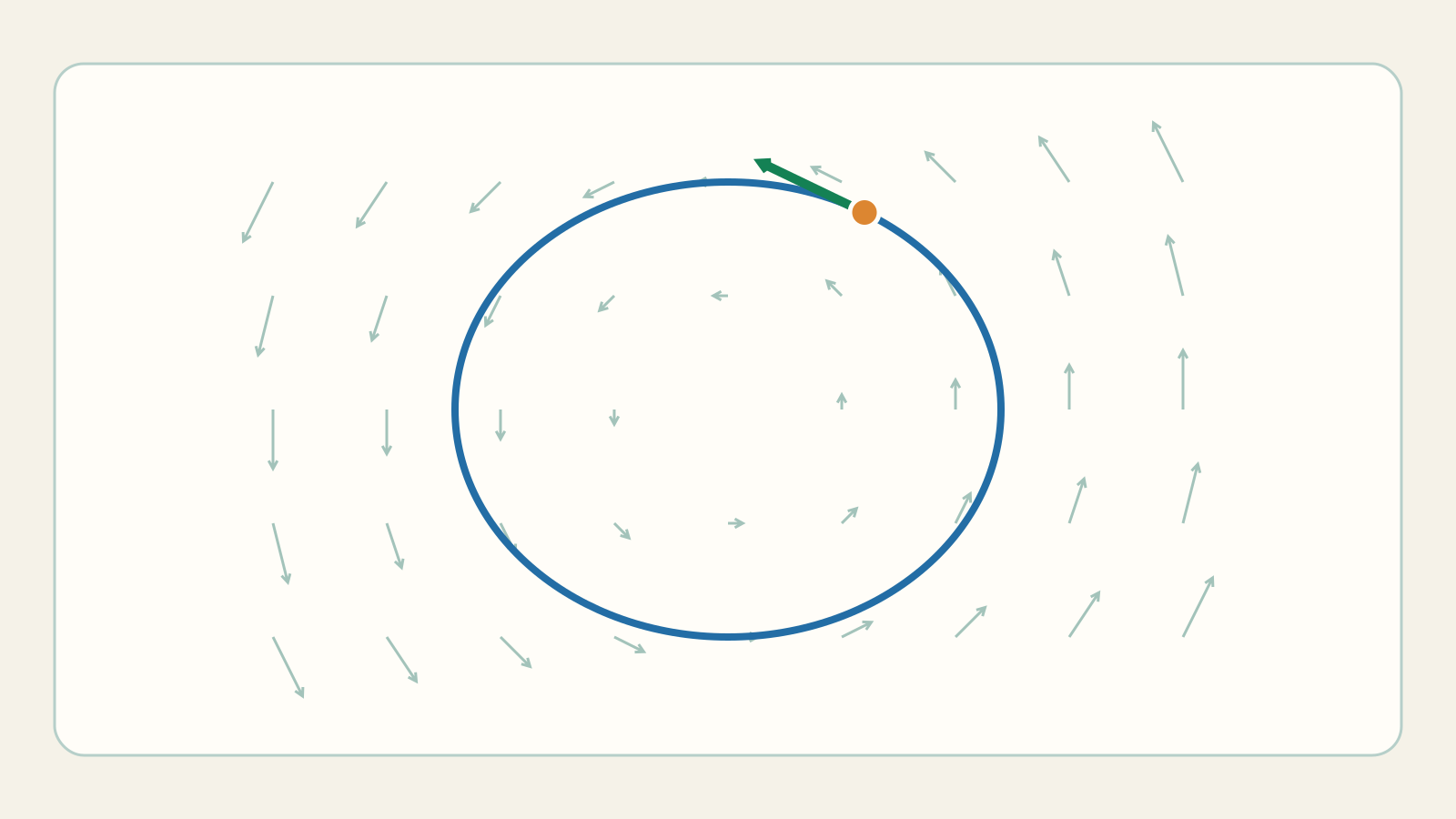
A road is a geometric shape; a journey adds a position at each time. A wind map instead adds an arrow at each location. The fourth block, Vector Calculus, starts by distinguishing curve, motion and field. New integrals can wait: first learn what vectors describe.
Curves and fields: vector lab · Learning-path index
1. From a number to a position
A scalar function returns a number, such as temperature f(x,y). A vector-valued function returns a pair or triple: r(t)=(x(t),y(t)) or r(t)=(x(t),y(t),z(t)). t is a parameter; if it represents time, r(t) is the moving point’s position. Evaluate components separately at the same t.
r(t)=(−2+t, −1+t/2), 0≤t≤4
r(0)=(−2,−1)
r(1)=(−2+1,−1+1/2)=(−1,−1/2)
r(4)=(2,1)
The position vector starts at the origin and ends at the point. It differs from a velocity vector drawn at that point. If coordinates are metres and t seconds, position and velocity have different units.
2. Curve, parameter and orientation
The trace is the set of points reached; the parametrisation adds their order and traversal speed. The interval is part of the description. r(t)=(cos t,sin t), 0≤t≤2π, traverses the unit circle once counterclockwise: right at t=0, top at t=π/2. Angles are radians.
x=cos t, y=sin t → x²+y²=cos²t+sin²t=1
Eliminating t gives a geometric relation but loses orientation and possibly the actual portion traversed. A circle is not globally y=f(x): one x can have two y values. A curve is closed when endpoints coincide; that does not ensure no self-intersections or only one traversal.
3. The derivative is vector velocity
Between t and t+Δt displacement is r(t+Δt)−r(t). Divide by Δt for average velocity, displacement per unit time. Let Δt approach zero to obtain instantaneous velocity. Differentiate each component, not the whole picture as if it were y=f(x).
v(t)=r′(t)=(x′(t),y′(t),z′(t))
r(t)=(−2+t,−1+t/2) → v(t)=(1,1/2)
|v(t)|=√(1²+(1/2)²)=√5/2≈1.118034
Speed |v| is a non-negative number; velocity v also includes direction. If t is not physical time, r′ is simply change per unit parameter. Opposite vectors have the same speed but different velocities.
4. Tangent and regular points
If r′(t₀) is nonzero, it gives the tangent direction. The tangent line passes through r(t₀) with that direction. Divide by the norm to show direction alone: T has unit length. The lab’s green arrow shows T, not speed.
ℓ(s)=r(t₀)+s r′(t₀), s∈ℝ
T(t)=r′(t)/|r′(t)|, r′(t)≠0
A regular piece has a continuous nonzero derivative. If the derivative is zero the formula fails; do not automatically conclude no geometric tangent exists. For r(t)=(t²,t³), derivative vanishes at 0: the geometric tangent is the x-axis but the two limits of T are opposite. The lab hides rather than invents the unit arrow.
5. Circle and ellipse with calculations
To check perpendicularity use the dot product: multiply matching components and add. For nonzero vectors, zero dot product means perpendicular. The result is a number, not a new arrow.
u·v=u_xv_x+u_yv_y+u_zv_z
For a radius-R circle, position is radial and velocity tangent: they are perpendicular. Speed is R for this parametrisation. At R=2 and t=π/2 compute position and velocity as follows.
r(t)=(R cos t,R sin t)
r′(t)=(−R sin t,R cos t)
|r′|=R√(sin²t+cos²t)=R
R=2, t=π/2 → r=(0,2), r′=(−2,0), T=(−1,0)
r·r′=−R²cos t sin t+R²sin t cos t=0
After one turn the point returns to the start: displacement and average vector velocity are zero, but instantaneous speed remains R. On the ellipse r(t)=(2cos t,sin t), speed changes: 1 at t=0 and 2 at t=π/2. Equal parameter increments need not cover equal lengths.
r′(t)=(−2sin t,cos t)
|r′(t)|=√(4sin²t+cos²t)
6. Same shape, different motion
Use t² as the angle: r(t)=(R cos(t²),R sin(t²)), 0≤t≤√(2π). The trace remains one circle but angle grows slowly at first and faster later. Apply the chain rule: differentiate the trigonometric function, then multiply by 2t.
r′(t)=(−2tR sin(t²),2tR cos(t²))
|r′(t)|=2R|t|
t=0 → r′(0)=(0,0)
To reverse a path on [a,b], set τ=a+b−t and use r(τ). Its derivative is −r′(τ) because dτ/dt=−1. Endpoints swap, orientation reverses and speed at corresponding points stays the same. Changing playback speed alone is a display choice, not a change to the studied formula.
7. Add a third coordinate: the helix
A circle in xy becomes a helix by adding z=bt. When t grows by 2π, x and y repeat but height changes by 2πb, the vertical pitch. Positive b rises, negative b descends; b=0 gives a circle. The lab shows two turns, 0≤t≤4π.
r(t)=(R cos t,R sin t,bt)
r′(t)=(−R sin t,R cos t,b)
|r′|=√(R²sin²t+R²cos²t+b²)=√(R²+b²)
R=1.5, b=0.25 → |r′|=√2.3125≈1.520691
2πb=π/2≈1.570796
The 3D picture is projected onto a flat screen: apparently close points may have different heights. Read coordinates and axes, not just the image. The helix’s xy projection is a circle; alone it cannot show the rise.
8. A field: one arrow at each location
A planar vector field is F(x,y)=(P(x,y),Q(x,y)). Its input is a location, not a time; its output is an arrow anchored there. P is horizontal and Q vertical. For wind they are velocity components; for force they have force units. Physical meaning must be specified, not inferred from the letter F.
F(x,y)=(−y,x)
F(2,1)=(−1,2)
|F(2,1)|=√((−1)²+2²)=√5
F(0,0)=(0,0)
A zero arrow has zero magnitude and no defined direction: it cannot be normalised. The map samples a grid. Scaling all arrows by one factor preserves magnitude comparisons; equal-length arrows would show direction only. Check the legend.
9. Recognise five elementary maps
F=(1,0): arrows point right with equal magnitude. F=(−y,x): tangent to origin-centred circles, counterclockwise. F=(x,y): outward radial arrows growing with distance. F=(−x,−y): inward arrows. F=(x,−y): outward along x and inward along y, a saddle pattern.
Similar pictures do not make formulas equal. For example (−y,x) and (−y,x)/(x²+y²) have the same direction away from the origin but different magnitudes; the second is undefined at the origin. Field domain matters as much as appearance, especially for potentials and line integrals.
10. A curve does not automatically follow a field
Along a curve evaluate F(r(t)) by substituting x(t),y(t). This field arrow is not the derivative r′(t). If F is a velocity field, following its motion requires r′(t)=F(r(t)). A streamline without fixed speed only requires nonzero vectors to be positively parallel: r′=c(t)F with c(t)>0.
r(t)=(R cos t,R sin t), F(x,y)=(−y,x)
F(r(t))=(−R sin t,R cos t)=r′(t)
Here the circle follows the rotational field exactly. With F=(x,y), the field is radial and perpendicular to the tangent. The animated point stays on the circle because the curve is prescribed, not because arrows push it. Agreement at one point does not establish agreement along the entire path.
11. A guided lab experiment
Choose Circle and Rotation. Play, pause and step: position, derivative, tangent and field update together. Reverse direction: same curve but tangent opposes field. Switch to outward radial: tangent crosses arrows. Compare Circle with Circle t²: same shape, different speed.
For the cusp set the slider halfway: t=0, zero derivative, T unavailable. For the helix compare space and xy views: the latter loses height. Tables use 81 samples, plots 401; exploration is not proof of regularity or identity. No free expressions or numerical motion equations are executed.
12. Bridge to work and line integrals
We separated the ingredients for stage 25: path r, orientation, tangent direction and field evaluated along the curve. Summing the component along motion will lead to work and line integrals. For now distinguish an arrow, a local product and an integral over a whole path.
Exercises: try before revealing
1. Find r(1) for r(t)=(−2+t,−1+t/2).
Show the explained answer
Substitute 1 into both components: r(1)=(−2+1,−1+1/2)=(−1,−1/2). Velocity is (1,1/2), not this position.
2. Circle R=2: position, velocity and T at t=π/2.
Show the explained answer
r=(2×0,2×1)=(0,2). r′=(−2×1,2×0)=(−2,0). |r′|=2, hence T=(−1,0), pointing left.
3. Ellipse (2cos t,sin t): speed at 0 and π/2?
Show the explained answer
r′=(−2sin t,cos t). At 0 it is (0,1), norm 1; at π/2 it is (−2,0), norm 2. Uniform parameter does not mean uniform speed.
4. For the t² circle with R=1, what is speed at t=1?
Show the explained answer
The chain rule gives r′=(−2t sin(t²),2t cos(t²)); norm 2|t|, hence 2. Omitting 2t gives the wrong derivative.
5. Why is T absent at t=0 for the cusp?
Show the explained answer
r′=(2t,3t²), so r′(0)=(0,0). Division by |r′|=0 is impossible. The geometric tangent is still the x-axis; unit tangents from either side have opposite directions.
6. For F=(−y,x), find F(2,1) and magnitude.
Show the explained answer
F(2,1)=(−1,2), magnitude √(1+4)=√5. It is anchored at (2,1), not the position vector (2,1).
7. Does a circle follow an outward radial field?
Show the explained answer
No: r=(Rcos t,Rsin t), F(r)=r and r·r′=0. Radial arrows are perpendicular to the tangent; the shown motion is prescribed by the curve.
8. What changes when reversing the circle?
Show the explained answer
The trace is unchanged. With τ=2π−t, derivative −r′(τ): direction changes, not corresponding speed. The rotational field is unchanged, so motion opposes it.
9. Helix R=1, b=1/2: pitch and speed?
Show the explained answer
Pitch 2πb=π. Speed √(R²+b²)=√(1+1/4)=√5/2. Its xy projection is a circle and hides the pitch.
10. Is (−y,x)/(x²+y²) defined at the origin?
Show the explained answer
No: the denominator is zero. Domain is ℝ² minus (0,0). A grid omitting that point does not remove the restriction; read the formula.
Before: double and triple integrals · Learning-path index