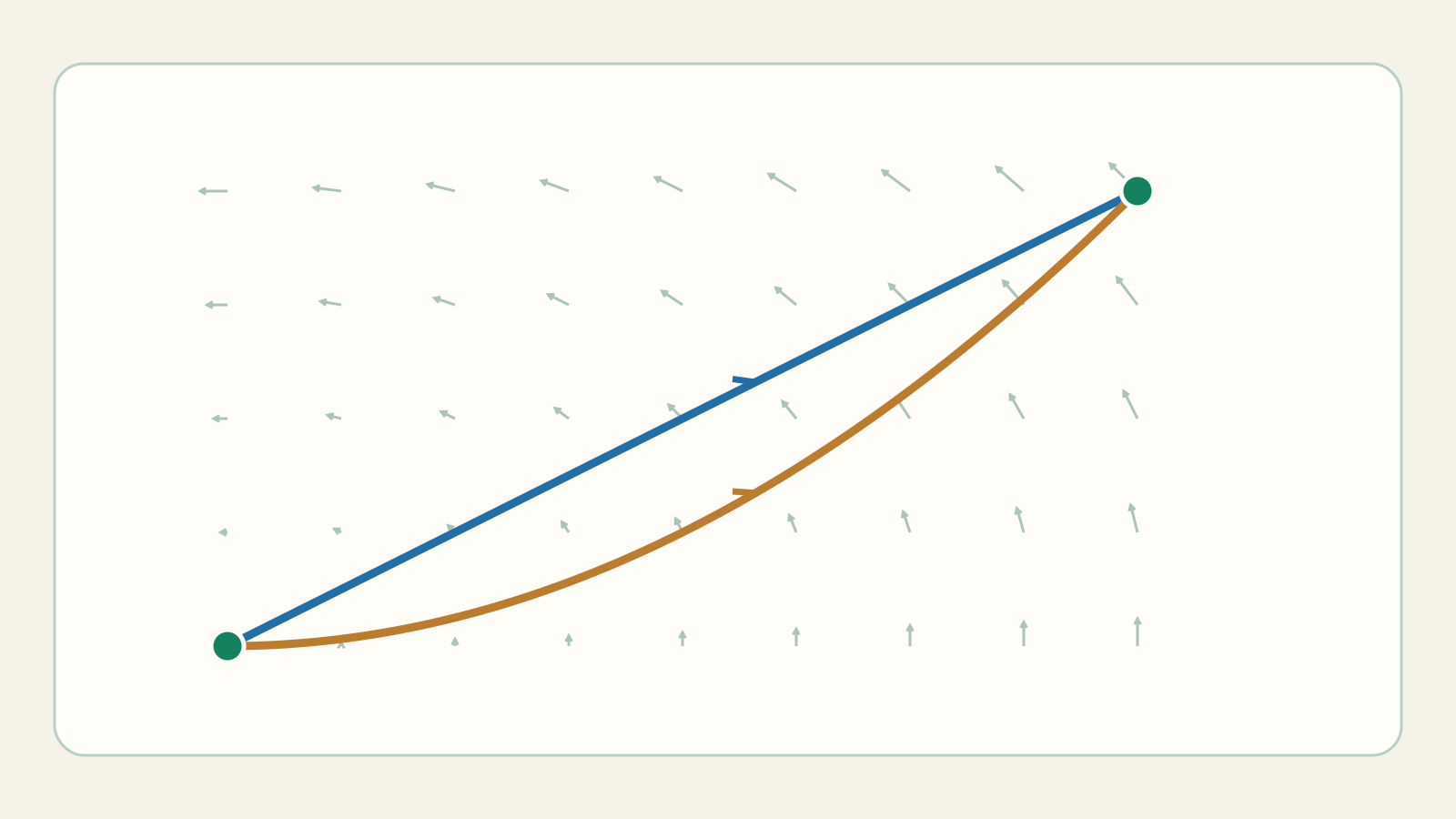
Two people share a start and destination but take different routes. Distance travelled may differ; work by a force may or may not. To understand when only endpoints matter, distinguish what is being added: lengths, masses or oriented field contributions.
Line integrals: compare two paths · Learning-path index
1. Ingredients before formulas
C is a curve oriented from A to B, described by r(t)=(x(t),y(t)), a≤t≤b. r′(t) is the tangent vector with its speed. We use piecewise regular curves: corners are allowed if the calculation is split into regular pieces. The field or density must be defined all along the path.
ρ(x,y) is a number, for instance linear density in kg/m. F=(P,Q) is a vector, for instance force in newtons. Integrating ρ against length ds differs from integrating F against oriented displacement dr. One measures quantity on a wire; the other field contribution along motion.
2. Scalar integral: length and mass
Cut a wire into small lengths Δs. Estimate each mass as density×length, add and shrink the pieces. For differentiable r, ds=|r′(t)|dt. The norm is essential: length does not change sign when direction is reversed.
∫C ρ ds = ∫[a,b] ρ(r(t)) |r′(t)| dt
ρ=1 → L(C)=∫[a,b] |r′(t)| dt
Example: r(t)=(t,t), 0≤t≤1, has r′=(1,1), norm √2. For ρ=1 length is √2. For ρ=1+x, mass is ∫₀¹(1+t)√2 dt=√2[t+t²/2]₀¹=3√2/2. Reversal gives the same values. Another wire with these endpoints can have different length and mass.
3. Work: the component along motion matters
For a small displacement Δr the contribution is F·Δr. The dot denotes the dot product: (P,Q)·(dx,dy)=Pdx+Qdy. Contributions are positive when the field assists motion, negative when it opposes it, zero when perpendicular. Replacing the dot product by |F| loses direction.
W=∫C F·dr=∫C P dx+Q dy
W=∫[a,b] F(r(t))·r′(t) dt
 =∫[a,b] [P(x(t),y(t))x′(t)+Q(x(t),y(t))y′(t)]dt
For force in N and coordinates in metres, W is N·m, joules. For a generic field this is its line integral, not automatically physical work. In three dimensions add the third component in the same way.
4. A recipe without skipped steps
Order: write r(t) and interval; check endpoints and domain; differentiate components; substitute x(t),y(t) in P,Q; take the dot product; integrate in t. For several pieces repeat and add. The parameter is removed only after definite integration.
F=(−y,x), r(t)=(t,t²), 0≤t≤1
r′(t)=(1,2t)
F(r(t))=(−t²,t)
F(r(t))·r′(t)=−t²×1+t×2t=t²
W=∫₀¹t²dt=[t³/3]₀¹=1/3
One calculation alone does not establish path dependence: compare another path with the same endpoints, keeping the field fixed.
5. Same endpoints, three different answers
Fix A=(0,0), B=(1,1) and F=(−y,x). The diagonal is r₁(t)=(t,t), parabola r₂(t)=(t,t²), both 0≤t≤1. The broken path uses (t,0) then (1,t), each from 0 to 1.
C₁: F(r₁)=(−t,t), r₁′=(1,1)
W₁=∫₀¹(−t+t)dt=0
C₂: W₂=1/3
C₃: ∫₀¹(0,t)·(1,0)dt+∫₀¹(−t,1)·(0,1)dt
   =0+∫₀¹1dt=1
Same endpoints and field, but 0, 1/3 and 1 differ: this field is not conservative on the plane. Not every pair must differ; one counterexample disproves global path independence.
6. Orientation and parameter speed
An increasing reparametrisation preserves the value when the same curve is traversed the same number of times: the chain-rule factor is accounted for by substitution. Reversal changes work’s sign but leaves scalar ds integrals unchanged.
r(t)=c(h(t)) → r′(t)=c′(h(t))h′(t)
W(−C)=−W(C)
∫[−C] ρ ds=∫C ρ ds
The lab uses s=t² for a slow start on [0,1]. With reversal use s=1−t² and ds/dt=−2t. Change the derivative as well as the point. Two turns count twice; this is not merely a new description with the same traversal multiplicity.
7. Potential: a function behind the field
A field is conservative on D if a scalar function φ exists with F=∇φ. The gradient is ∇φ=(φ_x,φ_y), the two partial derivatives. φ is a mathematical potential; adding a constant leaves its gradient unchanged. It must exist throughout the domain, not just locally.
φ=x²+y² → ∇φ=(2x,2y)
φ=x²y+y² → ∇φ=(2xy,x²+2y)
In physics potential energy U often uses F=−∇U. Here F=∇φ, so φ=−U up to a constant. Work itself does not change with notation; the named potential function does.
8. Why potential removes path dependence
Compose φ with r(t). The chain rule says its derivative is the dot product of the gradient and r′. If the field is that gradient, work’s integrand is a derivative. The fundamental theorem finishes the argument. Assume continuously differentiable φ and a piecewise regular curve in its domain.
d[φ(x(t),y(t))]/dt=φ_x x′+φ_y y′=F(r(t))·r′(t)
W=∫[a,b] d[φ(r(t))]/dt dt
 =φ(r(b))−φ(r(a))
 =φ(B)−φ(A)
For F=(2x,2y), A=(0,0), B=(1,1), W=(1²+1²)−0=2 on the segment, parabola and broken path. Their lengths are not asserted equal. With F=−∇U the formula is W=U(A)−U(B).
9. Reconstruct φ without guessing
Take F=(2xy,x²+2y). From φ_x=2xy integrate in x, treating y as constant. The integration “constant” may depend on y: write g(y), not just C. Differentiate in y and compare with the field’s second component.
φ_x=2xy → φ(x,y)=x²y+g(y)
φ_y=x²+g′(y)
x²+g′(y)=x²+2y → g′(y)=2y
g(y)=y²+C
φ(x,y)=x²y+y²+C
∇φ=(2xy,x²+2y) ✓
W=φ(1,1)−φ(0,0)=(1+1+C)−C=2
Check the gradient to avoid an incomplete primitive. On r=(t,t), F(r)·r′=3t²+2t, giving [t³+t²]₀¹=2. A coarse midpoint sum need not equal 2 exactly: approximation is not a counterexample to the theorem.
10. The derivative test needs a domain
For F=(P,Q) with continuous first partials, a conservative field must satisfy P_y=Q_x. This is sufficient on an open simply connected domain: closed curves can be contracted to points within it. In the plane think of a connected region without holes, retaining the openness and regularity assumptions.
F=(2xy,x²+2y): P_y=2x=Q_x; D=ℝ²; φ=x²y+y²
F=(−y,x): P_y=−1 ≠ Q_x=1
Unequal partials rule out conservativity. Equal partials without simple connectedness are inconclusive: seek a global potential or study loops. A hole does not automatically make every field nonconservative: (2x,2y) retains φ=x²+y² on the punctured plane too.
11. The punctured-plane counterexample
Consider F=(−y/(x²+y²),x/(x²+y²)) on the plane minus the origin. P_y and Q_x agree, but the unit circle surrounds the missing point. Substitute the circle directly, without applying a theorem whose domain assumptions fail.
P_y=Q_x=(y²−x²)/(x²+y²)²
r(t)=(cos t,sin t), 0≤t≤2π
F(r(t))=(−sin t,cos t)=r′(t)
F(r(t))·r′(t)=sin²t+cos²t=1
∮C F·dr=∫₀²π1dt=2π≠0
There is no global potential on D. From (1,0) to (−1,0), the counterclockwise upper semicircle gives π and clockwise lower one −π. The diameter is inadmissible because F is undefined at the origin. Ignoring that point and assigning zero is not valid.
12. Closed loops: what does zero prove?
For a continuous field on an open connected domain, path independence, existence of a potential and zero integral on every piecewise regular closed loop are equivalent. “Every” matters: one zero loop is insufficient, while one nonzero loop disproves a global potential.
F=∇φ, A=B → W=φ(A)−φ(A)=0
F=(−y,x), r(t)=(Rcos t,Rsin t)
F(r)·r′=R² → W=2πR²
In (2x,2y), circle work is zero despite nonzero field arrows. In the rotational field it is 2πR²; two turns give 4πR². This prepares circulation and Green’s theorem without using an unexplained shortcut.
13. Read the lab without being misled
Start with radial field, segment and parabola. Both exact references are 2, while midpoint sums may differ. Increase n: numerical discrepancy decreases. Switch to rotation: exact references 0 and 1/3 mean the difference is real. Reverse paths and check signs.
t_i*=(t_i+t_(i+1))/2
g_i^F=F(r(t_i*))·r′(t_i*)
g_i^ρ=ρ(r(t_i*))|r′(t_i*)|
ΔI_i=g_i Δt_i
S_k=ΔI_1+…+ΔI_k
Each step shows point, vectors or density, integrand, width and contribution. Corners are split exactly, even for s=t². Convergence is compared with known preset formulas, not a general certified error bound or free-expression potential solver. Different endpoints and invalid-domain paths are explicitly flagged.
Exercises: try before revealing
1. Length of r(t)=(t,t), 0≤t≤1?
2. Mass of the same wire with ρ=1+x?
Show the explained answer
Along the curve ρ=1+t. M=√2∫₀¹(1+t)dt=√2(1+1/2)=3√2/2. No force-field dot product is used.
3. F=(−y,x) on the diagonal: work?
Show the explained answer
r=(t,t), r′=(1,1), F(r)=(−t,t). Dot product −t+t=0, hence zero work despite nonzero F for t>0.
4. Same field along (t,t²)?
Show the explained answer
r′=(1,2t), F(r)=(−t²,t). Product −t²+2t²=t²; W=∫₀¹t²dt=1/3. Same endpoints as the segment, so path dependence is genuine.
5. Find φ for F=(2xy,x²+2y).
Show the explained answer
φ_x=2xy gives φ=x²y+g(y). Then φ_y=x²+g′=x²+2y, so g′=2y, g=y²+C. Thus φ=x²y+y²+C; its gradient gives both components.
6. With that potential, work from (0,0) to (1,1)?
Show the explained answer
φ(1,1)−φ(0,0)=(1+1+C)−C=2 on every admissible path. Finite-n sums may differ from 2: inspect error, not just displayed digits.
7. Reverse the rotational-field parabola: work and length?
Show the explained answer
Work becomes −1/3. Length is unchanged: dr reverses sign in work, while length uses |r′|. These are different integrals.
8. Does P_y=Q_x always imply a global potential?
Show the explained answer
No. With continuous partials it is sufficient on an open simply connected domain. On a punctured domain the test may be inconclusive: the angular field has equal partials but circle integral 2π.
9. The two semicircles from (1,0) to (−1,0) in the angular field?
Show the explained answer
Upper counterclockwise: π. Lower clockwise: −π. Difference 2π with fixed endpoints. The diameter crosses the excluded origin and is inadmissible.
10. F=(−y,x), radius-2 circle: one turn and two?
Show the explained answer
One turn gives 2πR²=8π; two give 16π. Traversal count matters; this is not merely changing the speed of one turn.
11. Does a radial field do work around a circle?
Show the explained answer
For F=(2x,2y), potential is x²+y². Circle endpoints coincide, so W=0. Arrows are not zero: they are perpendicular to tangent displacement.
12. Do numerical sums 1.999 and 1.998 prove path dependence?
Show the explained answer
No. Both may approximate exact value 2. Use a known reference or convergence checks; differing decimals are not proof. The lab separates analytic and numerical differences.
Before: parametric curves and vector fields · Learning-path index