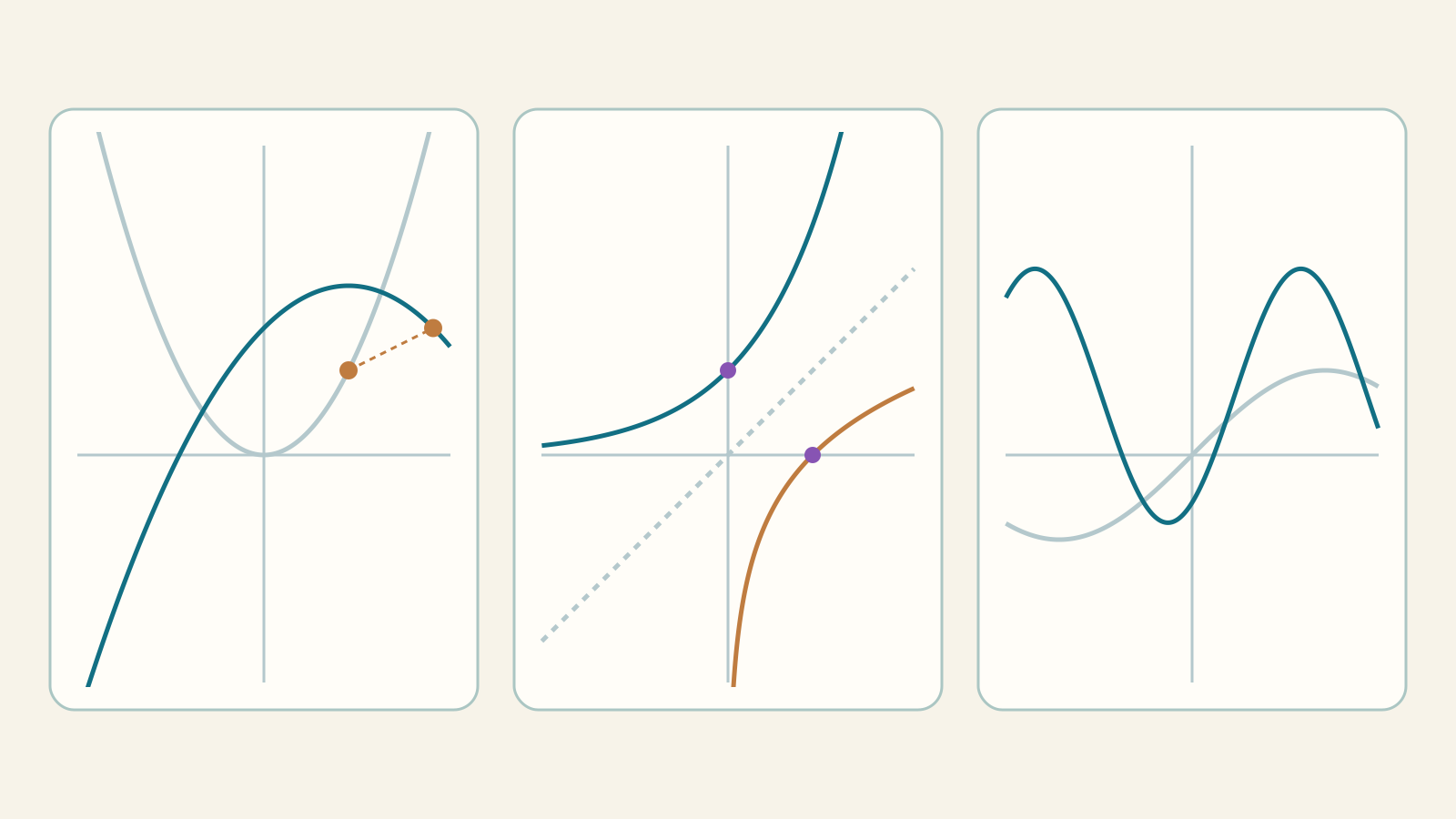
Before computing a limit or derivative, understand the function: where it exists, what values it takes and how it is built from simpler functions. This chapter opens the Calculus path and builds a common vocabulary through examples, checks and a lab for graphs, compositions and inverses.
Elementary functions lab · Learning-path index
1. A function is more than a formula
A function f:D→C assigns every x in its domain D exactly one value f(x) in the codomain C. Different inputs may share an output: x² sends both 2 and −2 to 4. Two different outputs for one input are forbidden. Thus y=±√x does not define a single function, whereas y=√x selects the nonnegative root.
Domain, codomain and rule belong to the specification. The same formula x² on ℝ and on [0,+∞) describes functions with different properties: only the latter is injective. A cost model f(t)=3+2t may have physical domain t≥0 although its formula accepts every real t.
2. Reading f(x), graphs and intervals
f(x) means the value at input x, not a product f×x. If f(x)=x²+1, then f(−2)=5 and f(x+1)=(x+1)²+1: substitute the whole input, retaining parentheses. The graph consists of points (x,f(x)). A vertical line cannot meet it at two distinct points with the same first coordinate.
[a,b] includes both endpoints; (a,b) excludes them; [a,b) includes only a. Parentheses at ±∞ are always open: infinity is not an included real endpoint. ∪ joins intervals; ℝ∖{c} excludes c. Zeros solve f(x)=0; the vertical-axis intercept is (0,f(0)), only when 0 belongs to the domain.
3. Domain: all conditions at once
The natural real domain contains all inputs for which the expression makes sense. Polynomials impose no exclusions; a denominator must be nonzero; an even root needs radicand ≥0; a logarithm needs argument >0. Odd roots accept negative numbers too. Simultaneous conditions are intersected, not united.
For 1/√(4−x²), the root is also a denominator: require 4−x²>0, not ≥0. Thus D=(−2,2). For √(ln x), require x>0 and ln x≥0, giving D=[1,+∞). For ln(√x), require x≥0 and √x>0, giving D=(0,+∞). Operation order changes the domain.
4. Simplification does not erase the domain
(x²−1)/(x−1)=(x−1)(x+1)/(x−1)=x+1 only for x≠1. Its graph is a line missing (1,2). The function x+1 on all ℝ is an extension, not exactly the original function.
For √[(x−1)/(x+2)], require x≠−2 and (x−1)/(x+2)≥0. The ratio is positive for x<−2, negative for −2<x<1, zero at 1 and positive for x>1. Hence D=(−∞,−2)∪[1,+∞). Replacing it everywhere by √(x−1)/√(x+2) would lose the x<−2 branch, where both numerator and denominator of the ratio are negative.
5. Image and codomain are different
The codomain is the declared target set; the image Im f={f(x):x∈D} contains the values actually reached. If f:ℝ→ℝ, f(x)=x²+2, the codomain is ℝ but the image is [2,+∞). Indeed x²+2≥2 and every y≥2 is produced by x=√(y−2). Finding a bound is insufficient: verify that every claimed value is attained.
A function is surjective when its image equals its codomain. x²+2 is not surjective onto ℝ, but is onto [2,+∞). Such properties depend on the chosen sets as well as the formula.
6. A library of elementary graphs
Learn a few reference shapes. Positive integer powers are defined on ℝ; even powers have nonnegative image, whereas odd powers also take negative values. Negative integer powers exclude zero. Distinguish even and odd roots: √(x²)=|x|, while ∛(x³)=x for every real x.
In the table, c>0 and c≠1; n∈ℤ in the tangent exclusions. Intervals describe the base functions, not all their transformations. The lab lets you compare every family.
| Family | Formula | Domain | Image |
|---|---|---|---|
| Identity | x | ℝ | ℝ |
| Square | x² | ℝ | [0,+∞) |
| Cube | x³ | ℝ | ℝ |
| Absolute value | |x| | ℝ | [0,+∞) |
| Square root | √x | [0,+∞) | [0,+∞) |
| Cube root | ∛x | ℝ | ℝ |
| Reciprocal | 1/x | ℝ∖{0} | ℝ∖{0} |
| Exponential | cˣ | ℝ | (0,+∞) |
| Logarithm | log_c(x) | (0,+∞) | ℝ |
| Sine | sin x | ℝ | [−1,1] |
| Cosine | cos x | ℝ | [−1,1] |
| Tangent | tan x | ℝ∖{π/2+nπ : n∈ℤ} | ℝ |
7. Zeros, sign, monotonicity and symmetry
The zeros of x²−4 are −2 and 2. Its sign is positive outside these zeros and negative between them. A function is strictly increasing if x₁<x₂ implies f(x₁)<f(x₂) for all relevant inputs; decreasing reverses the last inequality. x² decreases on (−∞,0] and increases on [0,+∞), but is not monotone on ℝ. 1/x decreases on each branch, not on all ℝ∖{0}: −1<1 yet f(−1)=−1<f(1)=1.
On a domain symmetric about 0, f is even if f(−x)=f(x), odd if f(−x)=−f(x). Even graphs reflect across the vertical axis; odd graphs have origin symmetry. x² and |x| are even, x³ and ∛x odd. √x lacks a symmetric domain and belongs to neither class. A finite plot suggests properties; identities prove them.
8. Exponentials, logarithms and periodic functions
For c>0, c≠1, cˣ is positive, passes through (0,1), increases for c>1 and decreases for 0<c<1. logcx requires x>0, passes through (1,0) and has the same monotonic direction. These functions are inverses. ln x is the logarithm to base e, with the same domain rule. The real identities log(ab)=log a+log b and log(a/b)=log a−log b require a,b>0.
In radians, sin x and cos x have period 2π and values between −1 and 1. tan x=sin x/cos x has period π and excludes x=π/2+nπ. A period T means translating the input by T preserves domain and values. Not every oscillating function is periodic, and a short plot cannot prove periodicity.
9. Transforming a graph by tracking points
Consider g(x)=a f(b(x−h))+k, b≠0. If (u,f(u)) is on the original graph, solve b(x−h)=u to obtain x=h+u/b. The point becomes (h+u/b, k+a f(u)). This correspondence explains all transformations without memorising apparently reversed signs.
- Positive h shifts right, negative h left.
- k shifts up or down.
- |a| scales vertically; a<0 reflects vertically before shifting by k.
- The horizontal scale is 1/|b|: b=2 compresses, b=1/2 stretches; b<0 reflects horizontally before shifting by h.
Example: f(u)=u², a=−2, b=2, h=1, k=3 gives g(x)=−8(x−1)²+3. Vertex (0,0) becomes (1,3); (1,1) becomes (3/2,1). The image is (−∞,3]. The lab moves points using these formulas, not by reconstructing them from pixels.
10. Transforming the domain and image too
For g(x)=a f(b(x−h))+k require b(x−h)∈Df. Its image consists of k+ay with y∈Im f. For g(x)=√(3−x), the radicand is −(x−3): domain x≤3, image [0,+∞). The endpoint (3,0) is included.
When a=0, the expression 0·f(b(x−h))+k equals k only where f(b(x−h)) is defined. For instance 0·(1/x)+2 retains x≠0: a constant with a missing point, not automatically the constant function on all ℝ. The lab preserves this restriction. b=0 requires a separate check of f(0) and is excluded from the lab parameters.
11. Composition: order matters
(f∘g)(x)=f(g(x)): apply g first, then f. Its domain is {x∈Dg:g(x)∈Df}. With f(u)=√u and g(x)=x², f(g(x))=√(x²)=|x| on ℝ. Reversing gives g(f(x))=(√x)²=x, but only for x≥0. Order changes both formula and domain.
Even identical final formulas may describe different functions: eln x=x only for x>0, whereas ln(eˣ)=x for every real x. With f=ln and g(x)=x², ln(x²)=2ln|x| for x≠0; 2ln x is invalid for negative inputs. The lab traces input→inner function→outer function and reports exact domains for the guided cases.
12. An inverse needs an unambiguous return
f is injective if f(x₁)=f(x₂) implies x₁=x₂. Then its inverse f⁻¹:Im f→D returns each output to its unique input. An inverse on the entire declared codomain additionally needs surjectivity: f must be bijective. Strict monotonicity is sufficient, not necessary on arbitrary domains: 1/x is injective despite not being globally monotone on its domain.
For f(x)=2x+1, set y=2x+1, solve x=(y−1)/2 and rename the variable: f⁻¹(x)=(x−1)/2. Check f⁻¹(f(x))=x and f(f⁻¹(y))=y on their respective domains. This is not 1/f(x)=1/(2x+1): inversion and reciprocation differ.
x² on ℝ is not injective: 1 and −1 produce 1. Restricted to [0,+∞), its inverse is √x; on (−∞,0], it is −√x. Both inverses have domain [0,+∞), but different images. Graphs reflect across y=x because (u,f(u)) becomes (f(u),u). Without injectivity the reflection is a relation, not an inverse-function graph.
13. Branches, checks and the next steps
Sine on ℝ is not injective. Restricting it to [−π/2,π/2] gives inverse arcsin, with domain [−1,1] and image [−π/2,π/2]. sin(arcsin y)=y on [−1,1], but arcsin(sin x)=x only on the principal branch: at x=3π/4 the result is π/4. Always declare the branch used for an inverse.
- Read parentheses carefully and declare the domain.
- Recognise the family and find its image, distinct from the codomain.
- For transformations, track a point with the formulas.
- For composition, check the inner function first.
- For an inverse, check injectivity and any restriction.
- Use the graph as a check, not a proof.
In the lab compare twelve families, move the point using the slider or Play, swap order in five pairs and explore nine inverse cases. The next chapter on limits adds approach; function analysis later combines domain, limits and derivatives. The lab derives results from guided cases, not a universal solver.
Exercises: try before revealing
1. What is the image of x²+2 on ℝ?
Show the explained answer
[2,+∞): minimum 2 occurs at x=0; every y≥2 is reached at x=√(y−2). The codomain may be ℝ, but not all its values are attained.
2. Domain of 1/√(4−x²)?
Show the explained answer
Require 4−x²>0 because the root is a denominator. x²<4 gives −2<x<2. Endpoints would make the denominator zero.
3. Domain of √[(x−1)/(x+2)]?
Show the explained answer
The ratio is nonnegative for x<−2 or x≥1. Exclude −2 and include 1: (−∞,−2)∪[1,+∞). At x=−3 the ratio is 4 and the root 2.
4. What is √(x²) at x=−3?
Show the explained answer
√9=3, not −3. Square root returns the nonnegative value, so √(x²)=|x| on ℝ.
5. Transform (1,1) with a=−2, b=2, h=1, k=3.
Show the explained answer
x=h+u/b=1+1/2=3/2; y=k+af(u)=3−2=1. The point is (3/2,1). Horizontal scaling divides the relative input coordinate, not multiplies it.
6. Domain and image of √(3−x)?
Show the explained answer
3−x≥0 means x≤3, so D=(−∞,3]. The root takes every nonnegative value: image [0,+∞). Point (3,0) is included.
7. With f=√x and g=x², evaluate both orders at x=−2.
Show the explained answer
f(g(−2))=√4=2. g(f(−2)) is undefined over the reals: inner operation √(−2) is invalid. Formally simplifying (√x)² to x is not enough.
8. Does ln(x²)=2ln x hold at x=−2?
Show the explained answer
No: ln4 exists but ln(−2) does not. For x≠0 the correct formula is ln(x²)=2ln|x|. At x=−2 both sides equal ln4.
9. Are e^(ln x) and ln(e^x) the same function?
Show the explained answer
No: both simplify to x, but the first domain is (0,+∞), the second ℝ. Inverse identities apply on their respective domains.
10. What is the inverse of x² on x≤0?
Show the explained answer
−√x, domain [0,+∞), image (−∞,0]. For example −3→9→−3. The positive root would return to the wrong branch.
11. For f(x)=2x+1, compare inverse and reciprocal.
Show the explained answer
The inverse is (x−1)/2 on ℝ. The reciprocal is 1/(2x+1), with x≠−1/2. They are different functions answering different questions.
12. What is arcsin(sin(3π/4))?
Show the explained answer
π/4, because arcsin returns the value in [−π/2,π/2]. 3π/4 is outside that branch; sine is not globally injective.