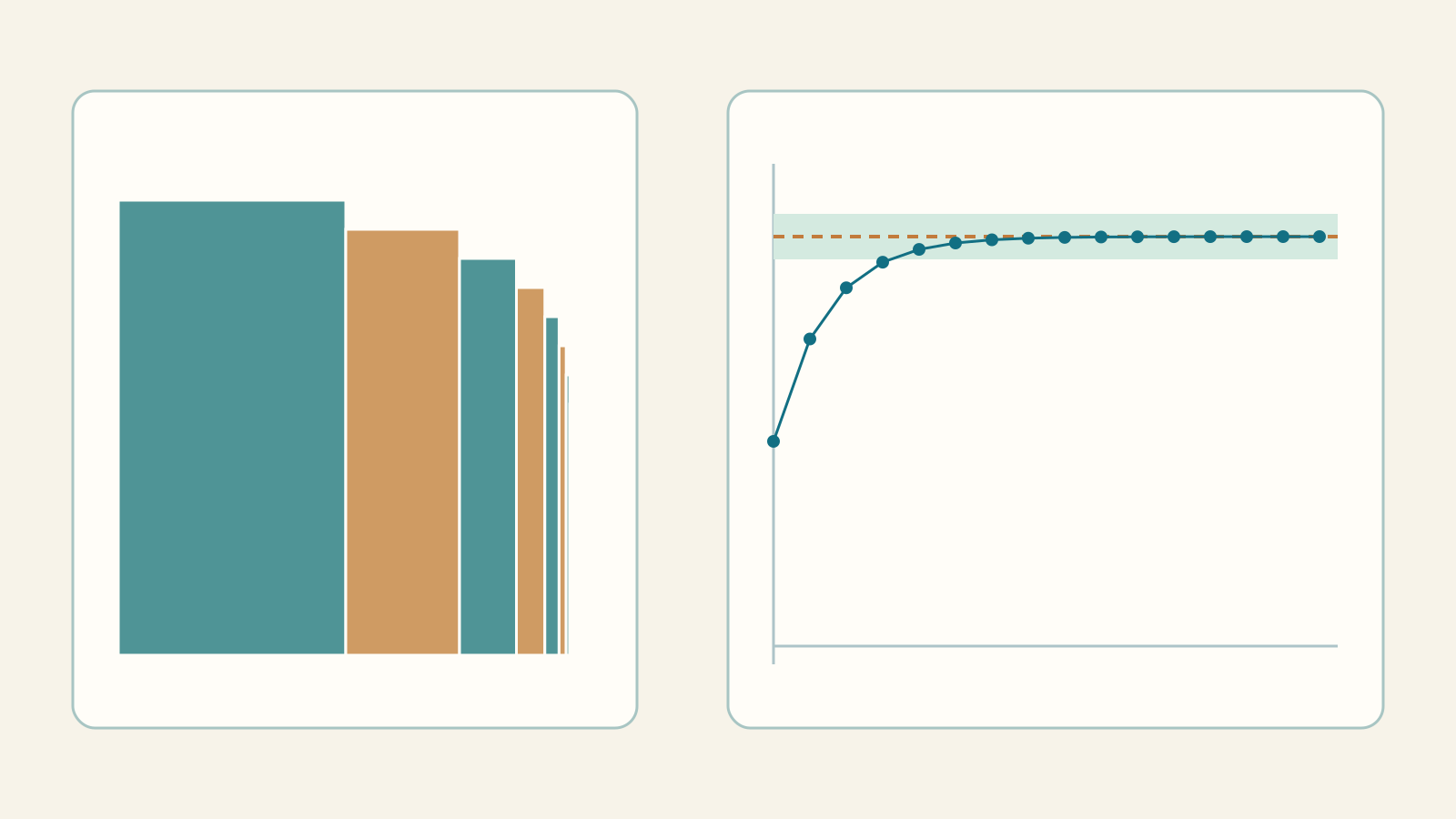
Can infinitely many numbers add up to a finite result? The answer depends on the terms and their order. We begin with computable sums and develop tests that decide convergence without requiring a formula for the result. This connects sequences to a deeper understanding of Taylor.
Series: partial sums and convergence · Learning-path index
1. Term, partial sum and series
A sequence is an ordered list a₁,a₂,… . Series Σₙ₌₁∞aₙ is defined through S_N=a₁+…+a_N. We do not perform an infinite addition at once: we study the limit of finite sums.
Σₙ₌₁∞aₙ=S ⇔ lim(N→∞) S_N=S, with S finite.
For aₙ=1/2ⁿ, terms tend to 0 while S_N tends to 1: these are different sequences. Here convergence means a finite limit; for nonconvergent series we distinguish infinite growth from oscillation.
2. Geometric series: proving the formula
Starting with 1, S_N=1+q+…+qN−1, where the final exponent is N−1. Multiply by q and subtract: (1−q)S_N=1−qᴺ. For q≠1:
S_N=(1−qᴺ)/(1−q). If |q|<1: S=1/(1−q), R_N=S−S_N=qᴺ/(1−q).
For q=1/2: S_N=2−2¹⁻ᴺ and S=2. After 10 terms the error is 1/512≈0.001953125; after 11 it is 1/1024<0.001. With first term A, multiply everything by A. For q=1, S_N=N; for q=−1 the sums alternate 1 and 0. A=0 always gives zero.
3. A necessary, not sufficient, check
If S_N→S then a_N=S_N−S_(N−1)→0. Therefore aₙ failing to tend to 0 rules out convergence. In Σn/(n+1) the term tends to 1: the sums grow without bound.
The converse fails: harmonic series Σ1/n diverges to +∞. Between 2ᵏ⁻¹+1 and 2ᵏ are 2ᵏ⁻¹ terms each at least 1/2ᵏ: every block adds at least 1/2. Although 1/n→0, the sums exceed every threshold.
4. Telescoping: cancellation in finite sums
Since 1/[n(n+1)]=1/n−1/(n+1), first write the finite sum: S_N=(1−1/2)+(1/2−1/3)+…+(1/N−1/(N+1))=1−1/(N+1). Only then take the limit: S=1 and R_N=1/(N+1).
N=99 terms suffice for error at most 0.01. We are not informally cancelling two divergent infinite sums: cancellation happens in a finite expression.
5. Comparing positive-term series
If eventually 0≤aₙ≤bₙ and Σbₙ converges, so does Σaₙ. If Σaₙ diverges to +∞, so does Σbₙ. Watch the direction: a series larger than a convergent one can do either.
For n≥1, 0<1/(n²+3)≤1/n², so it converges. Conversely 1/(n+1)≥1/(2n), so it diverges like the harmonic series.
For aₙ,bₙ>0, if aₙ/bₙ→L with 0<L<∞, both series have the same convergence behaviour. Compare (3n+1)/(n³+2) with 1/n²: the ratio tends to 3. The test decides convergence but does not automatically give the sum.
6. Integral test and p-series
If f is continuous, positive and decreasing for x≥1, series Σf(n) converges exactly when improper integral ∫₁∞f(x)dx converges. Rectangles above and below the graph give the comparison. The series and integral need not have the same value.
Σₙ₌₁∞1/nᵖ converges ⇔ p>1.
For p>1, ∫₁∞x⁻ᵖdx=1/(p−1). For 0<p≤1 the integral diverges; for p≤0 the terms do not even tend to zero. Parameter p=1 is the threshold, not a value to round away.
For p>1 the remainder satisfies (N+1)¹⁻ᵖ/(p−1)≤R_N≤N¹⁻ᵖ/(p−1). Add these endpoints to S_N to enclose the sum even without an exact formula.
7. Ratio and root: inconclusive is a valid outcome
If aₙ is eventually nonzero and L=lim |aₙ₊₁/aₙ| exists, L<1 gives absolute convergence and L>1 (including infinity) gives divergence. L=1 is inconclusive. The root test uses L=lim ⁿ√|aₙ|, when it exists, with the same conclusions.
For aₙ=3ⁿ/n!, the ratio is 3/(n+1)→0: absolute convergence. For aₙ=n!/3ⁿ it is (n+1)/3→∞: divergence. Both 1/n and 1/n² give L=1, yet the first series diverges and the second converges. Value 1 does not settle the series.
When these limits do not exist, these simple versions do not apply: choose another comparison. Versions using the limit superior are a later extension.
8. Alternating series and Leibniz remainder
For Σ(−1)ⁿ⁻¹bₙ with bₙ≥0 decreasing to 0, even partial sums increase, odd ones decrease and their gap tends to 0. They share a limit S. If monotonicity starts only eventually, initial terms do not affect convergence; apply the bound only in the tail where the assumptions hold.
|S−S_N|≤b_(N+1). S lies between S_N and S_(N+1).
For 1−1/2+1/3−… the sum is ln 2. With N=99 the error is at most 1/100=0.01; with N=999 at most 0.001. Alternating signs alone is insufficient: bₙ must tend to zero and satisfy the assumptions. Series 1−1+1−… does not converge in the ordinary partial-sum sense.
9. Absolute and conditional convergence
If Σ|aₙ| converges, Σaₙ converges absolutely and therefore converges. If Σaₙ converges while Σ|aₙ| diverges, convergence is conditional. The alternating harmonic series is conditional; Σ(−1)ⁿ⁻¹/n² is absolute because Σ1/n² converges.
For Σ(−1)ⁿ⁻¹/nᵖ: p>1 gives absolute convergence; 0<p≤1 conditional convergence; p≤0 gives terms not tending to zero. A conditional series cannot be freely reordered: doing so may change the sum or destroy convergence. The lab always keeps the original order.
10. Power series: centre, radius and endpoints
A series Σₙ₌₀∞cₙ(x−a)ⁿ has centre a and radius R, possibly 0 or ∞: it converges absolutely for |x−a|<R and diverges for |x−a|>R. For finite positive R test each endpoint separately by substitution. At the centre only c₀ remains: the zeroth power is 1 even at x=a.
For Σxⁿ, R=1 and neither endpoint converges. For Σₙ₌₁∞(−1)ⁿ⁻¹xⁿ/n, R=1; x=1 converges conditionally to ln 2, while x=−1 diverges to −∞. For Σₙ₌₁∞xⁿ/n², R=1 and both endpoints converge absolutely. The same radius need not give the same interval.
Σxⁿ/n! has R=∞ and represents eˣ. Σn!xⁿ has R=0: for x≠0 the absolute-term ratio is (n+1)|x|→∞; at x=0 only constant term 1 remains. Ratios or roots of coefficients can determine the radius when their limits exist.
11. From series to functions, keeping the assumptions
Inside the radius, a power series can be differentiated and integrated term by term; its radius stays the same, but endpoint behaviour can change. From the geometric series, for |x|<1:
1/(1−x)=Σₙ₌₀∞xⁿ; differentiating gives 1/(1−x)²=Σₙ₌₁∞n xⁿ⁻¹. Integrating from 0 to x gives −ln(1−x)=Σₙ₌₁∞xⁿ/n. Do not automatically extend these identities to endpoints.
Taylor chooses cₙ=f⁽ⁿ⁾(a)/n!. Having all derivatives does not guarantee representation of f: the remainder must tend to zero. This issue, Lagrange remainder and Peano remainder are developed in the Taylor chapter, which follows this one in the path.
12. A practical method and the lab
- Write the general term and test whether it tends to zero.
- Look for a known structure: geometric, telescoping, p-series.
- For positive terms choose comparison, integral, ratio or root, checking assumptions.
- For alternating signs test absolute convergence first, then possibly Leibniz.
- For a power series determine the radius and test each endpoint separately.
- Only then seek a sum and remainder estimate: convergence does not mean an exact formula is known.
The lab offers nine guided families. N counts addends: exponential and geometric power series start at index 0 and end at N−1. The slider controls how many are visible; Play adds one per second. Switch between terms and partial-sum plots.
Classification comes from formulas and tests, not plotted points. An exact sum is identified only where provided; otherwise a remainder-based enclosure may appear. “Find N” seeks a sufficient bound within 2000 terms: failure proves neither divergence nor impossibility. Numbers are rounded, not certified interval arithmetic.
Exercises: try before revealing
1. How many terms of 1+1/2+1/4+… suffice for error at most 0.001?
Show the explained answer
The sum is 2 and |R_N|=2¹⁻ᴺ. N=10 gives 1/512>0.001; N=11 gives 1/1024<0.001. Eleven terms suffice.
2. Find Σ1/[n(n+1)] and its remainder after 99 terms.
Show the explained answer
S_N=1−1/(N+1), so S=1 and R_99=1/100=0.01. Cancellation is established in the finite sum.
3. Compare Σ1/n and Σ1/n².
Show the explained answer
Both terms tend to zero, but the first series diverges and the second converges: p-series require p>1.
4. The ratio test gives L=1: can we conclude divergence?
Show the explained answer
No. Ratios for 1/n and 1/n² both tend to 1, yet the series behave differently. Use another test.
5. Does Σ(−1)ⁿ⁻¹/√n converge absolutely?
Show the explained answer
It converges by Leibniz but not absolutely: Σ1/√n is a p-series with p=1/2≤1. Convergence is conditional.
6. Find the interval of Σ(−1)ⁿ⁻¹xⁿ/n, starting at n=1.
Show the explained answer
R=1. At x=1 we get the convergent alternating harmonic series; at x=−1, divergent −Σ1/n. The interval is (−1,1].
7. What changes for Σxⁿ/n²?
Show the explained answer
R is still 1, but both endpoints converge absolutely because absolute terms are 1/n². The interval is [−1,1].
8. What is the radius of Σn!xⁿ, starting at n=0?
Show the explained answer
For x≠0, |aₙ₊₁/aₙ|=(n+1)|x|→∞: divergence. At x=0 only constant term 0!·x⁰=1 remains. Hence R=0 and convergence occurs only at 0.
Sequences · Taylor with remainder