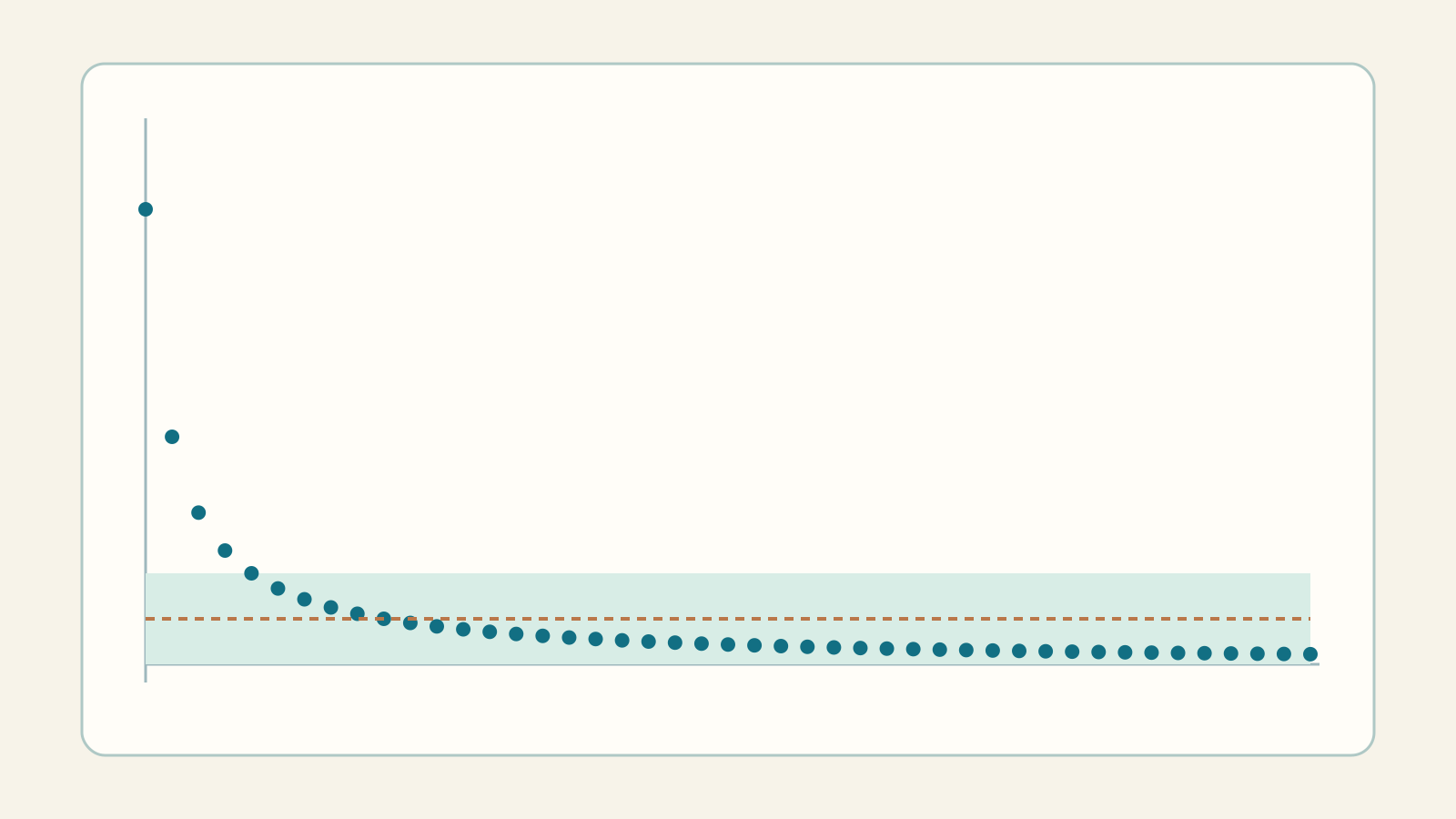
A sequence describes quantities changing in numbered steps: capital after each year, error after each iteration, or a sum after each new term. Computing the first values is not enough: we want to understand what happens as the number of steps grows without bound.
Sequences and Taylor lab · Learning-path index
1. A function with an integer index
Write (aₙ) for the sequence and aₙ for its term with index n. Here n starts at 1. Rule aₙ=1/n produces 1, 1/2, 1/3, … . In (4,1/4), 4 is the step number and 1/4 the result. The graph contains isolated points: connecting them creates no intermediate terms.
A finite list does not determine a unique rule: infinitely many formulas agree on ten terms and behave differently afterwards.
2. Explicit formula and recurrence
The explicit formula aₙ=2n+1 gives a₁₀₀=201 directly. The same sequence is defined by a₁=3, aₙ₊₁=aₙ+2: advancing needs the previous term. Without initial data a recurrence does not determine a unique sequence.
For a₁=1, aₙ₊₁=√(2+aₙ), we obtain 1, √3, √(2+√3), … . An equation for a possible limit does not prove its existence.
3. Arithmetic and geometric sequences
Arithmetic sequences have constant difference: aₙ=a₁+(n−1)d. For d>0 the limit is +∞; for d<0 it is −∞; for d=0 the sequence is constant. Geometric sequences have aₙ=a₁qⁿ⁻¹. The lab uses qⁿ, with first term q.
For qⁿ: |q|<1 gives limit 0; q=1 gives 1; q=−1 oscillates; q>1 tends to +∞; q<−1 oscillates with increasing magnitude. For q=0 and n≥1 all terms are 0. In the general form a₁ also matters: if it is 0 the sequence is always zero.
4. The limit: every term beyond a threshold
aₙ→L ⇔ for every ε>0 there is an integer N such that n≥N implies |aₙ−L|<ε.
ε is the accuracy; N tells when it holds forever. For 1/n and ε=0.05 we need n>20: N=21. Term a₂₀=0.05 is on the boundary, excluded by the strict inequality.
The band (L−ε,L+ε) is open. Changing ε changes N, not the limit. The lab derives N from a proved formula, not the first point inside the band. A plot can end before N without contradicting convergence. A finite limit, if it exists, is unique.
5. Convergence, divergence and oscillation
Convergence means having a finite limit. For n→+∞, every threshold M is eventually exceeded: no term is the number “infinity”. A nonconvergent sequence can instead oscillate without tending to either infinity, as (−1)ⁿ does.
Boundedness is insufficient: (−1)ⁿ is bounded. Changing sign does not prevent convergence: (−1)ⁿ/n→0. Some texts call every nonconvergent sequence divergent, others reserve the word for infinite limits; here we specify the behaviour.
6. Three limit techniques
Dominant power: (2n+1)/(n+3)=(2+1/n)/(1+3/n)→2. The error is 5/(n+3): n>5/ε−3 suffices.
Rationalise: √(n²+n)−n=n/[√(n²+n)+n]=1/[√(1+1/n)+1]→1/2. “∞−∞” is not a calculation.
Squeeze: −1/n≤sin(n)/n≤1/n. Both bounds tend to 0, so the middle does too. Finite-limit laws for sums, products and quotients apply; a quotient requires a nonzero denominator limit.
7. Monotonicity and boundedness: a proof
A real increasing sequence bounded above converges to its supremum; a decreasing sequence bounded below converges to its infimum. “Increasing” may include equality.
For a₁=1, aₙ₊₁=√(2+aₙ), if 0≤aₙ≤2 then 0≤aₙ₊₁≤2: induction keeps all terms in [0,2]. Also √(2+aₙ)≥aₙ is equivalent here to (2−aₙ)(aₙ+1)≥0. The sequence is increasing and bounded, hence convergent.
Only now L=√(2+L): L²−L−2=0 gives 2 or −1. Condition L≥0 excludes −1. Finally 2−aₙ₊₁=(2−aₙ)/(2+aₙ₊₁)≤(2−aₙ)/3, so 0≤2−aₙ≤3⁻⁽ⁿ⁻¹⁾: the error is controlled too.
8. Subsequences and the Cauchy criterion
A subsequence chooses strictly increasing indices n₁<n₂<… . If aₙ→L every subsequence has that limit. In (−1)ⁿ the even terms equal 1 and the odd terms −1: two different limits prove that no global limit exists. One convergent subsequence is not enough.
In ℝ, convergence is equivalent to being Cauchy: for every ε>0 there is N such that m,n≥N implies |aₙ−aₘ|<ε. This compares late terms without knowing L. The criterion concerns the infinite tail, not a finite sample.
9. A sequence is not a series
A series is studied through partial sums Sₙ=a₁+…+aₙ. For aₙ=1/2ⁿ, Sₙ=1−1/2ⁿ→1: the terms tend to 0, the sums to 1.
If a series converges, aₙ=Sₙ−Sₙ₋₁→0. The converse fails: 1/n→0, but Hₙ=1+1/2+…+1/n→+∞. Between 2ᵏ⁻¹+1 and 2ᵏ there are 2ᵏ⁻¹ terms at least 1/2ᵏ: each block adds at least 1/2, so the sums are unbounded.
For fixed x, Taylor polynomials evaluated at x, T₀(x), T₁(x), …, also form a sequence of partial sums. Will they actually tend to f(x)?
10. The number e and computer limitations
(1+1/n)ⁿ increases to e≈2.718281828. From u−u²/2≤ln(1+u)≤u for u≥0 follows 0≤1−n ln(1+1/n)≤1/(2n). Using 1−e⁻ᵛ≤v for v≥0 gives 0<e−(1+1/n)ⁿ≤e/(2n)<3/(2n). This simple, nonoptimal estimate gives a sufficient N.
A computer has finite precision: the root recurrence can display 2 while the mathematical value is still smaller. A displayed zero does not mean exactly zero error.
In the lab choose one of ten cases, press Explore and use Play to reveal one term at a time. Change ε to see the band and N; compare 1/n with harmonic sums. Classification depends on the guided formula, not observed points. This is not a solver for arbitrary sequences.
Exercises: try before revealing
1. Find a₁₀ for aₙ=3n−2.
Show the explained answer
3·10−2=28. The index is not the value.
2. For 1/n, find N with ε=0.01.
3. For (2n+1)/(n+3), find the limit and N with ε=0.1.
4. Does (−0.8)ⁿ converge?
5. Is boundedness enough?
Show the explained answer
No: (−1)ⁿ has even and odd subsequences with different limits, 1 and −1.
6. Find the limit of √(n²+n)−n.
Show the explained answer
Rationalising: 1/[√(1+1/n)+1]→1/2.
7. If aₙ→0, must Σaₙ converge?
Show the explained answer
No: harmonic terms tend to 0, but each block between powers of 2 adds at least 1/2. The sums are unbounded.
8. Compare the limits of 1/2ⁿ and Sₙ=Σₖ₌₁ⁿ1/2ᵏ.
Show the explained answer
The term tends to 0; Sₙ=1−1/2ⁿ tends to 1. They are different sequences.
Taylor with remainder: approximation and error control · Review limits · Review derivatives